Custom software development cost comes down to how much effort a team needs to build, connect and then keep running your system, plus an allowance for whatever nobody yet understands about it. There is no meaningful price per screen or per feature, which is why quotes for what sounds like the same project can sit far apart. The practical answer for a decision-maker is not to hunt for an average figure. It is to define scope, integrations and maintenance well enough that vendors are pricing the same thing, then compare them on those lines.
This guide is written for the person who will sign the contract rather than the person who will write the code. It explains what actually moves the number, how to tell whether building makes commercial sense at all, how contract models shift risk onto you or the vendor, and how to write a brief that produces quotes you can lay side by side. If you are still working out what custom software is and whether the category applies to you, our introduction to custom software is a shorter starting point.
First, check that you should be buying this at all
The most expensive software project is the one that did not need to exist. Before collecting quotes, be honest about why the products already on the market fall short. Often the real reason falls into one of four groups, and only one of them leads to a custom build.
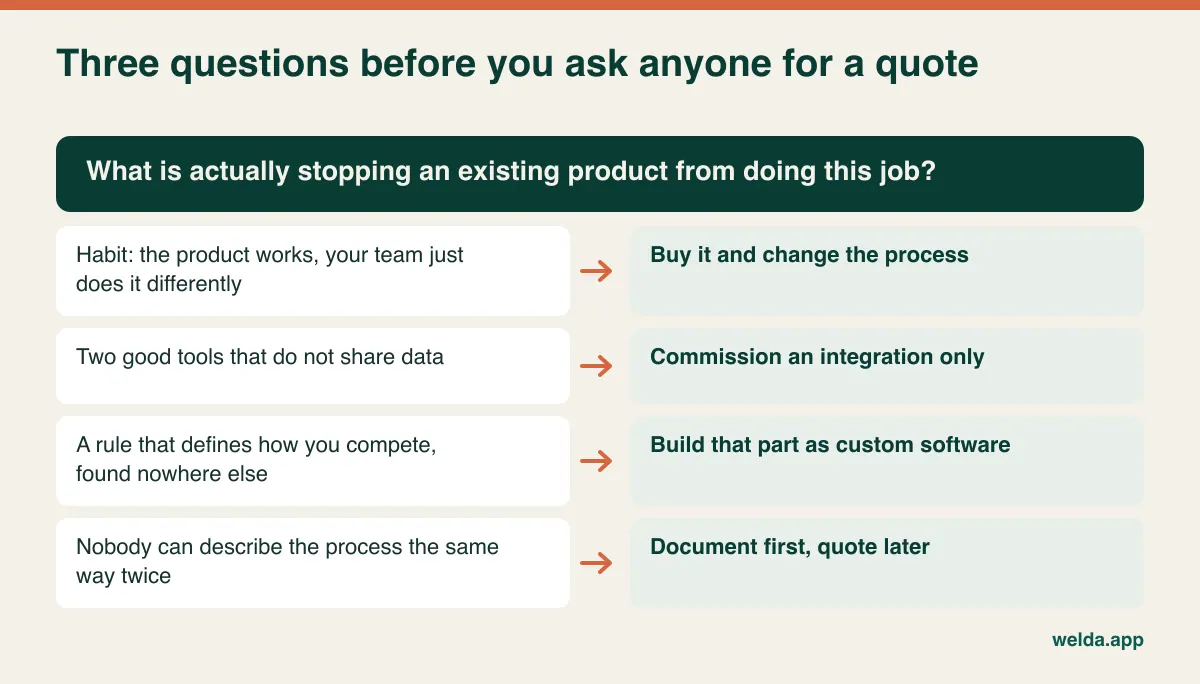
Consider a mid-sized distributor whose staff retype orders from a webshop into an accounting package each morning. That sounds like a software gap, but both products may work well. What is missing is the connection between them, and a modest API integration may solve it for a fraction of the effort of a replacement. Compare that with a logistics business whose pricing depends on a set of route, weight and contract rules it has refined for years, and which it regards as the reason customers stay. No product will model that properly, and forcing the rules into a generic tool could erode what makes the business different. That is the classic case for building.
Two warning signs suggest waiting. The first is a process that different people describe differently; software will freeze the confusion rather than cure it. The second is a process that has not run long enough to stabilize. Spend a few months on a spreadsheet or a no-code tool first. What you learn will make any later brief far better and cheaper to fulfill. And if your need is close to something we already run in production, it is worth looking there before paying for a build: Welda Stock covers inventory and point of sale for retail, while Welda CRM handles clinic and patient management, with a 7-day free trial.
Does the build pay for itself? A one-page test
Most articles on this topic start with a price and work forward. It is more useful to start from your side of the table: what is the current way of working costing you? That gives you a ceiling on what any quote can be worth, before a vendor has said a word.
Count the hours the manual process consumes each week across everyone who touches it. Then be conservative about how much the software would truly remove, because exceptions and supervision never vanish. Add errors with a real cost attached, such as wrong shipments, missed invoices or customer credits. The sketch below uses invented numbers and treats an hour as costing the same on both sides, which it rarely does, so substitute your own rates.
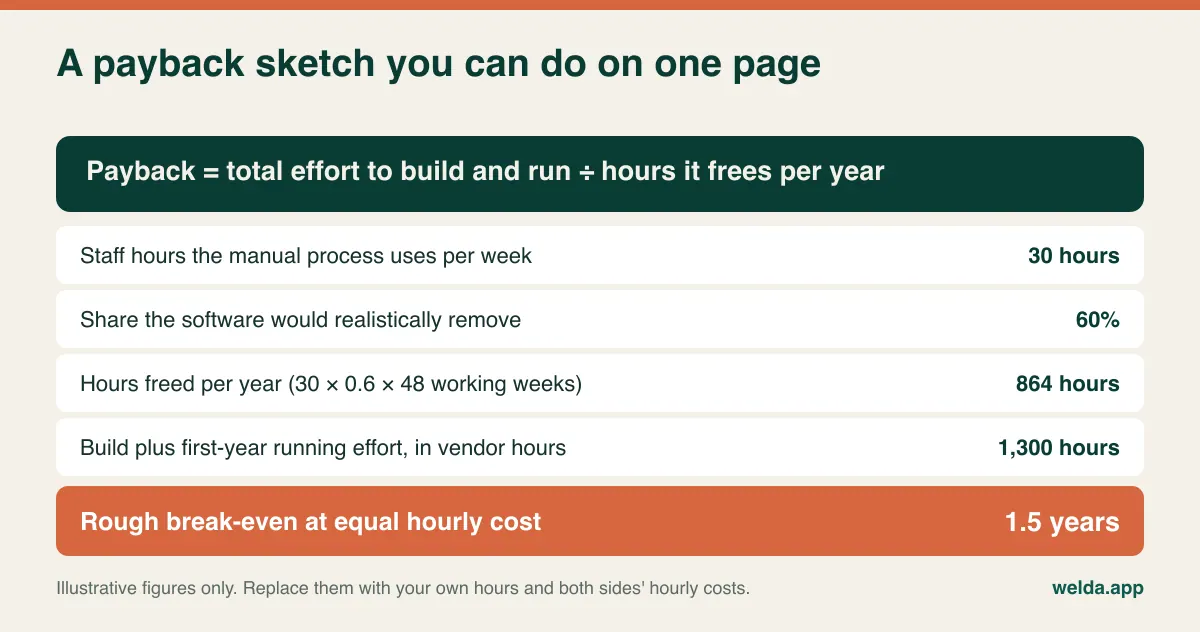
If the result lands at a horizon you are comfortable with, keep going. If it runs to many years, the honest conclusion may be that the problem is real but not worth a bespoke system, at least in full. This calculation also has a second use: it tells you which part of the workflow generates most of the value. That part becomes the first release. Time saved is not the only return, of course. Faster quoting, better compliance or the ability to serve a customer type you currently decline can all justify a build, but put them in writing, because a vague benefit tends to justify any budget.
The three things every number is made of
Strip away the formatting and every proposal estimates three things: scope, integrations and upkeep. It helps to know how each behaves, because they do not grow in the same way.
Scope is measured in rules, not screens
"A dashboard, an order form and a reports page" sounds small, and in a demo it may look small. Effort, however, lives behind the screen. Who can approve a discount above a threshold? What happens when an order ships in two parts, one of which is later returned? Can a regional manager see other regions' customers? Each answer adds logic, and each piece of logic needs testing against all the others. That interaction is why the tenth rule tends to cost more than the first.
That gives you a useful lever. The cheapest way to reduce scope is often to simplify a rule rather than drop a feature: three customer price tiers instead of a per-customer price list, or a manual workaround for an exception that occurs twice a year. A good vendor will press you on this. Be cautious with one who agrees to everything without asking how often an edge case actually happens.
Integrations are priced on someone else's behavior
A vendor controls its own code, but not your ERP vendor's documentation, sandbox, rate limits or support response. This is why integration lines vary the most between quotes. Well-documented modern APIs are comparatively predictable. CSV or FTP exchanges are simple until someone reformats a file by hand. Legacy systems with no documentation may need investigation before anyone can estimate them honestly, and that investigation is reasonably sold as paid work of its own. Tell vendors exactly which product and version you run, whether your license permits API access, and who can grant credentials.
Data migration sits beside this and is routinely underestimated. Years of duplicate customers, free-text fields and codes only one long-serving employee understands will not move cleanly. Decide early whether you truly need full history in the new system, or whether opening balances plus an accessible archive will do. The second option frequently takes a fraction of the work, and it is a decision only you can make.
Upkeep starts the day you go live
Custom software is closer to a vehicle than a building. Hosting, monitoring, backups, third-party usage fees, dependency updates and security patches continue for as long as the system runs. Connected services change their APIs on their own schedule, so software can stop working even though nobody on your side touched it. Then there are the requests that only surface once people use the system, some of which are unavoidable because your business itself keeps changing. How your software is hosted influences a good part of this, as does how much of the operation you want handled for you. Ask for these items as separate lines, and compare multi-year totals rather than launch figures alone.
What sits inside an estimate besides code
When a cheap proposal and a more expensive one both describe the same features, the difference often lies in work that does not appear on any feature list. Discovery and design, testing, release management, documentation and project coordination take real time. A proposal that leaves them out has not found a saving. It has moved that work to your team, or to the months after launch.
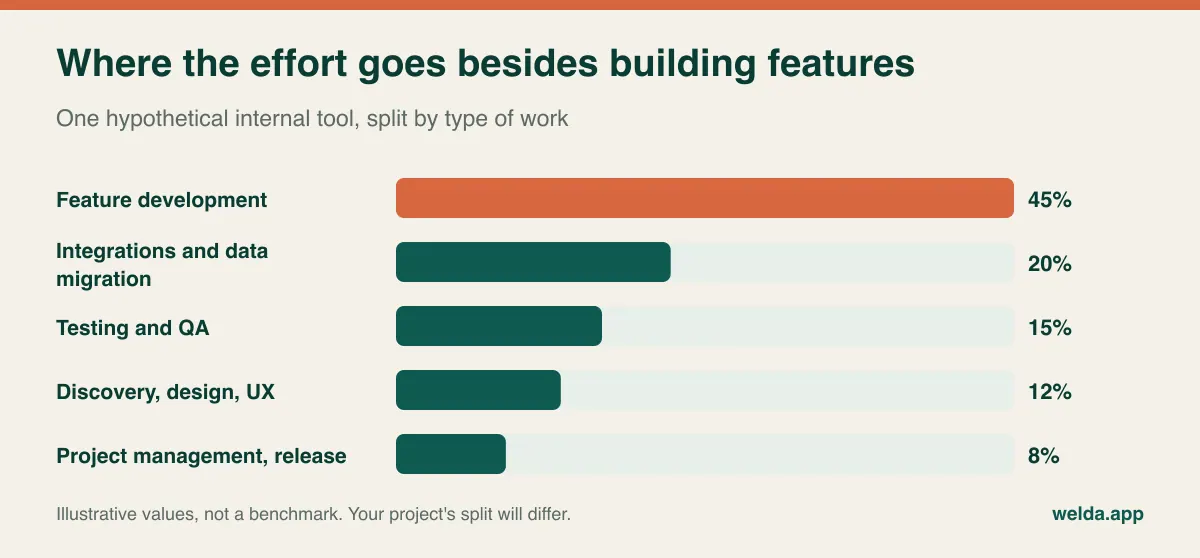
Team shape matters in the same way. A single freelancer, a small product team and a larger agency can each be the right choice, but they do not offer the same thing. A solo specialist can be excellent for a contained internal tool and carries an obvious continuity risk: what happens during an illness, or if they take a full-time job? A team adds coordination overhead and also redundancy, review and specialist skills. Location affects hourly rates, but rate is only one factor in the final bill. A cheaper hour that needs more rework, more of your supervision or more waiting across time zones is not automatically cheaper in total. Compare by asking who specifically will do the work, and how much of your own time the arrangement requires.
Also weigh requirements your customers may impose. If you sell to enterprises, they may eventually ask about security certifications, audit logs or single sign-on. If you take card payments, handling them through a compliant payment provider rather than touching card data yourself tends to reduce both risk and scope. If you process personal data, privacy rules such as the GDPR or state laws in the US may shape access controls, retention and where data lives. Requirements vary by jurisdiction and sector, so take advice specific to your case and write the outcome into your brief. Added later, these often cost more than they would have at the start.
Fixed bid or time and materials is really a question about risk
Buyers often assume a fixed price is the safe option. It does cap the invoice for the agreed scope, but the vendor prices that protection in, and every later change becomes a negotiation. Time and materials gives you flexibility and leaves overrun risk largely with you, which is fine only if someone on your side can review progress and make decisions every week. Phased or capped arrangements sit between the two.
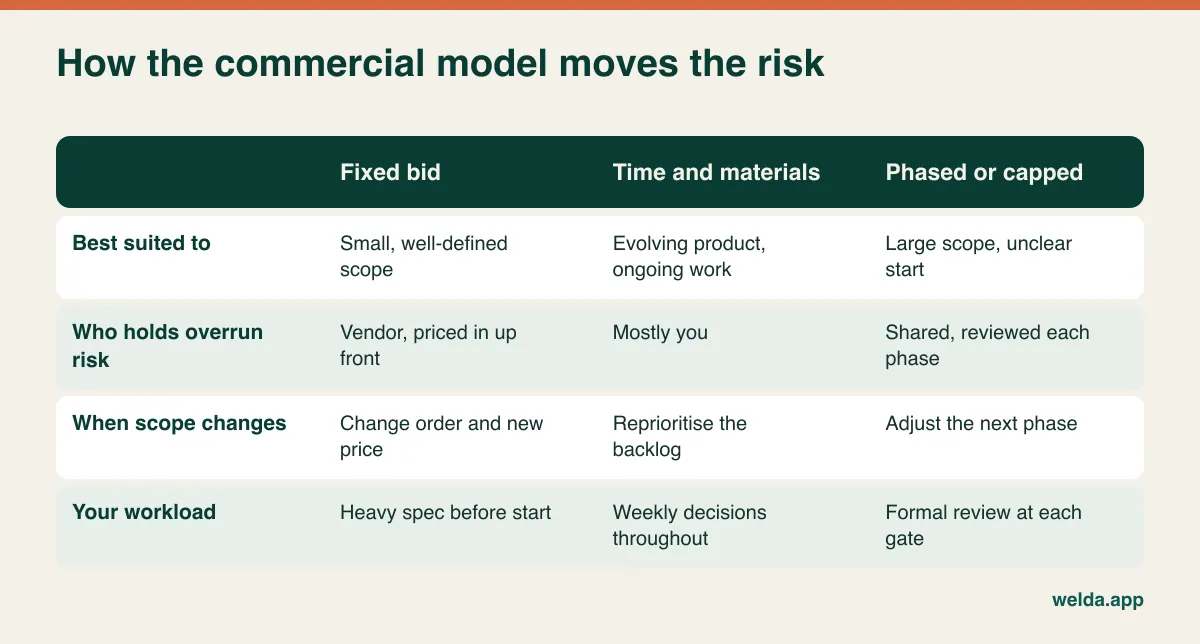
A simple test: if you can describe the scope on a page without using phrases like "depending on" or "we'll figure that out", a fixed bid is reasonable. If you cannot, a fixed bid will still produce a number, but one built on assumptions you may never see. For larger or uncertain work, consider a paid discovery phase that yields a data model, user flows and a detailed scope document. Make sure the contract says you keep those documents, so that you could take them to another vendor if you wished. Done well, this also reveals how the team thinks and communicates before you commit the larger budget.
Whichever model you pick, link payments to accepted deliverables rather than calendar dates, and define acceptance before work begins. "Working" should mean specific scenarios passed with specific data. Otherwise you may find yourself debating whether a problem is a bug, which the vendor fixes, or a change request, which you pay for.
Shrinking the first release without gutting it
A first release does not have to be a thin prototype. It has to be the smallest version that runs a real process end to end, so people can use it for actual work and tell you what is wrong. In practice, most wish lists narrow considerably once each item has to be tied to a stated problem.
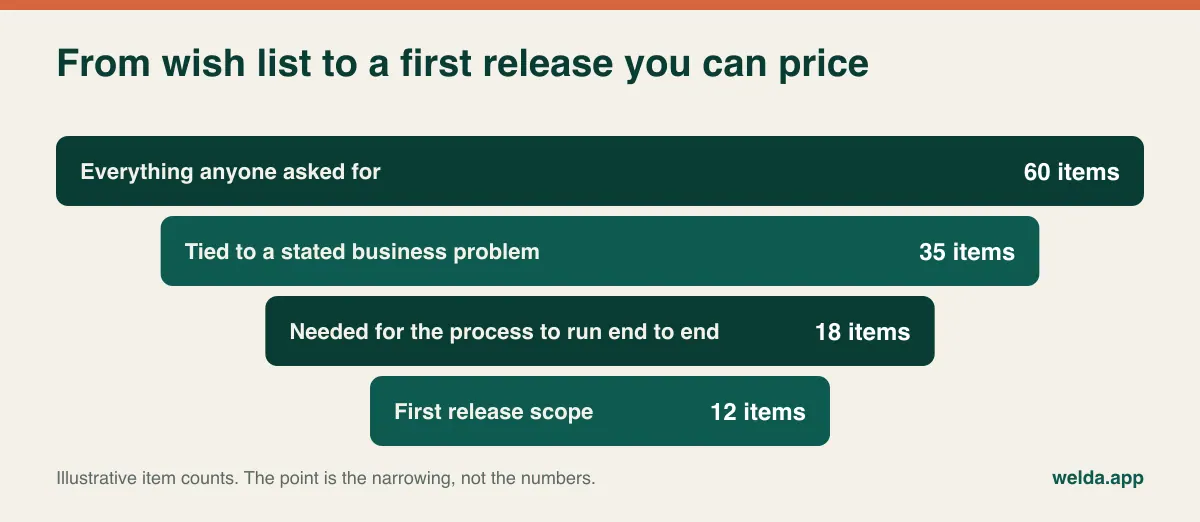
Run the exercise with the people who will use the system, not only with managers. Mark each item as must-have, later or nice-to-have, then ask vendors to price the must-haves and the later group separately. You then know what you can defer if budget tightens, based on real numbers rather than guesses. One caution: deferring features is safe, whereas deferring foundations is not. The data model, permissions and how the system handles multiple locations or currencies should be designed with likely growth in mind, even if the first release does not expose all of it. Cutting those decisions can look thrifty and lead to a partial rewrite later.
Internal rollout belongs in the plan as well. Training, a period of running old and new processes side by side, and someone on your team empowered to make daily decisions are all genuine costs. Without a named owner with authority, even strong vendors slow down, and in time-based contracts that delay shows up directly in the bill. See our business process automation guide for smaller steps you can take before or alongside a build.
Writing the RFP that makes quotes comparable
Vendors fill gaps with assumptions. If each one assumes something different, you end up comparing unlike things and may reward whichever assumed the least. You do not need a technical specification to stop this. A few pages written in plain business language, ideally with input from the people who do the work, go a long way.
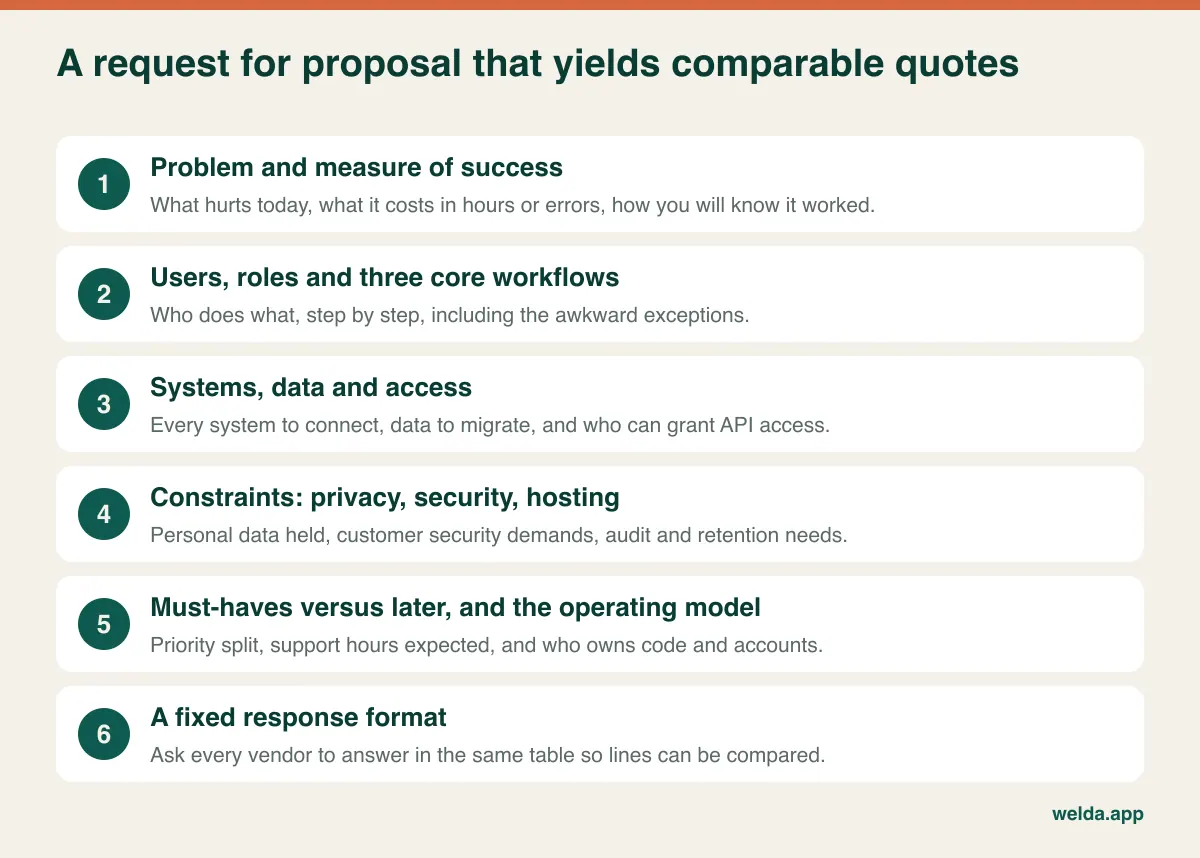
Write workflows with their awkward parts included. "Order placed, approved, shipped" is not enough; add the lines beginning with "but". But the item is out of stock, the customer cancels after approval, the approver is on leave. Sit with the employee who does the job when you write these, since the process a manager describes and the one actually followed often differ. Sharing a rough budget range is your call, though it usually helps vendors suggest a sensible scope instead of guessing. If you would rather not share it, state your priorities and target date clearly.
Then send every vendor the same document, and share every question and answer with all of them. Ask for responses in a common table: effort or cost per module, assumptions, exclusions, team members, maintenance terms. Vendors who refuse any structure at all are telling you something about how they will report once work begins.
What to look for when proposals land
Sorting by total is the most tempting and least informative way of reading quotes. Read assumptions first, then exclusions, and only then the figures. A blank line is often as telling as a high one.
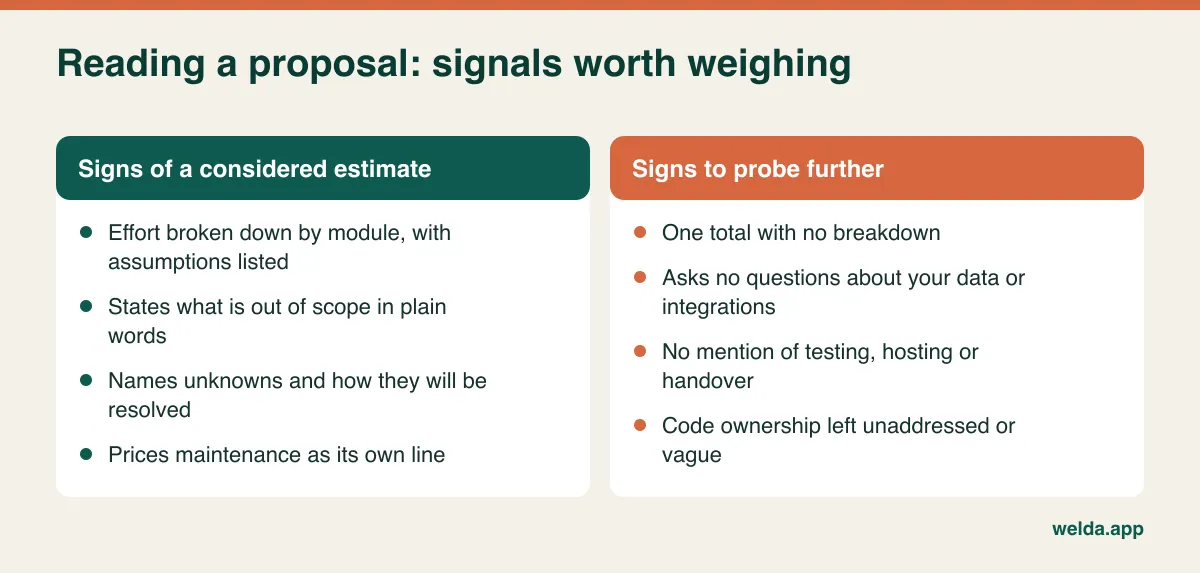
Put these questions to each shortlisted vendor:
| Question | Why it matters |
|---|---|
| Who exactly will work on this, and can we meet them? | Sales teams do not write code; the people assigned determine much of the outcome. |
| What worries you most about this project? | A vendor that can name risks unprompted has thought about the work. |
| What did you assume about our data and integrations? | This usually explains more of the gap between quotes than any hourly rate. |
| When will we first use something real? | Early working releases expose misunderstandings while they are still cheap to fix. |
| Who owns the code, accounts and documentation? | Your freedom to change vendors depends on the answer being clear in the contract. |
| What does maintenance cover, and when does it become new work? | This line sets your costs from the second year onward. |
| How do you handle bugs found after launch, and for how long? | A warranty period avoids later disputes about what counts as a defect. |
On ownership in particular, read the actual wording. Depending on the jurisdiction, code written by a contractor does not automatically become yours simply because you paid for it, so an explicit assignment clause matters; have a lawyer check it. Ask also about open-source components and their license terms, and ensure that cloud accounts and domains are registered to your company. Currency, tax treatment and how long the proposal remains valid are worth confirming too, particularly with an overseas vendor. Our comparison of WordPress and custom software shows how some of these trade-offs look at the smaller end of the market.
The hidden costs tend to be the same across projects: the internal time you did not budget, usage fees that grow with volume, migration work assumed to be on your side, change requests caused by a vague brief, and a maintenance agreement that covers less than you thought. A cheap initial quote that excludes all of these can end up as the more expensive path.
Where Welda fits, and where we may not
We build custom web applications, internal tools, CRM setups, WhatsApp Business API flows, system integrations and dashboards, working from Istanbul. We run our own products in production, which means operational concerns such as monitoring, updates and support are part of how we think from the start. We do not publish a price list because cost depends on scope and on your integration and customization needs. The process starts with understanding your workflows and defining the problem and how success will be measured, then planning the data model and integration points and showing you the interface and flows before code is written. Delivery comes in increments, and you own the source code, IP and documentation.
We are not the right fit for every project. Our focus is web-based applications and integrations, so if you need a native mobile app in the app stores as a core requirement, or your sector calls for a specific certification, raise that in the first conversation so we can tell you plainly whether it suits us. Vendors physically close to you may also be a better match if you need people on your site every week.
When you are ready to pressure-test your scope, talk to us about your custom software development cost in a free call. Bring the brief even if it is half finished. Pricing is clarified in that conversation and the tailored proposal that follows, once we understand the rules, integrations and upkeep involved. You can read more about how we scope custom software development cost and delivery on our service page.
FAQ
Why can no one give me a custom software development cost from a short description?
Because a short description leaves out what drives the effort: business rules, exceptions, integrations and data quality. Anyone quoting from two sentences is either pricing a large risk margin or assuming a much simpler system than you have in mind. Either way, the number will not hold.
Is a paid discovery phase worth it?
For larger or uncertain projects it often is, as long as you keep the outputs. It replaces guesswork with a defined scope and lets you judge how a team works before committing fully. For a small, well-defined tool, it may be unnecessary overhead.
Should I always choose the middle quote?
No. The position of a quote tells you little until you have checked its assumptions and exclusions. A low quote may be well reasoned, and a high one may be padded or may simply include more. Compare what each one contains, then decide.
How much should I plan for maintenance?
It depends on the number of integrations, how critical the system is and how quickly your processes change, so be wary of any rule of thumb. Ask each vendor to itemize hosting, updates, monitoring, support and small enhancements, and then compare the totals over several years.
Can low-code or automation tools replace a custom build?
For many internal workflows, yes, at least for a time. Tools such as Make, Zapier or n8n can link existing products quickly. Their limits show up with complex rules, high volumes or usage fees that grow over time. Starting there can also teach you what a later build truly needs.
Will Welda give me a figure on the first call?
Not before scope is understood, since a guess would mislead us both. The free call clarifies your needs, integrations and maintenance expectations. A tailored scope and proposal follow from there. You can also reach us at get@welda.app.