Logo design cost has no single answer because "a logo" can mean three different purchases: a graphic assembled by a logo maker, an original mark drawn by a freelancer, or an identity system built by an agency. What separates them is how much thinking goes in, which files you receive, and what rights you legally hold afterwards. If the logo will go on signage, packaging or vehicles and stay there for years, buying only the cheapest route often means paying twice. If you are still testing whether the business works, a full identity project is money spent too early. The sensible budget follows from where the mark will be used, and for how long.
So rather than a price table that would be out of date, wrong for your country and impossible to compare, this guide gives you what a price table cannot: a way to read any quote you receive, a scorecard to compare them, and a clear view of the costs that only appear after the invoice is paid.
Why two logo quotes usually aren't quoting the same thing
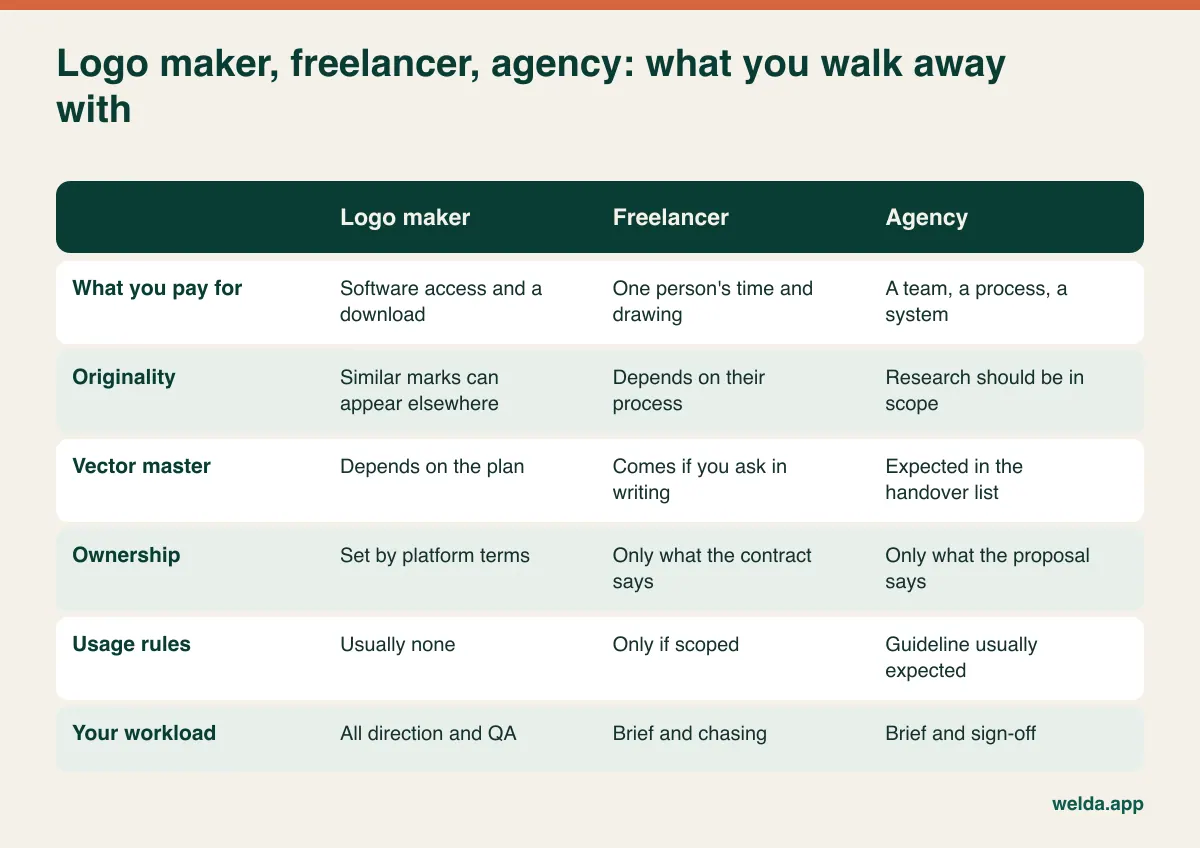
Put a logo maker's checkout page, a freelancer's message and an agency's proposal side by side, and the temptation is to see one product at three prices. It is closer to comparing a rental car, a used car and a fleet contract. All three get you moving, but what you own at the end, what you can change and who you call when something breaks are entirely different.
A logo maker sells software. You enter a name and an industry, it combines icons and typefaces from a library, and you choose. The fee buys access and a download, and every design decision stays with you, including the decision about whether the result is any good. That is not a criticism. For some situations, it is exactly the right trade.
A freelancer sells time and judgment. A good one looks at your market and competitors, explores several directions, kills the weak ones and refines what remains. A weak one edits a stock icon and sends a PNG. Both may describe themselves the same way and show polished images, which is why the spread among freelancers can be wider than the gap between freelancers and agencies.
An agency sells a process and usually a broader output. Discovery, concept directions, a logo family, colour and type standards and a guideline tend to arrive together, along with project management and the overhead of a team. For a one-location business that needs a card and a sign, much of that goes unused. For a company where ten people and three suppliers produce branded material every week, that system is the actual product and the logo is just its most visible part.
The drawing itself is the visible fraction of the work. Much of the effort lies before it, in research and direction, and after it, in testing at small sizes, building variations and preparing files. A better question than "how many logos do I get?" is "what do you do before you start drawing and after I pick one?" The answer tells you more about the quote than the total does.
Three ways to buy a logo, judged by what you walk away with
Logo maker: fast, disposable, and honest about it
A logo maker makes sense for a project whose name might still change: a pitch deck, a landing page testing demand, a side business without a physical location. You get something presentable the same day, for a low commitment. Its limits follow from how it works. Marks drawn from a shared library can resemble someone else's, and a logo built on a stock icon may be hard to claim exclusively or protect as a trademark. Before you pay, read the terms and check three things: whether vector files are included in your plan, whether commercial use is permitted and whether trademark registration is. These terms vary by platform and can change.
The real danger is not the tool, but the temporary logo that quietly becomes permanent. Set a review date when you adopt it, such as your first sign order or first print run, and treat that as the trigger to replace it.
Freelancer: the widest range of outcomes
For a small business with a clear direction, a capable freelancer is often the best-balanced option. You speak directly to the person doing the work, decisions move quickly, and the scope can be shaped around you. The risks are about the individual: whether portfolio work is really theirs, whether the mark is original, whether they will be reachable when your sign maker asks for a file in two years. Marketplace listings and contest sites add another question, since you may see many entries but little research behind them, and the terms of the platform shape your rights. A short written agreement and a delivery list close most of this gap. Ask to see one project from brief to final file, rather than only the polished result.
Agency: paying for consistency
The case for an agency gets stronger as more people touch the brand. Social, print, web and sales can all work from the same files and rules, and the knowledge doesn't live in one person's laptop. The cost goes beyond the fee: more meetings, a longer process, and deliverables a small business may never open. If you are comparing agencies, it helps to understand what a corporate identity actually includes, so that you can remove what you don't need rather than pay for it by default.
The rights question most quotes leave blank
Here is the assumption that causes the most trouble: "I paid for it, so I own it." In many countries, copyright in commissioned work begins with the person who created it, and payment alone does not necessarily move it to you. The specifics differ. In the United States, a logo from an independent contractor generally does not qualify as work made for hire on its own, so a signed written assignment is the usual route. In the UK, a commissioned designer normally remains first owner of copyright unless the rights are assigned in writing. In parts of the EU, copyright itself may not be transferable at all, so you receive usage rights instead, and moral rights can also apply. This is general orientation, not legal advice. If a logo will carry significant investment, it is worth having a lawyer in your country read the contract.
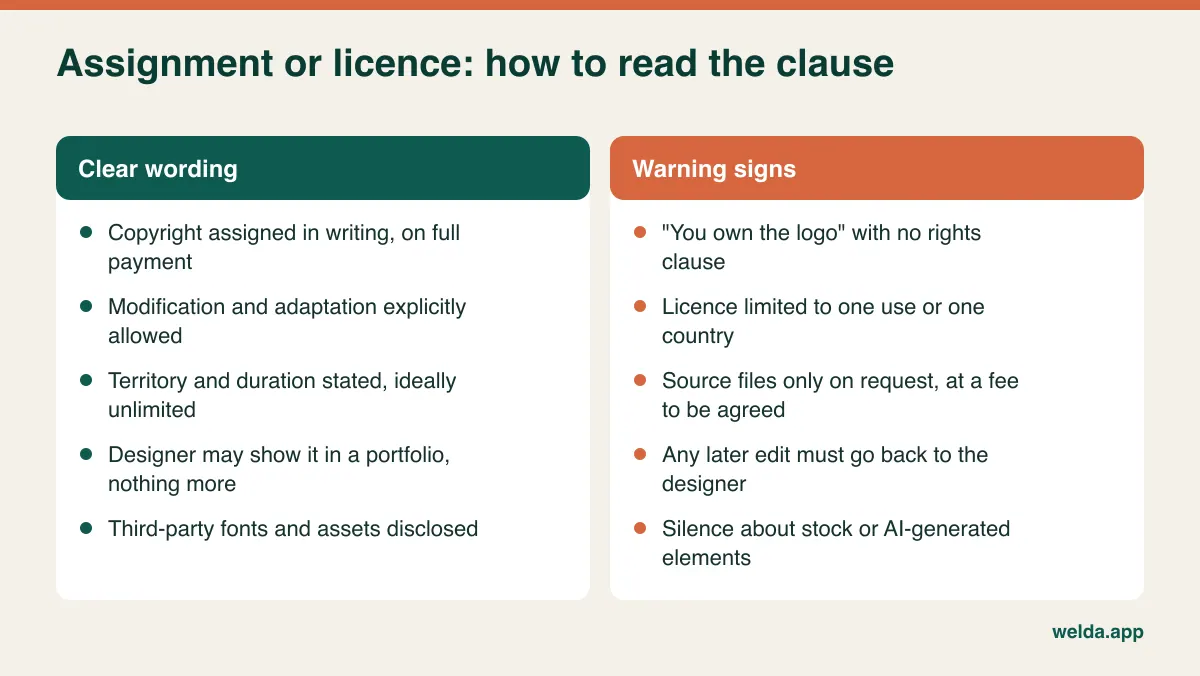
Whatever the jurisdiction, the questions are the same. What exactly transfers to you, and is it an assignment or a licence? Is there a limit by territory, time or medium? Can another designer modify the logo later? When does the transfer take effect? Tying it to final payment is common and fair to both sides. A designer showing the work in a portfolio is normal, and one sentence can cover it.
AI-generated marks raise a further question. Protection for works lacking human authorship is unsettled and treated differently from place to place, and the tool's own terms add another layer. Ask directly whether stock elements or AI output will be used, and get the answer in writing. Using them isn't automatically wrong. Building a brand on them without knowing is the problem.
Keep copyright and trademark separate in your head. Copyright concerns the artwork and the relationship between you and whoever created it. A trademark protects the sign in trade, for specific goods and services, in specific territories, and registration runs through offices such as the USPTO, UKIPO or EUIPO, or internationally through the Madrid System at WIPO. Our trademark registration guide goes deeper. For budgeting, the point is the order of work: run at least a basic clearance search before paying for design, since finding a conflict after approval means redoing it. A basic search offers no guarantee, but it does catch the obvious collisions early.
The files that decide whether a cheap logo stays cheap
Most logo buyers find out what they failed to ask for a few months later, when a sign maker says, "Do you have this in vector?" If all you have is a PNG, someone will have to redraw it. Each supplier's redraw differs slightly, and gradually your brand exists in several not-quite-matching versions.
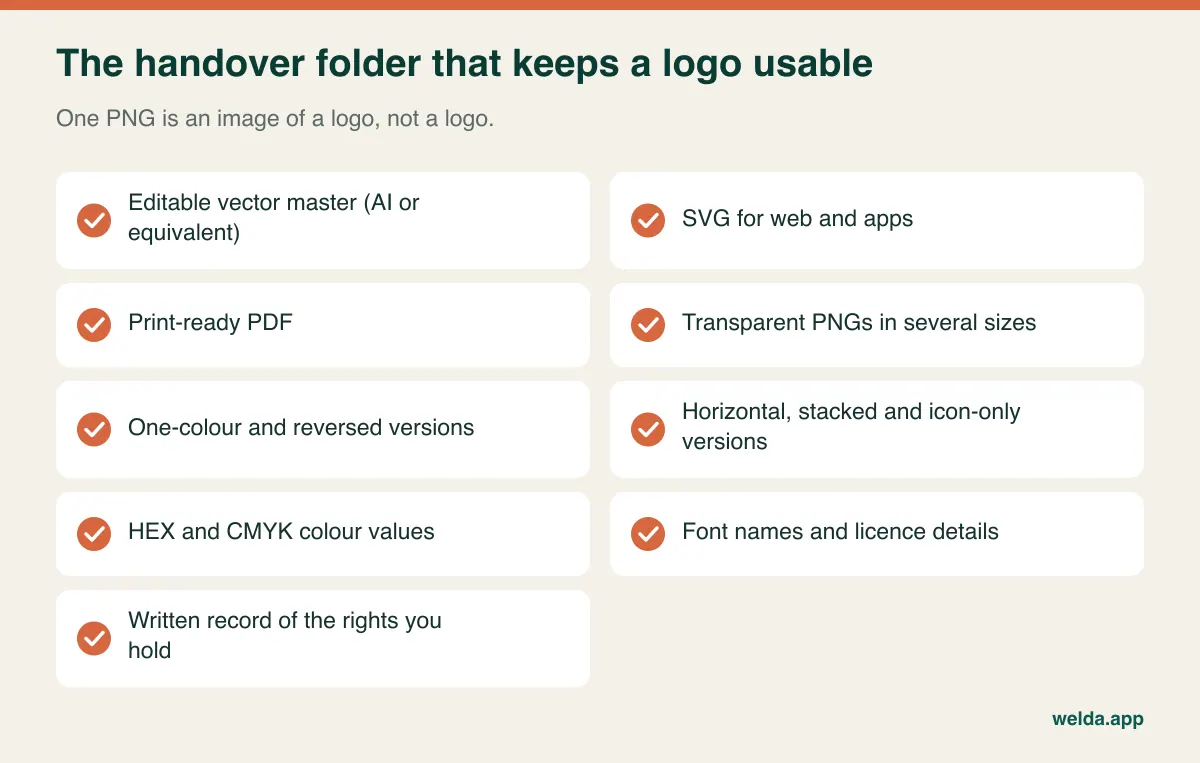
A quick translation of the formats. Vector files (AI, SVG, vector PDF) scale without losing quality and are the basis for signage, vehicle graphics and large print. SVG stays sharp on websites and keeps file sizes small. PDF is what most printers want. PNG suits everyday use such as slides and social profiles, but it is made of pixels and breaks down when enlarged. HEX values define colour on screen, while CMYK defines it for four-colour print. Automatic conversion between them can shift the look, so a designer should set both deliberately. If you are printing packaging, also ask about a spot colour reference.
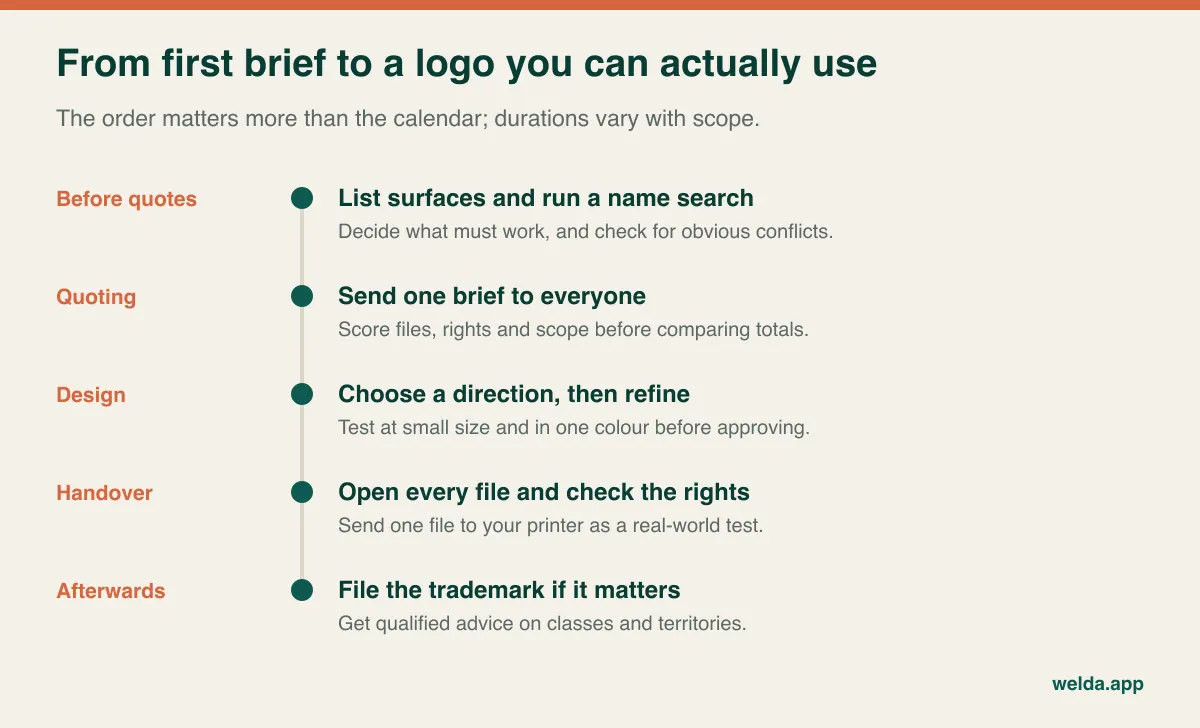
On the day you receive the files, run a test that needs no design training. Shrink the logo to the size of a business card corner and see whether it still reads. Print it in black and white on an office printer. Put it on a dark background and a photo. Crop it into a circle, as a social platform will. Finally, send the vector to your actual printer or sign maker and ask whether they can produce from it. Do this before the last payment, if the terms allow, because that is when problems are cheapest to fix.
Fonts deserve their own line in the delivery list. Outlining the wordmark solves the logo itself, but if your team then needs that typeface for documents or your website, a separate licence may be required. Knowing this before you approve a design can change which typeface you approve.
What pushes logo design cost up or down
Understanding the components also tells you what you can safely trim. These are the lines usually sitting behind a total, stated or not.
| Component | Pushes the cost up | Brings the cost down |
|---|---|---|
| Research and strategy | New market, crowded category, unclear positioning | Positioning already defined, good brief |
| Concept directions | Many distinct routes requested | A few well-argued routes |
| Revisions | Open-ended rounds, committee approval | Agreed rounds, one decision-maker |
| Variations | Horizontal, stacked, icon, one-colour, reversed | Fewer versions for fewer surfaces |
| Applications | Stationery, templates, packaging | Logo first, applications later |
| Guideline | A full brand guideline | A one-page usage summary |
| Rights | Full assignment, worldwide, all media | A narrow licence (cheaper, but risky) |
| Timing | Rush work against an opening date | A comfortable schedule |
If the budget is tight, applications and the size of the guideline are the safest things to postpone, because both can be added later without any harm to the mark. Rights and source files are the worst place to save, because you can rarely buy them back at the same price once you depend on the logo. "Logo plus the complete file set now, applications after launch" is usually a healthier compromise than shrinking every item at once.
To compare quotes without letting the total do all the talking, split one hundred points across what matters to you and score each proposal the same way.
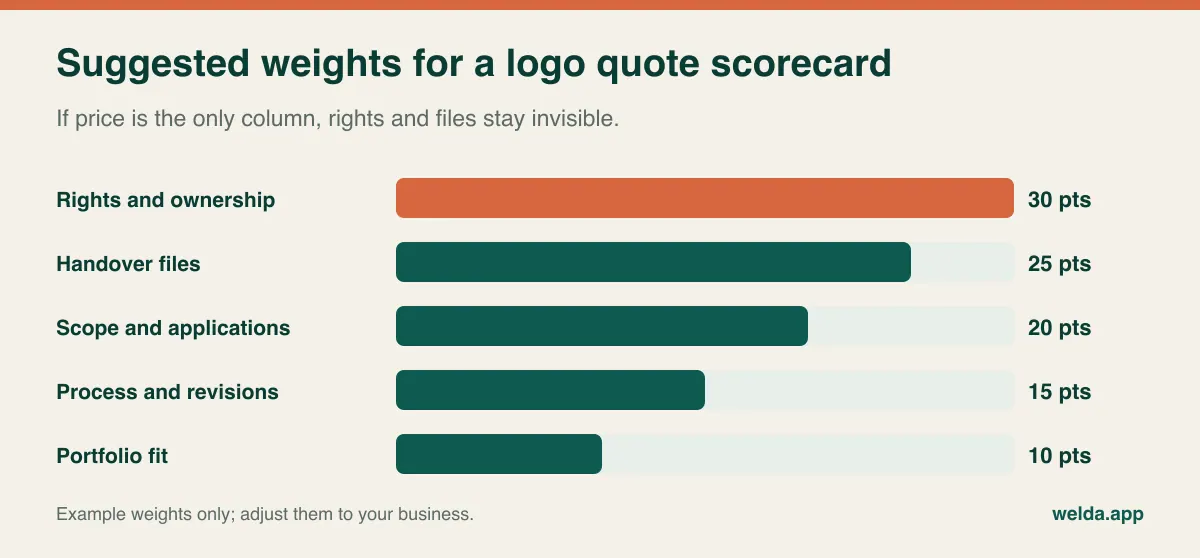
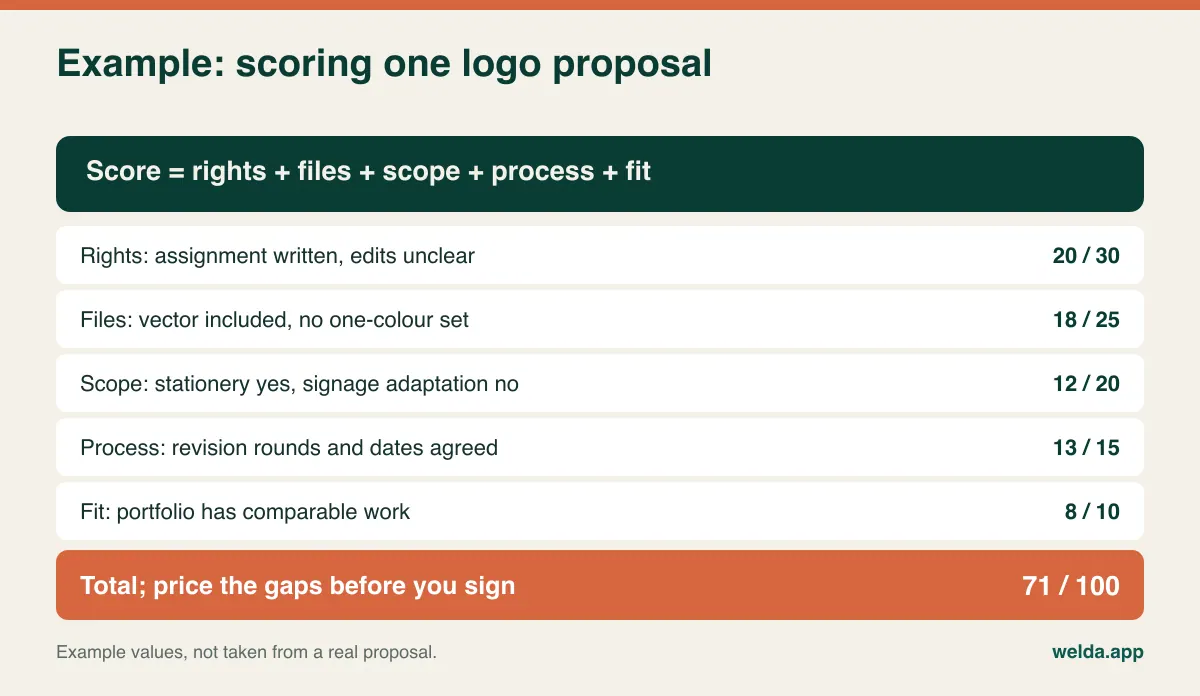
The value of this exercise isn't the final score. It is the gaps. In the example, the proposal lacks one-colour versions and signage adaptation. Ask for the cost of those two items and you can now genuinely compare it with a more complete offer. Sometimes the lower number stays lower and it really is the better deal. You only find that out once both quotes cover the same scope.
Costs that show up after the invoice
The logo fee is rarely the whole bill. None of these items is a scandal. They just don't get mentioned unless you ask.
- Tax and paperwork: Are figures inclusive of sales tax or VAT? Will you get a proper invoice? Paying a contractor abroad can bring its own reporting or reverse-charge rules, so check with your accountant.
- Source file fees: Some suppliers charge separately for editable files. That's fine as long as it is written down up front.
- Extra revisions: If the rate for going beyond agreed rounds isn't stated, you'll be negotiating it at the moment you have the least leverage.
- Adaptation: Preparing artwork for signage, vehicles or packaging may not be part of the logo scope, and producers often charge for their own setup.
- Print proofs: For a first packaging or signage run in new colours, a proof is a real line in the budget.
- Trademark costs: Official fees and attorney time are separate, and multiply across classes and territories.
- Font licences: A typeface for your website and documents may have a recurring or per-user fee.
- Replacement cost: When a logo changes, you also replace signs, stationery, printed stock, uniforms, vehicle graphics and every digital profile. This is the true risk of an underpowered logo. The second design fee isn't the expensive part. The rollout is.
Paste this list into an email and ask which items are included. It takes five minutes and tends to reveal quite a lot about how a supplier works.
Three businesses, three sensible budgets
These are hypothetical scenarios, not clients. They show how the same reasoning leads to different answers.
A consultant testing a new service. There is no storefront, nothing printed beyond a few cards, and the name might change in six months. A logo maker or a very modest typographic mark is enough. Heavy spending here buys certainty the business doesn't have yet. The discipline required is writing down when it will be replaced.
A neighbourhood café opening in a rented unit. The sign, cups, menu and an Instagram profile are all live from day one, and each surface asks something different: the cup needs a simple one-colour version, the profile needs a mark that survives a circle crop, and the sign maker needs a vector. A strong freelancer with a clear delivery list and a written assignment often fits well. A full guideline can wait until there is a second location or staff producing content.
A skincare brand selling online and planning retail. The logo will be printed on thousands of units, so colour accuracy and legibility on a tiny label translate directly into cost. Export ambitions make trademark clearance across territories a priority. Several people will also be creating content from the start. Here a broader identity project earns its keep, with clearance done before design begins.
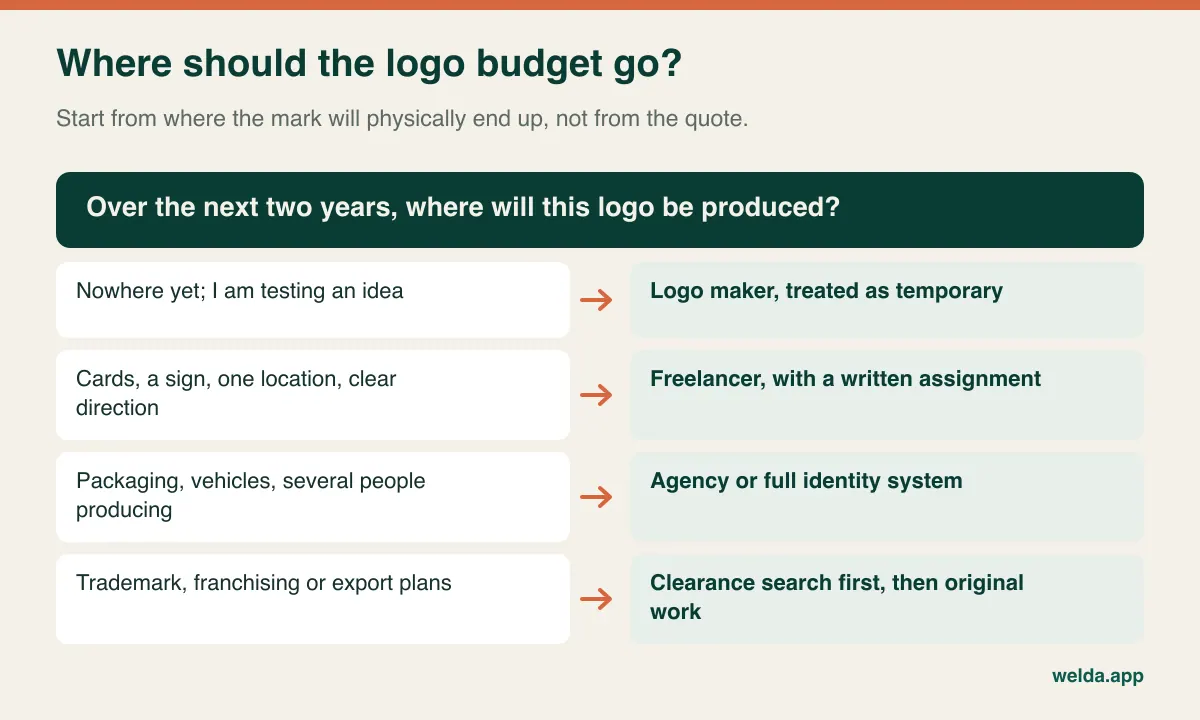
Treat this chart as a starting point rather than a rule. It's perfectly reasonable to mix routes: a freelancer for the mark, with a guideline commissioned a year later, or an agency for strategy and a local designer for applications. What matters is knowing what you've deferred, and why.
You already have a logo. Redraw, refine or replace?
Many people searching for logo design cost don't need a new logo. They've lost the files to an old one that customers already recognise. Three options exist, with very different budgets behind them.
Redraw the existing mark precisely as vector artwork when the design works and only the file is missing. First, contact the original designer or the last printer you used, since they may well still have a source file. Ask about rights while you're at it.
Refine when the mark is recognised but struggles in production. Thin details get simplified, the typeface is tidied up, and one-colour and icon versions are added. You keep what customers know and fix what suppliers complain about. For an established local business, this is often the sensible choice.
Replace when the business has moved on, the audience has shifted, or the mark gets confused with someone else's. Budget for the rollout as well as the design, and stage it: digital profiles first, printed stock as it runs out, signage and vehicles last. Before deciding, try a simple test. Show the logo to a few customers and ask what it says about you. If the answer is right, your problem is the file. If it is wrong, cleaning up the lines won't help.
What to ask on the first call
A quote tells you what someone will charge. A conversation tells you how they think, and how the project will go when something is unclear. These questions work for freelancers and agencies alike.
- Which of the files on my list are included, and which cost extra?
- What rights do I hold on final payment, and where is that written?
- Can another designer edit this later without coming back to you?
- How many directions do you present, how many revision rounds follow, and what happens past that point?
- Do you use stock elements or AI-generated output in your process?
- How do you check whether the mark resembles existing ones?
- If my printer has a problem with the file, who sorts it out?
- Where will my files be in two years, if I lose my copy?
Good suppliers tend to welcome these questions, and many will have answered them in the proposal already. Vague answers about rights or files are a stronger signal than a high or low total. When reviewing concepts, our guide to the qualities of a good logo offers useful criteria.
Where Welda fits, and where it doesn't
Welda's branding work is built around a system rather than a single graphic: discovery and concept directions, a logo family with primary, horizontal, vertical, symbol and single-colour versions, a palette with HEX and CMYK values, typography standards, a brand voice guide, applications such as a business card, letterhead and social templates, and a PDF guideline that gathers the rules. Files are delivered as AI, SVG, PNG and PDF, the full usage rights to the delivered identity are yours, and the number of revision rounds and scope are set out in writing in the proposal. If your team needs a guideline it can apply on its own, that is where this approach earns its fee.
It isn't the right fit for everyone. If you're still validating an idea, we'd rather you started with something simple and came back when the business is ready. Trademark filing is not on the deliverables list of our service page, which sets out what shapes logo design cost and scope, so you would work with a trademark attorney for that step. There is no fixed price list: the cost depends on scope, the number of variations and applications, and your strategy needs. To pin down the logo design cost for your own business, start with a free logo design cost conversation and bring your list of surfaces. You'll leave with a defined scope you can use to compare other offers, whether or not you choose to work with us.
Frequently asked questions
How long does a logo take?
It depends on scope. A logo alone is faster than a full identity with applications and a guideline. Delayed feedback and unclear decision-making stretch schedules more often than the design itself does. If you have an opening date, say so at the quoting stage, and remember that signage and print production take their own time.
Can I trademark a logo I made with a logo maker?
Possibly, but nobody can promise it. Stock icons available to other users can create issues around distinctiveness and similarity, and platform terms may add limits. Read the terms and speak to a trademark attorney before filing.
What happens if I don't get a vector file?
Probably nothing, until your first sign or large print job. At that point it will likely need to be redrawn, and the result may differ from the original. Asking for vectors up front is far easier than recreating them later.
How many logo concepts should I ask for?
A few reasoned directions are worth more than a long list of quick ones. A high concept count can even be a warning sign, since time is finite. What matters more is that the refinement rounds for the chosen direction are agreed in writing.
Can I negotiate the price of a logo?
You can change the scope, for instance by postponing applications or simplifying the guideline. Pushing down the number for the same scope usually means something gets cut from the process or the files. A more useful question is "what could we remove, and what would that change?"
Should a logo be part of my website project?
It can be, as long as the logo deliverables are listed separately so you're not left with a web-only file. If the site can't wait, a temporary mark is workable, and you can replace it later if the site is built to allow that. Decide consciously rather than letting a launch date choose for you.
What do I need to prepare to get an accurate quote?
A list of surfaces, a few sentences on your business and customers, examples of logos you don't want to resemble, one named decision-maker, and any fixed dates. If the name isn't settled, choose the brand name first, because the design depends on it.