The right B2B website design agency is the one that treats your site as part of your sales process rather than a brochure, and you can test for that before signing anything. Ask how they will handle a buying group of several people, what your RFQ form will capture, how technical documents will be served, and what happens to a lead once the form is submitted. An agency that can answer those four questions with specifics, and that asks to talk to your sales team, is worth a proposal. One that opens with mood boards and a homepage concept probably is not.
This guide is for owners and commercial leads at companies where a deal takes weeks or months: manufacturers, industrial suppliers, professional services firms, logistics providers, B2B software vendors. By the end you should know which kind of site you are really buying, what to put in a one-page brief, which questions to ask on the call, and how to compare proposals that all look different. The spread in what these projects cost comes almost entirely from the decisions below, so the section on cost shows which of them move the budget and where the hidden items sit.
First decide which B2B site you are buying
"B2B website" covers at least four different projects, and agencies price and staff them very differently. If you ask for "a new website" you will get proposals for whichever of the four each agency happens to prefer, which is one reason quotes for the same request can look like they belong to different planets.
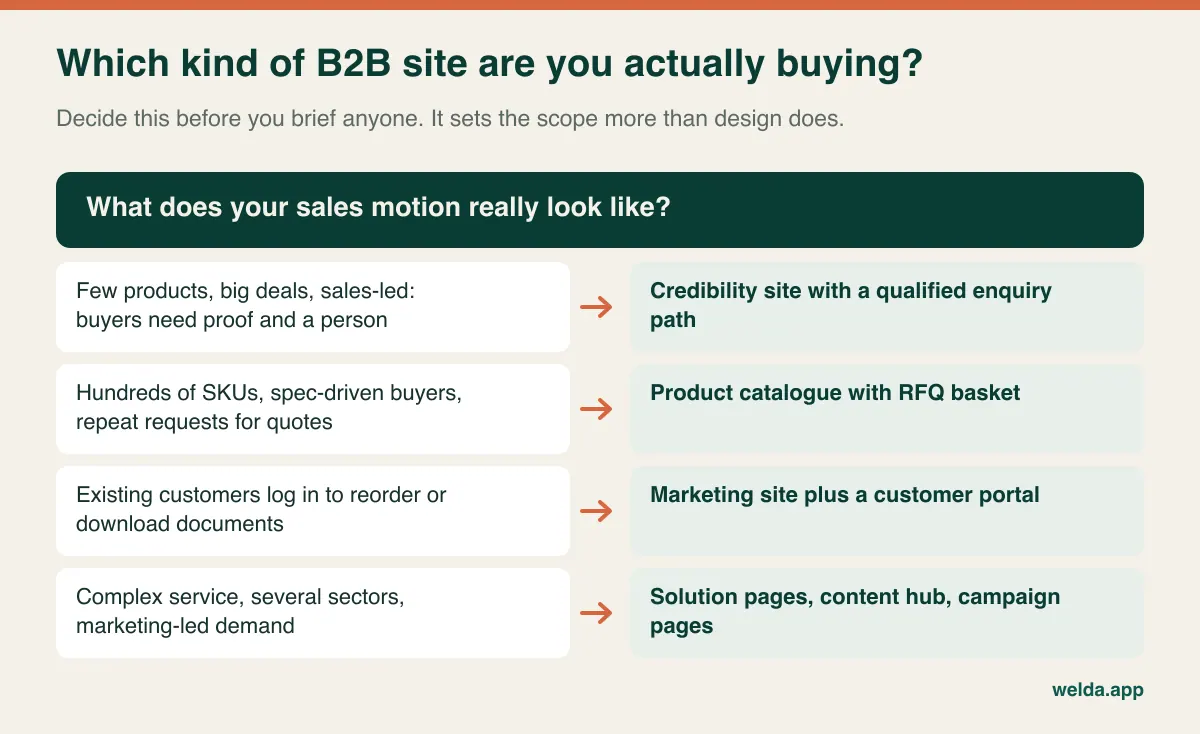
A precision engineering shop with twenty large accounts does not need a content hub; it needs a credible site that survives a due diligence check, with a simple way to send drawings. A fasteners distributor with thousands of SKUs lives or dies on catalogue structure and search. A SaaS vendor selling to mid-market IT teams needs solution pages, comparison content and a demo path. A packaging supplier with repeat buyers may get more out of a login area for reorders and certificates than out of any amount of homepage polish.
You can be a mix, and many companies are. But naming the primary job gives every later decision a tiebreaker. When someone asks whether the homepage needs a video or the product filter needs a third attribute, you know which matters.
The buying group reads in shifts, and any of them can veto you
In a consumer purchase, one person looks and buys. In B2B, several people from the same company visit separately, weeks apart, with different questions. Most of them will never contact you. The engineer checking a tolerance does not email to say she could not find a datasheet; she moves to the next supplier on her list, and your sales team never learns the deal existed.
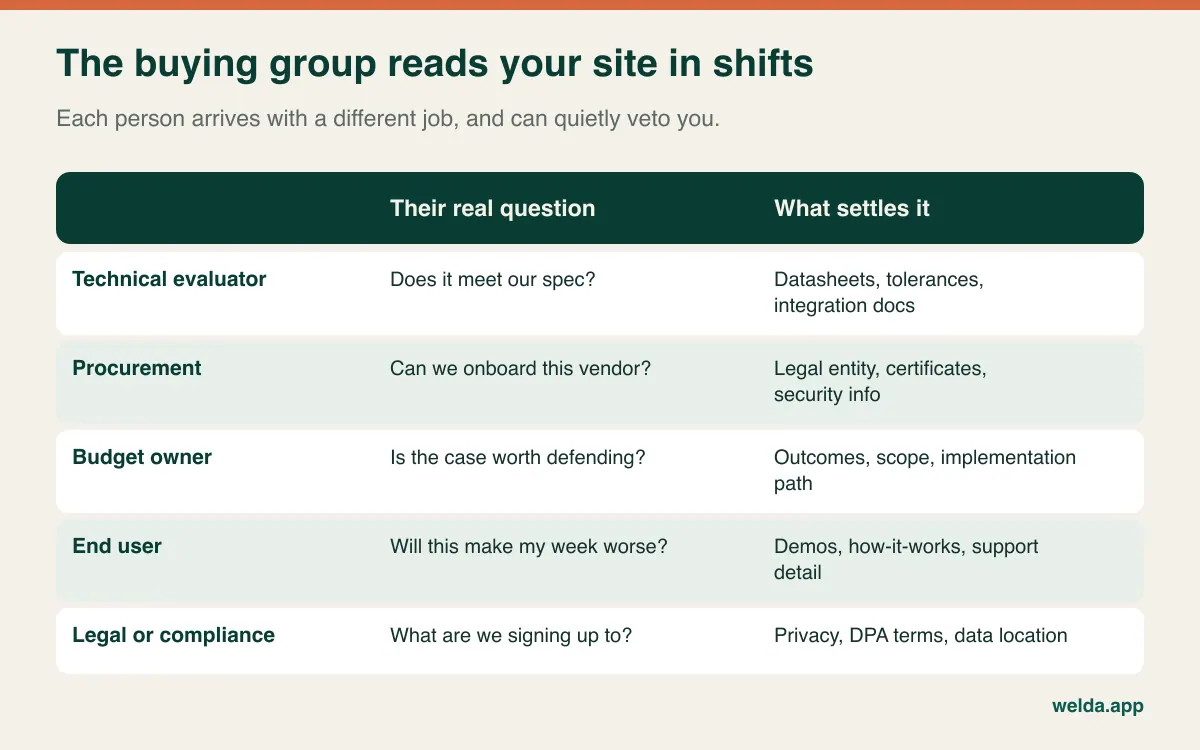
This changes what you should expect from an agency's site map. A typical template gives you Home, About, Services, Contact. A site built for a buying group gives procurement a page they can forward (legal entity, certificates, insurance, security posture), gives the evaluator documentation that can be read without a sales call, and gives the budget owner a short, plain explanation of outcomes and implementation they can paste into an internal memo.
Think about forwarding in particular, because it is the least appreciated behaviour in B2B buying. A link gets emailed around an organisation long before any meeting happens. Every important product or solution should have its own clean URL, a page that makes sense to somebody arriving cold, and ideally a printable or PDF version. If everything lives on one long scrolling page with tabs, your champion has nothing to send.
Ask your salespeople to list the questions they hear in the last two weeks before a deal closes. Those late questions are usually the ones a site could have answered earlier, and they tend to be the objections that stall deals: can you do this in our region, who supports it, what happens if your key person leaves.
The form count is a vanity metric until sales talks back
Most agency reports stop at "conversions", meaning form submissions. On a long sales cycle that number can go up while the business gets worse: more students, more vendors pitching you, more tyre-kickers, and salespeople spending their mornings filtering them out. A site that doubles form volume and halves quality has not helped.
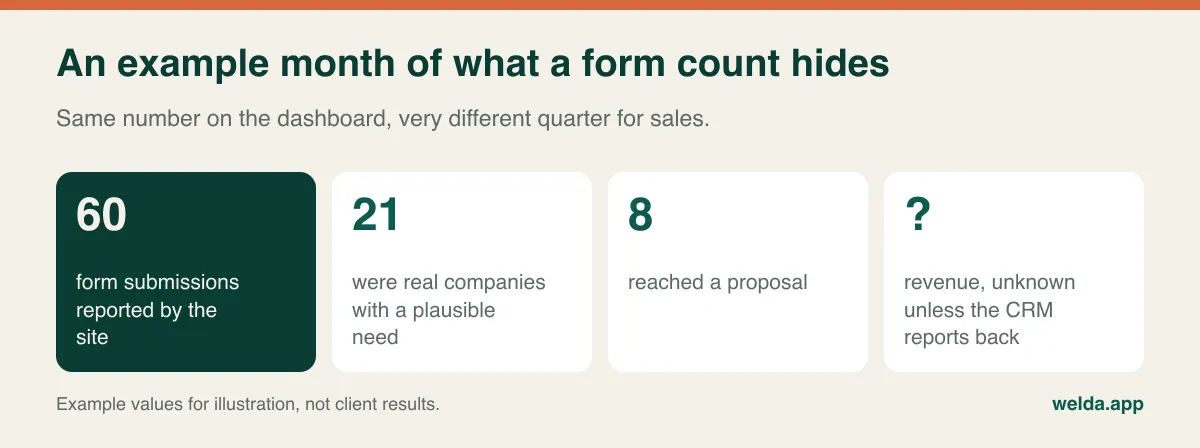
What you want is a chain from visit to revenue. That means the form passes source, campaign and landing page into hidden fields; the record lands in your CRM with those fields intact; sales marks each lead as good or bad; and someone looks at the result monthly. Because deals close months after the first visit, this is the only way to know which pages and campaigns are actually producing revenue. Our walkthrough of conversion tracking setup covers the event side of this; the CRM side is where you need to press the agency.
Before signing, ask to see how a past client's data flows, with names removed. You are not looking for impressive numbers. You are looking for evidence that the agency has thought beyond the thank-you page, and that it will write form and tracking tests into acceptance rather than hoping for the best.
Also be realistic about attribution. Plenty of B2B buyers read your site for months, then pick up the phone or get an introduction at a trade event. Adding a "How did you hear about us?" field to the form and a habit of asking on the first call will capture things analytics never sees. It is low-tech, and it often beats the dashboard.
Designing the RFQ form as a sales document
A contact form with name, email and message tells a salesperson almost nothing. Replying to "please send pricing" means going back to ask what, how many, where and by when, and in a busy week that reply slips. Treat the form as the first document in your sales process: it should carry enough to let someone give a useful first answer.
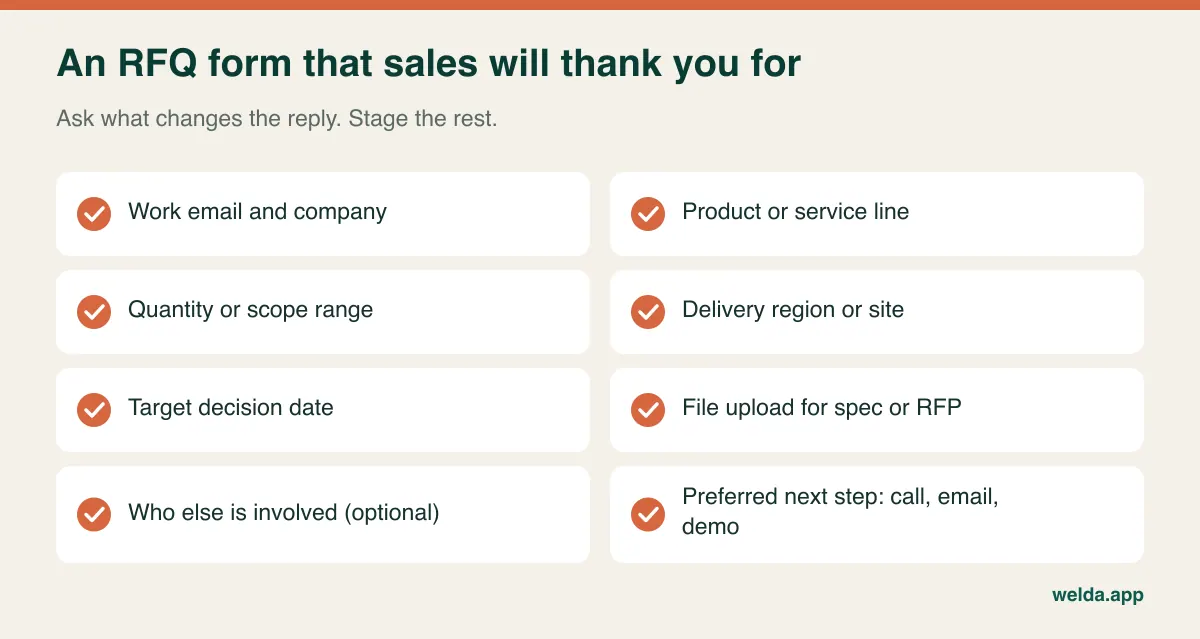
The test for each field is simple: does the answer change our first reply? Quantity, region and timing usually do. Company size often does not, and you can look it up. Splitting the form in two steps tends to feel lighter for the same information. Then brief the agency on three details that template sites routinely miss:
- File uploads. Buyers want to attach specs, drawings or an RFP. Decide on size limits, accepted formats, virus scanning, where files are stored and when they are deleted. An RFP may be confidential, so emailing it around in plain attachments is a choice you should make deliberately.
- Context from the page. If someone opens the form from a specific product page, that product should come along automatically. Sales should not have to ask.
- Corporate email filters. Some companies block free email addresses to cut noise. Think twice: in several markets, small firms and owners legitimately use them. Flag them for review rather than rejecting them.
Keep a phone number and direct email in sight as well. Forcing everyone through a form annoys senior buyers, and in many countries the normal way to start is a call or a message. The fix is to measure those channels rather than hide them.
What to leave open and what to gate
The standard marketing advice is to put documents behind a form and collect emails. On a long sales cycle this often backfires. Somebody compiling a shortlist will not hand over their details for a datasheet when a competitor offers it freely, and the emails you do capture mostly belong to people with no purchase in view, which sets up awkward calls for sales.
A workable rule: anything a buyer needs in order not to eliminate you stays open. That means datasheets, certificates, compliance statements and specifications. Something that does extra work for the reader, like a calculator, a template or a substantial selection guide, can reasonably ask for an email. Custom drawings, CAD files and price lists belong in the sales conversation anyway.
Publish key content as both HTML and PDF. PDF-only catalogues rank poorly and read badly on a phone; HTML-only pages leave an engineer with nothing to file. If you have a big catalogue, this becomes a real scope question: where does product data live, who updates it, and how does a revised certificate reach the page? An agency should ask you this without being prompted, and it is the kind of question our manufacturer website guide goes into further.
Pricing visibility belongs in the same conversation. Many B2B companies cannot publish a list because price depends on volume and spec, which is fine. But "contact us for pricing" on its own is a dead end. Explaining what drives a quote and how soon a reply comes reduces uncertainty, as long as sales can actually meet that promise.
Compliance, security and the international questions
B2B sites serving several countries meet some questions that small local sites do not. What follows is general information rather than legal advice, and the specifics depend on where you and your customers are, so run the final wording past counsel.
- Privacy law. A business contact's name and work email are still personal data under the GDPR, and the UK has its own equivalent. US state laws such as California's add their own rules, and their treatment of B2B contacts has changed over time. Plan privacy notices, retention periods and consent for analytics around the markets you truly sell in.
- Cookies and analytics. If you take traffic from Europe, your tracking setup, and the data your attribution relies on, depends on how consent is handled. Ask the agency what your reports look like when a visitor declines.
- Vendor security questions. Larger buyers may send a security questionnaire. A short trust page explaining hosting, access control and any certifications you truly hold saves everybody time. Do not list a badge you do not have.
- Languages and regions. Each extra language multiplies translation, approval and upkeep. Technical terms need review by someone who knows your industry. Ask how URLs and hreflang will be handled, and what the agency needs for a language added two years from now.
- Accessibility. Requirements vary across countries and some public-sector and enterprise buyers ask about conformance. Clarify what the agency means by "accessible" and how it tests.
After the form: the part nobody budgets for
Lots of websites are delivered with a perfectly working form that drops leads into an inbox nobody owns. Three weeks later, a qualified buyer has heard nothing. Everybody blames marketing, and the new website gets the rest of the blame. It costs very little to prevent, and it costs a lot to ignore, so the routing belongs in your brief.
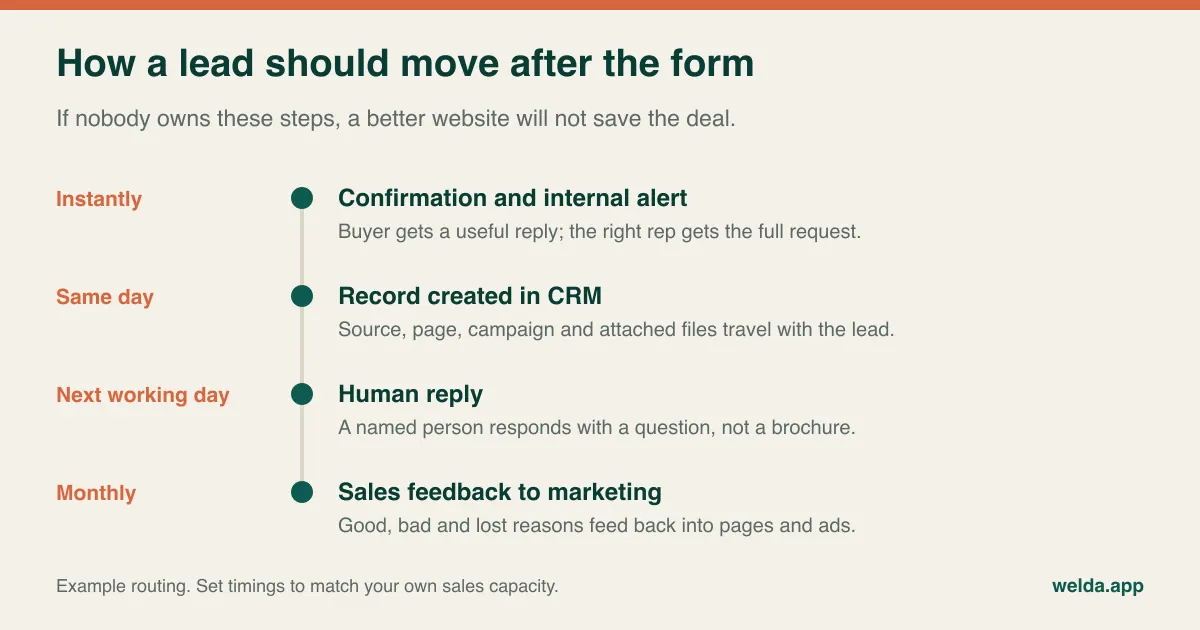
Write down where leads go by product and region, who covers when that person is away, and what the auto-reply says. A useful one tells the buyer what happens next and when. Then agree who reviews bad leads each month and feeds that back into the site. When a page generates mostly the wrong enquiries, that is a copywriting problem you can fix.
A word about CRM from our side. Welda CRM is built for appointment-based businesses such as clinics, salons and studios. It has a lead funnel and quoting, but it was not designed around long enterprise sales cycles, so if that is your world you will likely want a dedicated sales CRM. What matters for this project is that you decide which CRM the site must talk to before development starts, because adding that at the end is when it gets expensive.
Questions that separate B2B agencies from good-looking portfolios
General advice on hiring an agency is covered in our guide to evaluating website proposals. These questions are the ones specific to B2B. Send them in writing, then listen to the answers on the call.
| Ask this | Why it matters | A solid answer includes |
|---|---|---|
| Will you interview our sales team? | Good B2B copy comes from real objections. | Sales interviews already built into discovery. |
| What did you measure on a long-cycle client? | Shows whether they think past form fills. | Stages, source data, feedback from sales. |
| Where does a lead go, and how is that tested? | This is where deals get lost. | Field list, hidden fields, a written test plan. |
| How do we update products and documents? | Catalogues rot when updating is painful. | A CMS walkthrough or data import method. |
| How do we protect our existing rankings? | A redesign can cut off organic enquiries. | Redirect map and post-launch checks. |
| Who owns code, domain and accounts? | You need to be able to leave. | Ownership and handover stated in the contract. |
| What do you not do? | Clear limits prevent mid-project surprises. | A straight list, maybe with partners named. |
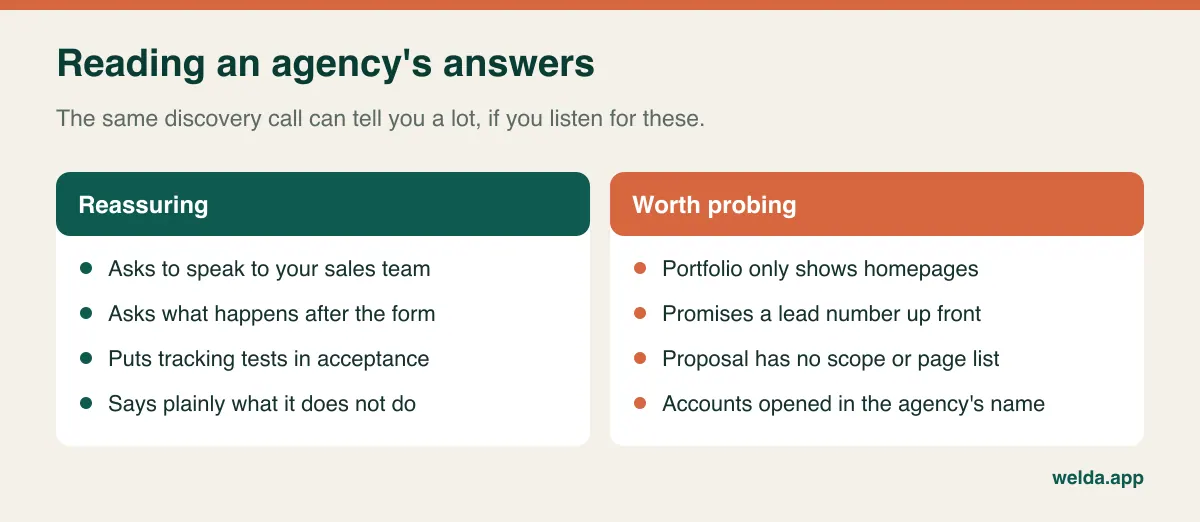
On portfolios, try this: open one of their B2B client sites on your phone, go to a product page, and try to request a quote. You will learn more in three minutes than from any case-study PDF. Also ask whether you can speak to a past client. Plenty of good agencies will arrange it, though some clients decline, so treat a refusal as a question rather than a verdict.
Location matters less than it used to, but it still matters a little. If the agency is in another country, as we are for many readers (our team is in Istanbul), ask how overlap hours work, who you will actually talk to, what language the project runs in, and how the contract handles governing law and payment. A remote team can be an excellent fit, as long as these things are settled up front.
The brief that makes proposals comparable
Bring those decisions together in one short document and send the same one to everyone. It does not need to be a formal RFP. Its job is to stop three agencies from quoting three different projects. If your organisation requires a formal RFP, keep this one-pager at the front: it is what people read.
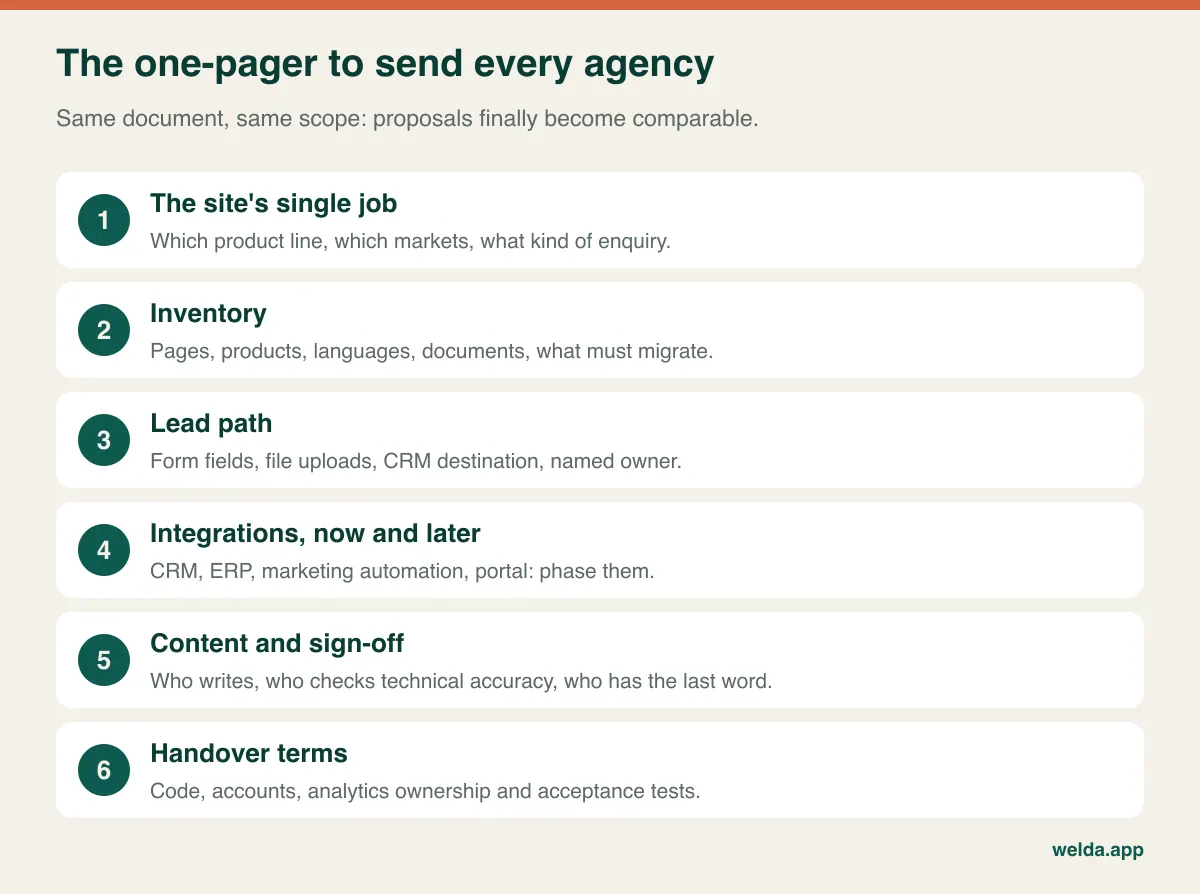
The heading most often skipped is content and sign-off. In B2B, projects rarely slip because of code; they slip because a technical page sits in a product manager's inbox for a month. Name who drafts, who checks accuracy and who decides when they disagree. Then phase the integrations. A first release might connect forms to the CRM and nothing else, leaving a customer portal or ERP feed for later. Ask directly: "We are not building phase two now, but does today's setup block it?"
What drives the cost, and how to compare offers
There is no meaningful market figure for this, since a ten-page credibility site and a multilingual catalogue tied to an ERP get sold under the same label. What moves the number most often:
- Product and data structure: filterable catalogues, variants, a document library, data import.
- Integrations: CRM, ERP, marketing automation, customer or dealer portals.
- Languages: translation is only one line; sign-off, URL structure and upkeep grow too.
- Content production: technical writing, photography and application pages. Ask whether these are in or out of scope.
- Migration: redirect mapping, content transfer, protecting rankings.
- After launch: hosting, security updates and support for small changes.
To compare, make a grid with your brief's items down the side and agencies across the top. Mark each cell "included", "extra" or "not stated". Compare totals only after that. A cheap proposal with many "not stated" cells usually comes back as change requests. Common hidden costs include entering content yourself, tight revision limits, annual licences for plugins, CRM connection billed as a separate job, and charging by the hour for every small post-launch change. Our B2B SEO strategy guide is also worth a look at this stage, since search work that is not in scope often turns into a surprise later.
When you probably don't need a specialist at all
If your customers all arrive through relationships and you are not looking for new ones, a simple, trustworthy site with your credentials and correct contact details will do the job. A sub-contractor serving one major customer has no use for a content programme. If your sales team cannot handle today's enquiries, fix that first, because more leads will simply mean more unanswered leads. And if nobody can maintain a large catalogue, a small accurate one beats a large stale one. On the other hand, a company entering a new market, shifting from distributors to direct sales, or losing shortlists it cannot explain has a clear reason to invest.
How we approach it at Welda
We work along similar lines. Discovery comes first: goals, audience and conversion expectations, then the site map and scope. Interface design happens in Figma before development in Next.js/React or WordPress. We tune for Core Web Vitals, set up Search Console and GA4, and add a CMS so your team can edit without waiting on us. You own the source code and documentation, so hiring us as your B2B website design agency does not tie you to us. When a portal or customer area is part of the picture, the same Istanbul team behind Welda Stock and Welda CRM builds it.
Some limits, too. We don't sell fixed packages, and we can't confirm the scope of a specific ERP or CRM integration before seeing your systems. Technical accuracy in your field has to be signed off by your own experts; no agency should claim otherwise.
Common questions
What is the difference between a B2B website and a corporate website?
They can look alike. A corporate site mostly presents the company. A B2B site built for demand answers different questions for several readers, supplies technical documents, collects qualified requests and connects them to the sales process.
How long does a B2B website project take?
It depends largely on scope and on how fast you can approve content. A small credibility site and a multilingual catalogue will not run on the same calendar. Ask for a phased plan that includes your own review time.
Should an agency guarantee a number of leads?
No. Lead volume depends on your market, competition, ad budget and offer. Ask instead how measurement will be set up and which numbers you will review together after launch.
Do we need to publish prices?
Not if pricing depends on volume and specification. Still, explaining what drives a quote and when a buyer can expect an answer takes away much of the uncertainty.
Should we rebuild or improve our current site?
If the platform is sound, you can often fix forms, documents and product pages step by step. If it blocks content updates, speed work or integrations, rebuilding may make more sense. Either way, plan redirects so that you don't lose existing search traffic.
Do we need a specialist B2B agency, or can a general agency do this?
The label matters less than the behaviour. A general agency that asks about your sales cycle and tests the lead path may serve you better than a self-described B2B specialist that only shows homepages.
One thing to do before you contact anyone
Spend half an hour with your sales team on your last two lost deals and last two wins. What did the buyer ask, which documents did they want, and who actually decided? Half your brief will come out of that conversation, and it will improve every proposal you receive, whoever you end up working with.
If you would like to go through it with us, we offer a free consultation. We can look at your brief, separate what you need from what can wait, and work out the price from that actual scope. If you are looking for a B2B website design agency and we are not the right fit, for instance because of language, location or a system we don't work with, we will tell you. You will still leave with a sharper brief.