Good dental website design starts with three decisions that have nothing to do with colours: which treatments you want more of, how a new patient gets from your page into your diary, and what your regulator lets you say. Settle those, write them into the brief, and any competent provider can quote against the same scope. Skip them and you will pay for a handsome site that shows your phone number to people who already know your name, while the person searching "broken tooth open Saturday" or "how long do implants take" goes elsewhere.
This guide is for practice owners about to commission a new site or replace an old one. It covers the choices that are particular to dentistry and leaves out the advice that would apply equally to a florist. The regulatory parts are a general orientation across several countries, not legal advice; your own dental board or regulator has the final word.
Your homepage is not where most new patients arrive
Picture how a patient actually finds a dentist. Someone searches on a phone, sees a map with three practices, glances at star ratings, taps through to one website for twenty seconds and calls. Or a colleague recommends you, and they look you up to check that you seem competent and take their insurance. Or they spend three weeks reading about implants and land on one treatment page from a search result. In none of these journeys does the homepage do the heavy lifting people imagine it does.
So the site has different jobs depending on the door a patient comes through, and a good proposal will treat them separately. A provider who shows you only a homepage mock-up has designed the part that matters least.
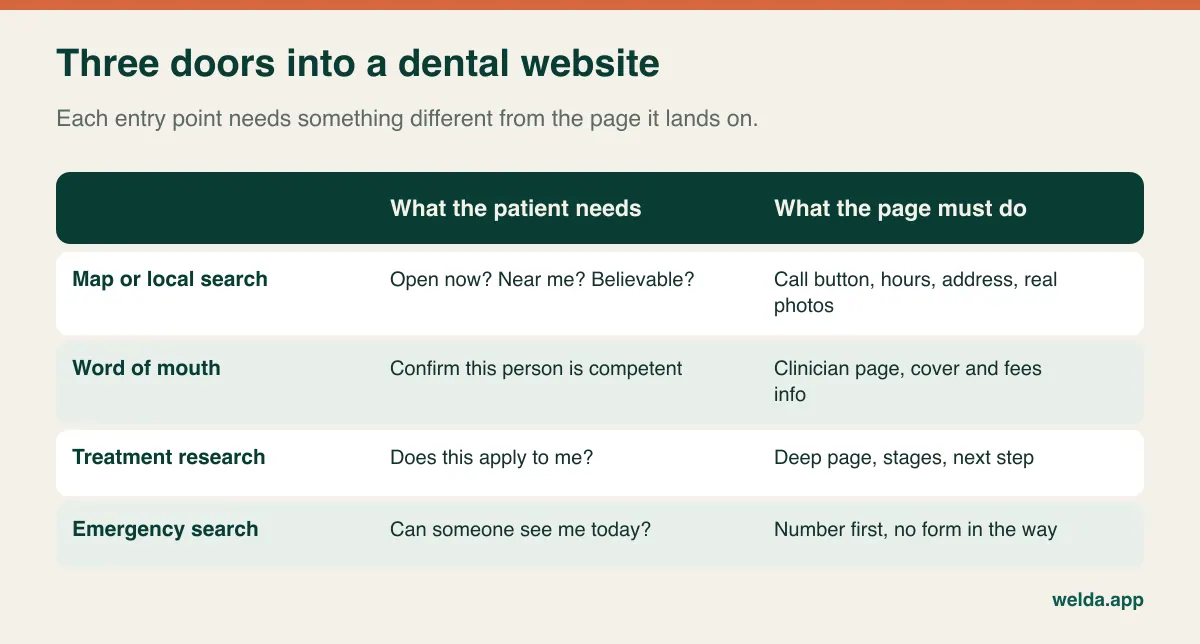
A useful exercise before you talk to anyone: pull your last three months of new patients, note what each came in for, and write beside it what you would like more of. Those two lists rarely match. A practice with a full hygiene book and empty implant slots should not commission fifteen equal treatment pages. It should build two or three deep ones, plus a clear path for emergencies, and leave the rest as short summaries until there is evidence they are worth expanding.
The reverse caution also applies. Do not give menu space to a procedure you perform once a month with a visiting clinician. The page will attract the enquiry, and the enquiry will end in a disappointing phone call. If you are working on the wider acquisition picture and not just the site, our guide to dental clinic patient acquisition covers local search, reviews and referrals; those channels send people to the pages discussed here.
Nervous patients read a dental site differently
Few other businesses have to sell to people who are actively scared of the service. Dental anxiety shapes how your site gets read, and most generic templates ignore it. A patient who has avoided the dentist for years is not comparing technology. They are looking for signs that no one will judge the state of their teeth, that they can stop if they need to, and that the first visit is not an ambush.
That has concrete consequences for the brief. Photographs of instruments, close-up procedures and gleaming mouths work against you on this audience. Pictures of your real team, your waiting room and an actual treatment room with the chair at rest work better. Copy should describe the first appointment step by step in plain language: who greets them, whether anything happens at the first visit besides talking and looking, how they can signal to pause. If you offer sedation, say what is offered and who is qualified to give it, and make it a route they can ask about without a commitment.
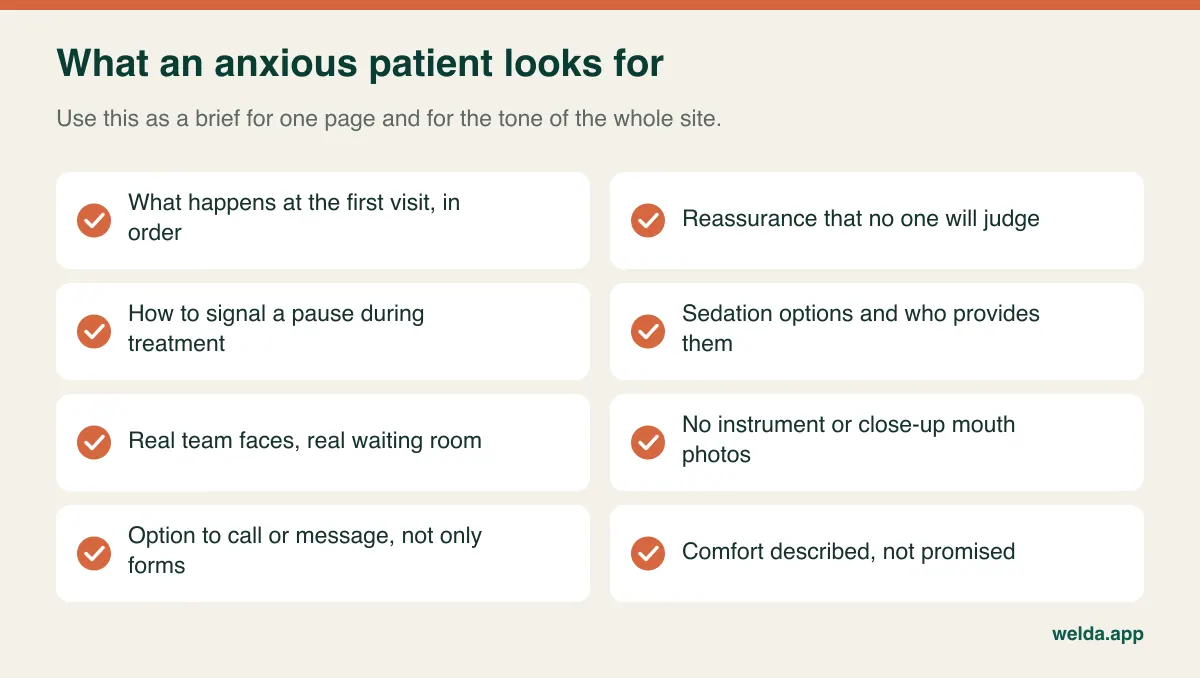
A short page for anxious patients is one of the cheapest things you can add and one of the most specific to your field. Do not promise "painless" treatment, which is a claim you cannot guarantee and one many regulators dislike. Describe what you do to keep people comfortable and let them draw the conclusion. The same goes for children's dentistry: parents want to know what the first visit looks like and at what age to come, much more than which equipment you bought.
Treatment pages that can carry a high-value decision
Ask a provider whether treatment pages are included and the answer will be yes. Ask what is on them. For many suppliers, a treatment page is one stock photo and three paragraphs of definition that could sit on any dental site in the world. It will neither rank nor persuade, because the person considering an implant, a full-arch restoration or clear aligners is not asking what the treatment is. They are asking whether it applies to them.
A page that does the work answers the questions you already hear in the consulting room. Am I a candidate if I have lost bone? Will I walk around with a gap? How many visits, and how far apart? What changes the scope of the work? Who actually does it, and how much experience do they have with it? What happens if something fails later? General answers are fine, provided the page says plainly what can only be settled at an examination. That honesty is often what gets someone to book the examination.
Three practical issues decide whether these pages ever exist:
- Who writes them. Clinical accuracy is your responsibility, even if a copywriter drafts the text. The efficient method is a twenty-minute call per treatment in which a dentist talks through the real questions, a writer turns it into a page, and the dentist approves it. If the proposal does not say who writes, how many revision rounds are included and how sign-off works, expect the project to sit waiting for content.
- Brand names. Aligner and implant systems are trademarks, and manufacturers often have rules about who may use the name and how, sometimes tied to provider status. Check before your developer builds an entire landing page around a brand you may not be entitled to feature that way.
- Photography. A half-day shoot of your actual clinic and team usually does more than any layout decision. Agree who organises it and who owns the rights. Any recognisable patient needs separate, specific written consent.
Clinician pages belong in this budget too. List qualifications, registration, areas of interest and memberships. Be strict about the word "specialist": in many countries it is a protected term tied to a formal register or training pathway, and a marketer who is unaware of this can create real trouble for you with one line of copy. Our medical clinic website guide covers trust signals that apply across healthcare if you want the broader view.
Insurance, plans and the question nobody puts on the homepage
Whatever the country, the first practical question from a new patient is usually some version of "can I afford to come to you, and will my cover apply?" The answer varies by market, which is why a design copied from an overseas example often misses it entirely. In the US, patients want to see which insurers you are in-network with, and many practices offer an in-house membership plan for the uninsured. In the UK, the crucial fact is whether you take NHS patients at all, and whether the list is currently open. Elsewhere, the issue may be private cover, public schemes or payment by instalment.
Give this a dedicated, easily found page and keep it current. A stale insurance list creates the worst kind of enquiry: one that ends with an awkward conversation at the front desk. It should be something your reception team can edit themselves in the content system, without a support ticket. Test that during the demo by asking the provider to show you the exact edit.
Publishing fees is a separate question. In some markets a fee guide is expected, or even required for certain services; in others it is uncommon. If you do publish one, name what is and is not included, and state that a treatment plan follows an examination. If you do not, explain which factors change the cost so the visitor leaves with something more useful than "contact us".
Booking: who is allowed to commit the chair?
The default pitch is real-time online booking, because it demos well. Dentistry complicates it. A check-up has a predictable length; a root canal does not; and a patient describing "a bit of pain" may turn into a much longer appointment than the slot they clicked on. Letting anyone hold any slot can quietly wreck a clinical day, particularly with specific rooms, assistants and hygienists involved.
So the actual decision is about which appointment types may be self-booked, for which patients and through what. Most practices land on a mix.
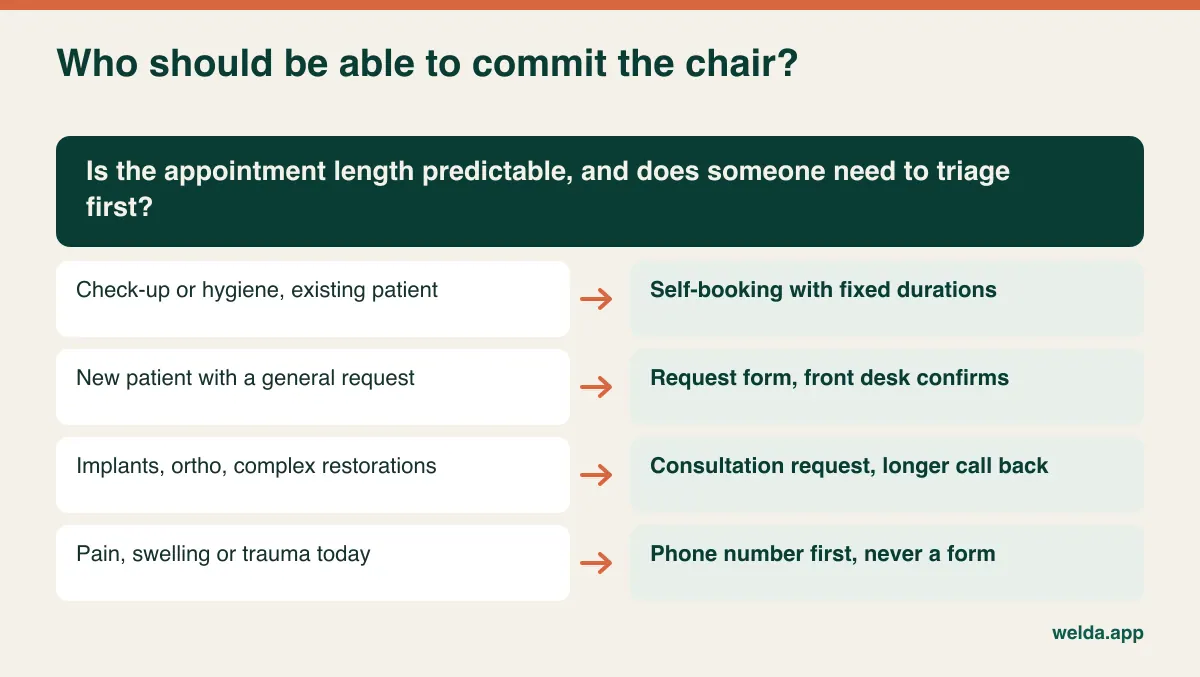
If your practice management software offers a booking module or an integration, ask early what it can really do: does it respect appointment durations and clinician rules, or does it just show free time? Who maintains the connection when the software updates? Does it distinguish new patients from existing ones? Ask to see the booking flow on a phone, on the live site of a current client, rather than a slide. Our piece on building a website with online booking goes further into the technical options.
Keep the request form short. Name, phone, treatment of interest and preferred time of day are enough for a first contact. Asking for medical history or uploaded X-rays at this stage drives people away and enlarges the sensitive data you must protect. Decide too what happens to a form submitted at 9pm on Friday: an automatic reply saying when you will call, and one shared inbox the front desk actually checks, will rescue more patients than another round of design tweaks.
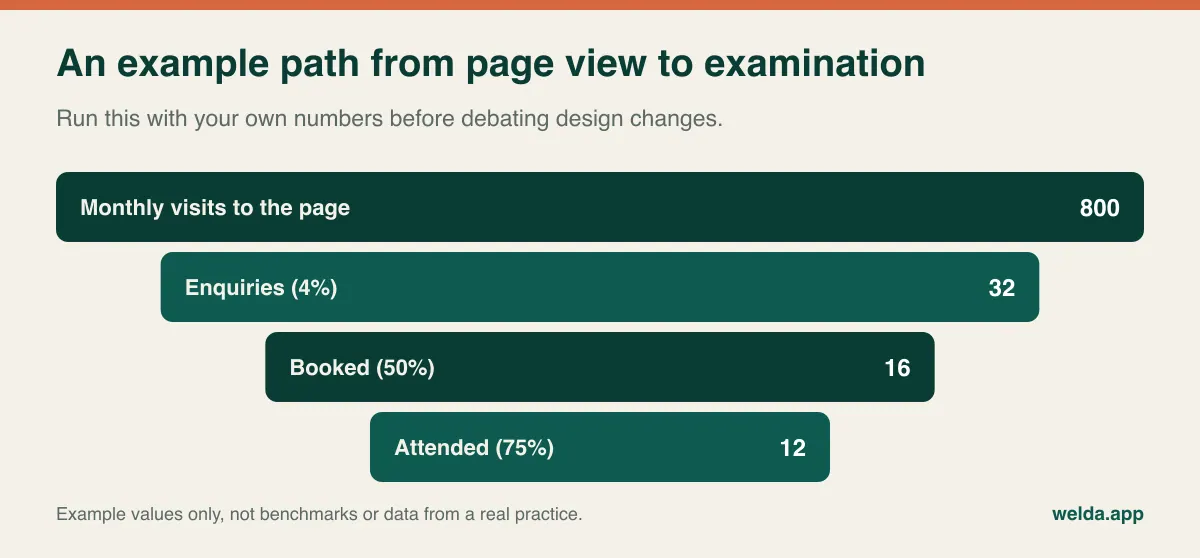
The funnel below is an example with made-up numbers, but the calculation is worth doing with your own. Notice how much depends on the last two stages, which no designer controls.
For practices that lack a proper diary in the first place, this is worth solving separately. Welda CRM, our own product, keeps clinician calendars on one screen, confirms online appointment requests only once you approve them, and sends reminders automatically over WhatsApp. It is a good fit for that request-then-confirm approach. We would not assume it connects to your existing practice software, though, and it should not be taken as a replacement for one that handles your country's clinical records or insurance claims; settle that question in conversation rather than on trust.
What you may say depends on where your chair is
A hairdresser who claims to be the best in town is just exaggerating. For a dentist, the same sentence can be a regulatory matter. There is no international rulebook, and the details change, so treat the following as a map of what to check rather than a statement of what the law requires in your jurisdiction.
| Market | Where to look | Typical website questions |
|---|---|---|
| United States | State dental boards, HIPAA, FTC rules on endorsements, ADA accessibility case law | Use of "specialist", review handling, tracking code on patient-facing pages, keyboard and screen reader access |
| United Kingdom | General Dental Council guidance, ASA/CAP advertising rules, UK GDPR | Titles, GDC numbers, claims that need evidence, consent for images |
| EU countries | GDPR, national professional law, national advertising law for health services | Health data on forms, cookie consent, legal notice, limits on promotion |
| Australia | Ahpra advertising guidance, Australian Privacy Principles | Testimonials about clinical care, before-and-after images, claims about outcomes |
| Medical travel markets | Rules of both the home country and the patient's country | Licences, claims in foreign-language pages, aftercare promises, data transfer |
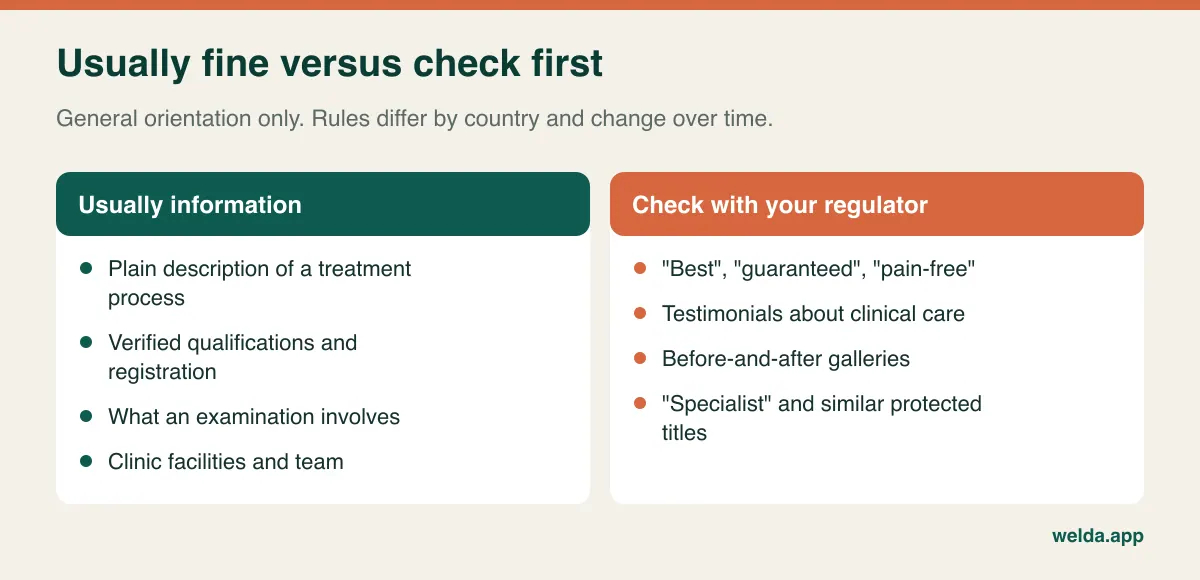
Some patterns recur nearly everywhere. Superlatives such as "best" and absolute promises such as "guaranteed" or "pain-free" are risky. Before-and-after galleries and testimonials need scrutiny well beyond a patient's signature, and in some places they are restricted outright for clinical claims. Discount countdowns borrowed from retail sit badly with professional rules. The provider's useful contribution here is not legal knowledge; it is knowing to raise the question and building in a step where you or an adviser checks the copy.
Privacy needs the same care. A form on which someone writes "my lower left molar hurts and I take blood thinners" is collecting health information, which most privacy regimes treat as sensitive. Marketing technology raises a subtler problem. An ad pixel on your implant page can tell an ad platform that a specific visitor looked at implant treatment. US regulators have paid particular attention to tracking technologies on healthcare sites, and under GDPR the same data flow raises questions of consent and transfer. Ask the provider to write down what each script sends and to whom, keep marketing tags off until consent is given, and limit what fires on treatment and booking pages.
Comparing proposals when the totals describe different work
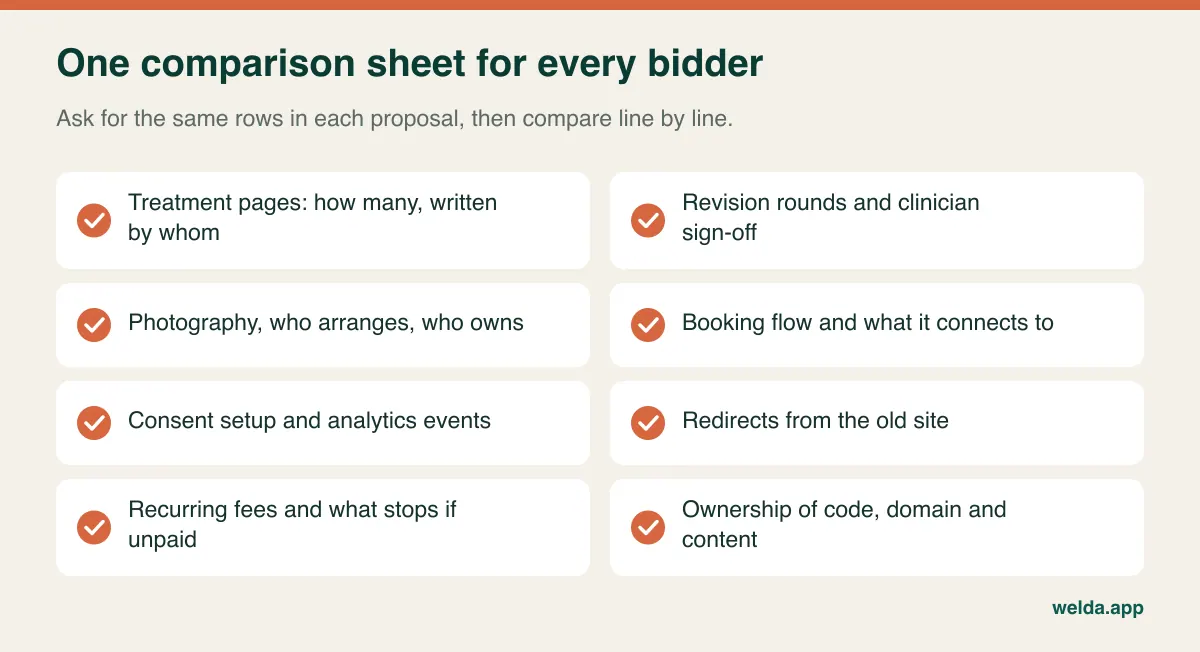
Three proposals on the table will rarely describe the same project, even if each one says "dental website". The cost is driven by a known set of items: how many treatment pages are written properly and by whom, photography, how booking works and what it connects to, number of languages and locations, the consent and analytics setup, redirects from an old site, and what happens after launch. Compare those lines rather than the bottom row. We do not quote from a rate card either; at Welda the price follows the scope and is settled in a free consultation.
Put the items in a one-page sheet and ask every bidder to fill in the same rows. The hidden costs tend to live in these places: per-page charges for adding a treatment later, needing the agency to replace a staff photo, rented themes and plugin licences, recurring platform fees that stop the site if you stop paying, a domain registered in the agency's name, and no right to take the code when you leave. Sector-specific dental marketing vendors are often a reasonable option, with useful defaults, but check how portable the site is before you sign, as you would with any provider. Our note on website ownership and source code lists the clauses to look for.
Then ask the questions that reveal how someone thinks:
- "Should we add a before-and-after gallery?" "Sure" means they have not thought about your regulator. A good answer brings up rules and sign-off.
- "Which treatment should we build first?" If they answer without asking about your capacity, they are selling a template.
- "Where exactly does form data go?" They should be able to sketch the flow and name every third party.
- "Can my receptionist update the team page?" Have them show you, live.
- "Who owns the code, the domain and the content?" The answer belongs in the contract.
- "How will you measure mobile speed?" Expect Core Web Vitals on real pages, not adjectives. Someone with toothache is on a phone, and may be in a hurry.
Where Welda fits, and where it does not
Asked the same questions, here is our honest position. Welda's dental website design work means a site built from scratch rather than a recycled theme, source code that belongs to you, a CMS so your team can edit content without us, performance tuned against Core Web Vitals and Lighthouse, and Search Console and GA4 set up from the start. The same Istanbul team builds and runs Welda Stock and Welda CRM, so booking flows and data handling are familiar ground.
Now the limits. We are not lawyers and will not certify your site as compliant with HIPAA, GDPR or any dental board's rules. If you are a US practice that needs a vendor contract for protected health information, raise that in the first conversation and do not assume it. Clinical content always needs a dentist's sign-off. Working with an Istanbul team also means thinking about time zones and how you prefer to communicate. And if you only need a quick one-page presence, a good template will probably serve you better than a custom project.
Sequencing the launch
If you already have a site, inventory what ranks before anyone rebuilds it. Treatment pages with years of history can vanish overnight if addresses change without redirects, so make redirects a separate line in the scope. Test the click-to-call on an actual phone. Submit the form and watch where it lands. Then update your Google Business Profile link and confirm that name, address and phone match everywhere.
After launch, watch three numbers for ninety days: enquiries per treatment page, phone and message taps, and the share of enquiries that become appointments. Keep asking "how did you find us?" at reception, because analytics cannot see recommendations. Decide on new pages, ads or redesigns only after you have seen those numbers. Put two reminders in the calendar: review team and insurance details every six months, and recheck your promotional wording against your regulator's current guidance at least once a year.
Frequently asked questions
How long does a dental website project take?
Written content, clinician sign-off and photography usually determine the timeline more than the code does. Ask for a stage-by-stage plan that includes the dates you must deliver material, since that is where most projects stall.
Do I need online booking from day one?
No. A phone button, a messaging link and a short request form cover most practices well at launch. Add self-booking for predictable appointment types once you know your diary can handle it.
Can I show before-and-after photos?
That depends on your jurisdiction and on the claims attached. Patient consent is necessary but often not sufficient. Check with your regulator or an adviser, and if in doubt, describe the process and show your clinic.
Is a template good enough for a small practice?
It can be, for a single-dentist practice with modest needs, provided that the site is fast on phones, you control what the scripts collect and you own the domain. You will outgrow it when clinician pages, several locations or deep treatment content enter the picture.
Should I build pages in several languages for overseas patients?
Only if someone can answer those patients in that language and you are set up for travel, aftercare and the rules of both countries. A translated page with nobody behind it wastes the enquiry.
How do I start with Welda?
Bring your priority treatments, your team list, your current booking process and your old site if you have one. We scope dental website design projects in a free consultation, and pricing follows from that scope. If you also need the diary and patient side, Welda CRM has a 7-day free trial. You can reach us through our contact page.