If you are working out how to choose aesthetic clinic software, start here: pick the system that keeps one continuous record from a person's first enquiry to their final aftercare check. The appointment screen matters far less than most demos suggest. Test whether the software can capture an enquiry before any booking exists, show you which quotes are still undecided, put allergies and contraindications in front of the practitioner before treatment, hold consent and photographs with proper access controls, and make sure a review date never depends on someone remembering. A product that cannot do those five things will push the missing parts back into spreadsheets, chat threads and staff phones, whatever else it offers.
What follows is written for the owner or manager of a clinic offering injectables, skin treatments, laser or minor procedures. Your purchase is different from a hair salon's. You sell before a person becomes a patient, decisions can take weeks, the treatment carries clinical responsibility, and the part that protects your reputation happens after the client has left the building.
First, name the kind of software you are buying
Three quite different products get sold under the label "clinic software", and much of the frustration owners describe comes from buying one while expecting another. Decide which gap you are closing before you book any demos.
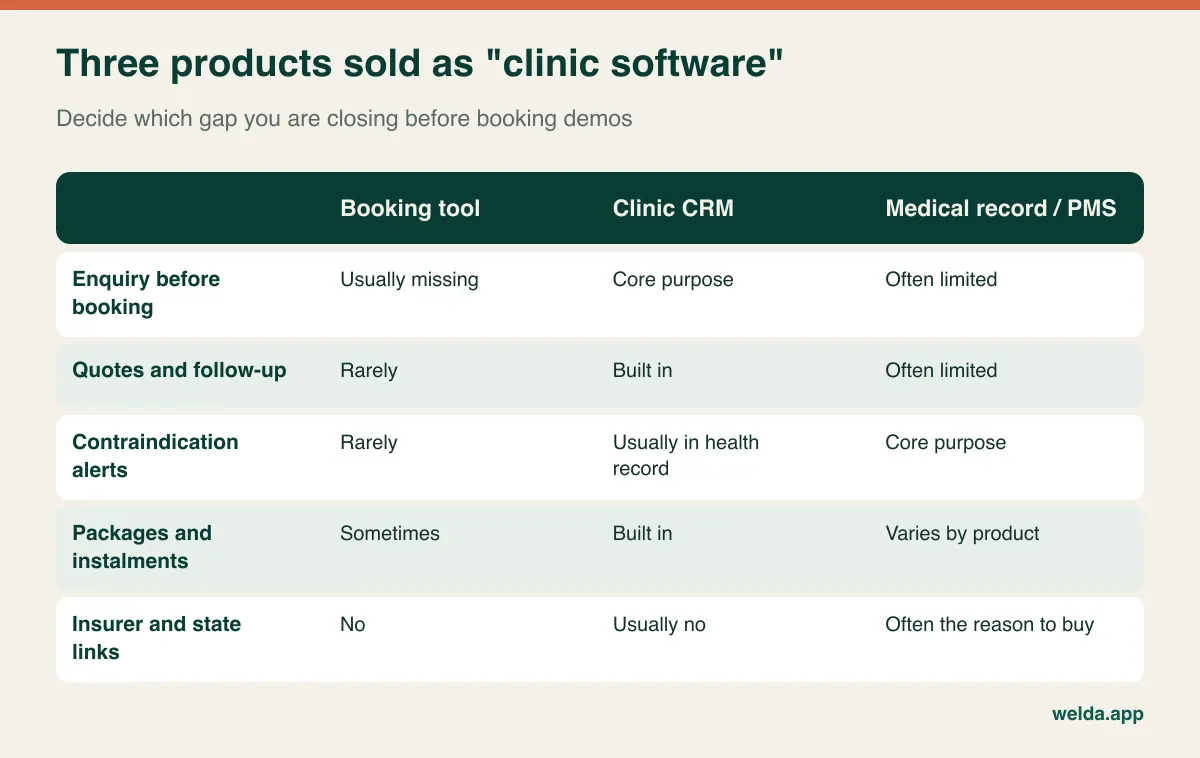
A booking tool is quick to adopt and excellent at filling a calendar, but it usually knows nothing about an enquiry that has not booked, or about a contraindication. A full electronic medical record or practice management system is the right answer where you bill insurers, prescribe through regulated pathways or run surgical theatres, though it often treats a person only as a patient and has little to say about marketing sources or undecided quotes. In between sits the clinic CRM, which runs the commercial and operational journey with a health record attached.
Welda CRM as aesthetic clinic software belongs in that third group. It combines appointments, a lead pipeline, patient records with allergy and contraindication alerts, packages, messaging and payments. If you need insurer claims, national health system connections, e-prescribing or theatre management, none of those appear on our product pages, so treat them as absent and look at a medical system, possibly running alongside a CRM. Knowing this early saves everyone a week of evaluation.
The 11 p.m. Instagram test
Picture a Tuesday night. Someone sends a direct message asking whether lip filler would suit her and whether she can send a photo. Your receptionist answers in the morning. Two days later the same person phones and a colleague picks up, unaware of the conversation. A week after that she fills in your web form using a different email address. To your clinic that may look like three strangers. In many booking systems she does not exist at all, because a record is only created when an appointment is made.
This is where aesthetic clinics quietly lose the most, and it never appears on a report. You spend money and effort creating demand, yet without a count at each stage you cannot tell which channel produces treated patients and which produces only conversations.
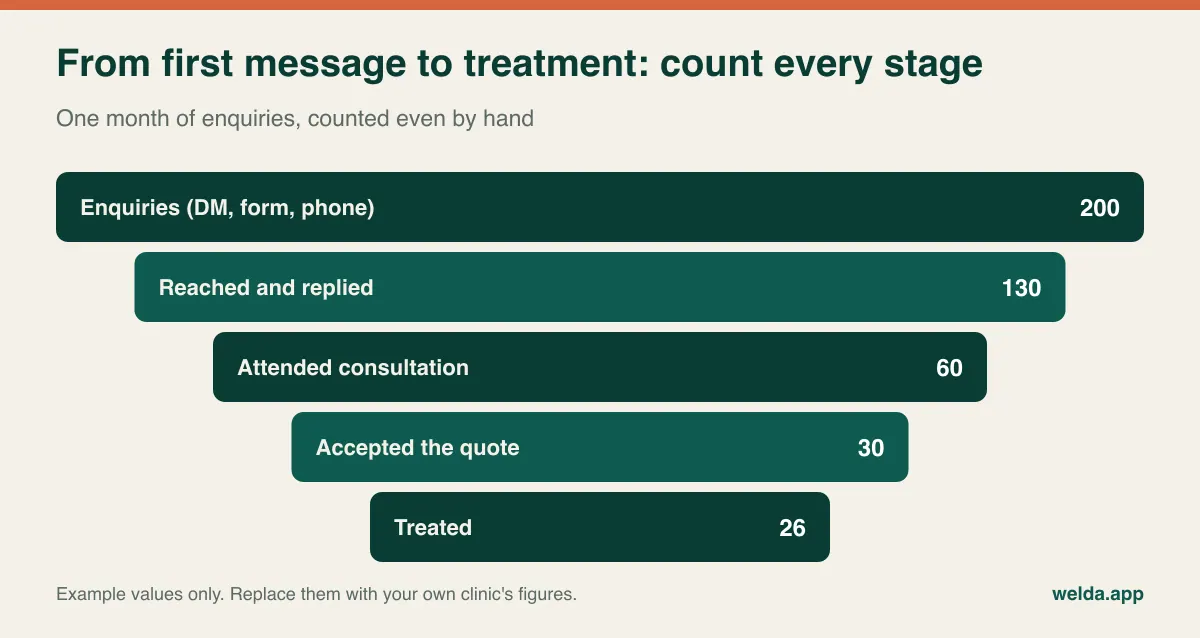
Run the numbers from a single month of your own, even by hand. In this example the steepest proportional drop falls between reaching someone and getting them through the door, which is a follow-up problem, not an advertising one. Yours may look different, and that is exactly the point of counting. Then ask each vendor:
- Can I record a person with no appointment, with a source and the treatment they asked about?
- Does every open enquiry have a named owner and a next contact date?
- Is there a daily list of who should be contacted today?
- When a known number gets in touch again, will staff see the earlier history?
- Can we record why an enquiry was lost: price, went elsewhere, no reply, not clinically suitable?
That last field looks minor. Three months in, it tends to be the most useful report you own. Welda CRM provides a lead pipeline, CRM stages and a daily follow-up queue for this work. To be plain about the limit: automatic capture of Instagram messages as leads is not listed on our product pages, so assume a team member creates the record. An open API is available on the Pro and Enterprise plans if you want to discuss feeding web forms or other sources into it.
A consultation is a medical assessment and a sales meeting at once
This double nature shapes how the software should behave. The consultant needs to know the budget conversation, the quote and the follow-up date. The prescriber or practitioner needs medical history, medication and previous treatments. In a small clinic these may be one person. In a larger one they often are not, and a patient coordinator on commission does not necessarily need to read a note about antidepressants or pregnancy.
So when you assess permissions, go further than asking whether roles exist. Sign in as the coordinator and try to open a health record. Check whether leavers can be locked out in one step, whether you can see afterwards who opened a file, and whether commission figures stay out of the view of those who should not see them. Welda CRM includes role-based permissions, encrypted health records, versioned consent records and an audit log, and all modules are open in the 7-day free trial, so you can test this with your real team structure rather than take our word for it. For a wider checklist, read our guide to patient data security in clinics.
The calendar should also understand this split. Consultations and treatments use different rooms, people and durations, and a visiting doctor may only attend on Thursdays. Check that clash detection covers both the person and the room, that service durations can vary, and that online requests wait for your approval. Most clinics do not want a new client booking directly into a toxin slot before anyone has assessed her. In Welda CRM, the calendar has staff, room and branch views, conflict detection, and booking requests that your team confirms. If a single device moves between rooms, separate device scheduling is not something we can promise, so try your own layout in the trial.
Cooling-off time and the quote that stays open
Many people do not decide on the day. They talk to a partner, compare another clinic, or simply need time. In some markets professional guidance goes further and encourages giving people time to reflect before cosmetic procedures, particularly more invasive ones, so a pause is not always something to overcome. It can be part of doing the job well.
Software helps here in a slightly unexpected way. A proper list of open quotes lets you follow up at an agreed interval, once, politely, with useful information, and then close the file when someone says no. Without one, follow-up tends to swing between total silence and whichever staff member feels like chasing. Decide your policy first: how long you wait, who makes contact, what you say, and how you honour an opt-out. Avoid countdown offers on medical decisions. Beyond the ethical problem, they tend to return later as complaints.
Then look at what the quote itself should hold: scope, number of sessions, what is and is not included, validity date and who issued it. When a client later says "I was told something different", the written version settles it. In Welda CRM, quotes are part of the Pro and Enterprise plans, alongside automated message flows. Lead tracking, notes and reminder tasks are available on Starter too, which may be enough for a single-practitioner clinic to manage undecided clients.
Injectables leave a paper trail
This is rarely covered in generic buying guides, yet it is one of the first things an experienced practitioner will ask about. For filler and toxin treatments, keeping the product name, batch or lot number, expiry date, the area treated and the quantity used means you can identify affected patients if there is ever a product recall or safety query. It also answers the simple question a new practitioner has when a returning client sits down: what exactly did she have last time?
Ask vendors how this gets captured. A dedicated structured field can be searched later. A free-text note is readable but hard to report on. Find out too whether stock is linked to treatment records, or only reduced at the level of a general quantity.
Here is where Welda CRM stands. It offers treatment notes, health records and stock and consumables tracking, with the stock module on Pro and above. Batch-level traceability is not described on our product pages, so plan to record lot numbers in the treatment note and ask us directly about your exact need before relying on it. Where prescription medicines are involved, who may prescribe, supply and record them is governed by your jurisdiction, and it remains your clinic's responsibility whichever system you use.
Photographs: three permissions and a storage sum
A before-and-after image taken for clinical follow-up, one used to train staff, and one posted on social media may be the same file, yet each rests on a different permission. Advertising rules can add a further layer, since many countries restrict how medical and cosmetic results may be promoted, and some restrict the promotion of prescription-only products altogether. Take local advice before you publish. Practically, your staff should be able to see at a glance what this person agreed to, when she agreed, and whether she has withdrawn.
The greatest risk is usually the phone in someone's pocket. Patient images in a personal camera roll offer no answer to who has seen them, or what happens when that employee resigns. A clinic-owned tablet that adds images directly to the patient profile is much easier to defend. Standardise the angle, lighting and distance in writing as well, because results are only comparable if the pictures are, and no software can do that for you.
Then do the sum nobody does before signing. Photographs consume storage quickly, and allowances vary widely between vendors and plans.
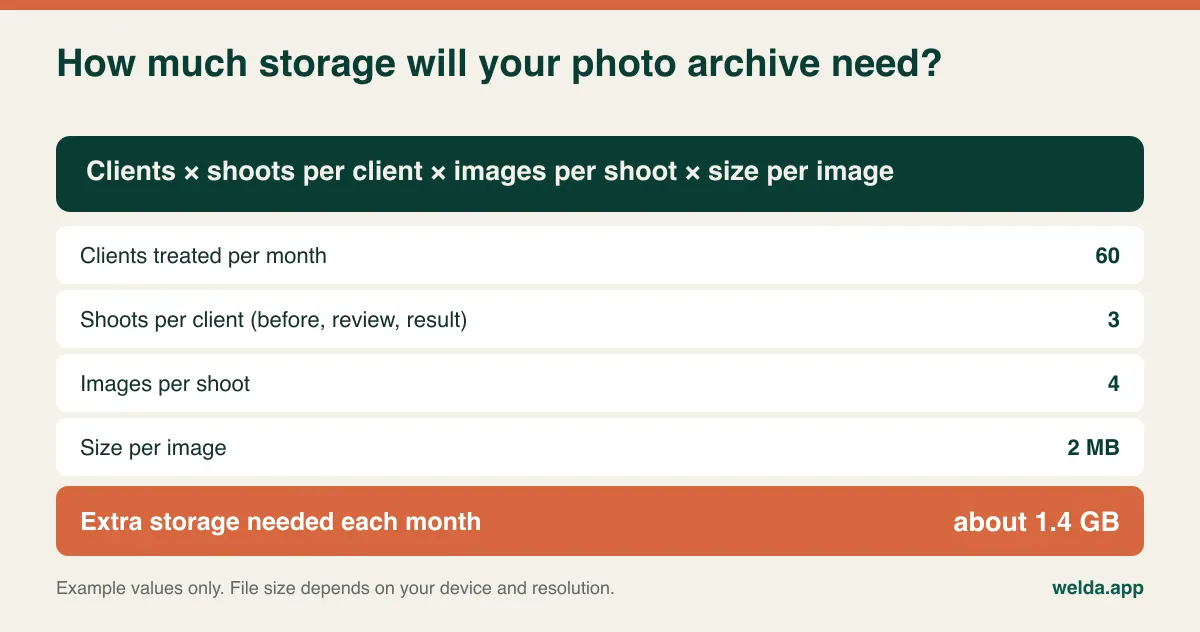
In this example you need about 1.4 GB each month. Welda CRM's photo and document storage is 1 GB on Starter, 10 GB on Pro and 100 GB on Enterprise. For a photo-heavy clinic, storage could therefore decide your plan before user numbers do. Your image size may change the sum considerably, so weigh a few real pictures from your own device and work it through with us in the consultation.
Aftercare is where software earns its keep
Most scheduling products consider their job finished the moment an appointment is marked complete. In an aesthetic clinic, that is often when the client is at her most anxious. "Is this swelling normal?" arrives two days after treatment. Who sees it, how it reaches a clinician, and whether it is recorded will shape your reputation more than any campaign.
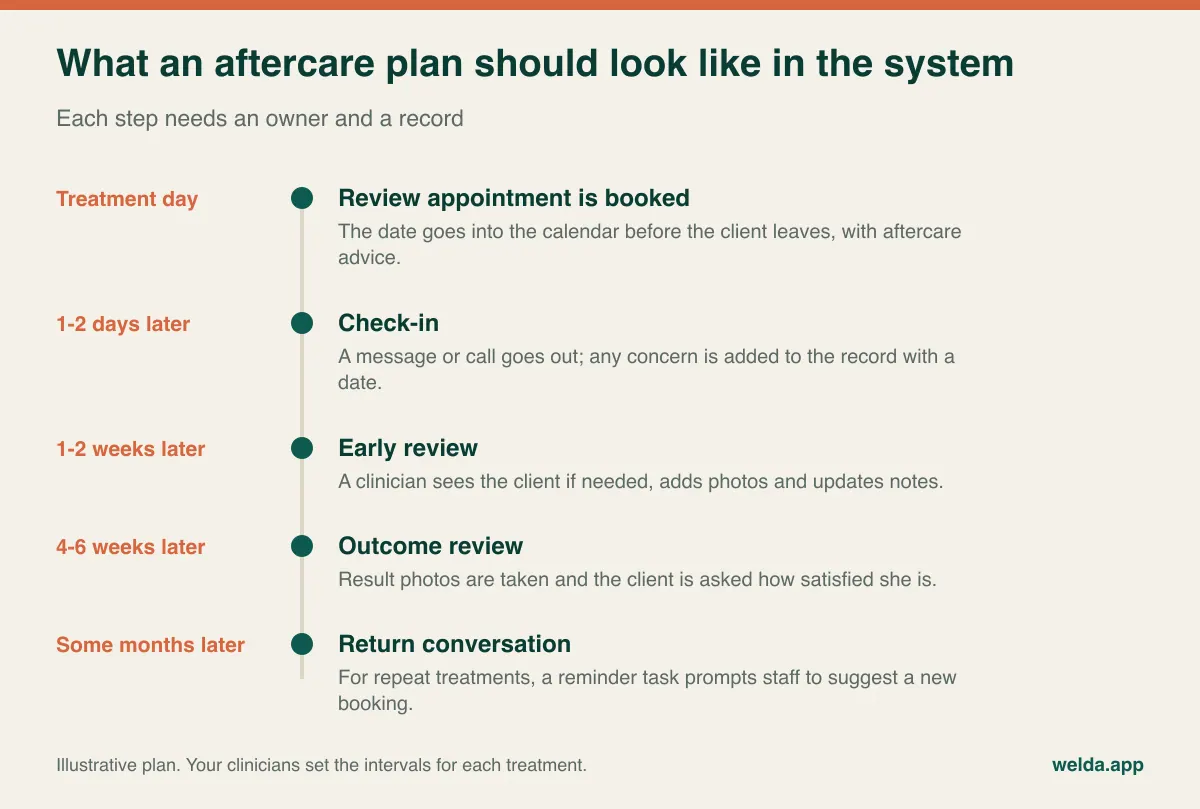
The intervals shown are only an illustration, and your clinicians set the real protocol for each treatment. What you are testing is whether the plan can happen without heroics. When treatment is completed, can staff create the review appointment from the same screen? Do aftercare messages differ by treatment? Does a client who misses a review land on somebody's list? Can a complaint or adverse event be added to the record with a date and author?
Remember a distinction that catches many clinics out: a reminder fires for an appointment that exists. A review nobody booked triggers nothing at all. The strongest rule is therefore a simple one: nobody leaves without the next date in the calendar. Welda CRM sends automatic WhatsApp reminders for booked appointments, supports message flows before and after treatment on Pro and above, and includes reminder tasks and a follow-up queue for catching what slips through. We do not promise a ready-made report that automatically lists every missed review, so talk to us about how to set that up for your workflow. Our guide to building a patient recall system is a sensible starting point for the routine itself.
Think about message wording as well. Previews appear on lock screens, so "See you tomorrow at 2 p.m." is safer than naming the treatment. Whether WhatsApp is appropriate at all for health-related communication depends on your country and your data protection position, so have that conversation with your adviser and collect the permissions you need.
The rules differ, so map them before you compare products
No single checklist covers every market. The table below is a starting point for questions to raise with your legal adviser, not a statement of what applies to you. Rules change, and this sector has seen a lot of recent regulatory attention in several countries.
| Where you operate | Topics worth raising | What to ask a software vendor |
|---|---|---|
| UK | UK GDPR and health data, advertising rules for prescription-only medicines, age restrictions on some cosmetic treatments, evolving licensing proposals | Where is data hosted? Is a data processing agreement available? |
| EU | GDPR special category data, national rules on who may perform treatments and on medical advertising | Can you export or delete a person's data? Who are your sub-processors? |
| United States | Whether HIPAA applies to your practice, state medical spa supervision rules, state privacy laws | Will you sign a business associate agreement if we need one? |
| Middle East and elsewhere | National health licensing, data residency requirements, advertising approval regimes | Which countries can data be stored in? |
Treat "compliant" on a vendor's website as the start of a conversation. Software can give you encrypted records, access control, an audit trail and versioned consent, all of which Welda CRM includes with support for KVKK and GDPR consent management. It cannot make your clinic compliant by itself, and we would not claim that it does. If you need data held in a particular country or a specific contract such as a business associate agreement, raise it at the outset, with us as with anybody else.
If you treat medical travellers, add language and timing. A person flying in may complete the consultation remotely, stay a few days, and then need aftercare at home. Welda CRM's message templates are available in English, Turkish and German; a client portal shows people their appointments and packages. If you need other languages, or a workflow involving agents and transfers, ask specifically before assuming it exists.
How much system does your clinic actually need?
A clinic with one practitioner and a clinic group with a sales team should not be running the same evaluation. Use the honest version of your current state, not your five-year plan.
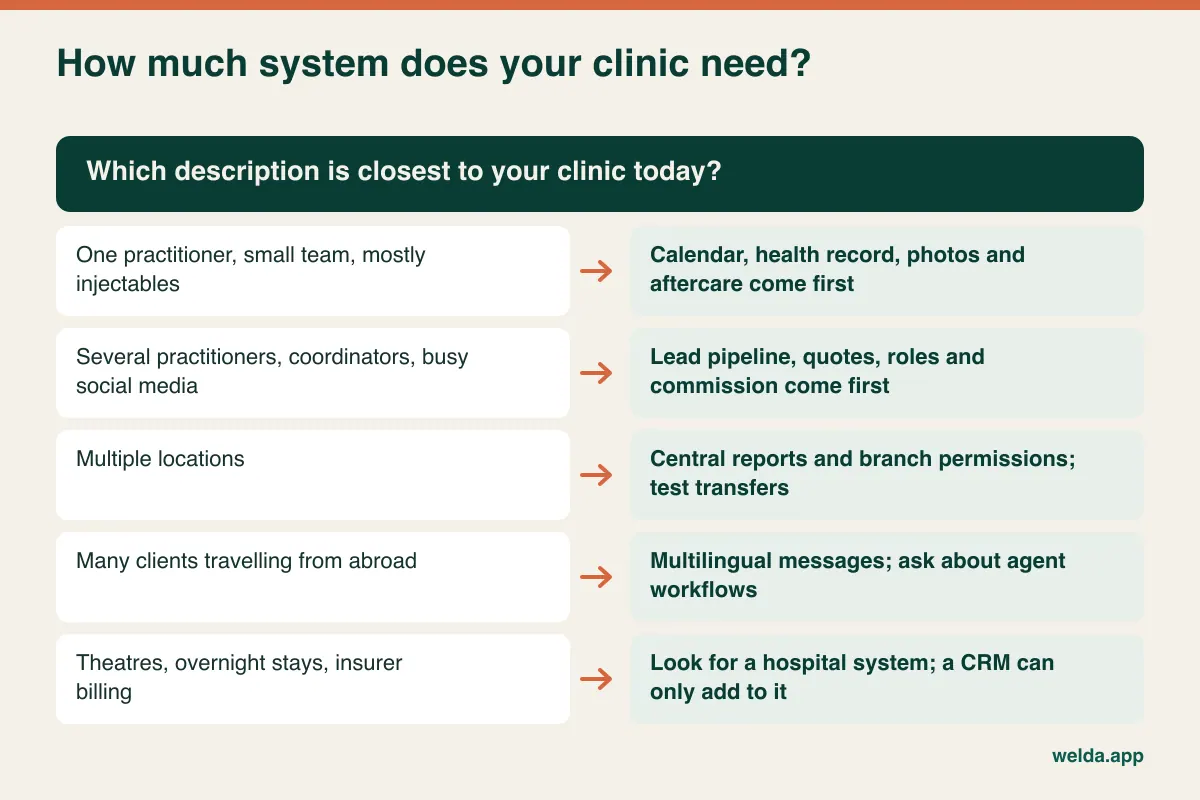
Some warning signs suggest you should stop and rethink. If your practitioner, reception and owner each want a different product, you probably have not agreed which problem comes first. If the case for buying rests on a feature used once a quarter, it is probably not the case. And if you are thinking of raising your advertising budget while enquiries still live in private chats, fix the follow-up first, because more demand will only leak faster.
Four cases to run in a demo
A vendor's prepared script always flows perfectly. Bring your own awkward situations and ask to see them done live on screen. When you hear "you can also do that from there", reply with "could you show me now?"
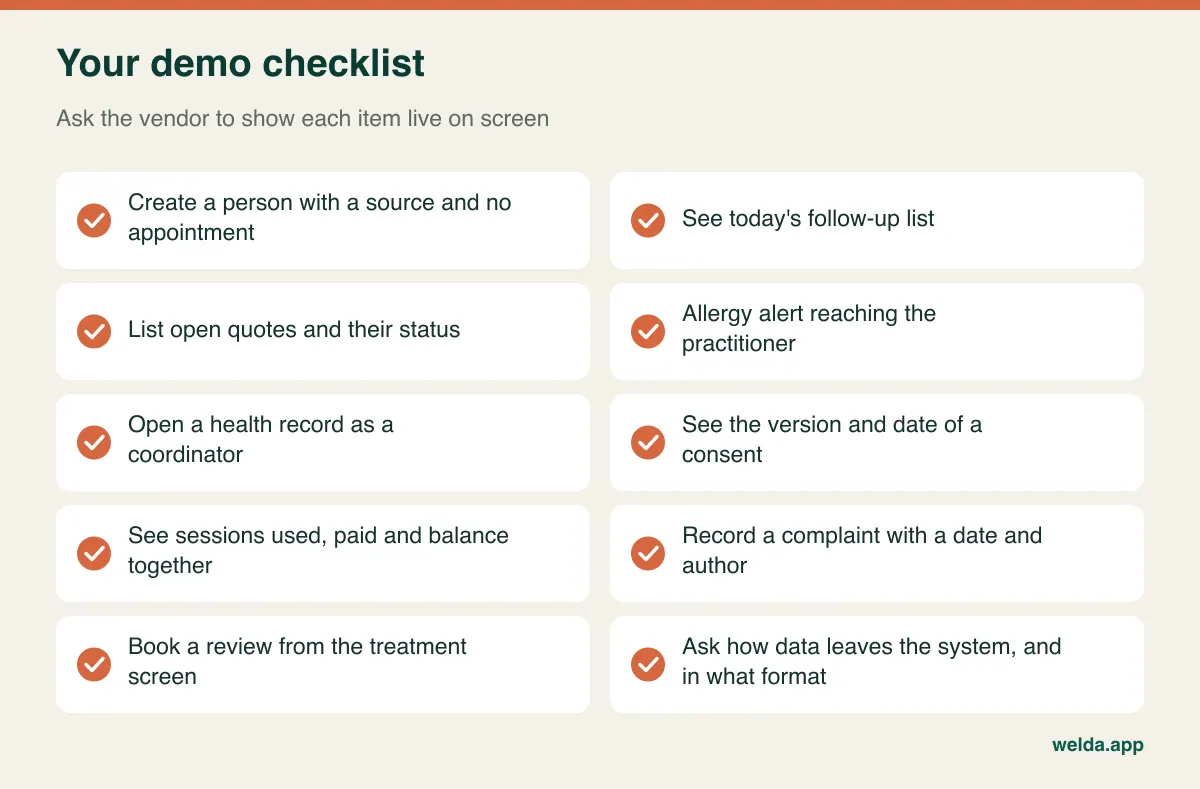
- The returning enquiry. Someone who messaged three weeks ago and received a quote now phones. How quickly do you find her, and do the quote and notes appear?
- The contraindication. A client with a recorded allergy is booked in. Where does the warning show, on whose screen and at what moment? A quiet line on a profile that the practitioner never opens is little protection.
- The abandoned course. A client on session three of six, with an overdue instalment, wants to stop. Can reception see sessions used, money paid and balance in one view? Your terms decide the refund; the system should simply make the facts obvious. Our guide to session and package tracking explains why this balance matters.
- The worried message. A complaint two days after filler. How does it reach a clinician, how is it recorded, and how fast can a review be booked?
Bring a coordinator, a receptionist and a practitioner with you. While an owner looks at dashboards, those who will use the system every day notice the extra clicks. Their question, "do I have to do this for every patient?", is often worth more than a feature list.
Reading a quote without being led by the headline figure
A monthly subscription number tells you surprisingly little, since the costs that grow tend to sit elsewhere. Send every vendor the same written questions and put the answers side by side.
- Users: Do part-time practitioners and visiting doctors count as paid seats?
- Messages: How many messages are included each month, on which channels, and what happens above that?
- Storage: What is included for photos and documents, and how is extra space charged?
- Module boundaries: Are quotes, stock, automated flows and commission included, or on a higher tier?
- Implementation: Are data migration and staff training included? Do they cover open courses and photographs?
- Third parties: Do tax invoicing connectors, card terminals or messaging providers bill you separately?
- Leaving: In what format would you receive your data, including images, if you left?
Welda CRM is a monthly subscription with no separate setup fee; account setup, migration of your existing data and team training are included on every plan. The figure itself depends on your locations, users, message volume and modules, and we settle it in a free consultation. For invoicing outside Turkey, ask us what is available in your country instead of assuming, and have your accountant confirm what your tax rules require, especially for prepaid courses.
Moving over without losing what clients have paid for
The sensitive part of a migration is not your old appointments. It is the relationships still in progress: unfinished courses, open quotes and upcoming reviews. Spend your effort there first.
- Count what is open. List active courses, remaining sessions and balances before the switch. Confirm the awkward ones with the client.
- Prioritise. Active clients, open quotes and planned reviews go first; the historic archive follows.
- Sort consent and images. Which belongs to whom, and which carries marketing permission? Ask your adviser how older consents should be treated.
- Set permissions on day one. Giving everyone an administrator login "for now" is the classic mistake, and it rarely gets undone.
- Keep the overlap short. Leave the old system read-only for a week or two, with new work entered only in the new one. Double entry soon collapses.
- Audit after the first month. How many enquiries have no source? How many treatments have no review date? Those two numbers show whether the team has truly moved across.
Once things are stable, our guide to aesthetic clinic management covers how to build the wider operating routine around the new system.
Questions clinic owners ask
Would beauty salon software do the job?
For a non-medical business with simple treatments, it often will. Once you have clinicians, contraindications, consent, role separation and aftercare to manage, check that those flows really work. The product's name matters less than what it does on a difficult day.
Does Welda CRM replace an electronic medical record?
Not if you need insurer billing, national health system connections, e-prescribing or theatre management, since none of those are listed on our product pages. It does hold encrypted health records with allergy and contraindication alerts, treatment notes, consent and before-and-after photos, which may be enough for a private aesthetic clinic. Check what your regulator expects of you.
Can it record product batch numbers?
You can write them in the treatment note. A dedicated lot-tracking feature is not listed on our product pages, so if you need searchable batch-level traceability, raise this before you commit.
How do we manage patient coordinators on commission?
Staff commissions and monthly targets are available on Pro and above, and role-based permissions control who sees what. Test commission rules with your own scheme during the trial, especially if payments arrive in instalments.
What happens after the free trial?
The trial lasts 7 days with all modules open. Your data stays where it is afterwards: the account turns read-only until you pick a plan, then you continue where you stopped.
How much does it cost?
That depends on locations, users, message volume and the modules you need, so we work it out together in a free consultation. It helps if you bring your team size, a rough monthly treatment count and how you keep records today.
Once you have mapped your own client journey and found the door where people slip away, the next step is short. Have a look at how Welda CRM works as aesthetic clinic software, tell us about your clinic in a free consultation, and try it free for 7 days with your own cases if you wish. And if you are still weighing up how to choose aesthetic clinic software, the four demo cases above are a good place to begin. If there is something we cannot handle, you will hear that from us in the same conversation.