Salon commission tracking software records who performed each service, what the client actually paid, and which of your pay rules applies, then produces a statement each stylist can check line by line. The right tool is the one that can hold your real rules, including back-bar deductions, assistant splits, retail rates, sliding scales and refunds, without someone fixing the result in a spreadsheet afterwards. If you are comparing products, skip the feature grid and ask how each one handles a messy month from your own books. A clean total on a demo screen proves very little; a total a stylist can trace back to individual tickets is what ends the arguments.
The sections below work through the decisions that actually change the number on a stylist's pay statement, using worked examples in neutral "units" rather than any particular currency. They are illustrations of how the rules behave, not suggested rates or market benchmarks.
The real test: can it answer "why is my number lower this month?"
Every owner who calculates commission by hand knows the conversation. A stylist looks at the figure, remembers a busy month, and asks why it is lower than expected. If your answer involves reopening a notebook, comparing it with the card terminal and remembering which client had the friends-and-family discount, you have lost an afternoon, and possibly some trust as well, even if your arithmetic was correct.
So the first buying criterion is not automation. It is traceability. Good software lets you open a stylist's total, click through to the tickets behind it, and see for each line the service, the amount, any deduction, the rule applied and the result. When that chain is visible, a disagreement stops being "you owe me more" and becomes "this colour correction was marked as a redo, should it have been?" That second conversation takes two minutes and usually ends in agreement, one way or the other.
Traceability has a useful side effect on your records. Stylists who can see that an unrecorded service earns nothing become your strongest allies in keeping the calendar accurate. In a salon where the pay calculation is opaque, the opposite tends to happen: people keep their own lists, and you end up with competing versions of the truth. Before you look at any software, write your rules on one page. What counts as commissionable? Which rate applies to which service? How are shared services divided? What happens on a refund? When is commission paid? That page becomes your buying checklist, and it often exposes a rule that has only ever existed in your head.
Commission on what? The back-bar question
Two salons can both advertise "40% commission" and pay very different amounts for identical work, because the percentage matters less than the base it is applied to. Take an example colour service with a menu price of 200 units. The client has a 20-unit promotion, 20 units of what they pay is sales tax or VAT in this example, and the salon applies a 30-unit back-bar charge for colour and developer.
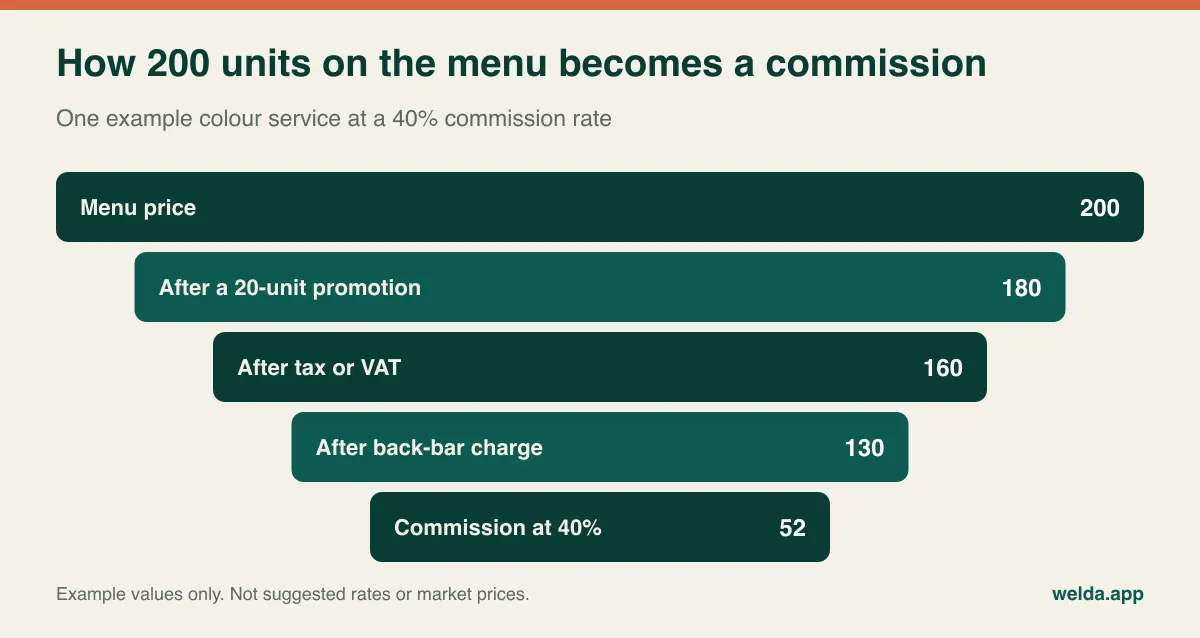
On the menu price, commission is 80 units. On the amount paid it is 72, excluding tax 64, and after the back-bar charge 52. None of these is automatically right. Commission on tax is hard to justify, since that money was never the salon's revenue, which is why many owners exclude it. Discounts raise a fairness question: if the owner decides to run a promotion, should the stylist fund part of it? And the back-bar charge is where you will feel the most heat.
Back bar is a real cost, particularly in colour-heavy salons, and ignoring it can make your most popular services your least profitable. There are three common approaches, and the software you choose needs to support the one you settle on.
- Actual usage. Product is weighed or recorded per service and deducted. This is the most accurate method, but it adds a step at the mixing station and can tempt someone to skimp on product to protect their pay.
- Flat fee per service. A set amount for each root touch-up or full head. It is predictable and easy to explain, although it drifts away from reality if product costs change and nobody reviews it.
- A reduced rate instead. No separate deduction, just a lower commission percentage on chemical services. It is the simplest on a statement, but it hides the logic, so write down why the rate differs.
Whatever you choose, the statement should show the calculation. "Commission: 52" invites a question. "Paid 180, tax 20, back bar 30, base 130, rate 40%, commission 52" shows exactly where to raise an objection, if there is one.
Assistants, double-booked stylists and the split ticket
Here is where salons differ from nearly every other appointment business, and where generic staff-performance tools tend to break down. A senior stylist applies colour on one client, moves to a cut in the next chair while the colour processes, an assistant rinses and tones, and a junior finishes the blow-dry. The calendar may show one name. Three people did the work, and the person whose name is on the booking was, for a portion of the time, earning from someone else's client too.
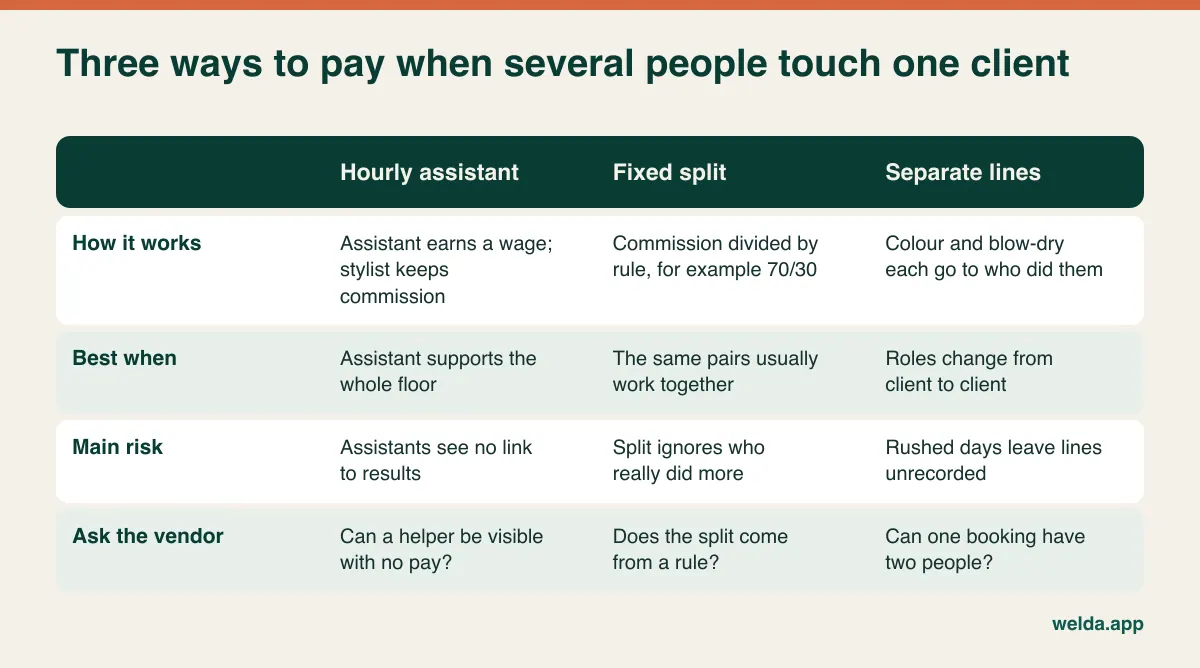
In the example above, if the 52 units of commission were split 70/30, the stylist would receive 36.4 and the assistant 15.6. If the salon instead lists colour and blow-dry as separate lines, each line simply belongs to whoever performed it, and no percentage split is necessary. Separate lines are the cleaner option where the division of labour changes from client to client, but they rely on the front desk recording what really happened during a rushed Saturday.
That recording moment is worth testing specifically. Say a client booked with Maya, but Maya's earlier appointment overran and Leah took over. Who changes the record, how many taps does it take, and does the correction reach the commission calculation automatically? Also consider a stylist's price level. Many salons charge more for a senior or master stylist. If a junior steps in at the last minute, does the ticket keep the senior price, and whose rate applies? These are small questions until they occur twenty times a month.
Requested clients and walk-ins
Some salons pay a higher rate or small bonus when a client specifically asks for a stylist, on the reasoning that the stylist built that relationship, whereas a walk-in was brought in by the salon's location and marketing. If you adopt this rule, decide what counts as evidence. A stylist chosen on the online booking page is hard to dispute. A note added at the desk after the fact is much easier to argue about, and a rule without a clear test will generate more friction than the bonus is worth.
Revenue that doesn't behave like a haircut
Service revenue on the day it is performed is the easy case. Commission errors tend to hide in everything else, because the money and the work happen at different times, or the margin is entirely different.
| Revenue type | The question to settle | A sensible starting point |
|---|---|---|
| Retail products | Who earns it: the stylist who recommended or the person at the till? | A separate, usually lower rate because the product has a purchase cost; credit the recommender |
| Gift cards | Is the sale itself commissionable? | Generally pay when redeemed for a service, as no work has been done at sale |
| Prepaid packages | Pay on sale, per session or both? | A small selling bonus, plus commission as each session is delivered |
| No-show fees | Does the stylist who lost the slot share in it? | Decide in advance and write it down |
| Redos and corrections | What happens to the original commission? | Record the zero-value redo and link it to the original ticket |
| Refunds and chargebacks | Which month absorbs the reversal? | Leave the paid month closed and post a negative line to the current one |
Prepaid packages deserve a closer look because of their timing problem. Suppose a four-session treatment series sells for a net 800 units. A 5% selling bonus is 40 units for whoever made the sale, and 15% commission per delivered session of 200 units is 30 units. If the client cancels after two sessions and takes a refund on the rest, a commission paid in full at the point of sale needs clawing back, whereas per-session commission has already sorted itself out. For this to work, the package balance and the commission calculation have to read from the same record. If you are comparing tools on this and other cost drivers, our guide to what hair salon software really costs covers how to compare the quotes themselves.
Card fees sometimes come up as well. A few owners want to deduct processing costs from the commission base. Before you do, ask an accountant whether that is permitted where you operate, particularly for tips, and think about how it reads on a statement. Small unexplained deductions do more damage to morale than their size suggests.
Sliding scales without the month-end scramble
A sliding scale rewards a stylist as their takings grow. It is also the rule most likely to change behaviour in ways you did not intend, and it depends heavily on a detail that is often left unstated: does reaching the higher tier apply the new rate to everything, or only to revenue above the threshold?
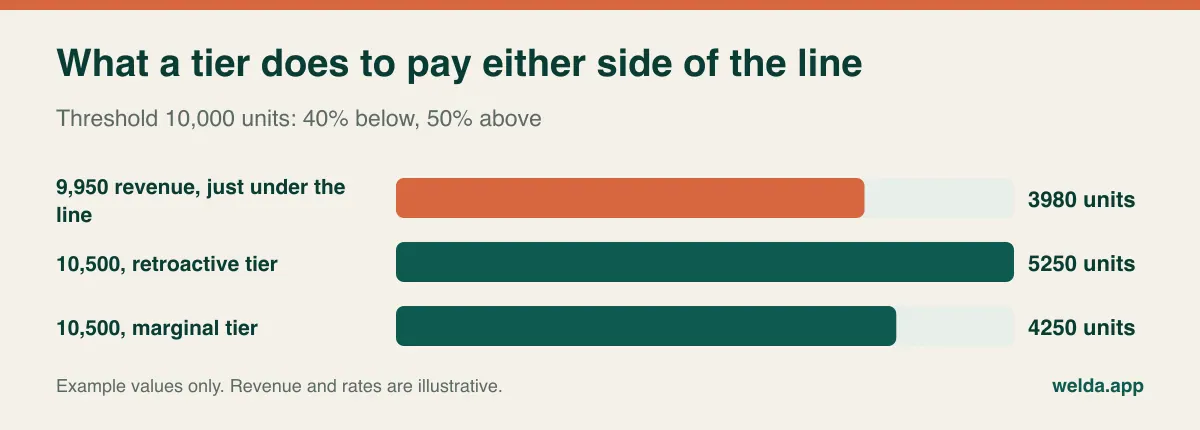
In this example the threshold is 10,000 units per month, at 40% below and 50% above. A stylist on 9,950 units earns 3,980. At 10,500 units, a retroactive scale pays 5,250, whereas a marginal scale pays 4,250. Under a retroactive scale, the last few days of the month get strange. A stylist just short of the line has every reason to take someone else's walk-in or to move an appointment into the current month. Someone far from the line has no reason to stretch at all. Nobody needs to be acting in bad faith for this to happen; the rule simply pays for it.
A marginal scale is calmer, though stylists may feel the reward is too small. Several smaller steps can sit between the two. Consider also whether a single revenue target fits everybody. A stylist working three days a week and one working five should not be chasing the same number, and neither should someone returning from leave or starting mid-month. Targets per booked hour, or adjusted for the days actually scheduled, tend to feel fairer. If occupancy varies a lot between stylists, check that first: a target cannot motivate someone whose chair is empty because the calendar is badly managed. Look too at seasonality, because a target that feels reachable before the holidays can feel punishing in a quiet January.
Software should let you define rates by person, role, service type and date range. The date range matters more than it sounds. If you change a rate in March, February's tickets must keep the old one. A system that recalculates history whenever a setting changes will quietly undermine every statement you have already issued.
Is commission even your model? Hourly, hybrid and booth rent
Before you buy anything, make sure commission tracking is the right problem to solve. Salons pay people in several ways, and each model needs something quite different from software.
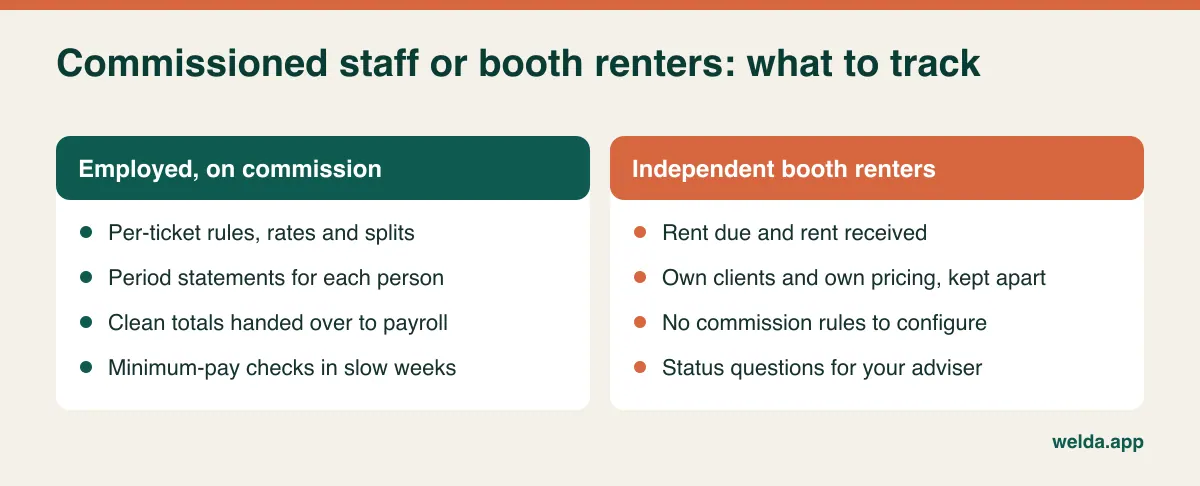
If your stylists are independent booth or chair renters who set their own prices and run their own clients, you are collecting rent, not calculating commission, and a calendar plus a simple payment record may be all you need. Employed staff on commission, or on an hourly wage with a commission top-up, is where tracking earns its place. Hybrid salons need to check that the system can treat each group separately, so that a renter's takings do not contaminate your staff reports.
The legal side varies considerably between countries and is one for your accountant or employment adviser, not for a software vendor or a blog post. In general terms, three issues come up repeatedly. Many jurisdictions set rules about minimum pay that commission-based staff must still reach, so a poor week may require a top-up. The line between an employee and a self-employed renter is treated seriously in many places, and the way work is organised can matter more than what a contract says. Tips and service charges are also regulated differently from country to country; the UK, for instance, has specific rules about allocating tips fairly, and elsewhere there are other requirements. Commission software helps you produce accurate records for these conversations. It does not make the decisions, and neither does it replace payroll, which handles deductions and net pay.
On tips generally, the safest design is to keep them out of the commission base and record them separately. Ask any vendor how a tip paid by card is recorded and how it reaches the right person, since this is a place where assumptions often go unspoken.
What a stylist's statement should look like
A useful exercise while evaluating software is to mock up the statement you would want to hand to a stylist, then ask each vendor to produce it. Here is an illustrative version built from the rules above.
| Line (example) | Net | Back bar | Rule | Commission |
|---|---|---|---|---|
| Root colour | 160 | 30 | 40% | 52 |
| Cut and finish | 80 | 0 | 40% | 32 |
| Highlights, assistant share 30% | 250 | 50 | 40%, own share 70% | 56 |
| Retail, shampoo and mask | 60 | 0 | 10% retail | 6 |
| Refund of a cut paid last month | -80 | 0 | 40% reversed | -32 |
| Period total | 114 |
Notice that the refund is a negative line in the current period, rather than an edit to a month already paid. That keeps paid periods stable and leaves a trail. Note what the statement does not show as well: anyone else's numbers. Earnings are personal data, and most data protection regimes, GDPR included, expect you to limit who can see them. Posting the monthly commission sheet in the staff group chat is a habit worth ending, both for that reason and because of the comparisons it starts. Look for role-based permissions so stylists see their own figures and managers see the overall report, and find out whether changes to records are logged. When someone asks who altered a line, you want an answer. Broader guidance on rotas and staff setup is in our article on staff and shift management; it is written for clinics, but the permissions and scheduling logic carry over to a salon.
A demo script built from your hardest month
Vendor demo data is always tidy. Choose a recent month, pull eight to ten awkward tickets, anonymise them if you prefer, and bring along the commission you actually paid. Then ask the vendor to enter those tickets live, in this order.
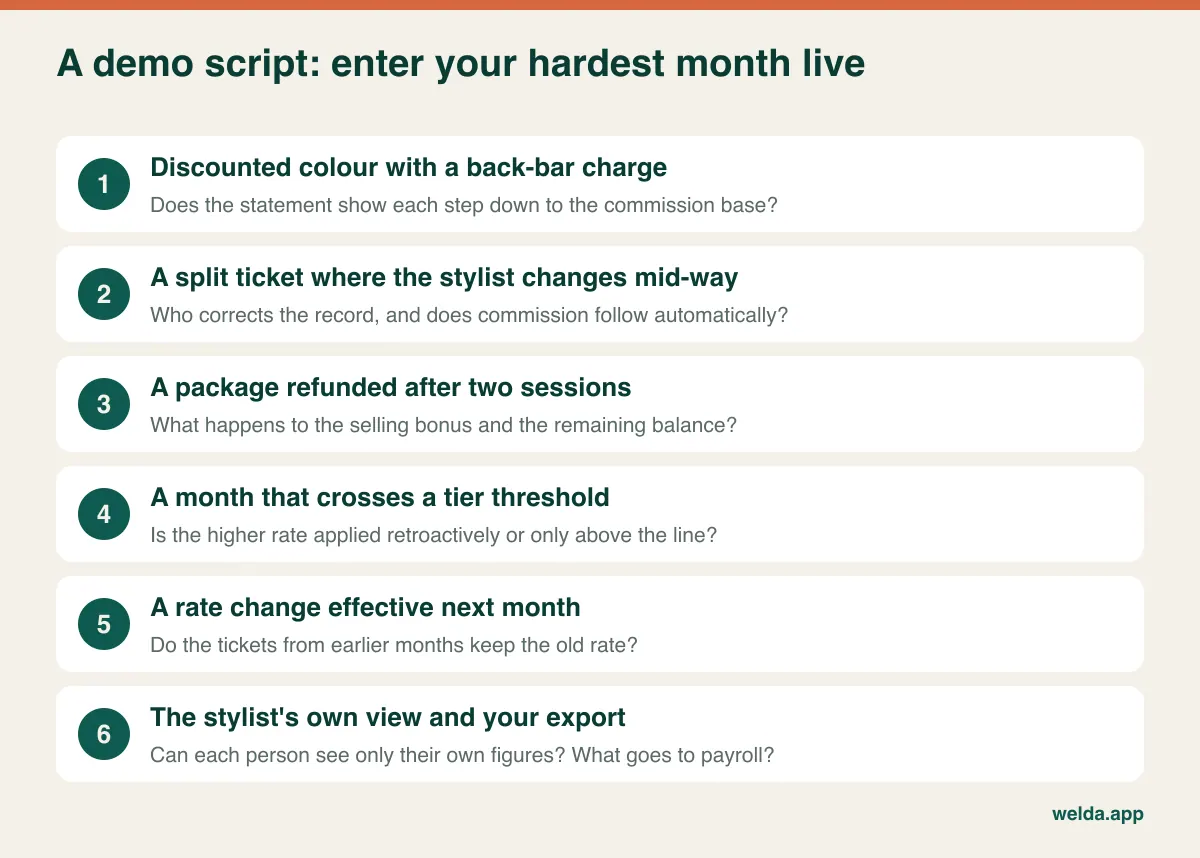
Where the software's answer differs from what you paid, do not assume either side is wrong. Sometimes the difference exposes a mistake in your own process. What matters is whether the vendor can explain the gap, line by line. After the script, ask three more practical questions. Can a period be locked once paid? Can you export a clean per-person summary for your accountant or payroll provider? And if you leave, can you take the commission history with you?
Price belongs at the end of this conversation, not the beginning. Ask which plan includes commissions, whether people who appear in the calculation without logging in count as paid users, and what happens if you outgrow your message or user limits. Compare the annual total for your actual team size, not the headline monthly figure. A cheap plan without the module you came for is not cheap.
Where Welda CRM fits, and what to check with us
Welda CRM is the appointment and client system we build for businesses that run on bookings, including hair salons. It puts each stylist's calendar with clash prevention, online booking requests, client history, automatic WhatsApp reminders, packages with remaining sessions, invoices and payments, and cash desk, bank and POS tracking in one place. For pay, it includes staff commissions and monthly targets from the Pro plan upward, alongside occupancy, revenue and performance reports. Having commission sit with bookings and payments removes the re-keying step that causes many spreadsheet errors. You can see the wider product on our salon commission tracking software and booking page.
Here is what we will not claim in a blog post. Our product information does not list every rule in this article one by one, so we are not going to promise that a particular split, back-bar method or tier structure works exactly as you run it. Bring your one-page rule sheet to a free consultation and we will show you what is covered and tell you plainly what is not. Payroll is not on our feature list either, so your accountant or payroll provider stays in the process. Tip handling and statement views for individual stylists are also worth checking with us directly. Role-based permissions and an audit log are included, which covers part of the privacy question above.
The 7-day free trial is a good place to run your hardest month, and setup and data migration are included. Price depends on your locations, users and modules and is settled in a free consultation. For how commissions fit within wider day-to-day salon running, see our beauty salon management guide.
Switching without starting a pay dispute
The technical setup is usually the easy part. The harder part is the suspicion that new software is a way of cutting pay. Run one full pay period in parallel: pay from your old method while the new system calculates in the background. At the end, compare each person's two figures and sort every gap into one of three groups: an old mistake, a deliberate rule change, or missing data. Share the results before the first live payment.
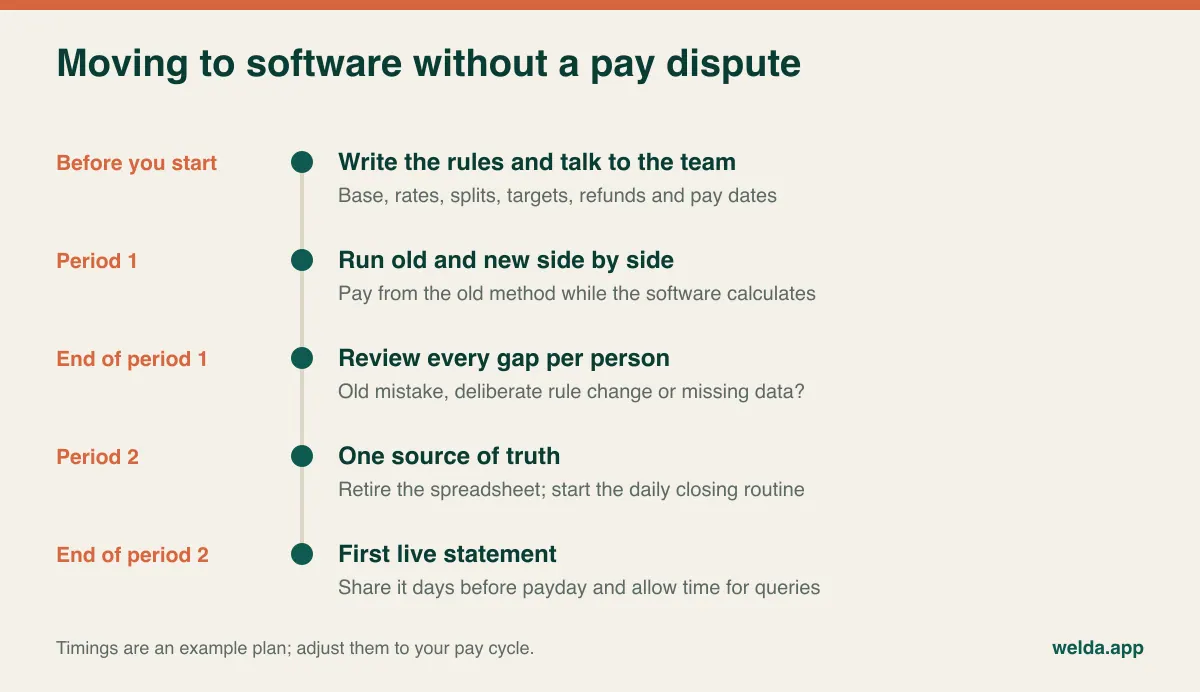
If a new rule reduces someone's earnings, tell them in advance and get proper advice before changing terms that may be contractual. Changing a rule openly is legitimate; letting people discover it on a statement is not. Set a simple dispute path too: who to tell, by when, and when they will get an answer. Issuing statements a few days before payday means problems get settled over a coffee rather than at the till.
Finally, build a recording habit, since your data will only be as good as the busiest hour on Saturday. Walk-ins go into the calendar. Stylist changes get updated at the time. Retail goes on the ticket. A short end-of-day routine for closing open appointments helps, and it pairs naturally with end-of-day cash reconciliation, since your commission base is only reliable if the takings behind it balance. Choose salon commission tracking software that fits your rules, then give the team a month to trust it.
Frequently asked questions
Do I need commission software for a small salon?
Not necessarily. If you work alone or everyone is on a fixed wage, you probably don't. It starts to pay off when several people earn commission, rates differ by service or role, or services are regularly shared.
Should commission be calculated before or after tax?
Many owners calculate it after removing sales tax or VAT, because that money isn't the salon's revenue. The important thing is that the rule is written down and applied the same way on every statement. Your accountant can advise on the tax side.
Should I deduct product costs from a stylist's commission?
That's a business decision, and it is more common in colour-heavy salons. A flat charge per service is easier to explain and avoids rewarding someone for skimping on product, while actual usage is more accurate but adds work.
Do tips count toward commission?
Usually they're kept separate and go to the person who earned them. Rules on tips vary by country, so check locally, and ask each vendor how card tips are recorded.
Can commission software replace payroll?
No. It produces the gross commission figure and the detail behind it. Tax, social contributions and net pay belong in your payroll process.
Which Welda CRM plan includes commissions?
Staff commissions are available from the Pro plan upward, and the 7-day free trial lets you try them on your own data. Pricing is agreed in a free consultation based on your locations, users and modules.
If you have your rules written down, or got stuck trying, book a free consultation and bring your hardest month. We'll go through it together and show you what the result looks like on screen.