The right spa management software schedules around resources, not just people. Ask one question before anything else: if a couple wants a side-by-side massage at 3pm on Saturday, can the system tell you straight away whether a two-table room and two suitable therapists are free at the same time, with the room's turnover included? After that, check whether a prepaid series shows sessions left and money owed on a single record. If a product cannot do those things with your own busiest day loaded into it, keep looking, however good the demo looks.
This guide is for owners and managers who run treatment rooms, perhaps a sauna or steam room, more than one therapist, and some form of prepaid selling. A solo massage therapist will find parts of it useful but can skip the heavier sections. It will not give you a ranking of vendors. It gives you the questions, what the answers mean for a business like yours, and the situations in which a piece of software is simply the wrong fit.
The booking that exposes weak software
Most appointment tools were built for a one-to-one world: one client, one staff member, one slot. A haircut fits that model. A couples massage does not. It needs one room, two therapists, two tables made up, and all of them beginning at the same moment. If either therapist is busy, the room being empty is irrelevant. If both therapists are free but the only double room is taken, the same is true.
Now watch what happens at the desk when the software cannot express that. The receptionist opens two separate appointments, one for each therapist, and types "couple, room 3" in the notes. Nothing stops a colleague selling room 3 to someone else. If the couple moves the booking by thirty minutes, both entries have to be moved by hand. If one entry is cancelled and the other forgotten, a therapist waits in an empty room while a walk-in is turned away. These are not rare edge cases in a spa; on a Saturday in December they may be a large part of your day.
So when you assess spa management software, start with the most awkward booking you sell, not the simplest. Ask the vendor to enter it while you watch. A confident demonstration of a single sixty-minute massage tells you almost nothing about the job you are actually hiring the software to do.
Not every room behaves like a room
A spa is a set of resources with different rules, and it helps to write them down before you speak to any vendor. A single treatment room is exclusive: one guest, one therapist, and it closes when either is taken. A couples room needs both therapists in parallel. A sauna, steam room or hydrotherapy pool is about capacity: there may be space for a sixth person until a scheduled cleaning break removes all of it. Some spas also run single-gender hours, which changes who can be booked at which time of day.
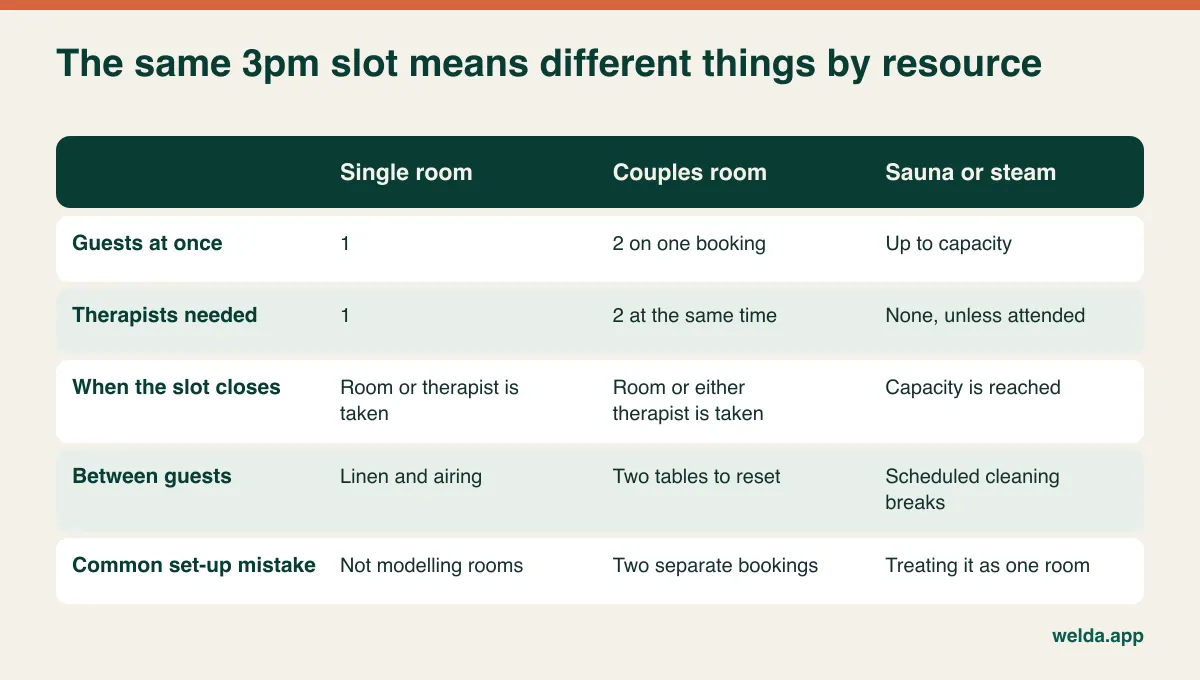
Asking "do you support rooms?" is a waste of a question, since almost everyone will say yes. Some calendars offer a room view that filters appointments but still checks conflicts only against the staff member. The better question is a pair of tests: book a free therapist into a full room, then book a busy therapist into an empty room. A system that treats rooms as real resources refuses both. One that treats them as labels will accept at least one, and you will find out in your first busy week rather than in the demo.
The ratio of therapists to rooms tells you how much this matters. With one room and one therapist, they are effectively the same thing and a simple calendar will do. With more therapists than rooms, which often happens where part-time staff overlap, the staff calendar is actively misleading: it shows availability you cannot sell. With more rooms than therapists, the therapist is the limit, but you still want to see which room to prepare.
Sixty minutes on the menu, eighty on the calendar
The time you sell and the time a room is occupied are not the same. Before a massage, someone changes the linen, warms the room, sets out oil and towels. Afterwards, the guest dresses, the table is stripped, and the room is aired. If the calendar does not know about any of this, the front desk either stacks appointments and makes guests wait, or carries an unwritten rule in their head. That rule walks out of the door when they go on holiday.
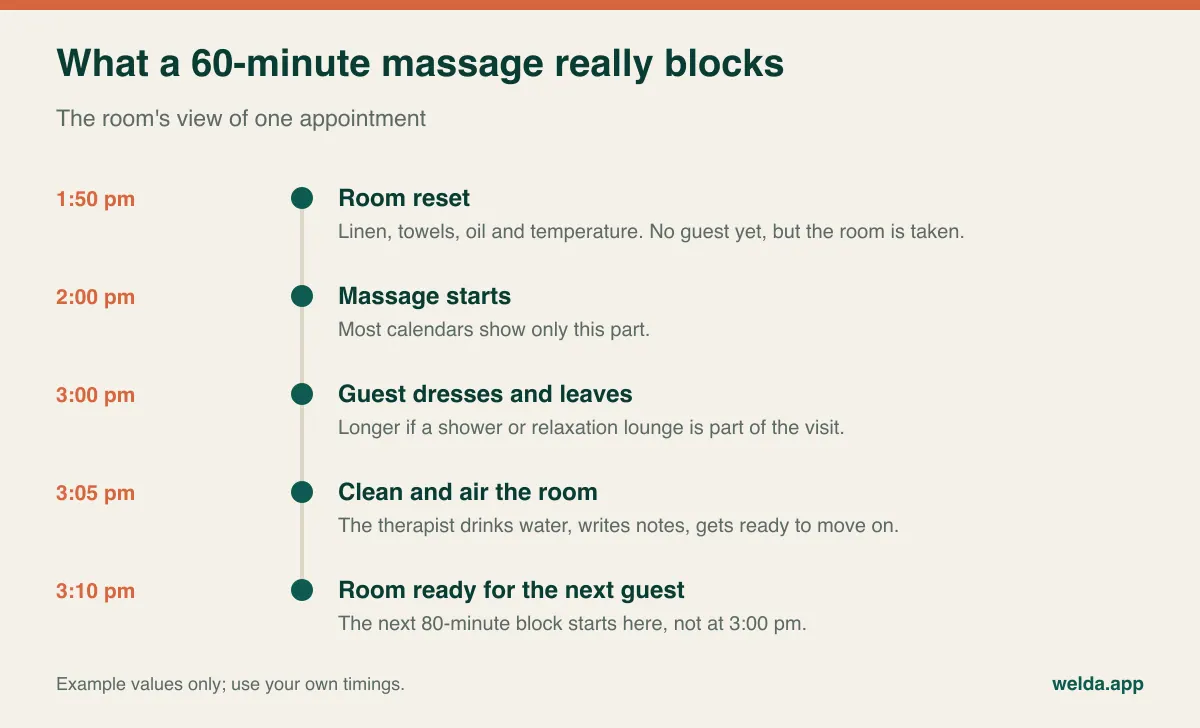
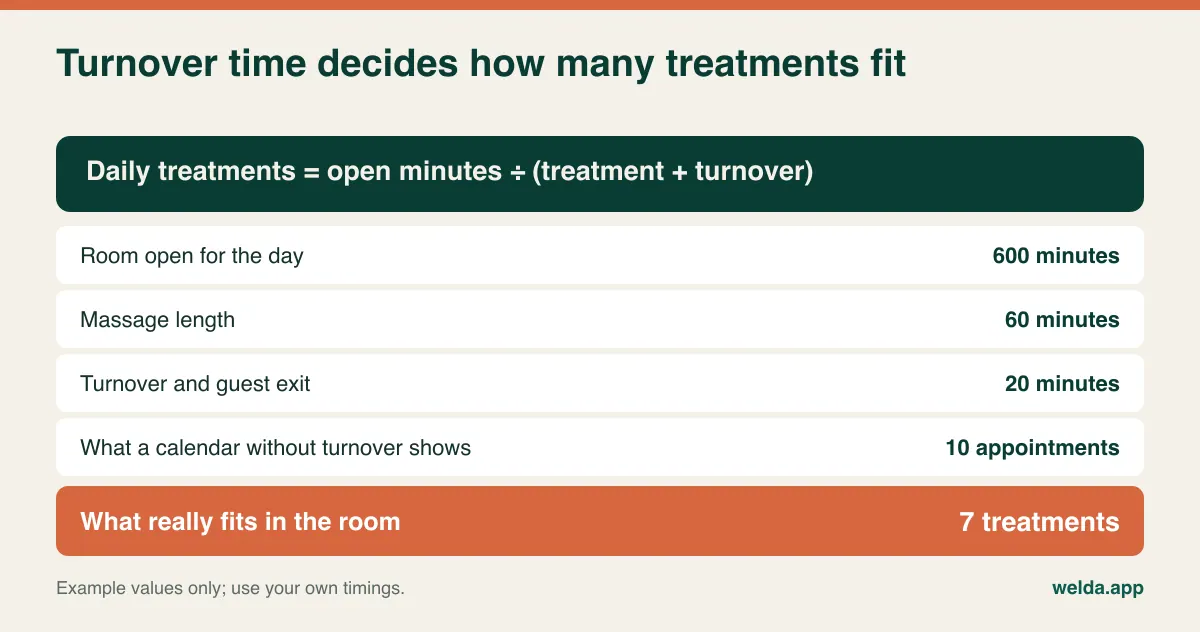
Here is an illustrative calculation, so replace these figures with your own. Say a room is open for ten hours, or 600 minutes. A calendar with no turnover shows space for ten sixty-minute massages. Add twenty minutes for preparation and exit, and the block becomes eighty minutes, so seven treatments really fit. The other three never existed, yet your occupancy report treats them as empty slots that a better marketing campaign might fill.
Turnover also varies. A short back massage needs far less reset than a hot stone treatment or a body wrap with a shower afterwards. So check where the buffer lives: on the treatment, on the room, or both. A therapist and a room also need different gaps. The room can be cleaned by someone else while the therapist moves next door, but a therapist needs recovery time after deep work. If a product has no buffer feature, the common workaround is to make the treatment longer on paper. That works, but check how it affects reminders, online booking and reports, since the guest may then be told to expect a longer massage than they bought.
Hands are the scarcest thing you have
Massage is physical work, and spas that schedule therapists purely by who is free tend to pay for it in quality and in tired staff. Three deep tissue sessions back to back is not the same as three facials. Many owners set their own rules, such as a limit on consecutive heavy treatments. Your software may not enforce this automatically, but the front desk must at least be able to see one therapist's whole day at a glance so that a person can.
Skills matter too. Not everyone offers prenatal massage, reflexology, hot stones or lymphatic work, and that knowledge should not live in one receptionist's memory. Look for a way to match services to staff. Guest preferences belong on the record as well: some guests ask for a female therapist, or a particular therapist they saw last time, and that note should be visible when the booking is made rather than buried three clicks deep.
Then there is pay. Commission structures vary widely: a share of the treatment, a bonus on retail or packages, or a target. In countries where tipping is customary, gratuities add another line to reconcile, and how they are handled for tax purposes depends on where you operate, so check with your accountant. The tricky question with prepaid packages is when commission is earned: at the point of sale or when each session is delivered? That is your decision, but the system has to be able to calculate it, or month-end becomes a spreadsheet and an argument.
Spa packages, memberships and gift cards are promises with a balance
Everything you sell in advance is a service you still owe. The money is in your account, but it comes with an obligation, and if you lose track of it you will either give away treatments or argue with a guest who is sure she has four left. Both are expensive. Our guide to package tracking software covers the mechanics of settling those disputes. Here, the point is that a spa usually sells several kinds of promise, and each asks something different of the software.
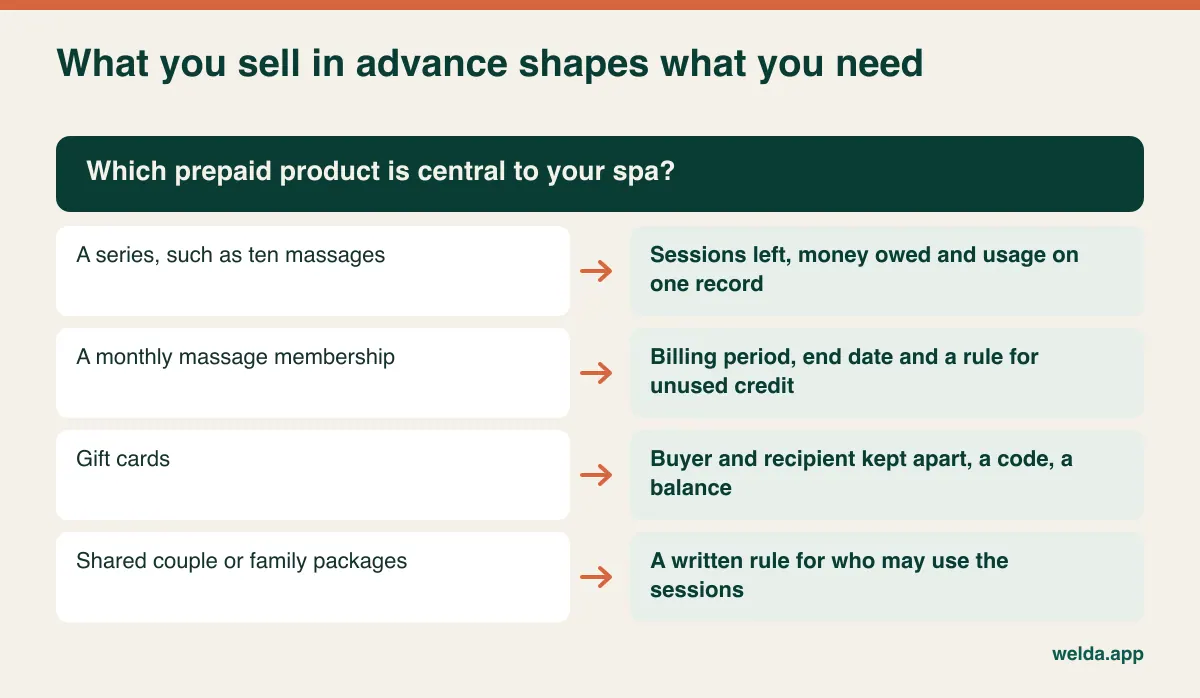
| Product | What it looks like in a spa | What to check |
|---|---|---|
| Series | Ten massages for one person | Total and remaining sessions, dates, who delivered each, instalments |
| Shared package | Partners or family share one bundle | How the balance links to two people, who each use is logged against |
| Membership | Monthly fee including a set number of treatments | Billing period, end date, rule for unused credit |
| Gift card | Bought by one person, used by another; often peaks before the holidays | Unique code, remaining value, expiry, separate buyer and recipient records |
| Pause | Pregnancy, injury or moving away | Ability to freeze and extend, and who is permitted to do so |
Many massage businesses use memberships to smooth out income, and memberships raise one question that catches owners out: what happens to unused credit? If credit rolls over without limit, the amount you owe grows silently each month. Whatever your policy, you need a report showing how much is outstanding. That figure also tells you about capacity. If you have committed a lot of future sessions, a new promotion may just add debt to an already full calendar.
Gift cards deserve a specific question in your first call, as some products handle them natively and others leave you to improvise with notes. Can staff look up a balance by code? Is partial redemption possible? Rules on expiry dates and accounting treatment differ by country and sometimes by state or province, so settle those with a local adviser rather than with your software vendor or this article.
Sequences: when one visit needs three resources in order
Many spa menus sell a journey rather than a treatment: sauna, then scrub, a rest, and a fifty-minute massage to finish. The guest sees one product. You see three resources that must be free in the right order. Good software prevents the receptionist from assembling this by hand, one slot at a time, with a pen.
Consider two friends staying nearby who ask for a sauna and massage at 4pm. The sauna has room. A scrub therapist is free at 4:30. By 5:15 you need two treatment rooms, but one does not open until 5:45. A clear view shows this immediately, and the receptionist can suggest starting at 4:30 so they finish together. With paper, that calculation happens while the guests are standing at the desk.
If a product has no sequence feature, you can usually book the steps as separate consecutive appointments. That may be acceptable, depending on what happens next. Move the first step: do the others follow? Cancel the visit: are all the slots released? How many reminder messages does the guest receive? Does the sale show up as one journey or three treatments in your reports? If you sell only single treatments, cross this section off your list and do not pay for a feature you will not use.
Day spa, hotel spa, or a practice of one: different shopping lists
Two businesses searching for the same phrase can have almost nothing in common. Be clear about which one you are.
- Solo or two-room massage practice. The person answering the phone is often the one with oil on their hands. Reminders, online booking requests, quick rebooking and simple package tracking matter most. A complex resource model is likely to get in the way. If you sell no packages and your week fits on one page, a simple calendar may genuinely be enough for now.
- Day spa with several rooms. Everything in this article applies: resource conflicts, turnover, sequences, couples, gift cards and commission. This is the group most likely to outgrow a general booking app.
- Hotel or resort spa. Your first question is whether a treatment can be posted to the guest's room bill through your property management system. Without that link, someone reconciles charges by hand every day. If it is essential, only shortlist products with a proven connection to your specific PMS. Language matters as well, since international guests may expect reminders in their own language.
- Multi-site group. Look for consolidated reporting, staff who work across sites, and whether packages bought at one location can be used at another.
- Medical or clinical massage. If you bill insurers or need formal clinical notes, you may need specialist practice software. A spa system could be the wrong tool altogether, whichever vendor you ask.
Intake forms, privacy and consent
A massage intake form usually asks about pregnancy, blood pressure, circulation, recent surgery and allergies to oils. That is health-related information, and many privacy regimes treat it more strictly than a phone number. In the EU and UK, that means GDPR and its rules on special category data. In other places, different laws apply, and in the US whether HIPAA is relevant depends on the type of business and how it bills. This is general information rather than legal advice, so have a qualified adviser check your own forms and notices.
For the software, the questions are practical. Is health information stored encrypted? Can a therapist see only what they need, or can anyone with a login browse every client? Is a record kept of who opened what? Is a consent stored with its date and version? And does a contraindication appear as an alert when a booking is made, or does it sit deep within a profile where nobody will look? Our article on health data security is written for clinics, but the same thinking applies to a spa that holds intake forms.
Keep marketing separate from service messages, too. A reminder about tomorrow's appointment and a "special offer this month" message are treated differently in many countries; promotional messages typically require a clear opt-in. Check that the system records that permission. The channel matters as well. WhatsApp is everyday communication in many markets and much less so in others, so ask which channels a product supports before you assume your guests will read its reminders. Our piece on WhatsApp appointment automation explains how those flows are usually set up.
Reading a quote: what sets the real cost
The real cost of spa software depends on your set-up, which is why a headline monthly figure says little on its own. Rather than comparing one number, ask every vendor to put these items in writing:
- Users: Does every therapist need a login, or just the desk? Do seasonal staff push you into a higher plan?
- Locations and resources: Are you charged per site, per staff calendar or per room?
- Messages: How many reminders are included, and what happens above that limit? A three-step journey may send three messages.
- Modules: Are commission, till, stock and automated message flows included, or only on a higher tier?
- Payments: Which processors are supported, and are there transaction fees on top of the subscription?
- Onboarding: Are setup, data migration and training included? Does migration cover package balances or only client names?
- Integrations: Does a PMS, accounting or e-invoicing connection need a third-party contract?
- Exit: In what format can you take your client and package data when you leave?
The biggest hidden costs do not appear on any invoice: the daily reconciliation at the desk, the side spreadsheet kept because the software cannot do one thing, the retraining every season. Put two quotes in the same table against these lines, add a rough estimate of staff time, and the cheaper option may or may not remain the cheaper one. Either way, you will know why.
Take over the demo
A vendor's sample data always works, because it was built to. Before the call, write out last month's hardest day: which rooms were full, who failed to show, who used a package, who cancelled at the last minute. Then ask to run these scenarios live.
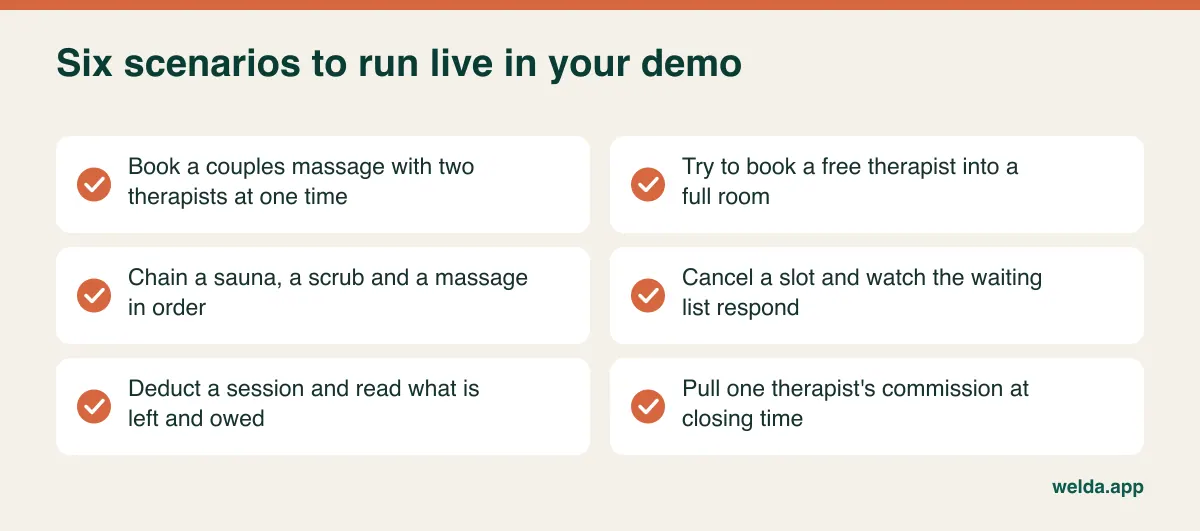
While you do, watch three things. How many steps does a booking take with a phone in one hand? Does the system block a conflict, warn about it, or quietly save it? And what can a therapist see from their own login? Bring whoever works your busiest shift on the desk. They will use the product more than you do, and they will notice in five minutes what you would notice in five weeks.
The classic mistakes are predictable. Buying the longest feature list adds screens your team will avoid. Buying an enterprise resort product for a two-room practice costs you in setup time and training. Forcing a hair salon calendar onto a spa with a wet area leaves you with workarounds from the first day. Moving over without package balances is the most expensive of all.
Switching without losing what guests have paid for
Many migrations begin with the client list, yet a wrong phone number is easy to fix, whereas a missing package balance becomes a dispute at the desk. Begin with what you owe.
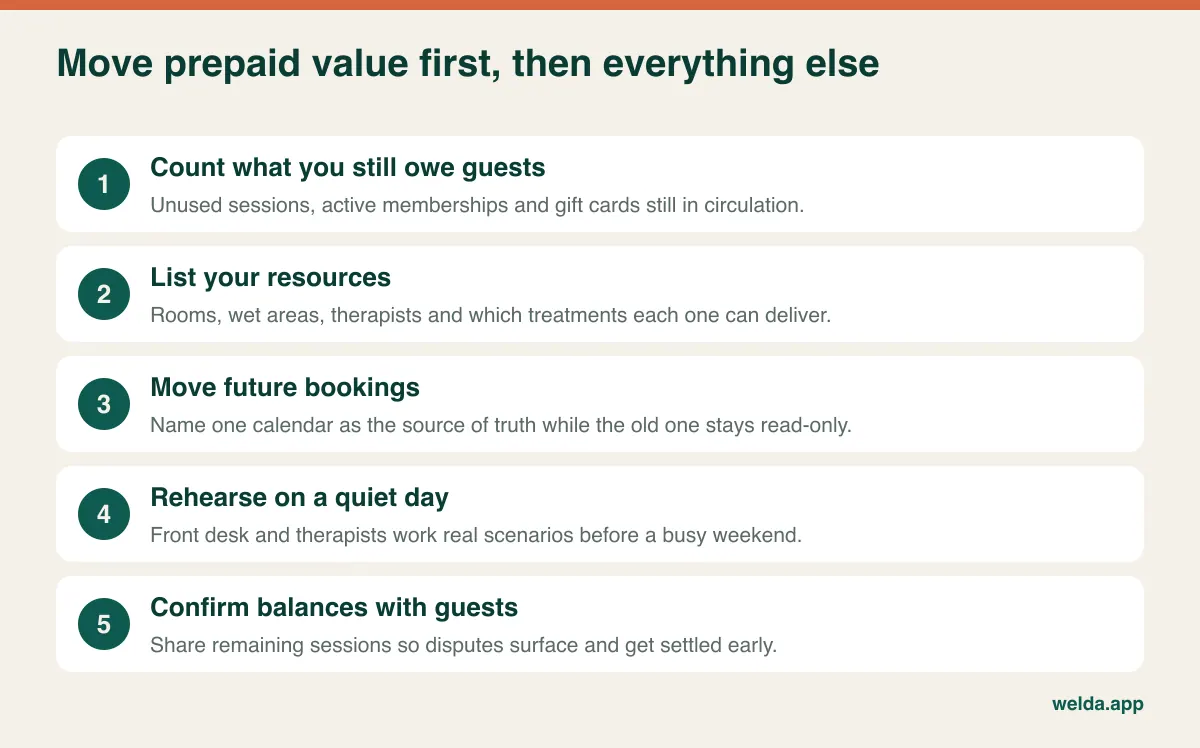
Pick your moment. The weeks before the holidays, when gift card sales peak, or the start of high season in a resort, are poor times to learn a new system. Start in a quiet week, keep the old records available as read-only for reference, and keep any period of double entry short, because staff stop trusting both systems if it drags on. Sending each guest a note of their remaining sessions is a good way to close: any disagreement appears in the first week rather than six months later.
Where Welda CRM fits, and where to test us
Welda CRM is web-based software for appointment-led businesses. We do not have a dedicated "spa" sector option; the closest starting point is our beauty salon set-up, which is why you can read about Welda as spa management software on our beauty salon page.
Here is what we can state plainly:
- Calendar: Staff, room and branch calendar views in one place, conflict detection to prevent double bookings, online booking requests that you confirm, and a waiting list that notifies the next client when a slot opens.
- Packages and memberships: Multi-session packages with remaining-session tracking, plus memberships. Invoices, receipts, payments and instalments are tracked as well.
- Records: Client history and notes in one profile, encrypted health records with allergy and contraindication alerts, role-based permissions, consent management and an audit log.
- Communication: Automatic WhatsApp reminders, templates in English, German and Turkish, NPS surveys and review requests.
- Management: Cash desk, bank and POS tracking, expenses and stock, staff commissions, monthly targets, and occupancy, revenue and performance reports across branches.
There are also things we would rather you test than read about here. Whether a booking locks a therapist and a room together, room turnover buffers, couples bookings, capacity-based resources such as a sauna, and multi-step journeys: bring these scenarios to the demo and see how they behave. Ask about gift cards and pausing a package in the same way. We make no claim of a ready-made link to hotel property management systems; open API access is part of our higher plans, but if posting to a room bill is essential, we need to work through it with you before you sign. Online booking creates a request that you confirm, not an instant paid reservation, so tell us if you need guests to pay and confirm on their own. Reminders run over WhatsApp, so if your guests expect SMS or email, ask how that would work. Access pauses during an internet outage, though your records remain intact. Stock, till, commission and automated message flows sit on higher plans. If you bill insurers, we are probably not what you need.
Price depends on your locations, users, message volume and modules, and is set out in a free consultation. Setup, migration of existing client and appointment data and team training are included in every plan. You can try Welda CRM free for 7 days with all modules open. To find out whether we are the spa management software for your business, book a free consultation and we will enter your worst Saturday together. If we are not right for you, we will say so.
Frequently asked questions
What is the difference between spa software and salon software?
The foundations are the same: appointments, clients, packages, payments. The difference is how heavily the product relies on resources. A spa needs to plan rooms, wet areas and therapists together and sell multi-resource bookings such as couples treatments and journeys. Salon software may handle some of this, so test it rather than assuming either way.
Do I need spa management software for a one-room massage practice?
Not necessarily. If you sell no packages and have a manageable number of appointments, a simple calendar could be enough. Once you tire of sending reminders by hand or start selling series, tracking and automation begin to pay their way.
Can therapists use it on their phones?
That varies by product. The question to ask is whether a therapist can see their own day and the notes they need, without seeing everything else. Welda CRM runs in a browser with role-based permissions; try it on your own phone during the trial.
Should I take deposits to cut no-shows?
That is a business decision. A deposit can protect a room, but it adds friction and the policy must be clear and stated in advance. If you plan to use one, ask how a vendor records the prepayment and what happens on cancellation. Many businesses begin with reminders and a waiting list because they are easier to introduce.
Can I import package balances from my old system or paper records?
Generally yes, but quality depends on what you have. Paper records must first become a list that matches each client with a session count. Migration of existing client and appointment data is part of our setup; we will look at the format of your balances with you during the consultation.
Is this type of software enough for a hotel spa?
It can be if the spa operates as a separate point of payment. If you need live room-bill posting or guest data from your PMS, verify that connection first and do not sign on a promise alone.
How long should the selection take?
There is no single right answer. A practical approach is to spend a week writing down your requirements and your hardest day, then run the same scenarios with no more than three candidates. For a wider view of the decision, our guide on how to choose beauty salon software pairs well with this one.