Digital marketing agency pricing has no standard price tag because agencies are not selling a standard thing. What you pay depends on how many channels are in scope, who produces the content, how the work is coordinated, and which fee model is used, while your ad spend usually sits on top as a separate cost paid to the platforms. So the useful question for a small or mid-sized business is not "what does an agency cost?" but "which work is worth handing over at my budget, and on what terms?"
This guide is for the owner or manager about to outsource more than one channel, perhaps with two or three proposals already open in another tab. The examples use neutral "units" rather than a currency. A figure quoted without a scope tells you very little, and the figure that matters to you can only be settled once the scope is on the table. Our own digital marketing agency pricing works the same way: the fee follows the scope.
Three things an agency can sell you: time, output, or judgment
Almost every proposal is a blend of three different products, and the labels on the front rarely tell you the ratio.
Output is what you can count: posts, videos, landing pages, ad variations, blog articles. Time is the ongoing attention that does not produce a visible artifact: reading search term reports, adjusting bids, replying to comments, fixing a broken tag. Judgment is the senior thinking: deciding what not to do, spotting that the offer is the problem rather than the ads, telling you the channel you love is not earning its keep.
A low-priced package is usually heavy on output and light on judgment. That is not automatically bad. If you already employ a capable marketer who sets direction, a production-heavy retainer may be exactly right, and paying for an agency's strategy layer would be paying twice. The trouble starts when a business with nobody steering marketing buys an output package and assumes the steering came with it. Six months later there is a full content calendar and no one can say what it achieved.
Before you compare any numbers, decide which of the three you are short of. It changes which proposals are even comparable.
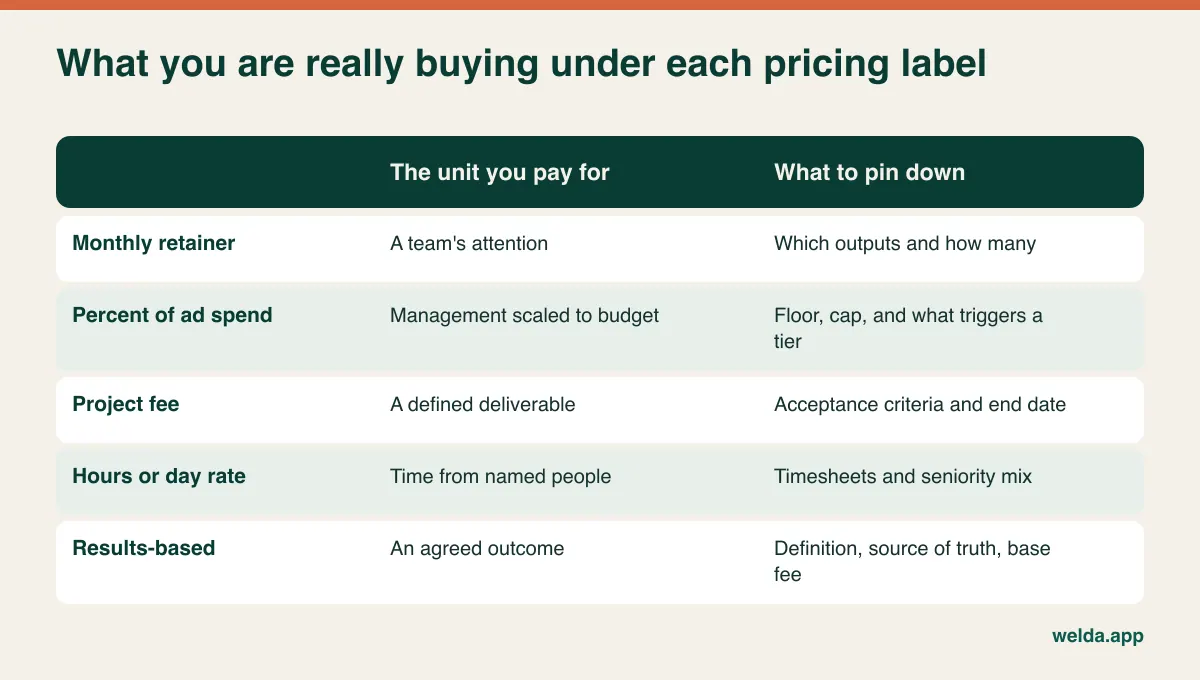
How each fee model bends agency behavior
Fee models are not neutral billing mechanics. Each one quietly rewards certain behavior, so it is worth asking what yours rewards.
A monthly retainer gives you predictable cost and the agency predictable revenue. It works best when the workload is steady. Its weakness is drift: the fee stays the same while attention slides toward newer clients, and without written outputs you have little to point at. A retainer with counted deliverables and a named team closes most of that gap.
A percentage of ad spend is common in paid media. It is easy to understand and scales with seasonal budgets, but the workload does not double when the budget does, and any recommendation to spend more arrives with a mild conflict of interest. That does not make the advice wrong. It does make a floor, a cap, or tiers sensible, and it gives you a reason to check the reasoning behind each increase. We walk through this comparison with worked examples in our guide to Google Ads management cost.
A project fee suits anything with a clear finish line, such as a tracking setup, an SEO audit, or a campaign launch. What you need in writing is the acceptance criteria and how many rounds of changes are included, because projects without an agreed definition of "done" tend to end in an argument.
Hourly or day rates are honest about what is being sold and work well when you have someone in-house directing the work. Ask for timesheets and for the seniority mix, since a day from a senior strategist and a day from a junior are not the same purchase. Ask too what happens to unused hours at the end of the month.
Results-based fees sound like the fairest option and generate the most disputes. They hold up when the sale is quick and clearly attributable. With a long sales cycle or several channels touching the same customer, you will spend real time arguing about who earned what, and the answer depends on whose tracking is treated as the source of truth. Expect a base fee to remain in most such arrangements.
On a multi-channel scope you will often see a mix: SEO and social on retainer, paid media on a percentage, shoots billed per project. That is fine as long as each element appears on its own line. A single bundled total that the agency will not break down is a warning sign, because you cannot adjust one channel without reopening everything.
The package test: rewrite the sales deck as a scope of work
Names like "Growth" or "Scale" carry no shared meaning from one agency to the next. "Social media management" might mean templated posts scheduled twice a week, or it might mean shot content, community replies, and monthly reporting. "SEO included" might be a keyword report or might be technical fixes plus content. You can only compare what has been translated into specifics.
Try a simple exercise. Take each sentence of the proposal and rewrite it as something a third party could verify. If a sentence cannot be rewritten that way, ask the agency to do it for you. A serious team can, because it had to estimate the work to price it.
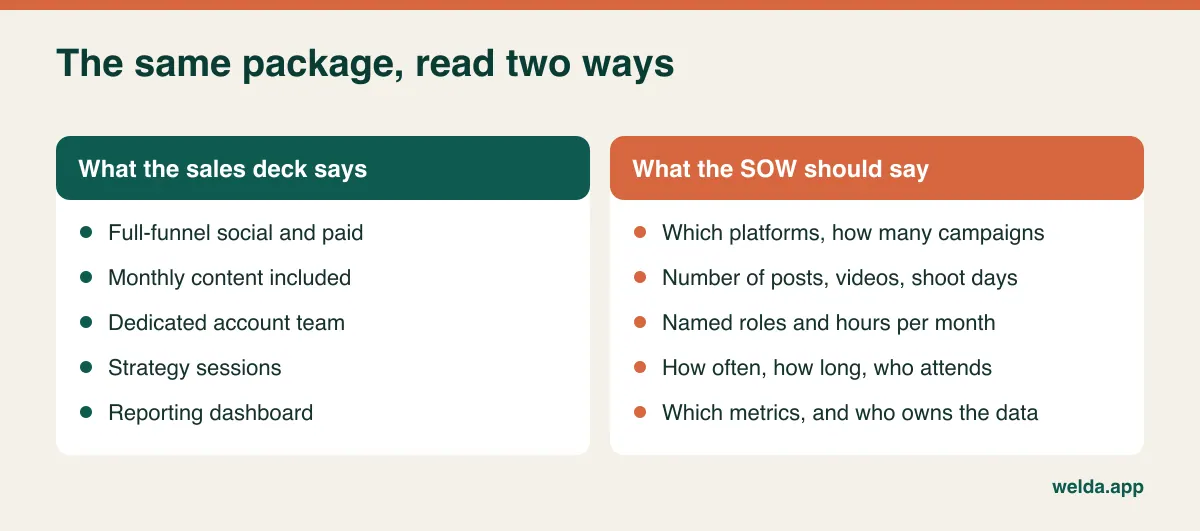
Keep the purpose in mind while you do this. You are not trying to squeeze out more posts. Thirty weak posts do not beat ten strong ones. You are trying to make sure both sides picture the same month of work, so that "that's out of scope" does not surface for the first time in month three.
While you are at it, ask what work goes to subcontractors. Plenty of good agencies use freelancers or white-label partners for specialist work, and there is nothing wrong with that. You simply want to know who is doing the work on your account and whether they have access to your data.
The line nobody itemizes: coordination between channels
This is the cost that makes multi-channel pricing different from buying single services. Channels depend on each other. Ads need creative, creative needs a brief, the brief needs the offer, and all of them need tracking that someone owns. When three vendors each handle one channel, nobody is paid to manage the seams between them.
You will see it in small ways. The paid team launches a promotion the social team has never heard of. The SEO vendor publishes a new service page that ads never point to. At the end of the month, each report counts the same customer as its own win, and the combined totals exceed your actual sales. Measuring marketing KPIs against your real numbers, rather than each platform's self-reported figures, is the only way out, and someone needs to own that job.
So a coordination cost always exists. An integrated agency builds it into its fee, which is why a three-channel proposal may look close to the sum of three single-channel quotes, with no bulk discount in sight. If you separate the vendors, that work moves to you, and it is paid for in your own time. A rough calculation is worth doing before you decide that separate vendors are cheaper.
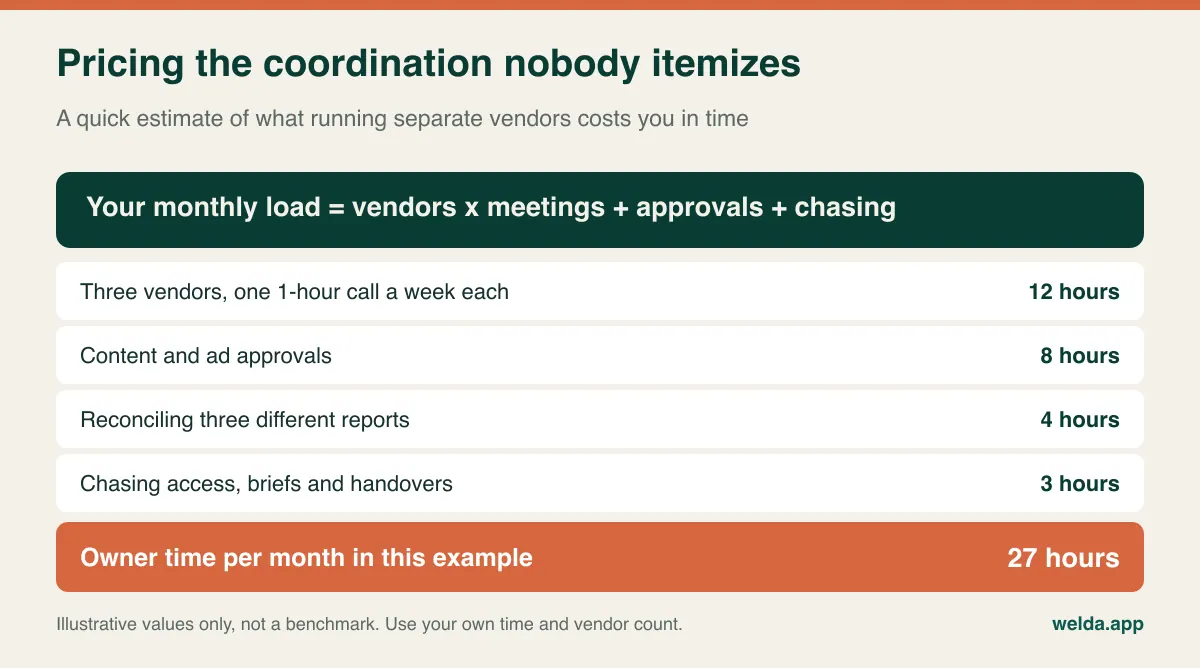
None of this makes one agency the automatic answer. Very few agencies are equally deep in every channel, and pulling one weak channel out of a bundled relationship can be awkward. Separate specialists are a strong option when you have someone in-house to run them. Without that person, either pay for coordination or reduce the number of channels until the coordination is manageable.
What your budget can actually support
The biggest multi-channel mistake is spreading a modest budget until nothing has enough fuel to produce a readable result. If a large share of your total pays for managing four channels, there may not be enough working media left in any of them to learn anything. Ad platforms need data to optimize. Content needs consistency to compound. A thin slice of everything often gets you plenty of activity and no clear conclusions.
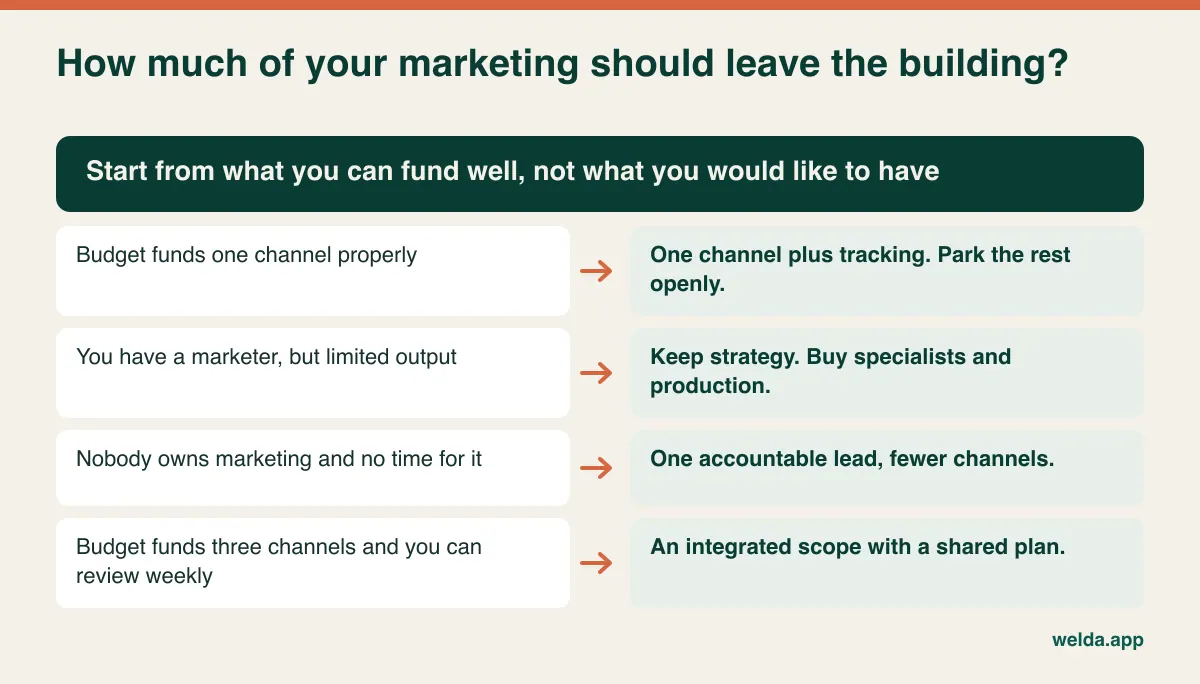
Three invented businesses show how this reasoning plays out. These are illustrations, not client stories, and we leave amounts out deliberately because what counts as sufficient varies widely by market and competition.
A two-location dental practice. Patients search when they need treatment, and the practice has a receptionist but nobody in marketing. The worthwhile scope is narrow: paid search on high-intent treatments, call and form tracking, a healthy Google Business Profile, and good treatment pages. A daily social presence can wait. Healthcare advertising rules vary by country and platform, so whoever writes the ads should know the local limits.
A direct-to-consumer homeware brand. The product is visual, margins can support paid social, and the team of three handles fulfillment and customer service. Here the bottleneck is creative. Ad accounts go stale when the same images run for too long, so production may matter more than a clever media plan. Outsource paid media and content production together, keep product decisions in-house, and begin SEO with an audit before committing to a monthly content program.
A B2B software company selling into a niche. Deal cycles are long, buyers are few, and the founder knows the market better than any agency will. Keep positioning in-house. Buy specialist help for technical SEO, subject-matter content, and tightly targeted search campaigns. Posting frequency matters far less than whether the buyer finds a convincing answer at the moment of research.
Sequencing: the order in which channels earn their fee
Even with a budget that covers several channels, starting everything in the same week is rarely wise. Dependencies decide the order. Measurement comes first, since no later decision can be defended without it. Next come the pages that will receive traffic: a slow or unclear landing page will waste whatever you send to it, however good the campaign is.
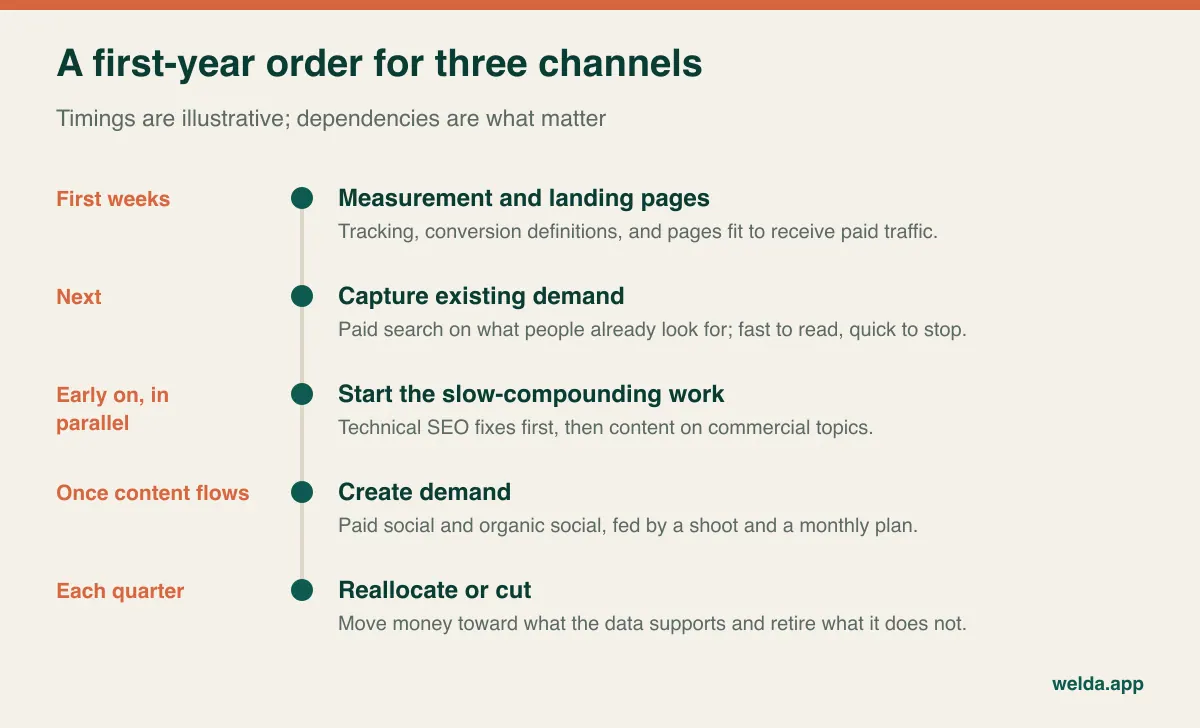
Paid search usually follows because it captures people who are already looking, reads quickly, and can be stopped in an afternoon. SEO starts early but in small doses, because it pays back slowly and survives when spending stops; our notes on SEO agency pricing go deeper on how that retainer is scoped. Social media and paid social create demand among people who were not looking for you, which means they consume content quickly. They become affordable once a production routine exists.
Exceptions exist. A boutique whose customers discover products on Instagram might bring social forward. What should not move is measurement, because a sequence that skips it is simply spending in the dark, with no way of telling later which part worked.
Hiring across borders: the extra clauses
Many businesses now hire an agency in another country, often for good reasons. Language coverage, specialist skills, and availability can all justify it. It also adds a few things to check that a domestic proposal would not raise.
Tax and invoicing. VAT, GST, or sales tax treatment can differ for cross-border services, and reverse-charge rules may apply in some jurisdictions. Ask your accountant before signing and confirm what the invoice will show. Currency. Decide which currency the fee is set in and who carries the exchange-rate risk over a twelve-month term. Ad spend billed in one currency and revenue earned in another can also complicate your reading of the results.
Data and privacy. Rules differ across markets. The GDPR and UK GDPR, various US state privacy laws, and others each have their own expectations around consent, tracking, and data transfer. If an agency will handle customer lists or access analytics that contain personal data, a data processing agreement may be required, and consent banners may need to behave differently by region. Treat this as a topic for your legal adviser, not something either we or the agency can settle in a sales call. Bear in mind that platform advertising policies change as well and often vary by country.
Working hours and language. Ask which hours your contact keeps, how quickly urgent problems are handled, and who will write copy in the local language. A native speaker's review may be needed for ads, and it may not be included in the fee.
Welda's team is based in Istanbul, so these questions apply to us too if you are outside Türkiye. Ask them.
Normalizing the proposals you already have
Once you have the scope translated, put every proposal in the same grid. Use rows for channels, counted output, management frequency, reporting, named people, and exclusions. Empty cells become questions for the agency. This step often settles the matter by itself, as the cheapest proposal frequently turns out to have nothing in one of the cells you care most about.
Then convert everything to a total over the minimum commitment rather than comparing monthly figures. Add up the headline retainer, setup, anything excluded from scope that you will realistically need, tools billed through to you, and the work of leaving.
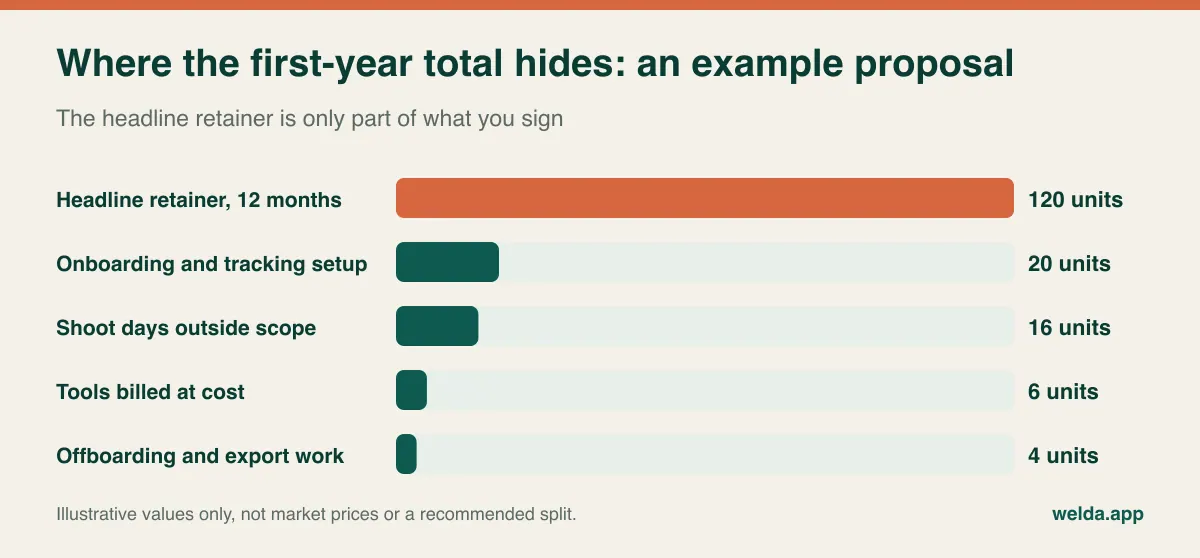
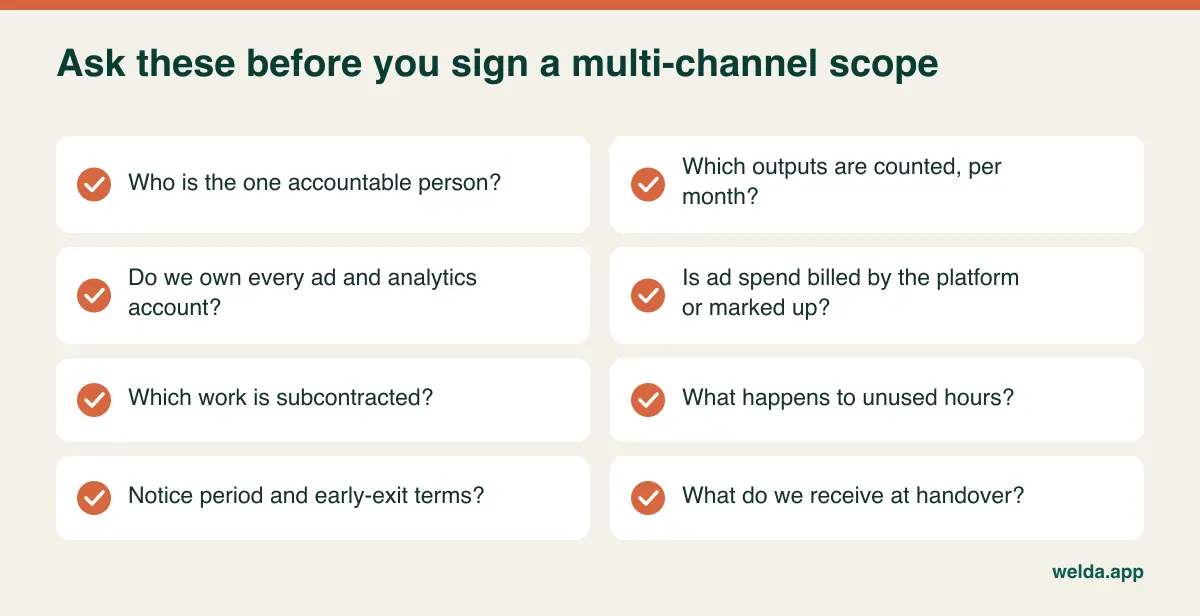
Look closely at these lines in particular. Is ad spend billed directly by the platform, or does it pass through the agency with a markup? Are tools charged at cost? Are stock images, music licenses, and paid shoot days included? Does the fee rise automatically at renewal? And what does it cost to leave? Accounts held in the agency's name are the most expensive hidden item of all, because you can lose the campaign history and data with them. Ask that every ad and analytics account sit under your company from day one.
Finally, ask for the conversation the numbers cannot give you. Meet the person who will run your account, not only the person selling it. Ask for a sample report and check whether spend and results appear side by side. Ask, "With this budget, which channel would you delay?" An agency that recommends everything may be describing its packages rather than your business.
Work that stays with you, whichever agency you pick
Outsourcing changes your marketing workload without removing it. The first thing that remains is responding to leads. An inquiry answered two days later can make a sound campaign look like a failure, and no agency can fix that from the outside. Agree who responds, and how fast, before the first ad goes live.
The second is approvals. Three channels mean frequent decisions, and a week's silence from you moves every deadline. If you cannot give a regular slot, cut scope instead. The third is knowledge: why customers pick you, what they ask before buying, and which services are actually profitable. Agencies can extract this only if you give them time. The last is the decision itself. An agency can recommend, but the call on budget and priorities belongs to the person who carries the profit and loss.
Where Welda fits, and where it does not
Our advertising service is built around Google Ads and Meta. If TikTok or LinkedIn ads are your primary paid channel, raise it at the start so we can assess together whether we are the right fit. We also do not list standalone email marketing as a service; email automation appears within our e-commerce work.
On the channels we run, we set up conversion tracking with GA4, Tag Manager, Meta Pixel, and the Conversions API, and share a monthly report with spend, CPA, and ROAS side by side. You own the ad accounts, we work through manager access, and ad spend goes directly to the platforms, separate from our fee. Our SEO work uses white-hat methods without a first-place guarantee, since no one can honestly offer one. Social media and content production can sit in the same plan as ads, or you can take just one channel and keep the rest in-house. Our guide to choosing a social media agency is useful if that is the piece you plan to split out.
We don't publish a list for digital marketing agency pricing; the fee follows scope, the number of channels, and the monthly workload. Bring any competing proposals to a free consultation and we can fill in the grid together, including which channel it would make sense to delay. You can reach us here to set that up.
Frequently asked questions
Why do quotes for the same work vary so much?
Usually because the work is not the same. Channel count, output volume, management frequency, team seniority, and whether coordination is included can each move the total. Put proposals into one grid before treating the difference as a difference in price.
Is ad spend included in digital marketing agency pricing?
Usually not. Ad spend normally goes to the platforms and the management fee to the agency, but read the proposal to confirm. If spend passes through the agency, ask how it is invoiced and whether a markup applies.
How many channels should a small business outsource?
There is no fixed answer. Check whether the budget can feed each channel enough to produce readable data, and whether you can give it regular approvals. One well-run channel with solid measurement often teaches you more than four thin ones.
Is one integrated agency better than separate specialists?
It depends on who coordinates. With an in-house marketer, separate specialists can work very well. Without one, an integrated agency takes on the coordination but increases your dependence, which makes account ownership and exit terms more important.
What contract length is reasonable?
It varies by channel, since SEO pays back more slowly than paid search and needs time before it can be judged. Pay attention to notice periods, auto-renewal, and what you receive at handover at least as much as to the term itself, and have your legal adviser review anything significant.
What should I prepare before the first call?
A rough monthly total you can commit, your most profitable product or service, who will answer leads, who currently holds the ad and analytics accounts, and any proposals you already have. That is enough for a useful first conversation.