Google Ads management cost is what you pay an agency or freelancer to build and run your campaigns, and it sits on top of the ad spend you pay Google. There is no single correct figure, because the fee depends on scope, the number of channels and the monthly workload. What you can decide right now is the pricing model: a flat retainer, a percentage of ad spend, and a setup fee can turn the same work into very different total costs and very different incentives.
If you have a proposal open in another tab and you are wondering whether it is fair, this guide is written for that moment. You will learn how to split a quote into its real parts, compare models with a simple calculation, work out which one suits your situation, and find what is missing before you sign. We deliberately leave out market rate figures. They travel badly between countries, currencies and scopes, and they tend to anchor people to the wrong comparison. The worked examples use neutral "units" instead, so you can drop in your own currency and your own numbers.
Three different costs hiding in one quote
Most confusion about what Google Ads "costs" comes from treating three separate payments as one. They go to different people, buy different things, and hurt in different ways when you cut them.
Ad spend is the money Google charges for clicks and impressions. None of it is the agency's income, at least when the billing is direct. How much you need is a separate question driven by competition and customer targets, which our guide on how to set an advertising budget walks through.
The management fee pays for recurring work: reviewing search terms, adding negatives, adjusting bid strategies, testing ad copy, moving budget between campaigns, and reporting back to you.
The setup fee covers the one-off work at the beginning: account structure, keyword research, conversion tracking, first ads, audience lists. Some agencies itemise it, others bake it into the monthly fee, and others waive it in exchange for a minimum term.
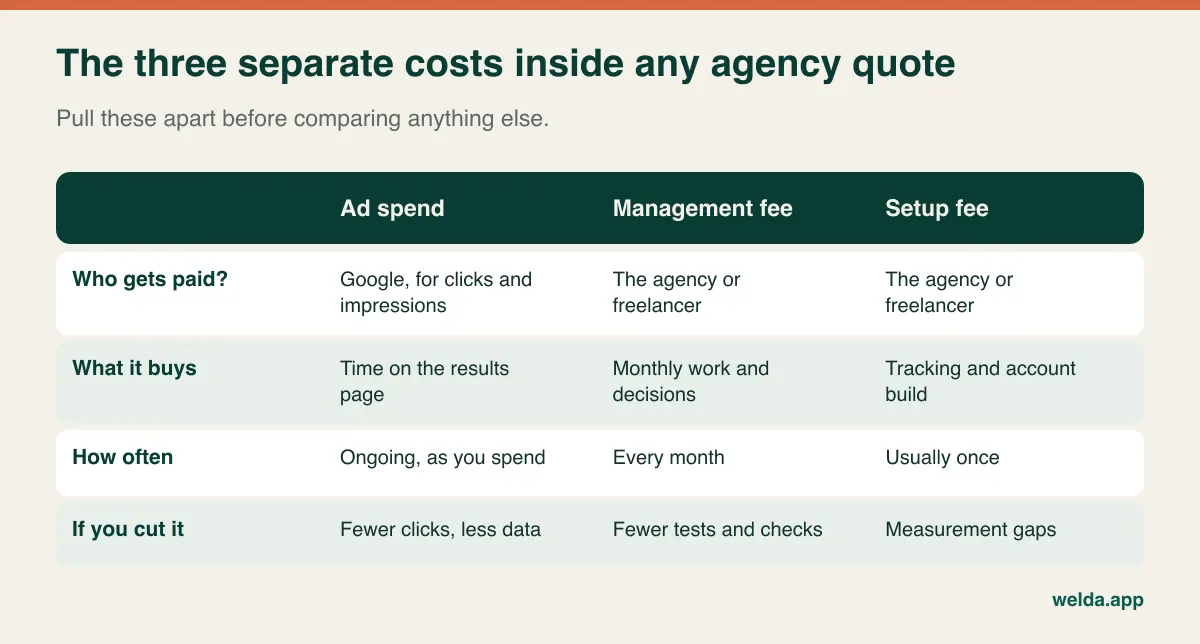
So before you compare proposals, rewrite each one under these three headings. If a quote gives you one "all-inclusive monthly package" with no breakdown, ask how much of it actually reaches Google. A good partner will answer without hesitation, because nobody can judge campaign results without knowing the real spend. We keep that split explicit too: the Google Ads management cost at Welda is entirely separate from your ad spend, which is paid directly to Google and Meta.
What actually drives the management fee
Two businesses with the same budget can create wildly different workloads. So the first question is less "is it cheap?" and more "what work is this price buying?" Here are the factors that matter most, along with what to pin down on your sales call.
| Cost driver | Why it changes the workload | What to ask |
|---|---|---|
| Campaign types | Search, Performance Max, YouTube and Shopping each need their own build and monitoring | Which campaign types does the scope name? |
| Catalogue size | Large stores add product feed work and margin-based segmentation | Who owns the feed and Merchant Center? |
| Countries and languages | Each market means its own keywords, ads, and reporting | What happens to the fee when we add a market? |
| Tracking quality | Broken conversion data has to be repaired before optimisation means anything | Is a tracking audit part of setup? |
| Creative needs | Copy, images and video are often billed separately | How many variations per month are included? |
| Reporting and meetings | A weekly call and a monthly PDF are different amounts of work | How often do we meet and get reports? |
| Competition | Crowded auctions need closer attention and more testing | How often is the account actually reviewed? |
A concrete way to feel the difference: a two-van plumbing firm bidding on emergency searches in one city needs tight keywords, call tracking, sensible ad schedules and quick clean-up of irrelevant queries. A store selling thousands of products across three countries needs feed management, margin-aware bidding and separate reporting per market. If both are handed the same "package", that is worth a follow-up question.
The three models: flat fee, percentage, setup
Most proposals are a mix of three building blocks. None is right or wrong in itself. Each leaves a different risk with you and a different one with the agency.
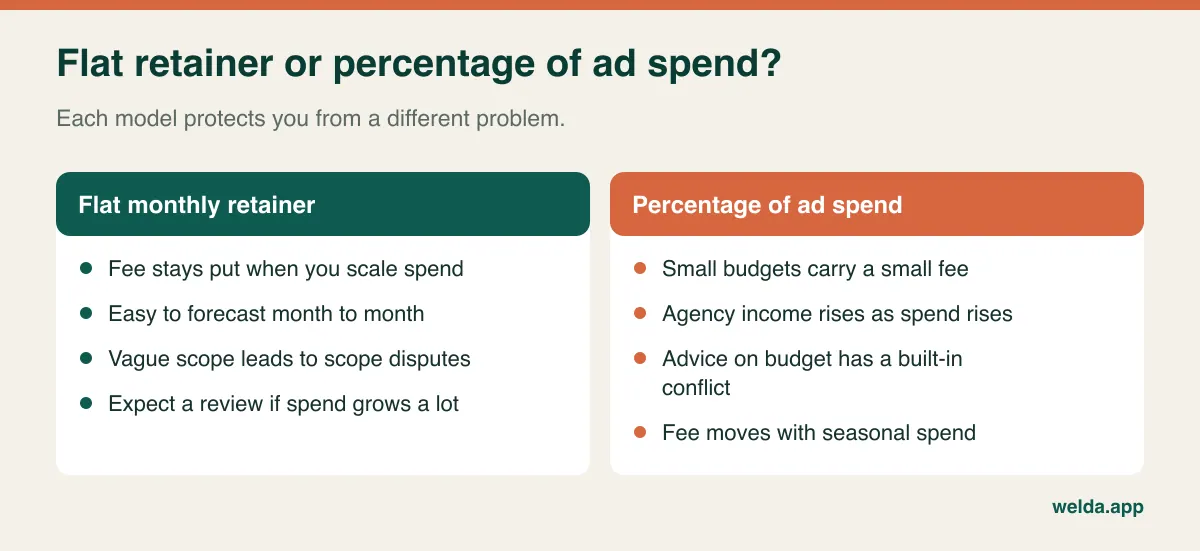
Flat monthly retainer
You pay the same amount each month for a defined scope. The advantage is predictability, and advice about raising your budget is less clouded because the fee doesn't automatically rise with it. The weak spot is scope. If campaigns, channels and revision rounds are not written down, you may eventually hear "that's outside the retainer". A flat fee can also be heavy relative to a very small budget.
Percentage of ad spend
The agency takes an agreed share of your monthly spend. The entry point feels low for small accounts, and the fee falls with spend in quiet months. Two issues deserve attention. First, the agency earns more when you spend more. That does not imply bad faith, but it does mean budget advice should be weighed carefully. Second, workload rarely scales in line with spend. Doubling the budget seldom doubles the work, yet it doubles the fee. If you choose this model, discuss a minimum and a maximum.
Setup fee
A setup fee is less a model than an add-on, but it can tip a decision. Itemised setup raises your first invoice and makes the work visible. "Free setup" doesn't mean the work is free; the cost is usually spread into the monthly fee or protected by a longer commitment. Both approaches can be perfectly legitimate. What matters is knowing what you would owe if you left early.
Hybrid and performance deals
Some agencies combine a base retainer with a percentage above a threshold, or use tiered fee bands. Others offer pay-per-lead or revenue share. These sound attractive because risk appears to shift to the agency, but they rely on measurement both sides trust and a written definition of a qualified lead. If tracking is shaky, a performance deal can easily become the deal that generates the most arguments.
A worked example: where the models cross
You can start the flat-versus-percentage decision with one line of division: flat fee ÷ percentage = break-even ad spend. Below that level the percentage is cheaper; above it, the flat fee wins.
Say one proposal is 40 units a month flat and another is 10% of spend. These numbers are chosen to show the maths and are not market averages. 40 ÷ 0.10 = 400 units. Spend 100 units and you pay 10 on percentage or 40 flat. Spend 800 and it flips: 80 on percentage, still 40 flat.
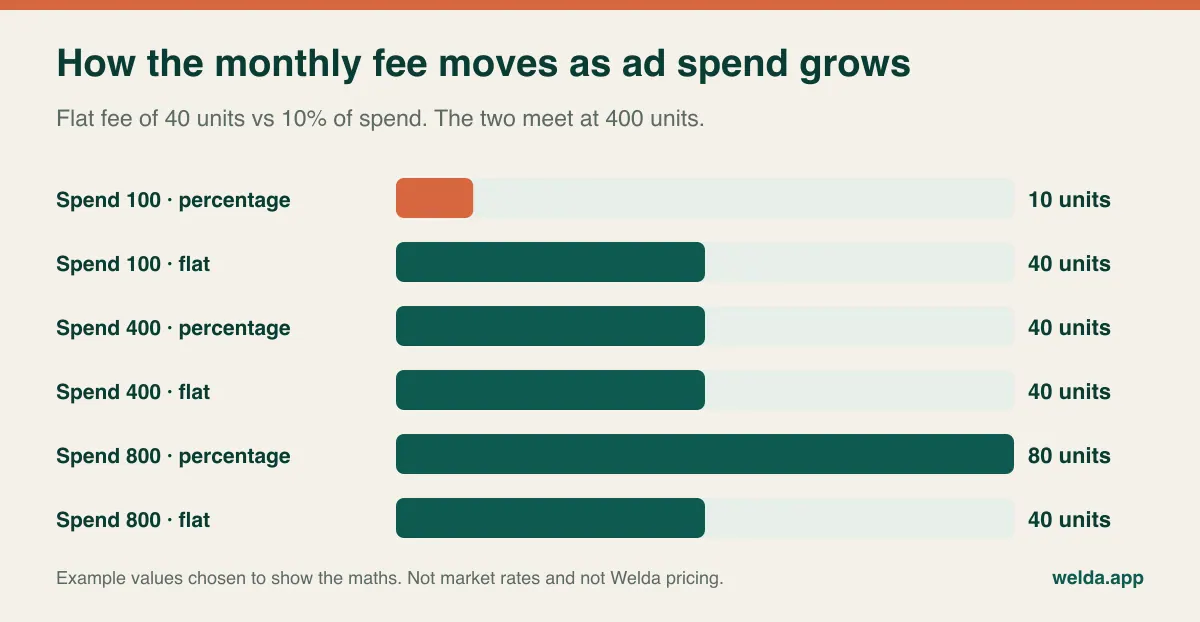
So the useful question isn't your budget today. It is where your budget will go over the next year if the campaigns work, because that's precisely when you will want to spend more. Run each proposal against both your current spend and your growth plan.
Comparing three quotes over twelve months
Choosing on the monthly figure is the most common mistake. Below are three made-up quotes. Ad spend is identical across them, so the table only counts money going to the agency.
| Example item (units) | Quote A | Quote B | Quote C |
|---|---|---|---|
| Monthly management | Flat 40 | 10% of spend | Flat 25 |
| Setup | 120 | None | None |
| Conversion tracking | In setup | Included | Extra: 150 |
| Creative production | Included | Extra: 200 | Extra: 200 |
| 12-month total, spend steady at 300 | 600 | 560 | 650 |
| 12-month total, spend 600 in second half | 600 | 740 | 650 |
Quote C looks cheapest on the monthly line and turns out to be the most expensive in the steady scenario. Quote B, with no setup charge, leads when spend stays flat and becomes the most expensive when you scale. Quote A hits hardest in month one and ends up lowest under growth. None of this makes A the universal winner. It only shows why the monthly number can't carry the decision alone. You also need to check the scopes truly match, since a team that sends one report a month and a team that cleans search terms weekly should not share a line in your spreadsheet.
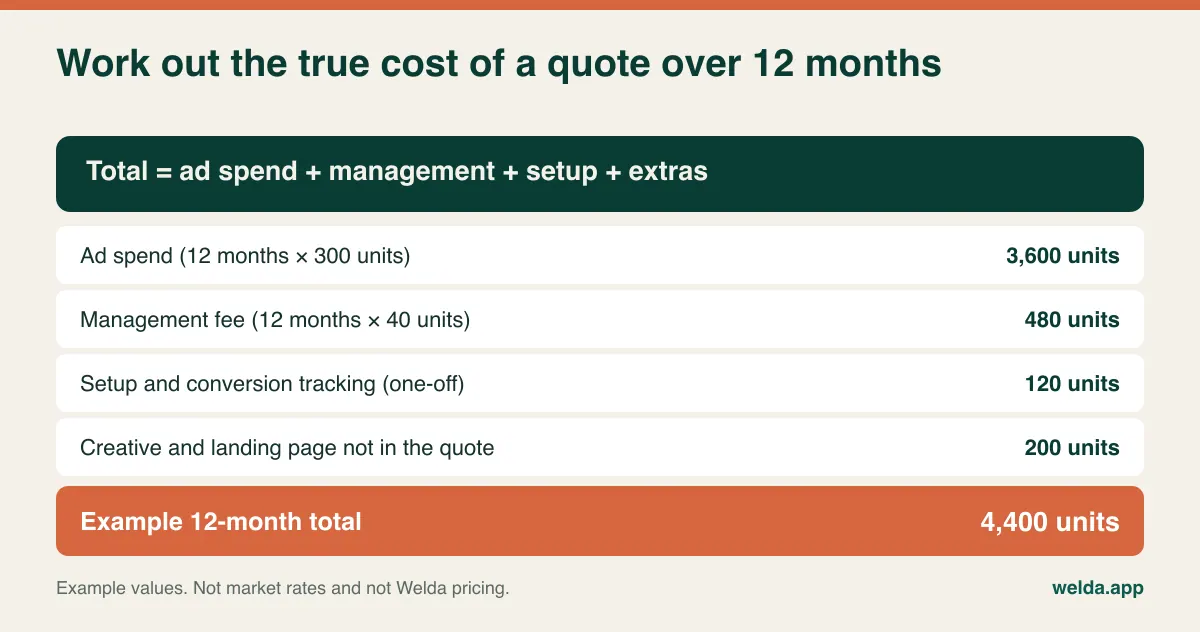
To see the whole picture, fill this formula in with your own quote. In the example below, creative and a landing page sit outside the proposal, which is the sort of item people only notice later.
Does the fee pay for itself?
A second test scales the fee to your business model: monthly management fee ÷ gross profit per customer = extra customers needed to cover the fee. With a 40-unit fee and 20 units of profit per customer, that's two extra customers each month. A low-margin, one-time purchase makes this bar tough. A B2B service with annual contracts may clear it easily. The point is to read returns in customers and profit instead of clicks, and our guide to measuring ROAS takes that thinking further.
Which model fits you, and which doesn't
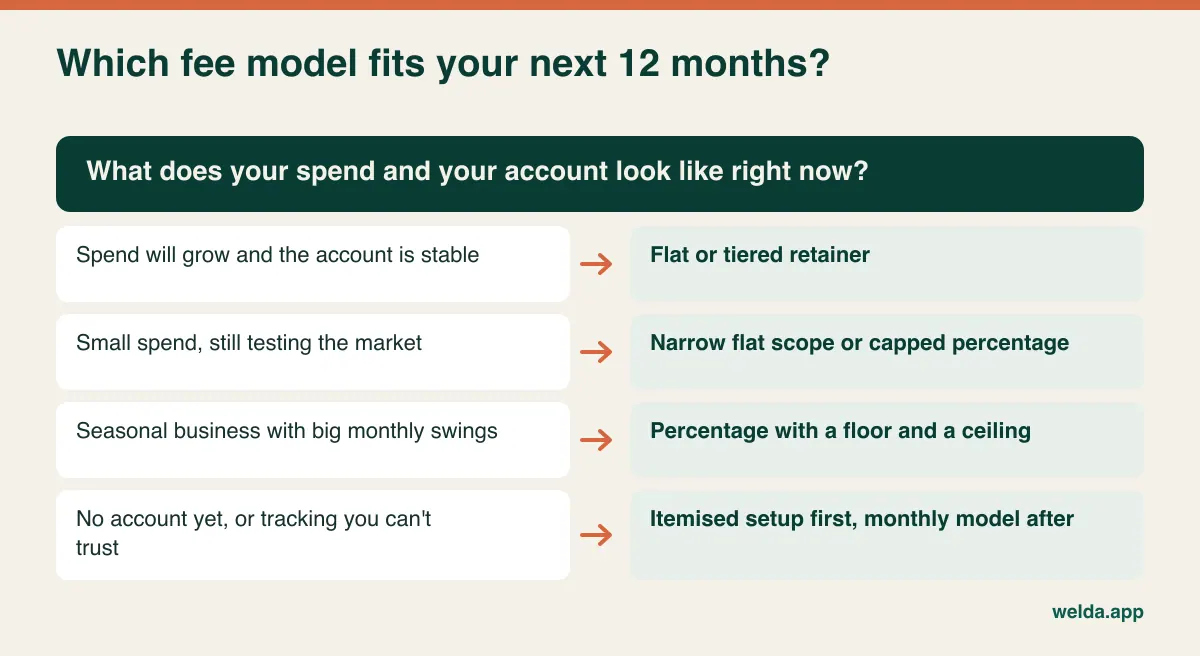
Weigh four things together: budget size, growth plans, seasonality, and the state of your account. Treat these scenarios as starting points, not rules.
- Growing spend on a stable account: a flat or tiered retainer is usually cleaner. Fee changes follow scope changes, not automatic spend increases.
- Small budget, testing a market: look at a narrow flat scope or a capped percentage. The danger here is a fee that dwarfs the media. If the spend can't produce enough data to learn from, shrink the scope first.
- Seasonal demand: a ski rental shop or a tax preparer has months of heavy spend followed by quiet ones. A percentage with a floor and ceiling, or a lower maintenance fee off-season, can make more sense.
- No account yet, or tracking you can't trust: ask for an itemised setup and audit before any monthly commitment. Without clean data, comparing models is guesswork.
- Multiple countries or product lines: a mixed structure that defines scope per market or campaign group tends to stay more transparent than one blended rate.
Sometimes the honest answer is not to hire anyone yet. If your contact form is broken, nobody picks up inbound calls, you don't know your profit per customer, or your ad budget is tiny next to any plausible fee, management won't fix it. Sorting out those foundations is a better first investment. If you would rather try things yourself, our Google Ads beginner's guide is a good first step, and knowing the basics also makes agency conversations easier.
Costs that don't show up on the proposal
You often learn more from what a quote leaves out than from what it states. None of the following suggests bad intent, but each can become a surprise if you don't raise it early.
- Creative and video: if YouTube or Performance Max are on the table, who produces the assets?
- Landing pages: ads bring the click; the page earns the conversion. If page changes are a separate job, budget for them from the start.
- Tracking maintenance: website updates can break tags. Are repairs inside the monthly fee?
- Tools and software: does the agency pass through costs for call tracking, dashboards, or bid tools?
- Extra channels and locations: how does the fee change if you add Meta Ads or another market?
- Commitment and exit: minimum term, notice period, and whether a waived setup fee gets clawed back if you leave.
- Currency and annual reviews: if your agency invoices in a different currency, exchange rate swings change your real cost. Check for any annual increase clause too.
- Billing through the agency: if ad spend arrives on the agency's invoice, make sure you can reconcile it with the spend shown in Google Ads. The arrangement isn't a problem in itself; opacity is.
The most expensive hidden cost never appears on an invoice: spend without conversion tracking. If form submissions and calls aren't measured, you can't tell which campaign brought in customers. Our conversion tracking setup guide shows what should be in place. At Welda, tracking is step one, and we don't launch ads until measurement is working.
Questions to ask before you sign
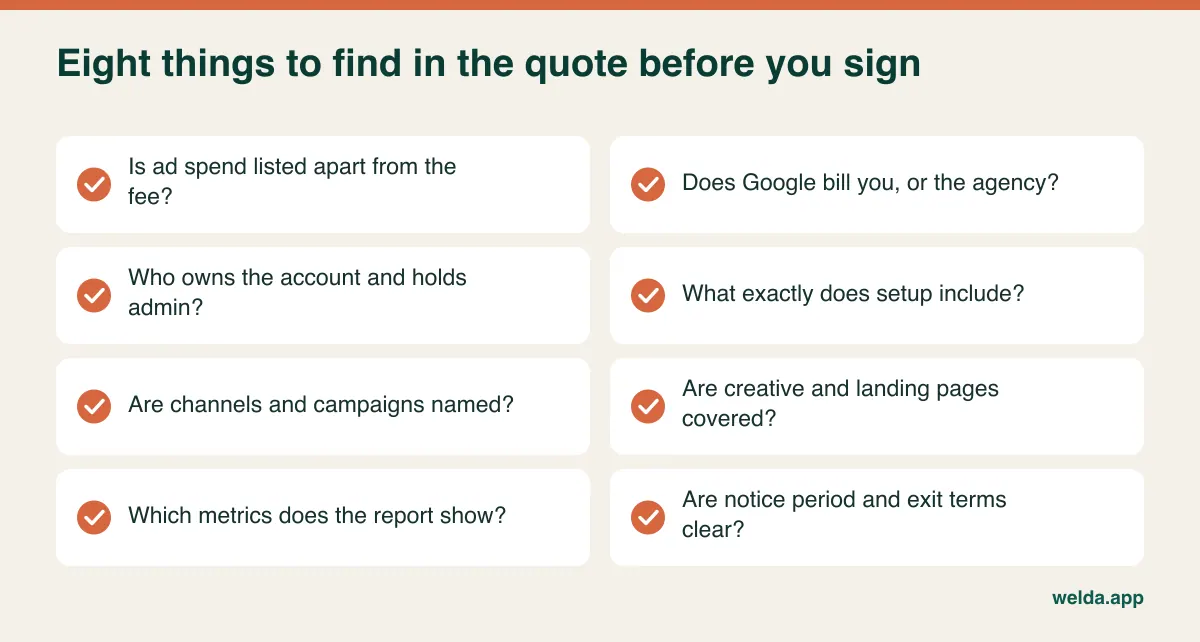
The quality of the answers will often tell you more than the proposal does. Clear answers usually come from teams that run accounts clearly. For a broader evaluation, see how to choose a digital advertising agency.
- Whose name will the ad account be in, and what happens to it if we part ways?
- Do I pay Google directly, or does the spend go through you?
- Exactly what work happens each month for this fee, and how often is the account reviewed?
- Who will actually manage the account: the person on this call, or someone else?
- Which metrics appear in the report? Just clicks, or spend, conversions, cost per acquisition, and ROAS together?
- What is a realistic goal for our first months, and how did you arrive at it?
- If we increase spend, how does the fee change? And if we pause or cut it?
- Will I have direct access to campaign data and change history?
- What notice do you need if I end the contract, and what do I keep?
Some answers deserve a closer look. Guaranteed top positions or a promised number of customers don't sit well with how an ad auction works. A cautious reply such as "the first weeks are for testing and the picture gets clearer as data builds" is usually the more realistic one.
Common mistakes when comparing agencies
- Picking the lowest monthly number: with different scopes, monthly fees aren't comparable. Total the first twelve months.
- Cutting spend but keeping the fee: very low spend starves the system of data while your fee stays the same. Review the ratio regularly.
- Never asking about ownership: account history and audiences have value. An account in the agency's name may mean starting over later.
- Settling for click reports: more clicks aren't more customers. Spend and results belong side by side.
- Comparing percentages in isolation: a low rate can mean a thin scope or plenty of extras. A rate tells you nothing without the scope behind it.
- Judging too early: switching agency or model on the first few weeks of movement can reset learning. Agree an evaluation calendar up front.
- Ignoring account hygiene: money spent on irrelevant searches builds up quietly. Ask how often negative keywords are reviewed; it's a revealing check.
Tax, privacy and contract points to check
Rules vary by country, so treat this as a list of questions for your accountant or lawyer rather than advice. On tax, check whether prices are quoted with or without VAT, GST or sales tax, because two quotes on different bases aren't comparable. If your agency or Google bills you from another country, reverse-charge or withholding rules may apply depending on where you are.
On privacy, conversion tracking and remarketing touch personal data and cookies. If you have customers in the EU or UK, GDPR and related cookie rules generally mean thinking about consent, and Google's Consent Mode is often part of that conversation. Other regions, including several US states, have their own privacy laws. Uploading customer lists for targeting deserves particular care. As the site owner, you generally carry responsibilities here, so make sure the contract states who does what.
In the contract itself, look for a scope list, reporting frequency, account ownership, data access, price review terms, notice period, and usage rights for ad copy and creative produced during the engagement.
Switching agency or model without losing ground
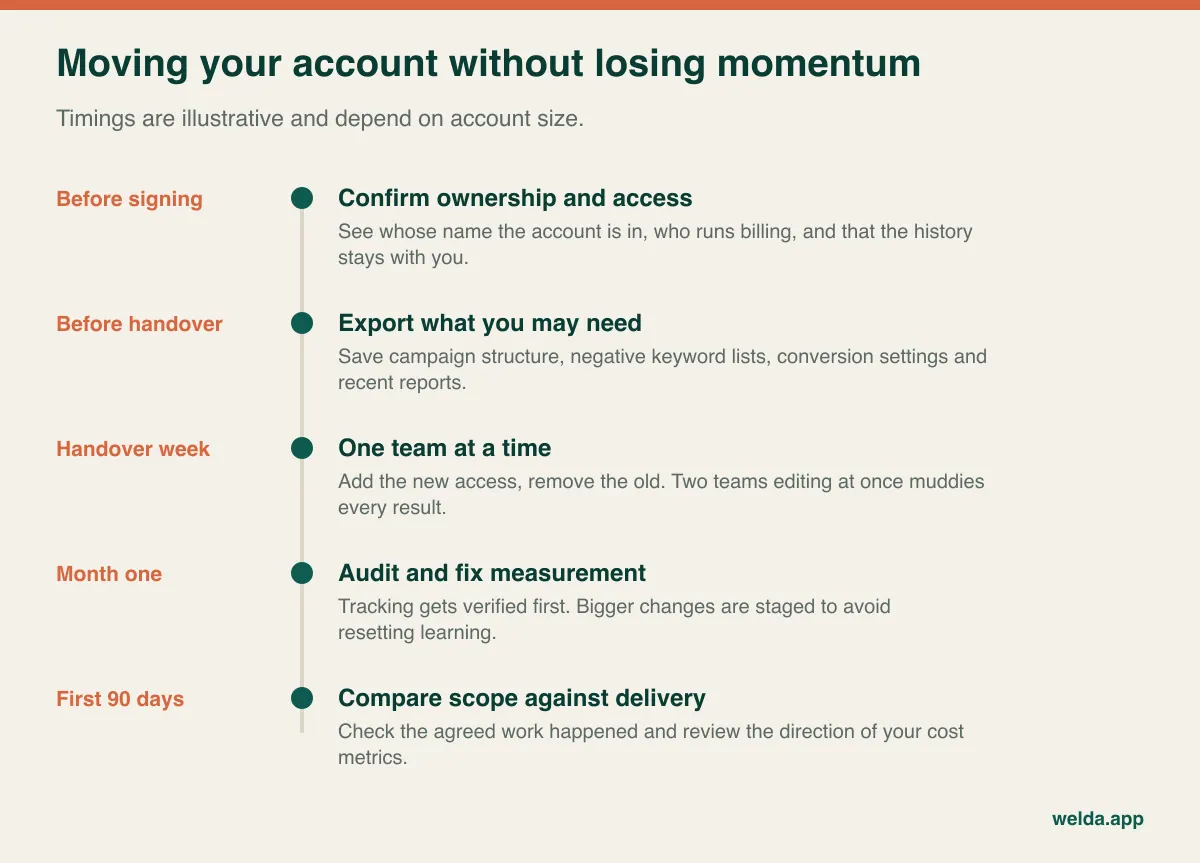
If an account is already running, include the cost of switching when you assess a new quote. A well-planned handover preserves history. A poor one can throw away months of accumulated learning.
- Confirm ownership. Check whose name the account and billing profile are in. If the agency owns it, discuss a transfer early.
- Export. Save campaign structure, negative keyword lists, conversion settings, and recent reports.
- Verify tracking access separately. GA4 and Tag Manager access matter as much as the ad account, and they are the logins people tend to forget.
- Keep one team in the account. Two teams making changes at once makes results unreadable, so set a clear handover date.
- Use month one to audit. Stage bigger structural changes. Changing everything at once hides what actually moved the numbers.
How Welda approaches this
We manage Google Ads across Search, Performance Max, YouTube and Shopping, alongside Meta Ads where they make sense. You keep ownership of your accounts and we work through admin access, so if we stop working together the accounts and their history stay with you. Each month you get one report showing spend, conversions, CPA and ROAS together.
We don't publish a fixed price list, because the fee depends on campaign scope, number of channels and monthly workload. If you'd like a quote you can compare using the method above, we can write the scope down together and pin down your Google Ads management cost in a free consultation. Feel free to put any other proposals you have into the same table. And if ads aren't the right next step for you yet, we would rather say so.
Frequently asked questions
Is the management fee included in my ad budget?
It shouldn't be, or at the very least it should be shown separately. Ad spend goes to Google and the fee goes to whoever runs the account. If you were quoted a single package price, ask for the monthly amount that will actually be spent on ads, in writing.
Is a percentage or a flat fee better?
There is no universal answer. If you expect to scale, a flat fee is more predictable. With a small or variable budget, a capped percentage may be more flexible. Calculate your break-even spend, then compare both over twelve months.
Do I have to pay a setup fee?
The setup work has to happen either way, so the real question is where its cost sits. An itemised fee makes the scope visible. If setup is "free", ask whether it has been spread across the monthly fee or tied to a term, and what happens if you leave early.
Can I just manage Google Ads myself?
Yes. For a single location and a small keyword set, with time to spare, it's a reasonable choice. Your hours still have a cost, though, and search term clean-up, measurement and testing need regular attention. Factor your own time into the comparison.
How soon can I judge whether it's working?
First data generally arrives within days, and the early weeks are about testing and learning. A fixed deadline would be misleading since conversion volume and industry both affect it. Agree the evaluation timeline and the metrics you will use before you start.
Why does account ownership matter so much?
Account history, conversion data and audience lists build up over time. If the account is in your name, you don't start from zero when you change agency. However attractive a quote looks, get this point in writing.
Is hiring a freelancer cheaper than an agency?
Sometimes, but compare scope rather than job titles. A freelancer may offer direct access to the person doing the work, while an agency may bring wider coverage across creative, tracking and holiday cover. Apply the same twelve-month calculation and the same questions to both.
If you've run your proposals through this method and still have questions, get in touch. We'll go through your scope and the model that fits it in a free consultation.