Switching PPC agency is safe when you control the ad accounts, know where your conversion data comes from, and move in the right order: secure admin access, map what the agency has built around the account, export your data, then give notice. Done that way, campaigns can keep running throughout. Done the other way round, you can find yourself negotiating for access to your own history with a supplier you have just fired.
This guide is for advertisers who are close to a decision and want to make it calmly. It will not tell you your agency is bad. Sometimes it is, and sometimes the real leak is a slow sales follow-up or a thin margin, in which case a new agency will inherit the same disappointment. So we begin with three checks you can run this week, then work through the less obvious technical traps, how to decide whether leaving is the right call at all, and how to run the handover without two teams pulling the same levers.
Three checks to run before you say anything
None of these requires telling your agency anything, and together they tell you how hard this switch will be.
Check one: can you log in as an admin? Sign in to Google Ads with your own Google login, not a shared one. Open the access and security screen (menu names shift over time, so look for the user list). Your work address should appear with Admin access. Standard or read-only access means you can look but cannot add or remove users. If the account does not appear at all, you do not currently have it, whatever your invoices say.
Check two: who pays Google? If your card or payment profile is on the account, an agency change does not touch billing. If you pay the agency and the agency pays Google, the account may depend on the agency's billing arrangement, and that arrangement goes when they go. This is the most common reason ads actually stop during a switch.
Check three: what counts as a conversion? Open the conversions screen and read the list of primary actions. A purchase, a qualified lead form or a tracked call is reasonable. A page view or a time-on-site goal is not a business result, and if automated bidding is optimising towards it, the account's history is worth less than it looks.
The answers put you in one of three positions. With admin access and your own billing, you can plan at leisure. Without admin access but with a cooperative agency, request an invitation in writing, using a company email address rather than one person's inbox, and wait until it is accepted before discussing an exit. If access is refused or the agency claims the account as its own, read the contract, put the request in writing, and take legal advice if the budget justifies it.
The agency's footprint is bigger than the campaigns
An agency that has worked with you for a year or two has usually left traces well beyond Google Ads: tags on your site, a phone number in your ads, a landing page on a tool you have never logged into. The handover failures that hurt most are quiet. Nothing errors out; reported conversions just drift down, or a phone line goes dead, and someone notices weeks later. Map the footprint before anyone knows you are leaving.
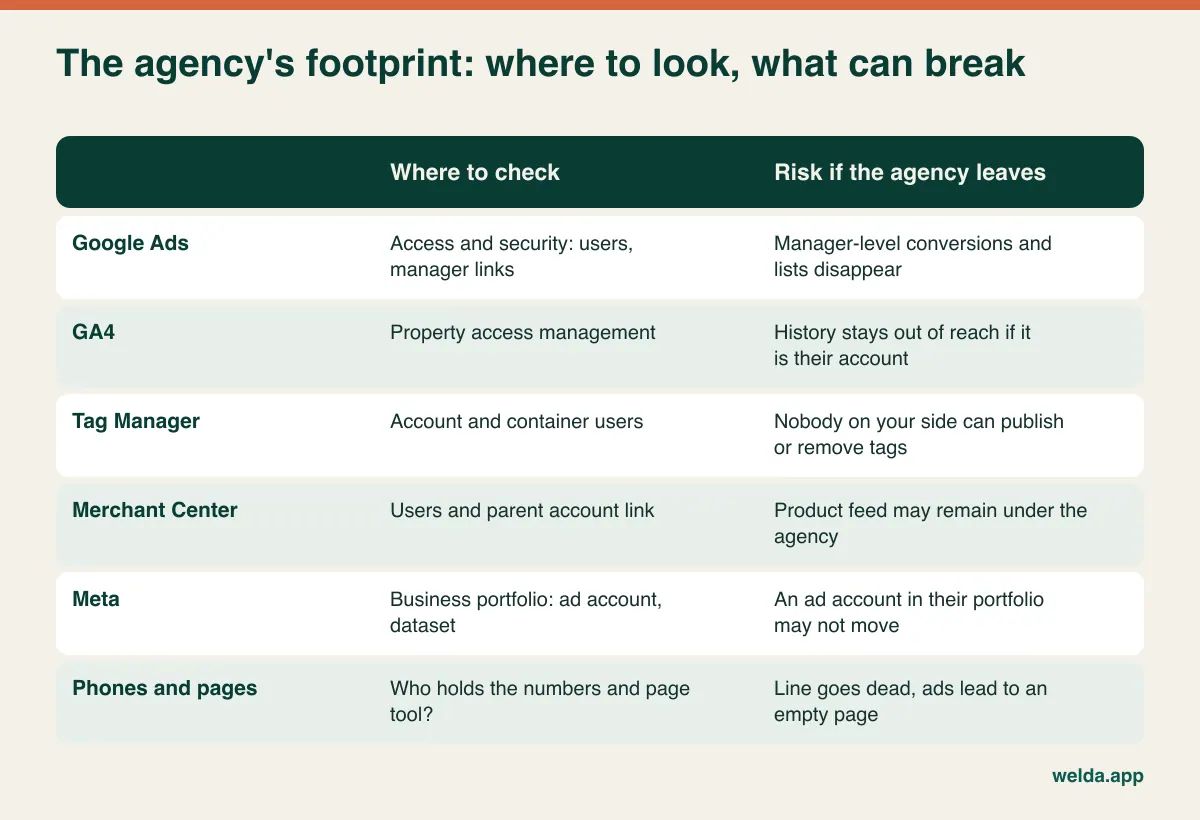
Four items deserve particular attention because they are invisible until the link is cut.
Conversions defined in the agency's manager account. Agencies often manage clients through their own manager account (MCC), which is standard practice. Some also define conversion actions at that level, known as cross-account conversion tracking. Unlink the manager account and your campaigns can lose the very conversion source their bidding relies on. Check where each action is defined, and have the replacement ready and recording before the link is removed.
Shared negative lists and portfolio bidding. Negative keyword lists and portfolio bid strategies can also sit at manager level. A negative list that took years of search-term review to build can disappear from your campaigns overnight, sending budget to queries you long ago excluded. Automated rules and scripts running from the manager account stop too. Copy the lists into your own account first.
Call-tracking numbers. If the numbers on your ads and website are forwarding numbers rented by the agency, they may stop ringing when the contract ends. Ask who owns them and whether they can be ported. A dead line is a far worse outcome than a gap in a report.
Landing pages and reports. Pages hosted on the agency's landing page tool can go offline with the subscription, leaving ads pointing at nothing. Dashboards built on the agency's login can stop refreshing. Ask for the source files and rebuild what you still need on your own domain. Our guide to switching web agencies covers the website side of the same problem, including domains and hosting.
Meta needs a separate look. An ad account created inside the agency's business portfolio generally cannot be moved to yours; you can be given partner access, but you may need a new ad account for the long term. Pixel or dataset ownership raises the same question. Platform rules change, so confirm against the current help pages before relying on this. Ask the same of Merchant Center: is your feed in a standalone account, or under a multi-client account the agency runs?
Is leaving actually the answer?
A switch has real costs, even with a clean handover. A new team has to learn your business, measurement gets corrected, and performance may be unsettled for a while. If the agency is not the problem, you pay all of that and arrive back at the same place. Reduce your complaint to one sentence, then test it.
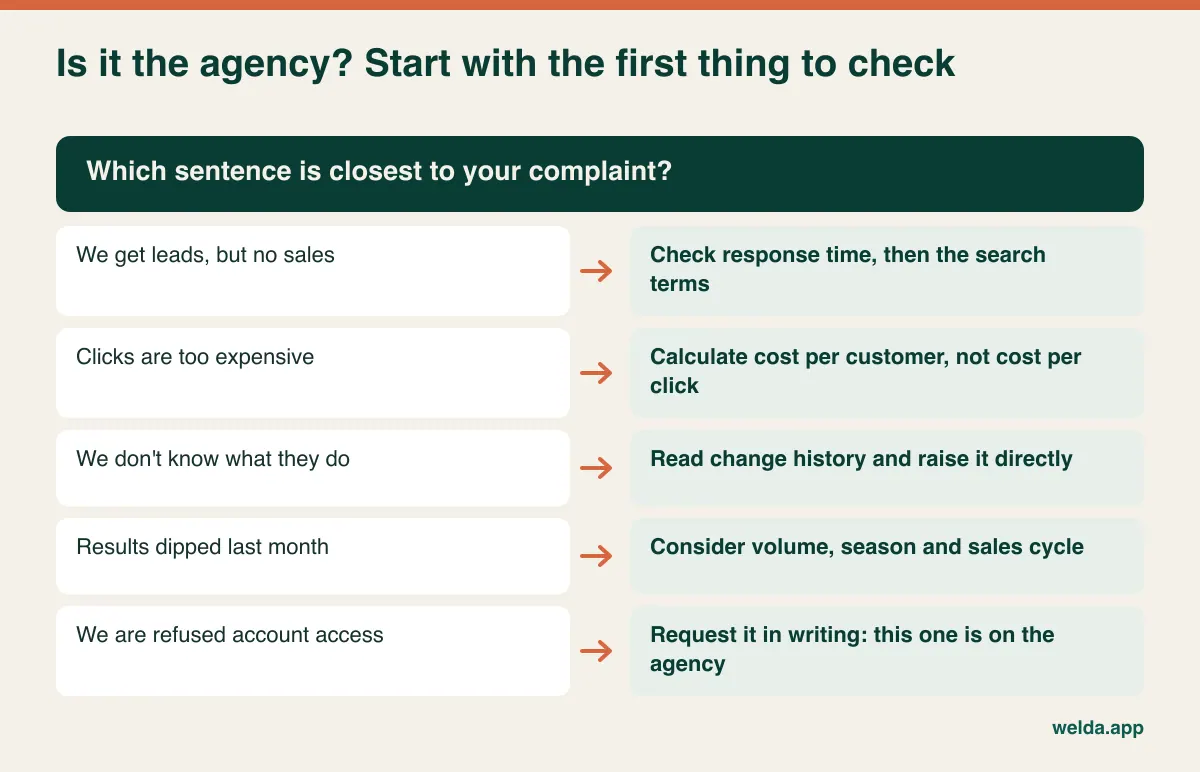
"We get leads, but no sales." Look at response time first. A home-services business that returns enquiries the next afternoon has often lost the customer before the call. Then read the search terms report: if the queries show no buying intent, the targeting is part of the problem too. Both can be true.
"Clicks are too expensive." Auction prices are set by competition, and no agency removes competition. The useful question is whether the clicks you buy turn into profitable customers. Our explanation of return on ad spend gives you a way to work that out on your own margins.
"We don't know what they do all month." This is the complaint most clearly about the agency. Change history in Google Ads shows what changed, when and by whom. Don't over-read it, because a well-built account does not need daily edits. But months of near silence combined with reports that only show impressions and clicks is a fair basis for a direct conversation.
"Results dipped last month." Be careful. A low-volume account can swing widely on chance alone, and a business selling expensive equipment on a six-month cycle cannot judge anybody on last month's numbers. Seasonality and a new competitor can also explain a dip.
If you are still unsure, give the current agency a defined last chance. Put three measurable requests in writing with a deadline: share the search terms monthly, add CRM sales to the report, correct a specific conversion definition. How quickly and how honestly they respond tells you more than months of accumulated impressions. Some working relationships recover at this point, and that is also a good outcome.
Your conversion data is the real inheritance
The campaigns can be rebuilt. What matters is whether the numbers beneath them are true, because automated bidding will faithfully chase whatever you have labelled a conversion. Mark a page view as a conversion and the system becomes very good at finding people who view pages. The report looks wonderful and the bank balance does not change.
Before you switch, line up three numbers for the same period: conversions reported in Google Ads, enquiries or orders that actually reached your CRM or inbox, and the sales that came from them. The chart below shows the shape this often takes, with a qualified-conversation stage added for businesses that sell through a conversation. Then work out the cost per real customer, which is often a far less flattering figure than the reported cost per conversion.
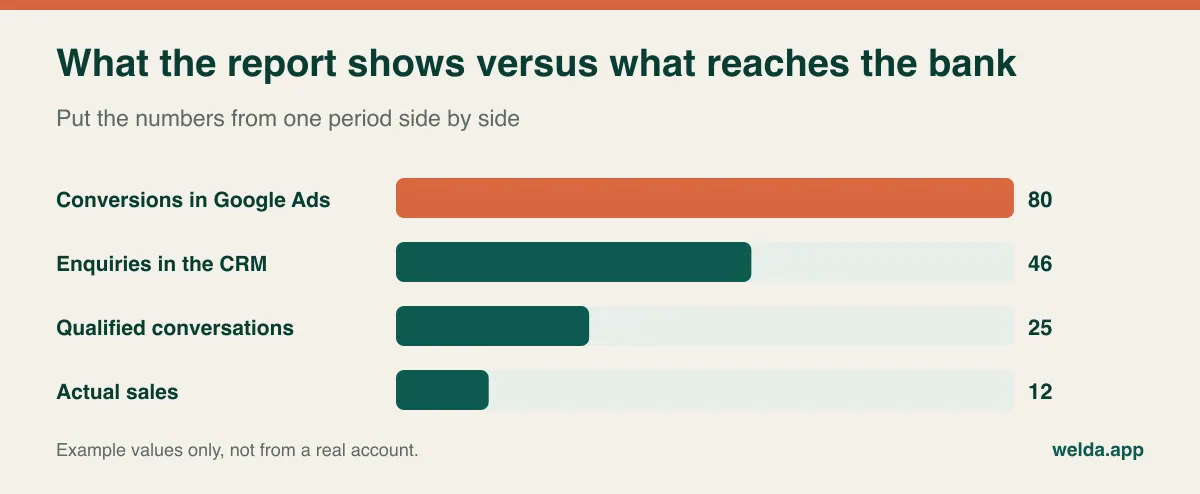
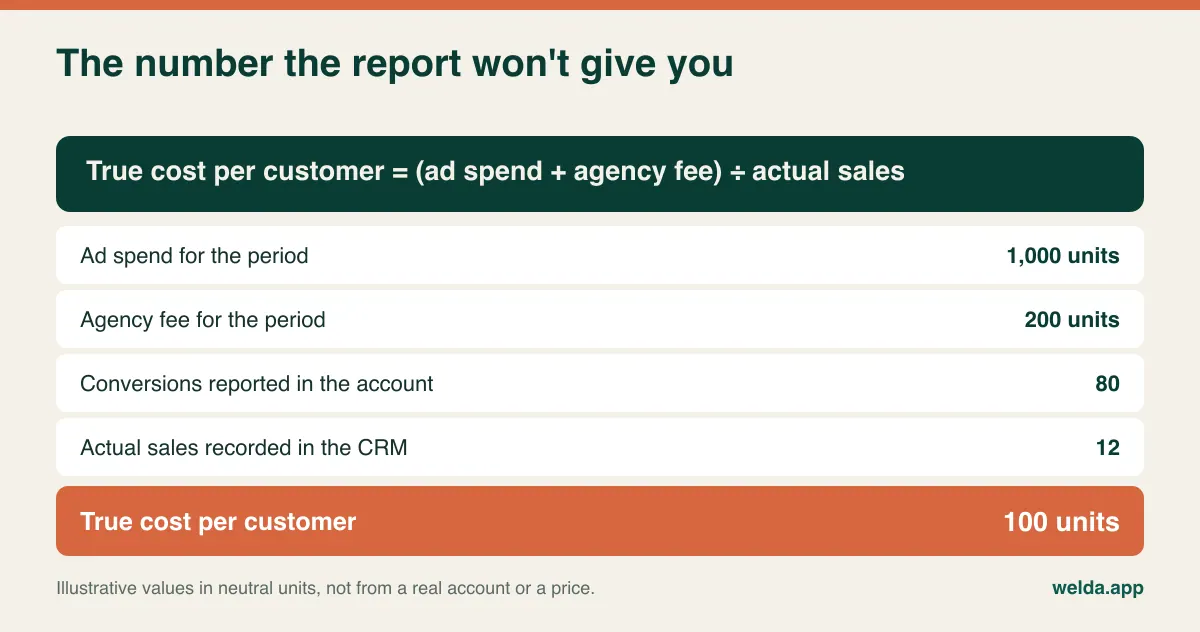
A large gap between reported and real has familiar causes: a form counted twice, a thank-you page that fires on each reload, spam submissions counted as leads, a weak action set as primary. Some gap is entirely normal, since Google Ads and GA4 use different attribution logic and should not be expected to match exactly. What you want is an explanation for the difference, not a perfect match. If yours needs rebuilding, our guide to setting up conversion tracking walks through what a sound configuration looks like.
Keep the order of work strict: validate measurement first, restructure campaigns after that, change bidding last. Change all three in one fortnight and when performance moves, nobody can say why. It also gives you a fair baseline for judging the new agency.
For long sales cycles, ask whether closed sales can be fed back to Google Ads through offline conversion imports. That teaches the system to look for people who resemble buyers rather than form-fillers. It works only if your CRM records are kept in reasonable order, so if they are not, start there.
Keep the account, or start a new one?
If you can get control of the existing account, keep it in nearly every case. A new agency may want to rebuild the structure, which can be perfectly sensible, but that can happen inside the same account with the old data still available for reference. An agency that insists on a fresh account under its own control should explain precisely why; it would also be recreating the very situation you are trying to escape.
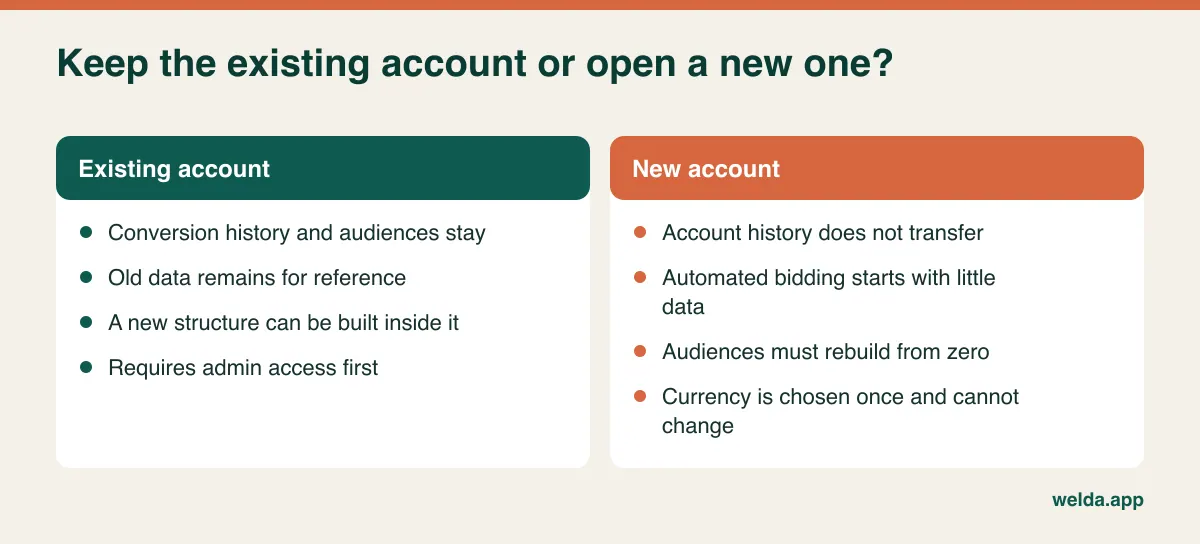
If a new account is unavoidable, go in with open eyes. Conversion history and remarketing audiences do not transfer, so automated bidding starts with far fewer signals. While you still have access to the old account, export campaigns, ads and keywords through Google Ads Editor, which saves a great deal of rebuilding. Never open a new account to get around a policy suspension; that can be treated as a further violation, so deal with the appeal first. Finally, pause the old account rather than closing it where you can, because last year's search terms are useful next season.
The wrinkles of running across borders
Advertisers selling in more than one country face a few extra points that a single-market guide tends to skip.
Currency and time zone. An account's currency cannot be changed after creation, and the time zone setting shapes how your daily reporting lines up. If a new account is forced on you, choose both deliberately with your finance lead. A company invoicing in euros but running an account in another currency can end up reconciling the difference for months.
Invoices and tax. When spend moves from an agency's invoice to direct billing from Google, the supplier on your books changes, and with it possibly the VAT or sales tax treatment. Which entity invoices you depends on your billing country. Ask your accountant before the changeover rather than at year-end, and close out any balance with the old agency in writing.
Consent and privacy. Rules differ by jurisdiction. If you advertise to people in the EEA or UK, GDPR and the local cookie rules apply, and consent signals (Google's Consent Mode is the usual mechanism) affect what can be measured and used for audiences. In the United States, state privacy laws add their own obligations. A handover is a good moment to check whether the consent banner actually governs the tags on your site, since tags added by a former agency are easy to overlook. This is general orientation rather than legal advice.
Customer data held by the agency. Customer Match lists, CRM exports and form data may all sit with your outgoing agency. Ask what it holds, and how it will be deleted or returned, and when its accounts will be closed. Check whether your contract or a data processing agreement already sets out those terms.
Language and market knowledge. If an agency ran campaigns in several languages, find out who wrote them and whether the new team can actually read them. Ask to see the negative keywords for each market, because those are where local knowledge shows up. It is easy for a new team to lose this quietly by treating every country as a translation of the home market.
Contracts, notice and the exit conversation
Find three clauses before you speak to anyone: the notice period, any minimum term, and what must be handed over when the relationship ends. Check who owns ad copy, creative assets, video and keyword research. Where the contract is silent, ask in writing rather than assuming. For a substantial account, an hour of a lawyer's time is modest insurance.
Two rules govern the sequence. First, get admin access before serving notice. Most agencies behave professionally when a client leaves, but requesting access afterwards is always harder than having it beforehand. Second, finish your exports before the conversation. That is ordinary diligence rather than distrust, since these are your accounts and you do not need permission to download your data.
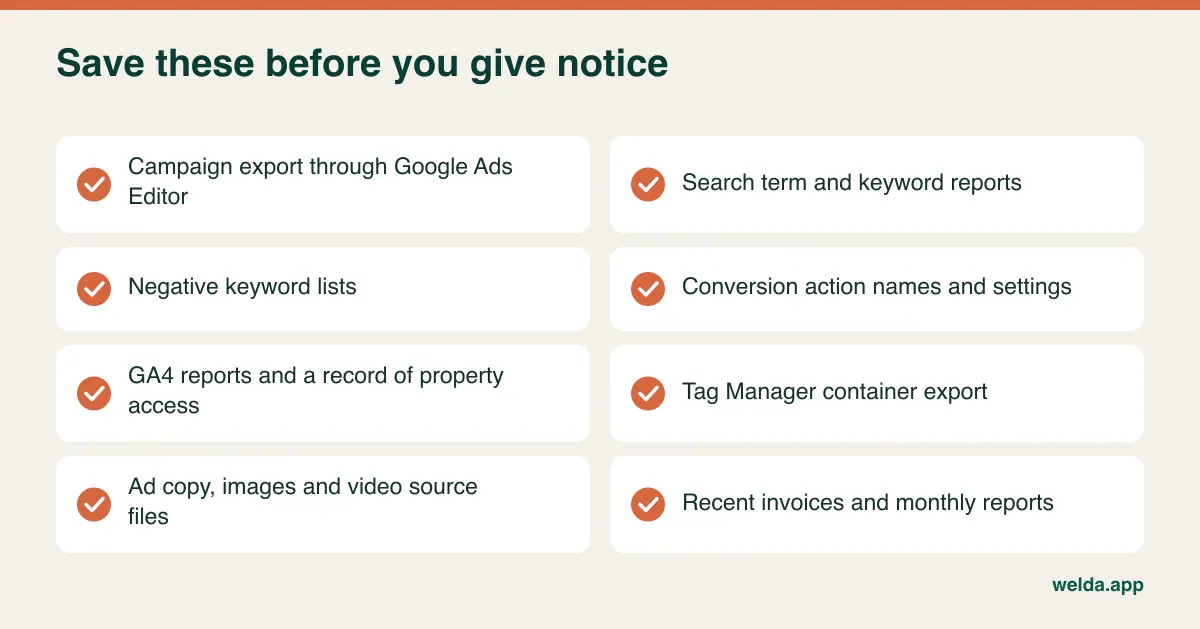
Then keep the message brief and in writing: the decision, the last working day, the handover list, and who is allowed to change what during notice. You do not owe a debate about performance. Usually the healthiest instruction is that campaigns continue as they are, with no major changes until the handover date.
Interview the next agency with your account open
Skip the capabilities deck. Give your shortlist temporary read-only access, which lets them see real data without being able to change a thing, and ask them to talk about your account rather than about marketing in general. Remember that an agency chasing your business has every reason to find faults in the incumbent's work, so ask for evidence each time: which search terms, how much spend, which report. General selection criteria are in our guide to choosing a digital advertising agency. These questions are the ones specific to a takeover:
- What will you deliberately leave alone for the first month, and why?
- Which conversion actions look wrong to you right now, and what would you make primary?
- Under which login will the account sit, and what happens to access on the day we part ways?
- Will your monthly report reconcile against sales in our CRM?
- Who will actually work in the account, and who covers when they are away?
- Over what period should we judge you, and what evidence is that based on?
Be wary of comparing quotes on a single monthly number. Scope varies widely: which channels are included, whether creative production is covered, how reporting works, whether takeover or setup is charged separately. The hidden costs tend to lie in tracking repairs, landing page revisions and extra creative, so ask about each directly. Our article on Google Ads management cost compares fee models using worked examples. Treat guaranteed results with caution, since performance also depends on competition, your offer and your website, none of which an agency fully controls.
A handover without two hands on the wheel
The riskiest stretch of any switch is when both teams have access. If one changes bids while the other moves budget, nobody can trace cause and effect afterwards. A good plan lets you say in a single sentence who has editing rights on any given day.
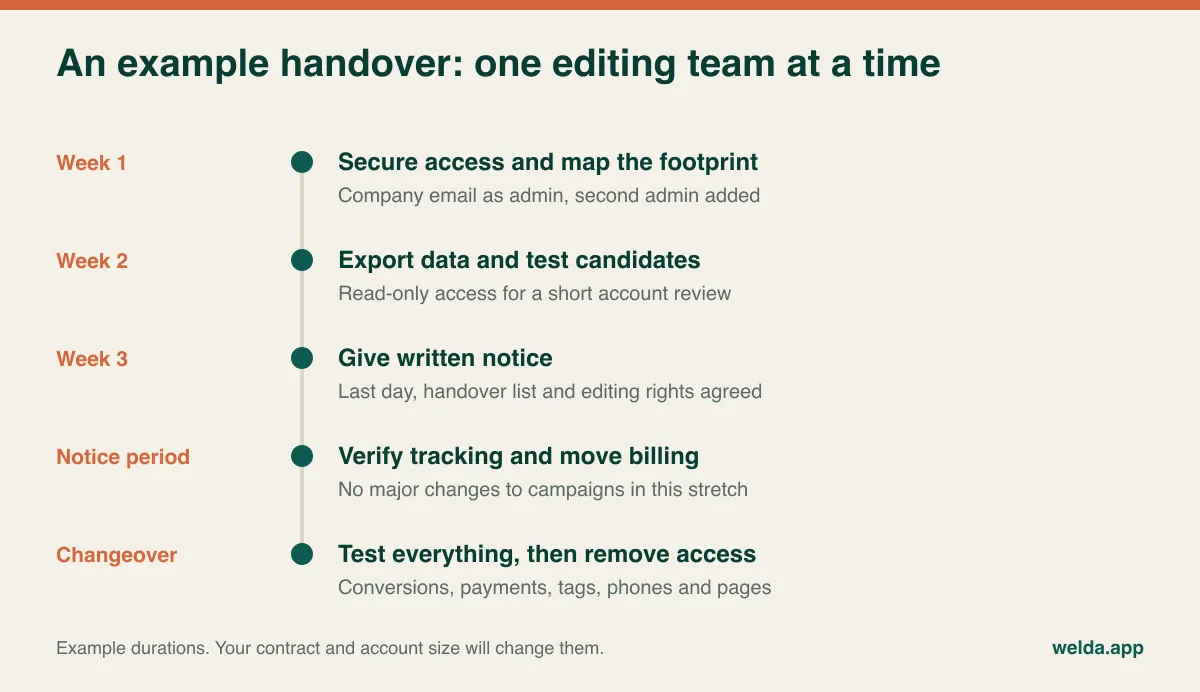
Avoid your peak if you can. Black Friday for a retailer, enrolment season for a training provider, and booking season for a travel business are poor moments to change hands. If notice periods force the timing, let the new team observe through the peak and hold structural changes until afterwards.
On changeover day, run a short check: are conversions still recording, are ads approved and serving, is the payment method valid, do the tags still fire, do the phone numbers ring? Only then remove the old agency's users, and go platform by platform: Google Ads, GA4, Tag Manager, Merchant Center, Meta, your CRM and your website admin. Former suppliers keeping access for years is an easy thing to let slide.
Judging the new team fairly
New structures and bidding changes need time to settle, so early wobble alone is not a verdict. But "the algorithm is still learning" is not an indefinite excuse. Use different yardsticks at different stages. In the first weeks, judge the work: is measurement fixed, is the explanation clear, are the questions good? Once there is enough data, judge the outcome against your real cost per customer.
Compare with the same period last year where you can, not simply the previous month. If measurement was corrected, old and new conversion counts are not like for like. A drop may just mean duplicates have gone, which is progress rather than decline. Your CRM is the tie-breaker. With a long sales cycle, allow for conversion lag too, as this month's click may be next quarter's order.
What working with Welda looks like
If you are switching PPC agency and considering us, the principles above are how we work. Ownership and control of your ad accounts stay with you, and we work through manager access. If the engagement ends, the accounts, historical data and accumulated learnings stay with you. We manage Search, Performance Max, YouTube and Shopping on Google, and Facebook and Instagram ads on Meta. We set up conversion tracking with GA4, Google Tag Manager, Meta Pixel and the Conversions API, and we do not run ads without proper measurement. Each month you see spend, conversions, CPA and ROAS in one report.
Our limits are worth stating as well. Our service covers Google and Meta, so if you rely on another ad channel, raise that early. We don't publish list prices, because the management fee depends on campaign scope, the number of channels and the monthly workload; ad spend goes directly to the platforms and is separate from that fee. We manage timelines honestly and don't make inflated promises.
A free consultation is where the price and the plan become clear. Tell us what access you have, how billing runs, and what is bothering you, and talk to us about switching PPC agency. If it turns out that staying with your current agency makes more sense, we will say so.
Frequently asked questions
Will my ads stop when I switch PPC agency?
They need not, provided you control the account and billing and have replaced anything that depended on the agency first. Stoppages usually come from billing tied to the agency's arrangement, landing pages on the agency's tools, or conversion sources left behind in its manager account.
What if my agency won't give me access to the account?
Gather your contract, invoices and correspondence, then request access in writing. If that fails, get legal advice. If ads must keep running in the meantime, you may need a new account in parallel, accepting that the history will not come with it.
Do I lose my Quality Score and history when I change agency?
Not if you stay in the same account. The data belongs to the account, so a new agency sees the same history once linked. A new account starts without that history, and performance signals take time to build up again.
Can I talk to other agencies without telling my current one?
Yes. Check your contract's confidentiality terms before sharing reports or screenshots. If you give temporary read-only access, you need admin rights to do it, and you should remove it as soon as the review ends.
How long does the handover take?
It depends on your notice period and how much sits outside the account. A simple Search-only account with clean billing can move quickly, while accounts with feeds, several markets or agency-owned tracking need longer. Build the plan around the notice period and your sales peak.
Why did reported conversions drop after switching?
There are three possibilities: duplicates were removed when measurement was fixed, a tag or conversion source broke when the agency left, or performance really fell. Real enquiries and sales in your CRM will tell you which one it is.