Facebook ads management cost has no standard rate, because the fee pays for a mix of work that varies enormously between businesses. Three things move it most: how much new creative has to be produced each month and by whom, how much targeting and tracking infrastructure has to be built and maintained, and how far the reporting goes beyond what Ads Manager already shows you. Your ad spend, which goes straight to Meta, sits on top of all that. When two agencies quote very different amounts for what sounds like the same service, they are usually pricing different jobs.
That is good news if you are comparing proposals, because scope can be examined even when a price cannot be judged in isolation. The sections below walk through what each part of the scope actually involves on Facebook and Instagram, where the hidden work sits, and how to line up unlike proposals so that you can choose. If you are still deciding whether paid social fits your business at all, our Facebook and Instagram advertising guide covers the basics first.
What you are really buying each month
A proposal for managing Meta ads usually bundles several kinds of work under one line. Unbundling them is the first useful thing you can do.
The media budget is what Meta charges for showing your ads. The management fee pays for the people who plan, build, monitor, test and report. Production pays for what people actually see in the feed: photos, video, editing, motion and design. Then there is measurement, the setup that tells everyone whether any of it worked, which may be one-off or may be folded into the monthly fee.
The balance between those parts is what makes Meta different from search advertising. On Google, someone has already typed what they want, and much of the work concerns intent. On Instagram, nobody asked to see your ad. You have to stop a thumb. That makes creative the lever that does most of the work, and it is why a Meta proposal that glosses over creative is missing the most expensive question. If you are also looking at search, our piece on Google Ads management cost explains how those fees behave, and you will notice the difference in emphasis.
Creative volume: the question that decides most of the quote
Ads wear out. Show the same video to the same people often enough and they stop reacting; marketers call this creative fatigue. How quickly it happens depends on your audience size, your spend and the ad itself, so nobody can give you a universal schedule. A narrow audience with a large budget burns through material quickly. A broad audience with a modest budget can keep a good ad alive for much longer. What matters for cost is that the need for fresh material is continuous, and someone has to meet it.
Take two businesses that would both ask for "Instagram ads". A personal trainer films short clips on a phone, sends them over, and needs an expert to cut them, write copy and run campaigns. The agency's work is mostly editing and media buying. A direct-to-consumer skincare brand wants new concepts for every product launch, in vertical video for Reels and Stories and in square or landscape for Feed, plus a product catalogue running in the background. The agency is effectively running a small production desk. The word on the invoice is the same, but the hours are not.
When you read a proposal, look for four numbers: new concepts per month, format adaptations per concept, revision rounds, and shoot days if filming is included. If none of them appears, "creative management included" tells you very little. To one agency it may mean rewriting a headline; to another it means a new video. Both will believe they delivered what was promised, and the disagreement usually surfaces around week five.
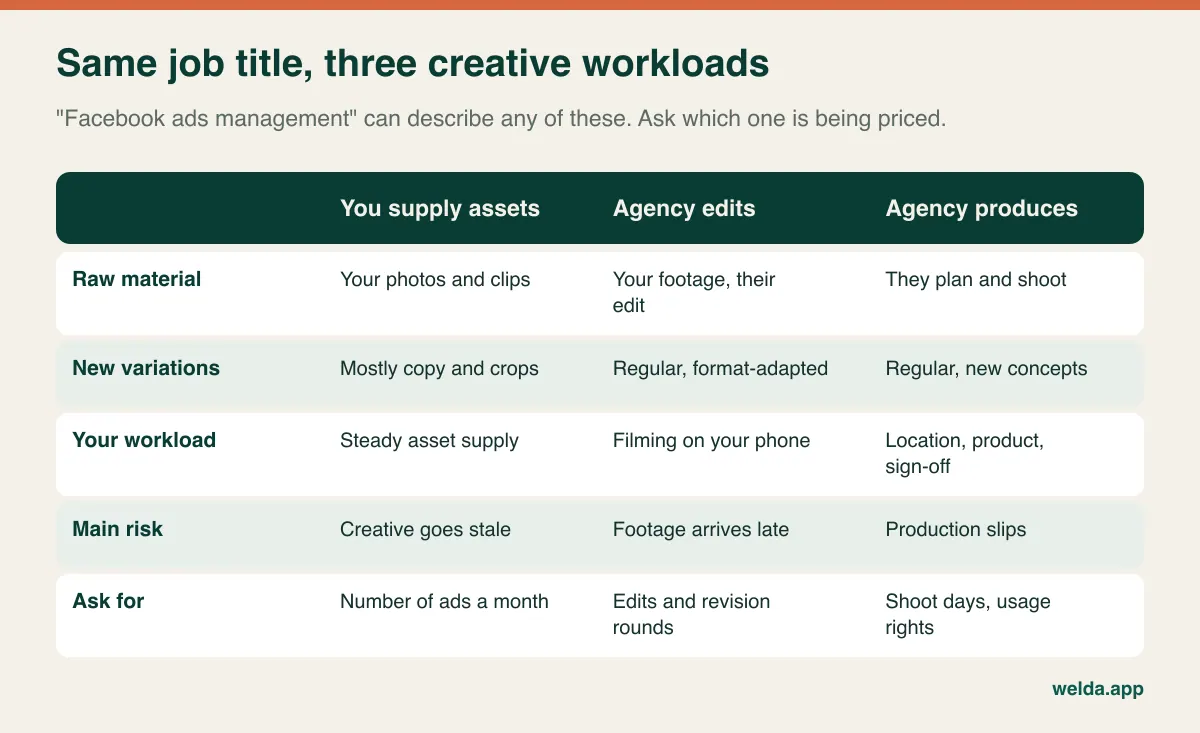
Rights are the detail people forget. Who appears in the footage, and did they agree to paid use? Is the music licensed for advertising? Tracks that are fine in an organic post may not be cleared for ads. If you stop working together, do you keep the edited videos only, or the editable project files as well? Are you allowed to use the material on your website or in other channels? None of this is exotic, yet each answer can carry a cost later. If regular filming is part of the plan, it helps to see content production as a line separate from media management, so you can change one without disturbing the other.
Targeting: why counting audiences is a poor yardstick
Older proposals still list "number of audiences built" as if it were a measure of value. Meta has been moving audience selection steadily towards automation, and in the Advantage+ options the system can treat your inputs as suggestions and look beyond them. That doesn't remove targeting work. It moves it. The useful effort now tends to sit in three places: feeding the algorithm the right conversion signal, building first-party audiences from customer lists and site visitors, and keeping the campaign structure simple enough for each part to gather data.
Pricing by audience count even creates a small trap. Slicing a modest budget into many small ad sets slows learning in all of them, so the structure that looks like more work on paper may perform worse for you. Rather than asking how many audiences they will build, ask why they recommend this structure at your budget. A good answer refers to your spend and conversion volume, and it may well be shorter than you expected.
Where targeting does become genuinely more work is at the edges. A restaurant serving one neighbourhood reaches the same people quickly, so frequency has to be watched and ads refreshed more often. Regulated categories such as credit, employment, housing and political or social issues can face restricted targeting options on Meta depending on the market, and health-related advertisers may run into limits on the data they can use. Those accounts can also see more rejected ads and appeals, and that time has to come from somewhere. If you are in one of these sectors, say so at the start and ask how the agency has allowed for it.
Reporting depth is a cost driver, not a footnote
"Monthly reporting" appears in nearly every proposal, and it can mean almost anything. At its simplest it is an export from Ads Manager: impressions, clicks, spend. One level up you get analysis by campaign and creative, with a view on what won, why it probably won and what changes next month. At the deepest level, ad data is joined with your own sales or CRM records, so you can see what Meta claims against what actually landed in the bank.
That last comparison matters because Meta reports conversions using its own attribution settings, which can include people who only viewed an ad as well as those who clicked. Meanwhile, mobile privacy changes and declined cookies remove some signals altogether. So the platform number can be higher or lower than reality without anyone doing anything wrong. An account steered purely on the platform figure can end up moving budget for the wrong reasons. Whenever a proposal mentions ROAS, ask for the definition in writing: from which source, using which attribution window, and before or after refunds.
Deeper reporting costs more because someone has to clean, match and interpret data. You may not need it. A single-location service business can do very well with a short monthly call and one clear table. A store with several product lines and a meaningful return rate is taking larger decisions and has more to lose from a misleading figure. Buy the reporting depth that matches the size of the decisions it will inform.
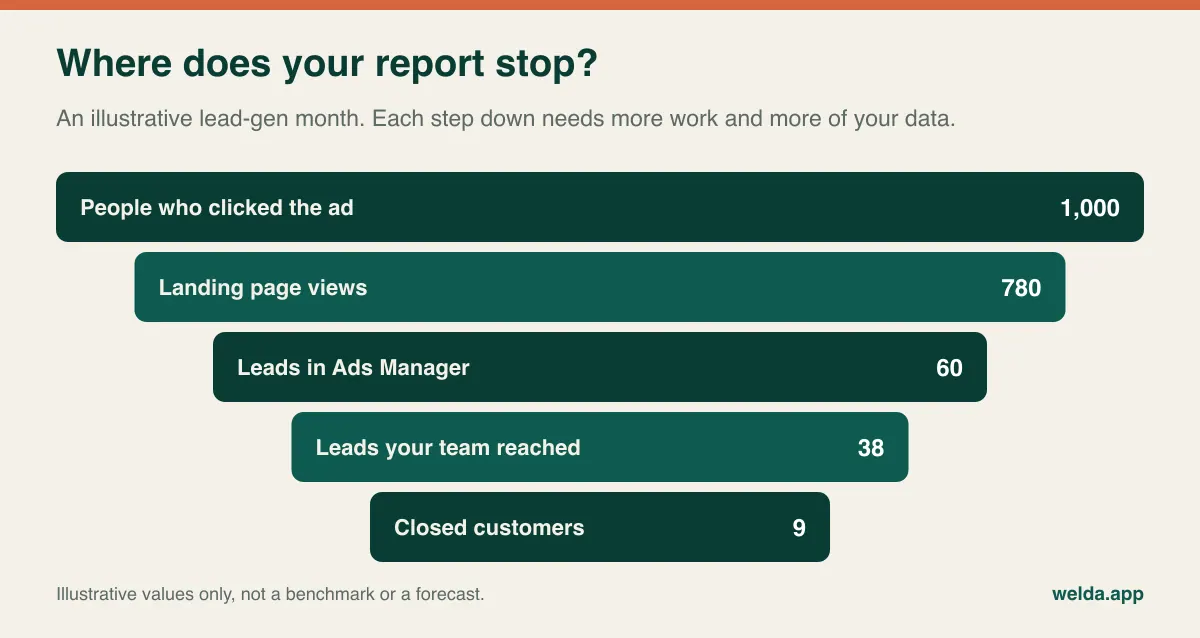
The route to conversion shapes this too. An instant form inside Facebook is easy to complete, so lead counts can look strong while quality disappoints; your team may spend its time calling people who barely remember filling it in. Click-to-message ads count conversations, not customers, and a conversation only becomes a sale if someone records it. Sending people to your site means conversion tracking, page speed and checkout become part of the job. Each route needs a different scope, so settle it before you compare fees.
Retainer, percentage or performance: how each behaves on Meta
The familiar pricing models all exist for Meta ads, but creative-heavy work changes how they behave.
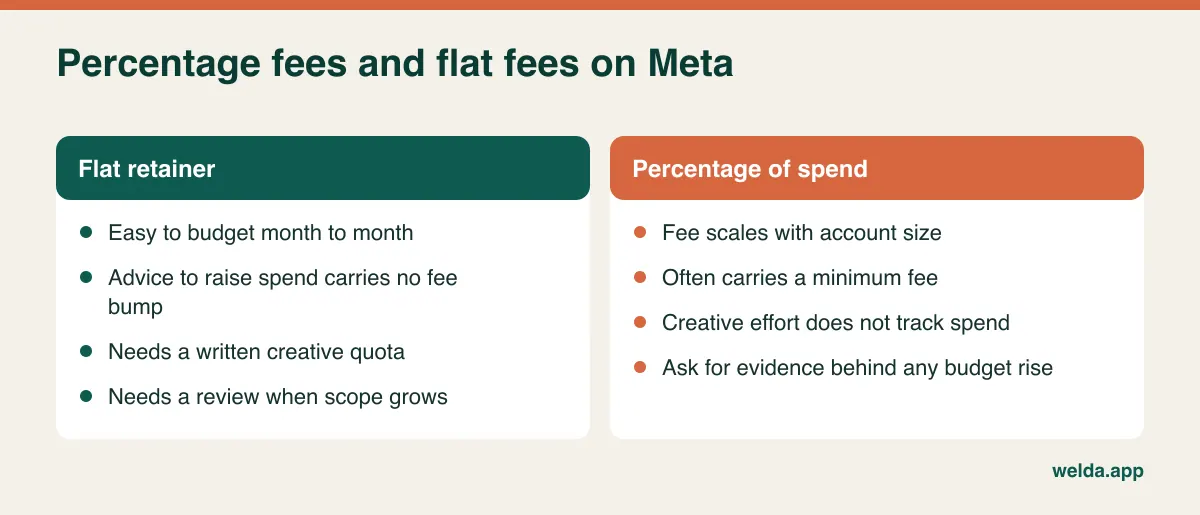
A percentage fee ties income to spend, yet much of the effort on Meta goes into creative and testing, which don't grow in step with the budget. At low spend with lots of new video, the percentage won't cover the work, which is why you often see a minimum fee. At high spend with stable creative, the same percentage can run ahead of the effort. And if a budget increase also raises the agency's income, it is reasonable to ask for the data behind the recommendation. That isn't an accusation, just a question the model invites.
A flat retainer is easier to plan around and removes that tension, but it needs a clear quota. Otherwise you may find either an agency quietly doing less as work grows or a stream of change requests. Seasonal businesses should raise the issue early: a ski rental shop or a beach hotel does not need the same month-to-month workload all year, and a retainer can be structured around that if you ask.
Performance deals sound like a shared risk, and sometimes they are. They need watertight definitions, though. What counts as a sale? Are refunds deducted? How do you separate customers who would have bought anyway from those the ad brought in? If sales close over the phone or in a chat, that attribution gets harder still. An unclear performance deal tends to fall apart in the first disputed month.
Running ads across countries multiplies the scope
Many businesses searching in English are selling across borders, and this is where proposals diverge most. "Three countries" sounds like a settings change. In practice it can triple parts of the work.
Language comes first. Translated copy often misses the tone, and an ad that relies on a local reference won't travel at all. Someone needs to write or check copy natively, including replies to comments if community management is in scope. Next, the offer itself: delivery times, payment methods, returns, currency and local proof differ by market, so landing pages may need versions as well. Compliance varies too. EU and UK visitors generally bring GDPR and cookie consent into the picture, several US states have their own privacy laws, and ad claims in sectors such as health or finance can be held to different standards.
Budget also matters. Splitting a modest budget across several countries can leave each too thin for the system to learn from. A sensible agency may suggest proving one market first, even though it means a smaller project for them. Reports need decisions as well: one currency or several, whose time zone defines a day, and whether Meta's numbers are compared to a shop system that closes the books differently. Ask the agency to state explicitly which markets and languages the fee covers, and what adding one would change.
Putting three proposals on the same page
Monthly figures side by side are misleading. One agency may list setup separately, another may leave production out, a third may require a twelve-month commitment. Use this grid, and treat every empty cell as a question to send back.
| Line to compare | What to look for | If it is missing |
|---|---|---|
| Setup and tracking | Pixel, Conversions API, event list, audiences | Spread into the fee, or not being done |
| Creative quota | Concepts, adaptations and revisions per month | Expectations will differ |
| Production costs | Shoot days, travel, talent, music | Possible extra invoices later |
| Report depth | Frequency, meetings, joined sales data | Possibly a platform export only |
| Channels and markets | Meta only, or others too; which countries | Additions may be billed extra |
| Tax basis | With or without VAT, GST or sales tax | Figures aren't comparable |
| Exit terms | Minimum term, notice, file handover | Switching cost stays invisible |
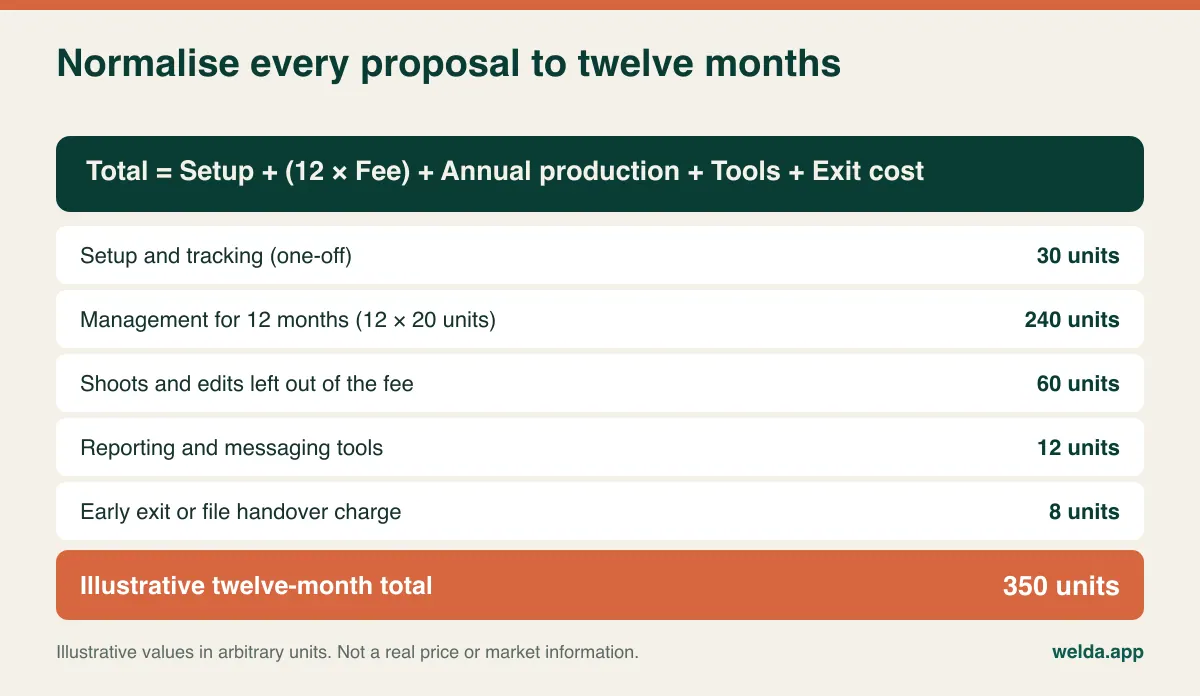
Add a stress test once you have the totals. In the example above, management and production work out at 25 units a month. If each order leaves you 5 units of gross profit, you would need five orders a month just to cover the agency, before paying for a single impression. Running your own figures this way sometimes reveals that the problem isn't the quote but the economics. A low-margin, one-time purchase can struggle to carry any managed paid social, whereas repeat purchases or high-value leads may justify it. The arithmetic is more useful than any industry average, since it uses your margin and not somebody else's.
Agency, freelancer, in-house or yourself?
The honest answer for some businesses is not to hire an agency yet. If you have one clear offer, modest spend and someone with time to learn, running ads yourself is reasonable, possibly with a paid setup review from a specialist. Without a product that already sells, capacity to deliver and enough budget to test for a few months, a management fee doesn't fix the underlying issue. It only makes it more expensive.
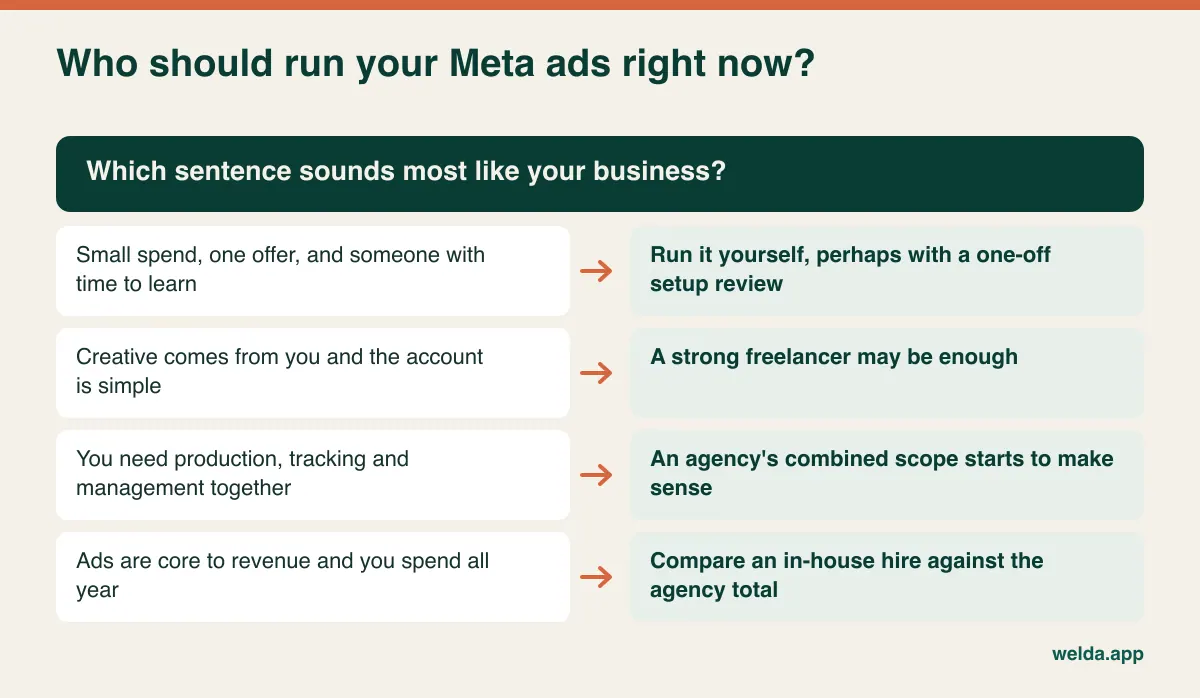
A freelancer can be an excellent fit where the work is focused and creative comes from you. Check what happens during holidays or illness, and who else can access the account. An agency's extra value comes from having production, measurement and media management in one place, so don't pay for that combination unless you need it. An in-house hire makes more sense when ads are central to revenue all year, although remember salary, tools, the learning curve and the single point of failure. Compare all of these on the same twelve-month basis, including your own hours if you plan to do the work yourself.
Questions that reveal more than a case study
Sales calls tend to dwell on results. Steer yours towards scope and ownership. Ask the agency to describe the first month on your account: what happens in week one, when the first ad goes live, and what they need from you. A concrete answer suggests they understand your business. A generic one tells you how the first month is likely to go.
Also ask them what they would not do for you, and when they would advise against raising the budget. Ask to see a sample report with client details removed, and ask who actually runs the account day to day, since the person selling isn't always the person managing it. Treat confident promises of a specific return with care: nobody controls auctions, competitors and consumer demand.
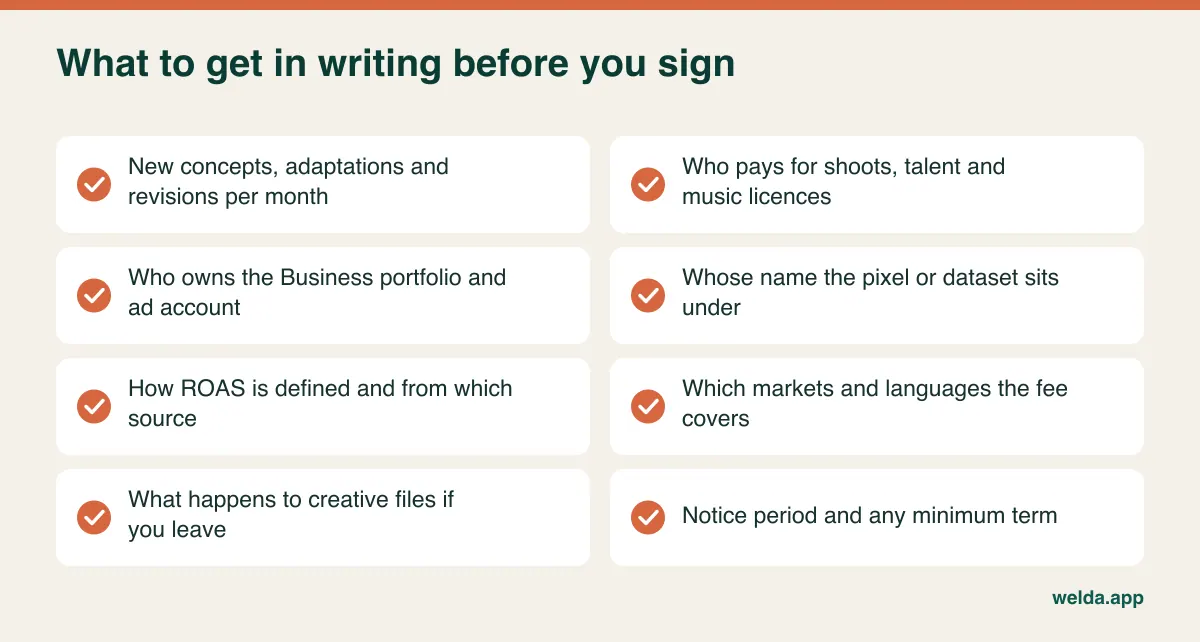
Ownership deserves special attention on Meta because the chain has more links than on many platforms. The Facebook Page, Instagram account, ad account, Business portfolio, pixel or dataset, and payment method are separate assets. An ad account created inside an agency's portfolio may not transfer to you later, and the data accumulated in its pixel could stay behind. The healthy arrangement is simple: the assets live in your portfolio and the agency gets partner access. When the work ends, you remove access and carry on with everything intact.
Changing manager without starting again
If you already run campaigns, the cost of switching belongs in the comparison. A careful handover protects your history, while a careless one can throw away months of learning.
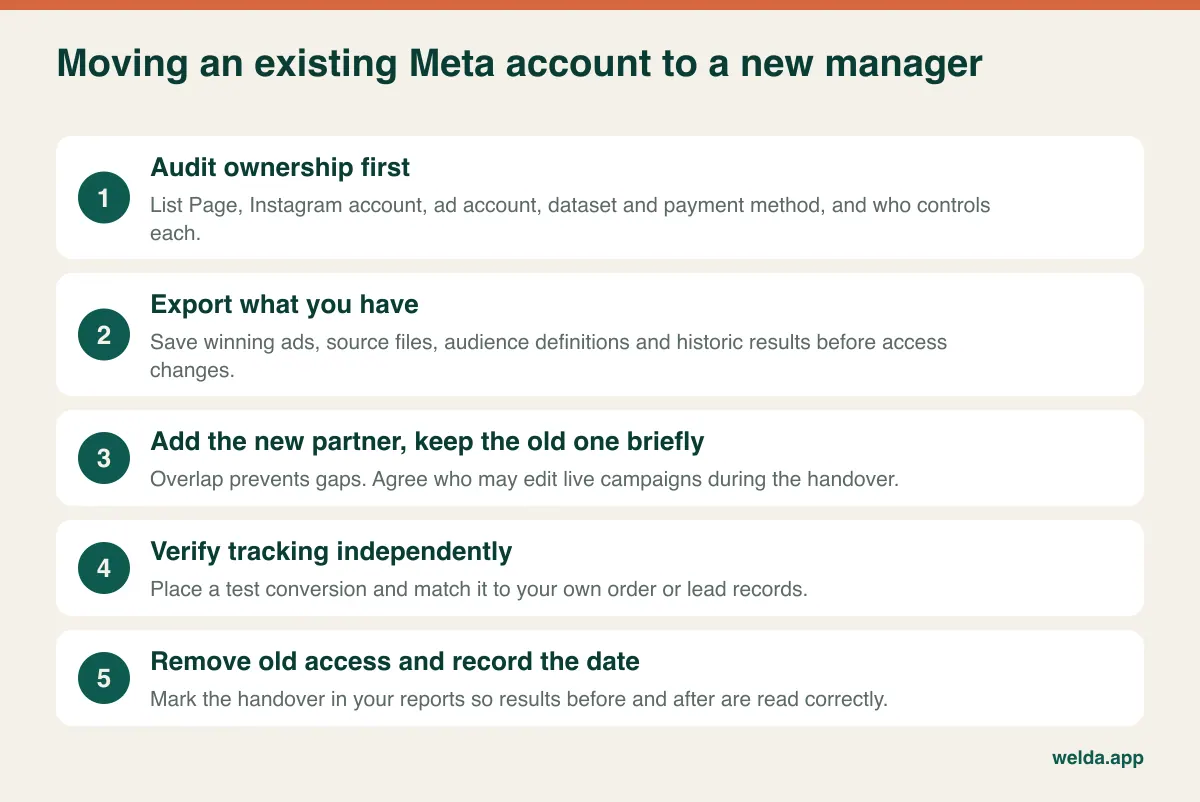
Expect results to wobble for a while after any major restructure. Meta's learning phase resets with significant edits, so a new manager who rebuilds everything in the first week should be able to explain why. Agree in advance what you will judge at thirty and at ninety days, and write the criteria down before launch. Ninety days in, you also have real data for a fee conversation: was the creative quota too small, did you leave part of it unused, did the reports match your sales? You can then adjust scope based on your own account, not on a forecast.
Tax, privacy and contract points to raise
Rules differ by country, so take these as questions for your accountant or lawyer and not as advice. Check whether quotes include VAT, GST or sales tax. If an agency or Meta bills you from another country, reverse-charge or withholding rules may apply where you are. On privacy, the pixel and Conversions API send visitor data to a platform, so consent, a privacy notice and a lawful basis may all come into play depending on your audience. Uploading customer lists for custom audiences needs particular care. If the agency handles customer data for you, ask how that is covered in the contract, and name the person who signs off ad claims.
How the scope conversation works at Welda
At Welda we build, test and manage Facebook and Instagram ads by audience, format and placement, plan the funnel from cold audiences to retargeting, and set up conversion tracking with Meta Pixel and the Conversions API. We A/B test copy, images and video, and share a monthly report on spend, conversions, CPA and ROAS. The ad accounts stay yours, and we work through admin access. For work involving shoots we also offer content production, and it is worth settling in the first conversation which line of your proposal that belongs on. We don't publish list prices either: Facebook ads management cost with us depends on campaign scope, number of channels and monthly workload, and it becomes clear in a free consultation.
Frequently asked questions
Does the management fee include ad spend?
Normally not. Spend goes directly to Meta and the fee goes to whoever runs the account. If you are offered one bundled figure, ask in writing how much reaches Meta each month, then verify it in your ad account's billing section.
Are Facebook and Instagram priced separately?
They're generally treated as one channel because both run from Ads Manager, although agencies differ. The real difference comes from formats: vertical video for Reels plus separate edits for Feed adds work. Ask how many formats are included, not how many platforms.
Will the fee drop if we produce our own creative?
It should, since production is out of scope. But a steady supply of assets then becomes your responsibility. If filming stops during a busy period, ads go stale, and you are still paying for management with little left to test. Be realistic about your capacity.
Is an agency worth it on a small budget?
Run the numbers first. When the fee is large compared with media spend, use the twelve-month total and your profit per order to test it. A one-off setup followed by managing the account yourself may be the better starting point.
How soon will I see results?
First data usually arrives within days, but reliable decisions generally take a few weeks of testing. It depends on spend, sales cycle and conversion volume. Be cautious about any proposal that guarantees a timeline or a specific return.
Is retargeting charged separately?
It's usually part of management, but it needs its own creative and enough visitors or engagement to build an audience. When you discuss Facebook ads management cost with an agency, ask whether it is covered and whether your traffic can support it yet.
What happens to pixel data if we change agency?
If the pixel and ad account sit in your portfolio, nothing is lost and only access changes. If they were created in the agency's portfolio, a transfer may not be possible. Check ownership before you start, not when you leave.
If you fill in the grid and some lines still look unclear, get in touch. In a free consultation we can work through your creative, targeting and reporting scope, and if paid social isn't the right next step for you, we will say so.