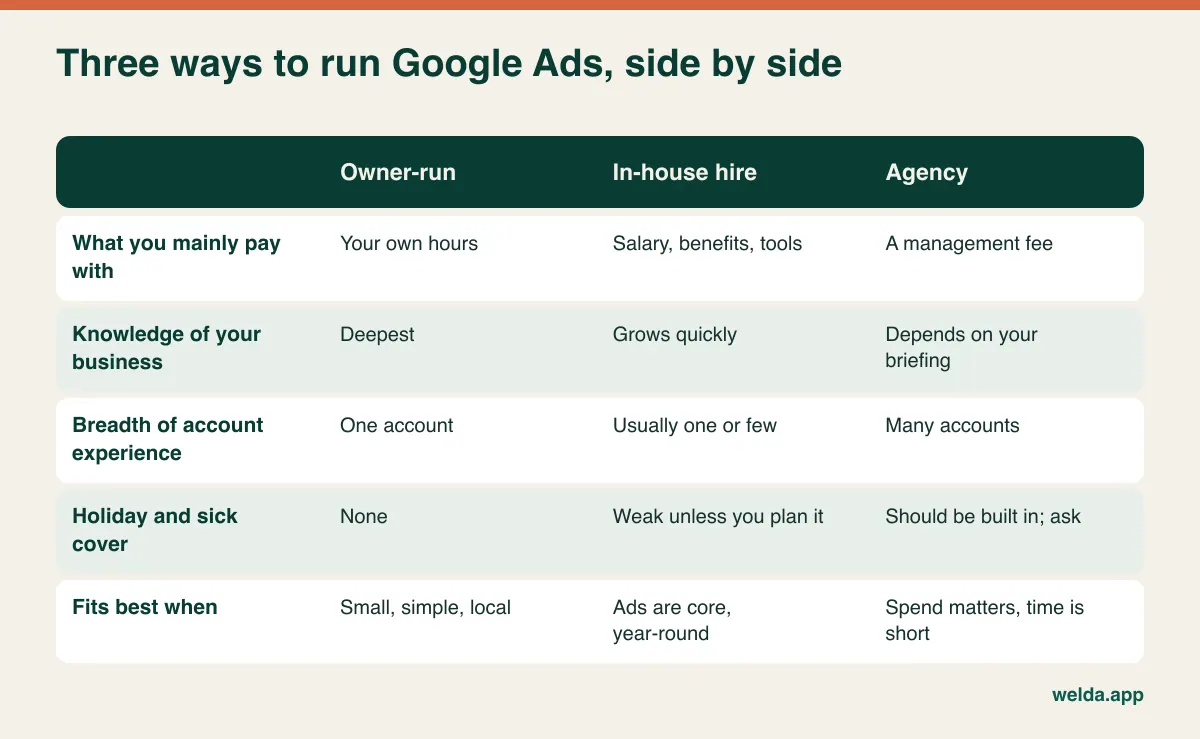
Here is the short answer. If your ad budget is small, your offer is simple and you can protect a few hours a week, keep running Google Ads yourself. If ads have become a main source of customers but nobody has time to watch the account properly, an agency usually wins. A full in-house hire only makes sense when there is enough paid media and related marketing work to fill a real job. The right call in any Google Ads agency vs in-house decision comes from your margin, your hours and what a mistake would cost you, not from an industry rule of thumb.
"In-house" also hides two very different things: you, the owner, logging in on Sunday evening, and an employee whose job this is. They have different costs and different failure modes, so this guide treats them separately and gives you a calculation, an audit and a test you can use this month.
The budget threshold is a calculation, not a number
You will see confident claims online that you need some specific monthly spend before an agency is worthwhile. Be sceptical of any figure that ignores margin. A dental practice earning a large profit from each new patient can justify outside management at a spend level that would make no sense for a reseller working on thin margins, even if both spend exactly the same.
So work out your own break-even. Take the fee you were quoted, subtract the value of the hours you would stop spending, and divide what remains by your gross margin. The result is the extra revenue the arrangement must generate each month just to pay for itself. We use neutral "units" below instead of a currency because the method matters here and a made-up price would only mislead you.
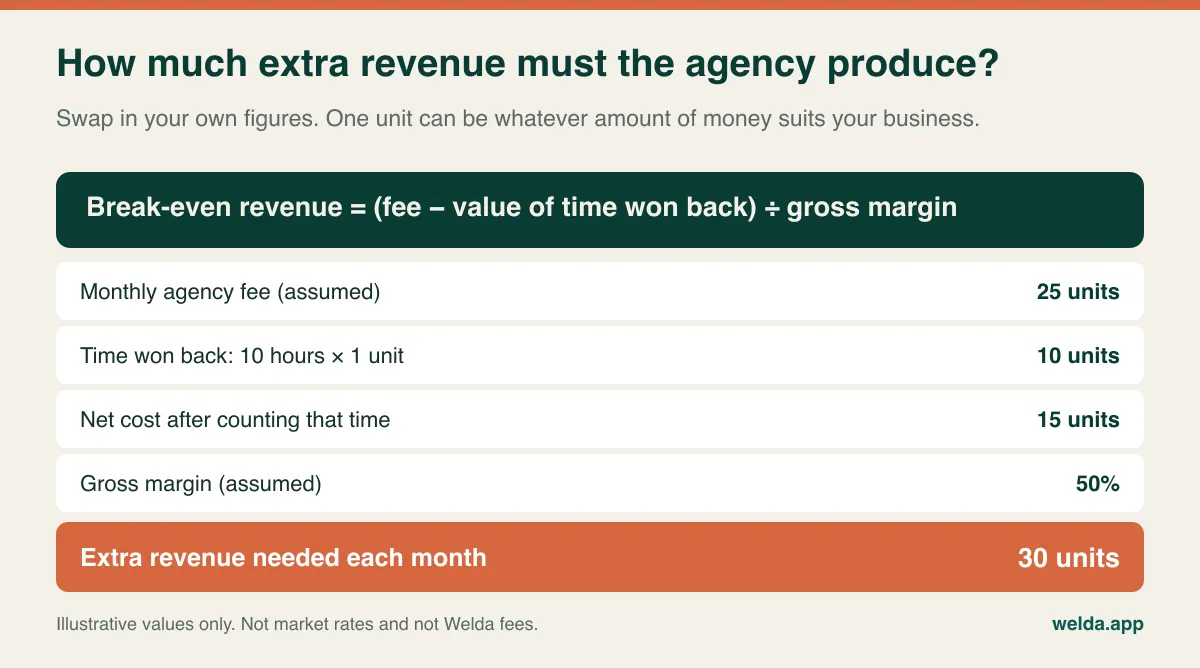
Margin does most of the work in this formula. At 50% gross margin, 15 units of net cost needs 30 units of extra revenue. At 20%, the same 15 units needs 75. That is why two businesses with identical budgets can reach opposite conclusions and both be right.
Now compare that number with what your ads currently bring in, and do the same exercise for a hire. A salaried marketer has a far higher fixed cost than a typical part-time retainer, but also gives you a whole person rather than a slice of one. In the example below we assume the hire needs 132 units of extra revenue and the agency 30, with each unit of ad spend returning 4 units of revenue.
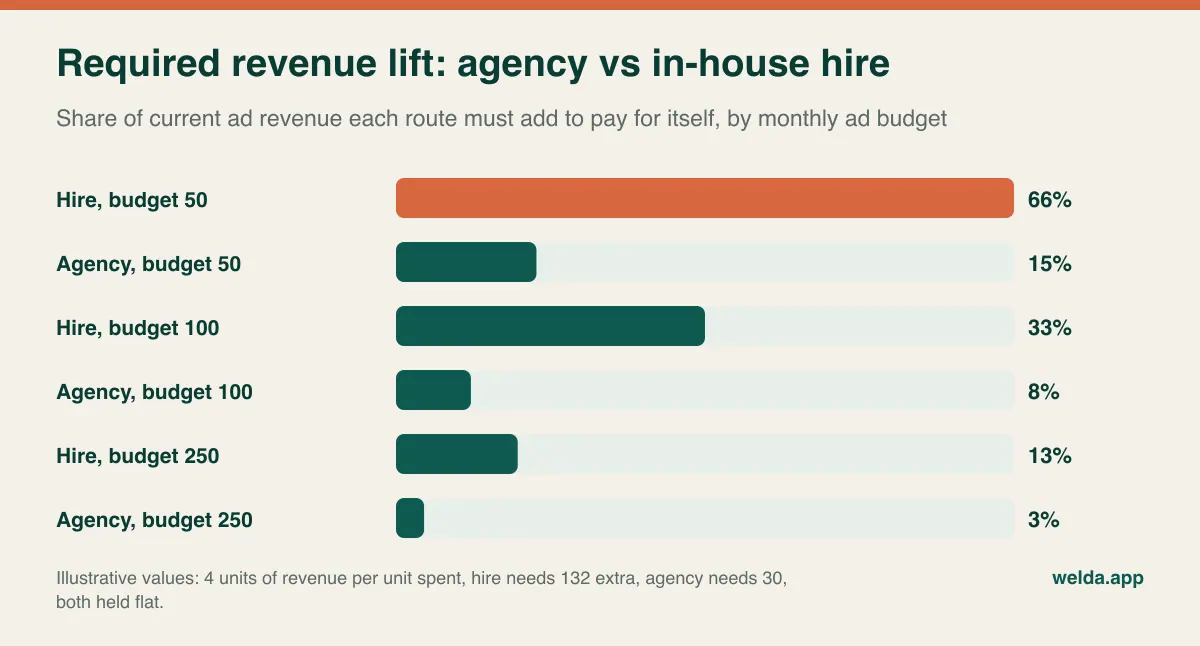
A 3% or 8% lift is a modest thing to ask of someone competent, especially if the account has never been cleaned up. A 66% lift means you are betting on the account being badly broken today. It might be. The audit below will tell you. But if the account is already in reasonable shape, that bet will not pay out, and spending the money on the ads themselves or on your landing page may do more.
Two caveats keep this honest. Fees are not actually flat as budgets grow, because scope and channels change, and a hire does more than ads, so part of the salary may be justified by other work. If so, count only the share of salary that belongs to paid media. For the mechanics of comparing fee structures, see our guide to Google Ads management cost, and for deciding the spend itself, how to set an advertising budget.
Your time is the expense nobody invoices
Owners who run their own ads often say it costs them nothing. It costs them the thing they have least of. The HVAC contractor checking search terms at 9 pm is not quoting tomorrow's jobs. The founder rewriting ad copy between meetings is not talking to customers. Neither shows up as a line in the accounts, which is exactly why it tends to be undercounted.
To price your time, ask what the hour would have earned if you had spent it on the next most valuable thing. For a practitioner who bills by the hour, that is close to the profit on a billable hour. For someone closing sales, it is the profit from the deals those hours would have produced. For an owner who truly has slack, it may be low, and that is a legitimate reason to keep doing it yourself.
There is real work in a well-run small account: reading search terms and adding negatives, testing ad copy, checking that conversions still record, adjusting budgets and bids, and keeping up with changes to the platform. Add it up honestly for a typical month, then add three things most people leave out:
- Relearning. Campaign types, automated bidding options and settings menus keep changing. Time spent working out what a setting now does is real time.
- Fragmented attention. Four quick checks from your phone do not equal one uninterrupted hour. Looking at numbers is fast. Working out why they moved is not.
- The peak-season problem. Ads matter most when you are busiest, which is when you are least able to watch them. A landscaper in spring or a gift retailer in December knows this well.
Hiring help does not take this to zero either. Someone still has to brief the agency, approve copy, say which leads were any good and read the report. A new employee also needs managing, particularly in the first months. Assume you recover part of your hours, not all of them, and be wary of anyone promising you will never have to think about ads again. An account that gets no information from the business cannot know which customers the business wants.
A 30-minute audit before you decide anything
Before speaking to anybody, look at your own account. If it is healthy, you may save yourself a fee. If it is not, you will know what you need and you will ask much better questions.
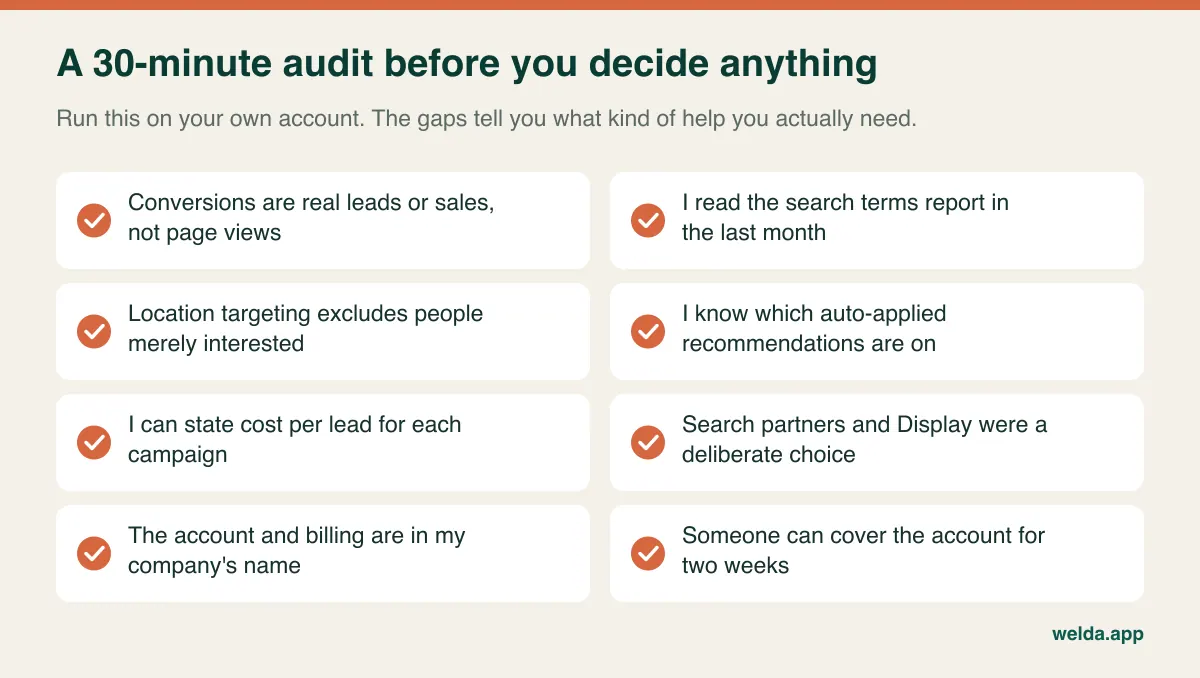
A few of these items deserve a closer look because they quietly move the most money.
What counts as a conversion. If the account counts page views or button hovers, automated bidding will find people who do those things, not people who buy. Businesses that close by phone should be measuring calls, and should ideally feed qualified outcomes back into the account. Our guide to setting up conversion tracking walks through this.
Search terms. What people actually typed is more revealing than your keyword list. A roofing contractor may discover it is paying for searches about roofing jobs, roofing courses or how to repair a roof yourself. Read the last 30 days line by line. It is the most educational half hour in paid search.
Location settings. Search campaigns let you target people in a location or also people showing interest in it. A local service business that has never checked this may be paying for clicks from people who will never be customers.
Network choices and recommendations. Search partners and Display expansion are options, and some recommendations can be applied automatically. None of them are inherently wrong, but they should be decisions you made rather than defaults you never saw. The change history screen will show who altered what, and when.
If you pass most of this and your budget is small, there is no rush to hire anyone. If you answered "I don't know" to most of it, the immediate problem is visibility rather than who runs the account. Fix measurement first, by yourself or with paid help, because nobody can judge performance without it.
The in-house hire: when a salary beats a retainer
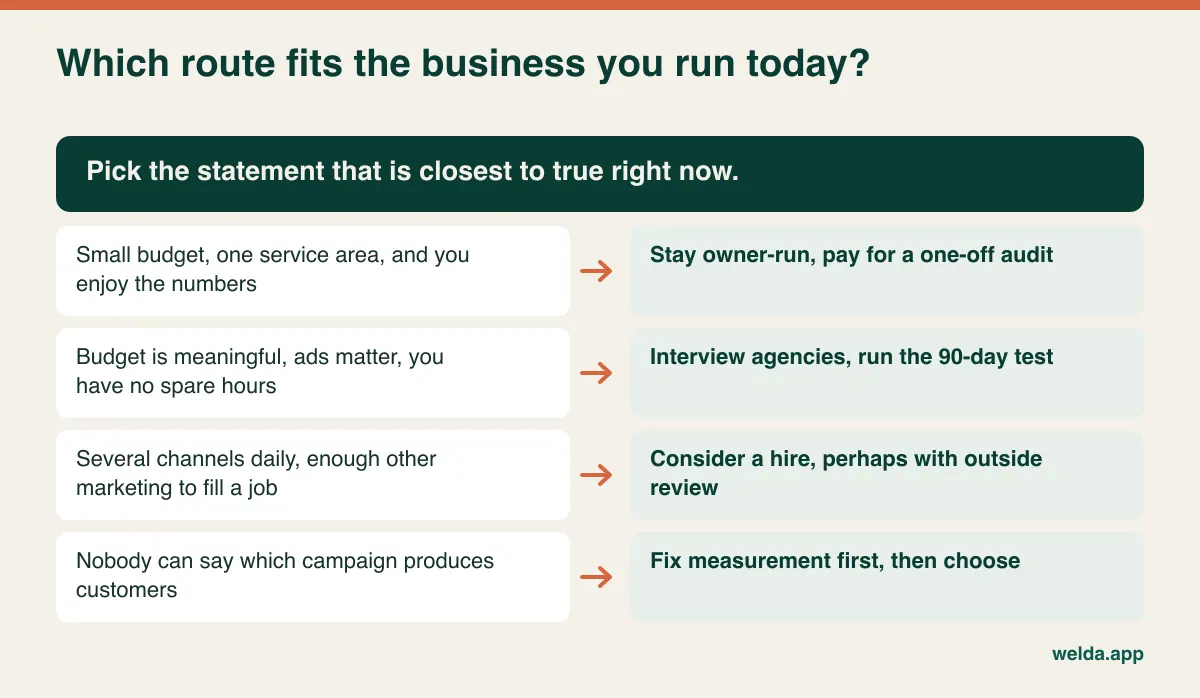
This is the part of the decision that owner-run businesses rarely get right, in both directions. Some hire too early and end up with a talented person bored and underused. Others stay with outside help for years when a full-time role would have paid for itself.
A hire starts to make sense when these are mostly true:
- There is enough paid work across Google, Meta and similar channels, or enough adjacent marketing, to fill a genuine full-time job for the foreseeable future.
- Your product is complicated enough that deep internal knowledge changes results: long sales cycles, technical buyers, many product lines, regulated claims.
- Ads need to work closely with sales or operations daily, for example changing campaigns as stock or capacity shifts.
- Someone in the business can actually assess the person's work, or you are willing to pay for periodic outside review.
The cost is also wider than the salary. Add recruitment, payroll taxes and benefits where they apply, tools, training, management time, and the months before the person is fully productive. Then add the risk that is hardest to price, which is that one resignation can take most of your paid media knowledge out of the door. An agency has the opposite weakness: continuity is better but attention is divided, and your account is one of many.
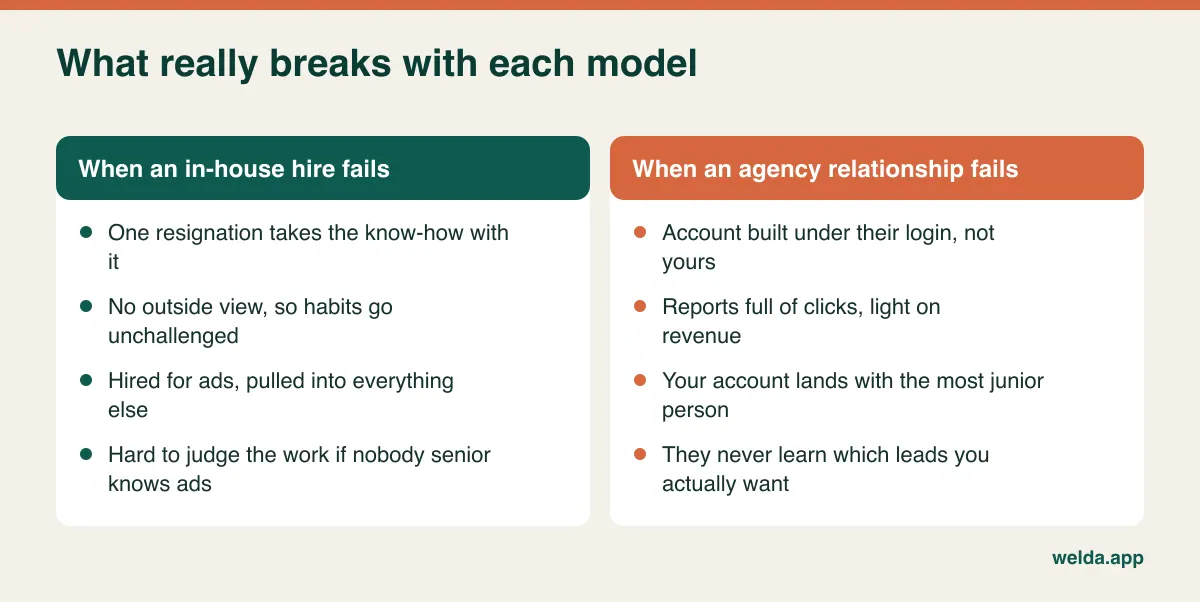
Agencies do bring something a single employee cannot easily match, which is seeing many accounts and noticing what changes across them. A hire brings something an agency cannot easily match, which is hearing from sales on Tuesday that a certain kind of lead is rubbish and fixing it by Wednesday. Many mid-sized companies end up combining the two, with an internal owner of the marketing plan and outside specialists for specific channels. It is a reasonable destination, though a small business rarely needs to start there. If you are weighing the Google Ads agency vs in-house trade-off, our service page sets out what outside management covers, so you can compare it against a job description line by line.
Who suits which route, by type of business
| Business | What makes the account hard | How fast you notice problems | Usual leaning |
|---|---|---|---|
| Local trade or emergency service | Few keywords, clear intent, tight area | Same day: the phone stops ringing | Owner-run is often fine after a one-off check of tracking and location |
| Clinic or law firm | Expensive terms, advertising rules, policy limits | Within weeks | Outside help tends to pay back because each client is valuable |
| Online shop with a large catalogue | Feeds, Merchant Center, Shopping, Performance Max, margin by product | Quickly in revenue, slowly in profit | Agency or a dedicated person; the technical load never ends |
| B2B or SaaS with long sales cycles | Low volume, late-closing deals, offline outcomes | Months later | Whoever runs it needs CRM data; a hire becomes attractive at scale |
| Seasonal business | Short intense period, little data in between | Too late if the season has gone | Get specialist setup before peak, then watch closely |
The column worth dwelling on is the third. The slower your feedback, the more damage a wrong setting can do before anyone sees it, and the more you gain from someone whose job is to read the account regularly. A locksmith gets the verdict the same day. A company selling industrial equipment may not learn that its leads were poor until a quarter later.
Questions that separate useful agencies from polished ones
Bring your break-even number and audit results to the first call. The conversation becomes specific very quickly. Then get clear answers to these:
- Whose name is the account in? Can you work in my existing one? If we part ways, what exactly do I keep?
- What will you count as success? How will calls, forms and qualified leads be kept apart, and how will you find out which ones became customers?
- Who actually touches my account? Is it the person I'm speaking to? How often? Who covers when they are away?
- Can I see a sample report? Is spend next to results? Can I see the work that was done, not only the numbers?
- What would you want to see before committing to any forecast? A serious answer involves looking at your data. Be careful with guarantees offered before anyone has seen the account.
- What do you need from me? The honest reply tells you how many hours you are really getting back.
- How does this end? Term, notice period and any setup costs should be in writing.
- Is my account big enough for you? You learn a lot from how this is answered, and an agency that says "not yet" has told you something valuable.
A partner badge or a certificate is a reasonable starting signal, but it says little about how your particular account will be handled. Our guide to choosing a digital advertising agency covers selection in more depth. If you are interviewing candidates for a role instead, ask them to read an anonymised export from your account and explain what they would do first and what they would leave alone.
Privacy, tax and ownership checks
These rules differ by country and change over time, so treat this as a list of things to ask your accountant or adviser rather than as legal guidance.
Privacy. Consent requirements for analytics and advertising tags vary. GDPR and UK rules generally expect more explicit consent than many other places, and several US states have their own privacy laws. Uploading customer lists for targeting or building remarketing audiences raises questions about your privacy notice and your legal basis. An agency handling that data on your behalf should be covered by a suitable data processing agreement. Decide how lists will be shared rather than emailing a spreadsheet.
Tax and invoices. Keep ad spend and management fees apart. Spend paid directly to the platform is invoiced under your billing profile, and VAT, GST or sales tax treatment depends on where you are. If an agency passes spend through its own books, you should still be able to see exactly what went to the platform.
Ownership. Check this regardless of what you decide. If your account sits on someone's personal email or a former employee's login, fix that now. Use a company-controlled address with at least two administrators, and apply the same rule to Analytics, Tag Manager and Merchant Center. Employee departures cause the same lockouts as agency breakups.
Run it as a 90-day test, not a leap of faith
Whichever way you are leaning, you can reduce the risk by treating the switch as a measured trial. This works for moving to an agency, for handing the account to a new hire, and for taking it back in-house.
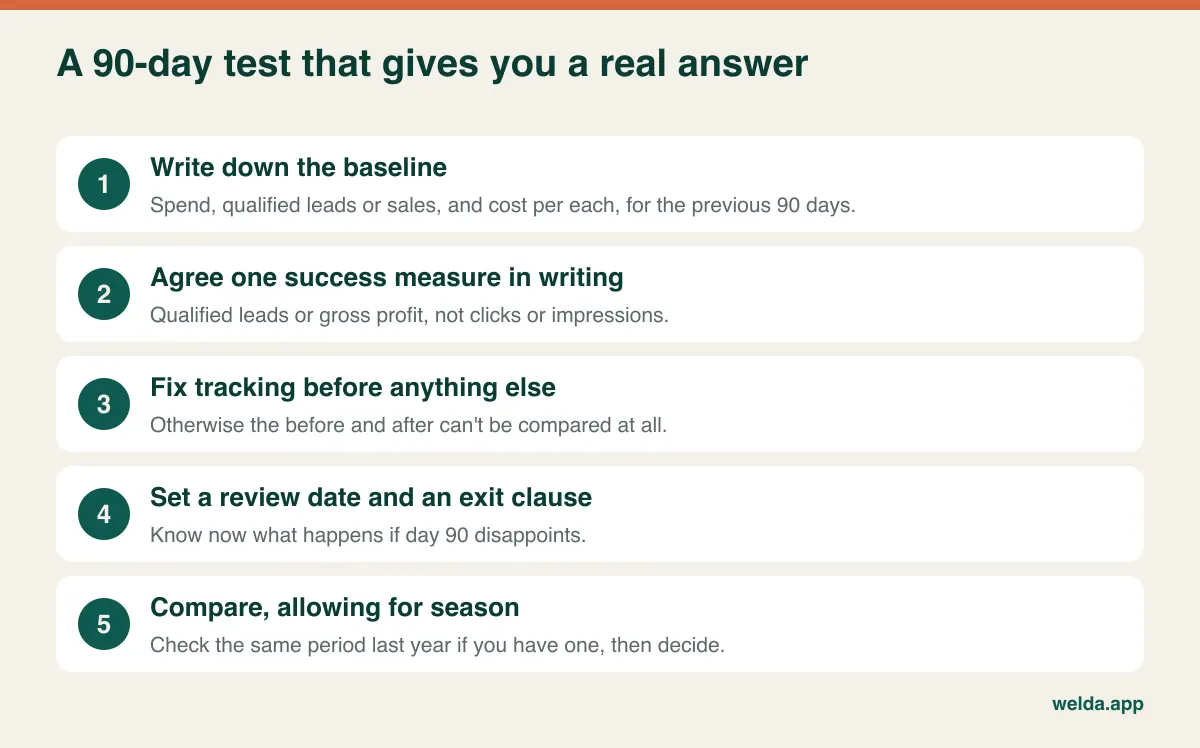
The baseline is the part people skip. Export spend, qualified leads or sales, and cost per each for at least the previous three months, and keep your own copy. Allow for the first few weeks being messy, because tracking gets corrected and automated systems take time to adjust. A rise in recorded conversions right after fixing tracking is often better measurement, not better performance, so read those figures carefully.
Keep the account's history where possible. Do not agree to scrap an existing account without a clear reason. When taking an account back from an agency, confirm before you end the contract that you hold admin access, that billing is yours, and that your conversion tags do not depend on a Tag Manager container or Analytics property you do not own. This last issue is a common way to lose measurement at exactly the wrong moment.
When you take on the account yourself, block regular time in your calendar and keep a dated log of changes. If you change three things at once, you will not know which worked. Google's free Skillshop courses are a useful introduction and cover the fundamentals, though your own search terms will teach you more.
Talking it through with us
If you have run the numbers and still can't call it, we are happy to go through them with you on a free call. Welda's digital advertising service covers building and running Google Ads and Meta campaigns, full conversion tracking with GA4, Tag Manager, Pixel and the Conversions API, day-to-day optimization, and a monthly report that puts spend and results side by side. You keep ownership and control of your ad accounts, and we work through manager access, so the account and its history stay with you if we stop working together.
Ad spend is paid directly to Google and Meta and is separate from our management fee. We don't publish list prices, because the fee depends on campaign scope, the number of channels and the monthly workload. You'll get a clear figure after a free conversation, and we'd encourage you to put it straight into the formula above. To talk through your own Google Ads agency vs in-house numbers, get in touch through the service page. If the maths says you should keep running the account yourself, that is a useful outcome too.
Frequently asked questions
Is it cheaper to manage Google Ads in-house?
Only on paper in many cases. Doing it yourself has no invoice, but it does take hours and it carries the cost of mistakes you might not notice. A salaried hire adds a substantial fixed cost that only makes sense if there is enough work. Compare the routes using net cost and gross margin rather than comparing the fee to zero.
What ad budget justifies an agency?
There is no universal figure. Subtract the value of recovered time from the quoted fee, divide by gross margin, and compare the result with your current ad revenue. If the lift required is modest, your budget is probably big enough. If it needs the account to improve dramatically, it may be too early unless your audit found serious problems.
Can I start with an agency and bring it in-house later?
Yes, provided the account, billing, Analytics and Tag Manager are in your name from day one. Ask for documentation of the structure and the reasoning behind it, and treat knowledge transfer as a task with a date on it rather than something that happens by itself.
Should my office manager or marketing generalist run the ads?
That can work for a simple account if the person has dedicated hours, a clear goal and someone reviewing the work from time to time. It tends to fail when ads are treated as whatever gets done when everything else is finished.
How long should I give an agency before judging it?
Results take time, particularly with low conversion volume, so a single poor month is rarely decisive. Activity can be judged sooner. By the end of the first month you should be able to see that tracking has been verified, search terms cleaned up and the work explained clearly. If that hasn't happened, waiting longer is unlikely to help.
Does the same logic apply to Meta ads?
The break-even logic does. The workload differs, since creative production takes much of the time on Meta while reading search intent matters most on Google. Redo the hours estimate for the channel you actually use.