Free hair salon software can be genuinely enough if you work alone, take your own bookings and have a schedule you could recite from memory. It stops being enough once a second person writes in the same calendar, once sending reminders becomes a job in itself, or once client color notes live in somebody's head. So the useful question is not "is free good enough?" but "what is the free setup costing me this month, and who is paying for it?" This guide gives you a way to answer that with your own numbers, plus the checks to run before you trust a free tool with your client list.
A word about where we stand. We make salon software, so we have an obvious interest in you paying for something. We also think plenty of small salons should not pay for anything yet, and we will say which ones. A renter with one chair and a steady book has different problems from a four-stylist shop with a front desk, and advice that ignores that difference is just a sales pitch.
Follow the money before you read the feature list
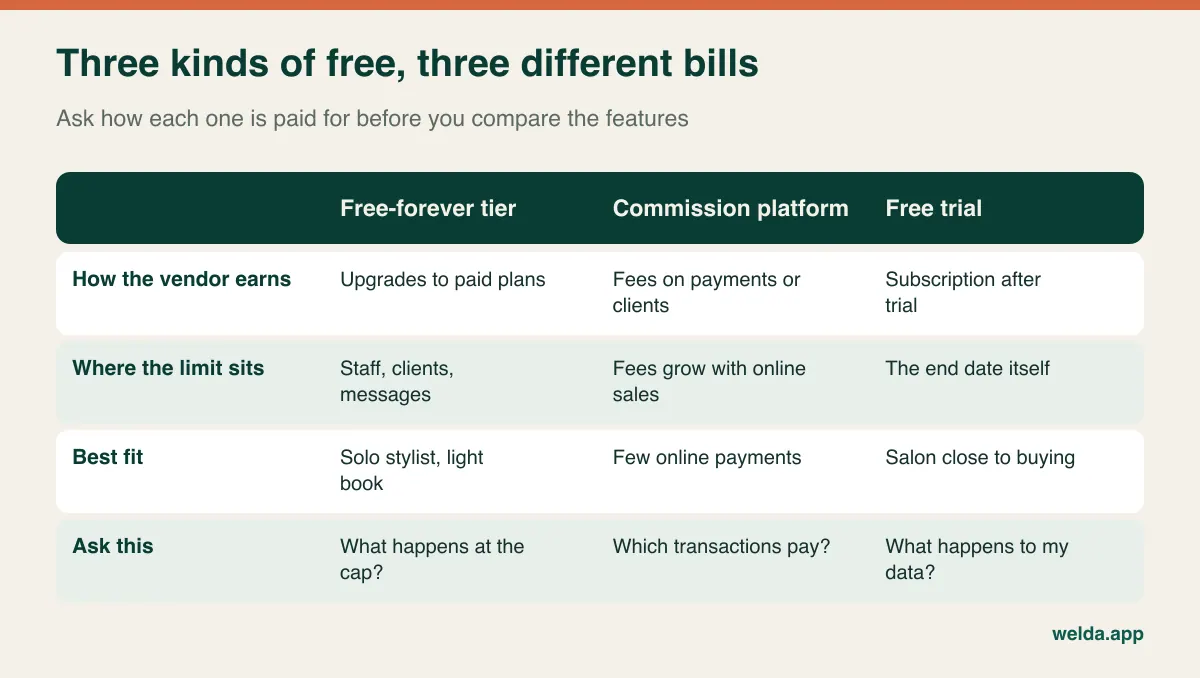
Software costs money to run, so every "free" offer gets paid for somehow. The way it gets paid for tells you more about your future than the feature grid does. Most of what you will find falls into one of these groups:
| Type of "free" | How it gets paid for | Where a salon usually feels it first |
|---|---|---|
| Calendar app plus spreadsheet | Your own time | Two people need the same schedule at the same moment |
| Free-forever tier | You, once you upgrade | A cap on staff, clients, messages or history |
| Marketplace or booking platform | Fees on payments or on new clients | Online payment volume grows and the deductions become noticeable |
| Free trial | A subscription when the trial ends | The end date, and what happens to your data on that date |
| Open-source, self-hosted | Hosting, upkeep and technical skill | The first failed update or backup, with nobody on call |
None of these is a scam. A commission model can be a fair deal for a salon that takes few online payments, and if a marketplace really brings you new clients, paying a fee for them can be perfectly rational. The trouble starts when an owner chooses one believing it costs nothing, then builds years of client history on top of it. If you want to see what the paid side adds up to, our guide on how to work out hair salon software cost breaks down the line items.
The salons that should stay on free, for now
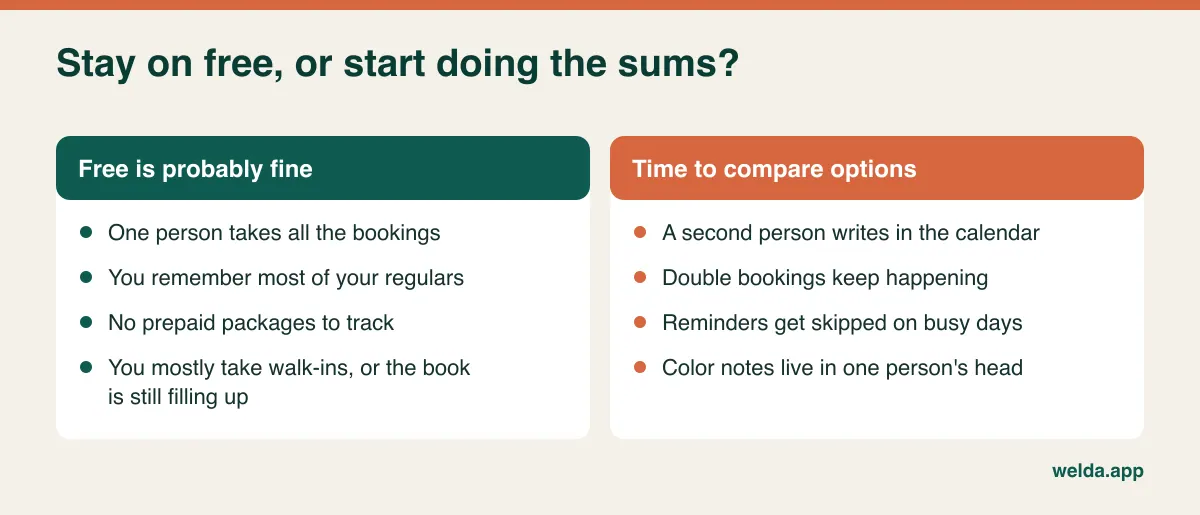
Here is the honest list. Free is probably fine if most of the following describe you. You are the only person taking bookings. You rent a chair or run a one-person studio. You do not sell prepaid packages. Your reminders take a few minutes because there are not many of them, and most of your clients are regulars who have your number anyway. Barbers who run mainly on walk-ins may also get little from a booking system, because a queue does not need a calendar.
A new salon is a special case. When your book is half empty, the main problem is finding clients, and software that organizes appointments will not create them. Spend your early effort on your Google profile, your photos and a simple page where people can reach you. Our website guide for hair salons and barbershops covers that ground.
Free does not have to mean sloppy, though. Three habits now will save you a painful cleanup later. Save every client consistently, with a full name and a phone number in international format, so you do not end up with "Sarah color" and "Sarah H." as two people. Keep notes in one place instead of half in your phone and half in a paper book. And once a month write down two numbers: how many clients failed to show up, and how many you turned away because you were full. Those two figures are the raw material for the decision later on.
Booth rental changes the question: whose clients are they?
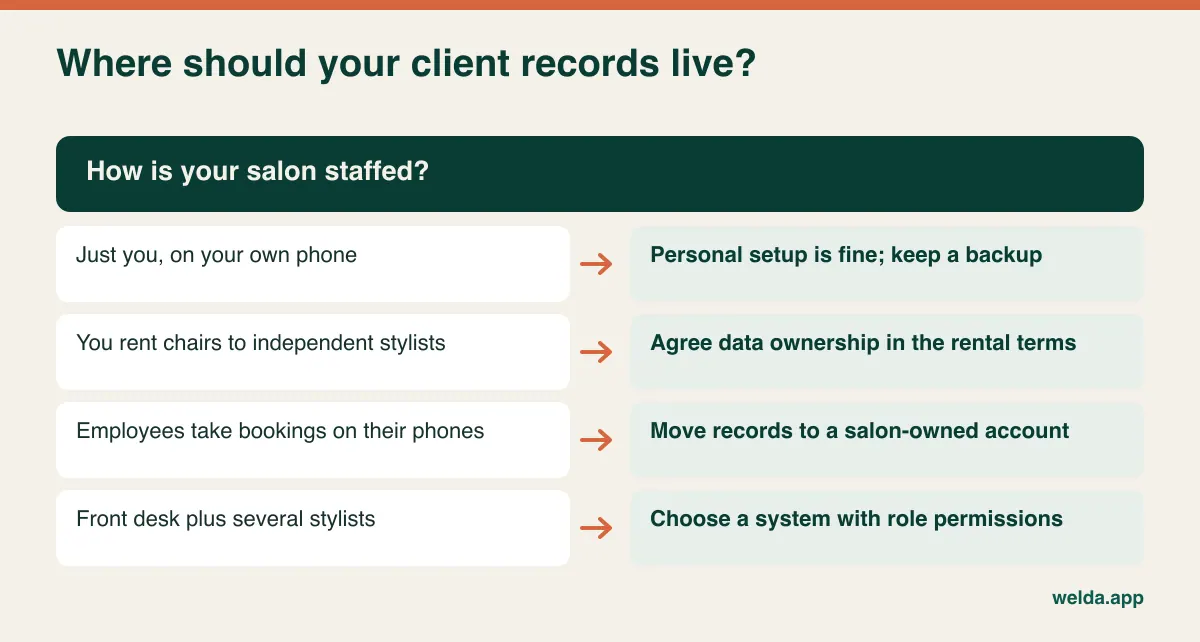
In many markets, renters and employees work side by side in the same salon, and that is where free tools quietly create disputes. A booth renter generally runs an independent business, so the renter may reasonably regard their client list as their own. An employed stylist is in a different position, and the salon may regard those clients as salon clients. The rules and contracts vary by country, so this is not legal advice, but the practical point holds everywhere: the software decides who actually has the data, whatever anyone believes.
When a stylist takes bookings through a personal calendar and personal WhatsApp, the salon owns nothing, regardless of what the employment contract says. If that stylist leaves, the appointment history leaves too. No tool can stop a loyal client from following a favorite stylist, nor should it. The question is whether the salon keeps a working record of the people it has served, and whether it can still contact them under whatever consent it holds.
Before you add anyone to a shared free tool, agree three things in writing. Who owns the client records? What happens to them when someone leaves? And who can export the full list? Then check whether the tool can actually enforce your answer. A free tier may give everyone the same access, or may tie the account to one person's email address. Open the account under a salon email rather than a personal one. It is a small step that keeps the account with the business when people move on.
The color formula problem
A men's cut is forgiving. A client can usually tell a new barber what they want, and if the fade is a little different, it grows out in weeks. Color work is another matter. Which shade and developer did you use last time, how long did it process at the roots, did the client feel it pulled too warm? Those details decide whether a returning client gets the result they came for, and the difference between stylists shows up immediately when the regular person is off sick.
Plenty of salons keep this on index cards, and a tidy card system works better than a messy app. The weak spot is finding it when the phone is ringing, and not having it at all when the card went home with someone. Here is a simple test for any tool, free or paid: type a client's name and time how long it takes to reach their last color formula. If it lives in a notes field on the client's profile, good. If it is buried in the title of an old appointment, you will not find it in eight weeks. Also check how far back a free tier keeps history, because older visits are exactly what color work needs.
Allergy and sensitivity notes deserve extra care. If someone reacted to a dye product, that note has to reach whoever mixes the next batch, and it also counts as sensitive information in many privacy regimes. A shared spreadsheet open to all staff is a poor home for it. Welda CRM keeps previous services, color notes and dates on the client's profile, and health records are stored encrypted with allergy warnings. If you run a clippers-only barbershop, by the way, skip this section. It should not push you toward paying for anything.
What free costs when you count it in minutes
The biggest cost of a free setup never shows up on an invoice, so you have to go and measure it. For one ordinary week, keep a rough tally of the minutes spent on booking admin. The figure below is an invented example to show the method, not data from a real salon: a three-chair shop with 90 appointments a week.
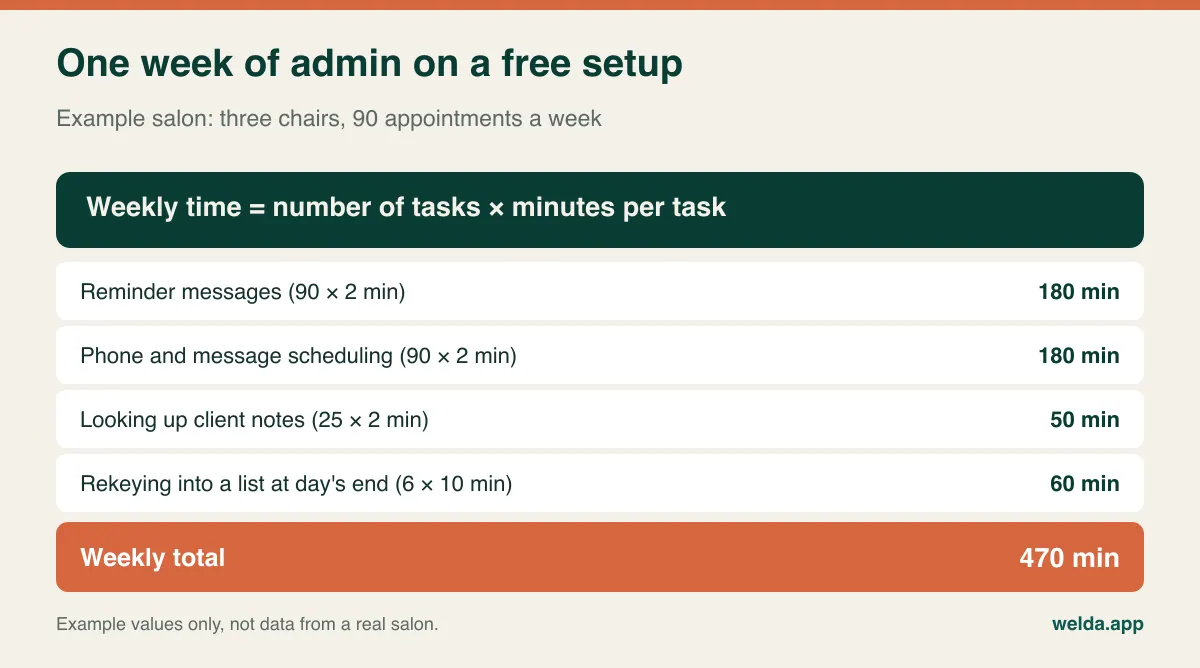
In that example, the admin runs to nearly eight hours a week. To be straight with you, no software takes that to zero. People still phone, some clients will never book online, and someone still has to answer the awkward question about moving a balayage to Thursday. What software really removes is the repetitive part: reminder messages, routine confirmations and hunting for notes. So estimate what you would actually get back, not the full total.
Then ask what those hours are worth, which depends on your situation. If your diary has gaps anyway, the recovered time has little cash value and you might reasonably stay put. If your owner-stylist spends prime hours typing messages instead of doing color, or you are turning clients away while empty slots go unfilled, the same hours come straight out of revenue. WhatsApp appointment automation is often the easiest of these to measure, since the work grows in a straight line with your bookings.
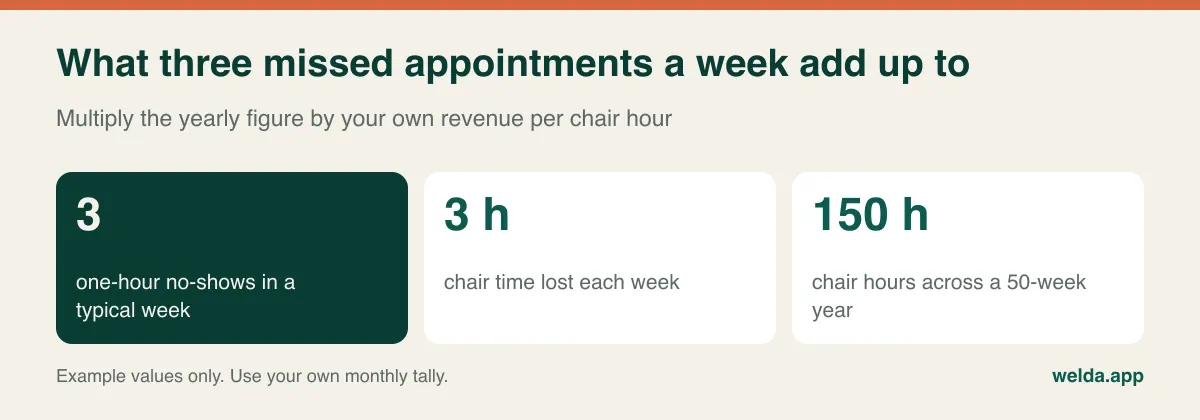
No-shows are the other half of the sum. A simple example: three missed one-hour appointments a week is about 150 empty chair hours across a 50-week year. Multiply by your average revenue per chair hour, then be realistic about how many of those a reminder or waitlist could actually recover. Reminders do not fix every missed appointment, and some clients will always forget. Our piece on reducing no-shows was written with clinics in mind, but the mechanics carry across to a salon. The result is the figure to set beside any paid quote you receive.
Test it on your worst week, not your best one
Free tools look flawless on a slow Tuesday. Your real test is prom season, the run-up to the December holidays, or the Saturday with two bridal parties. On those days, long blocks crowd the calendar, the phone and the door compete, and a canceled slot at noon is worth filling because someone was asking for it an hour ago. Think back to your last peak week and ask yourself:
- Did two clients end up booked into the same slot, and when did you notice?
- Did anyone wait for a reply that never came because the message got buried?
- When someone canceled, could you find a person who wanted that time, or did it go empty?
- Did the free tool hit a message or booking cap at the worst moment?
- Could you tell that evening who did what, and what you took?
If the answers are mostly fine, your setup can carry your peak and there is no rush. If not, remember that peaks are your most profitable days, and small failures there cost more than they would on a slow week. Do not, however, switch systems right before one. Pick a calm stretch, give the team time to learn the new calendar, and go into the busy period already comfortable with it.
Run an exit drill on day one
The most expensive surprise with free software comes at the end. You have outgrown it, or the vendor has changed the terms or closed the free tier, and you discover that your client history cannot come with you. You generally have little leverage over a product you are not paying for. So test the exit before you commit, while it is still cheap: enter a handful of dummy clients and a few appointments, then try to get them back out.
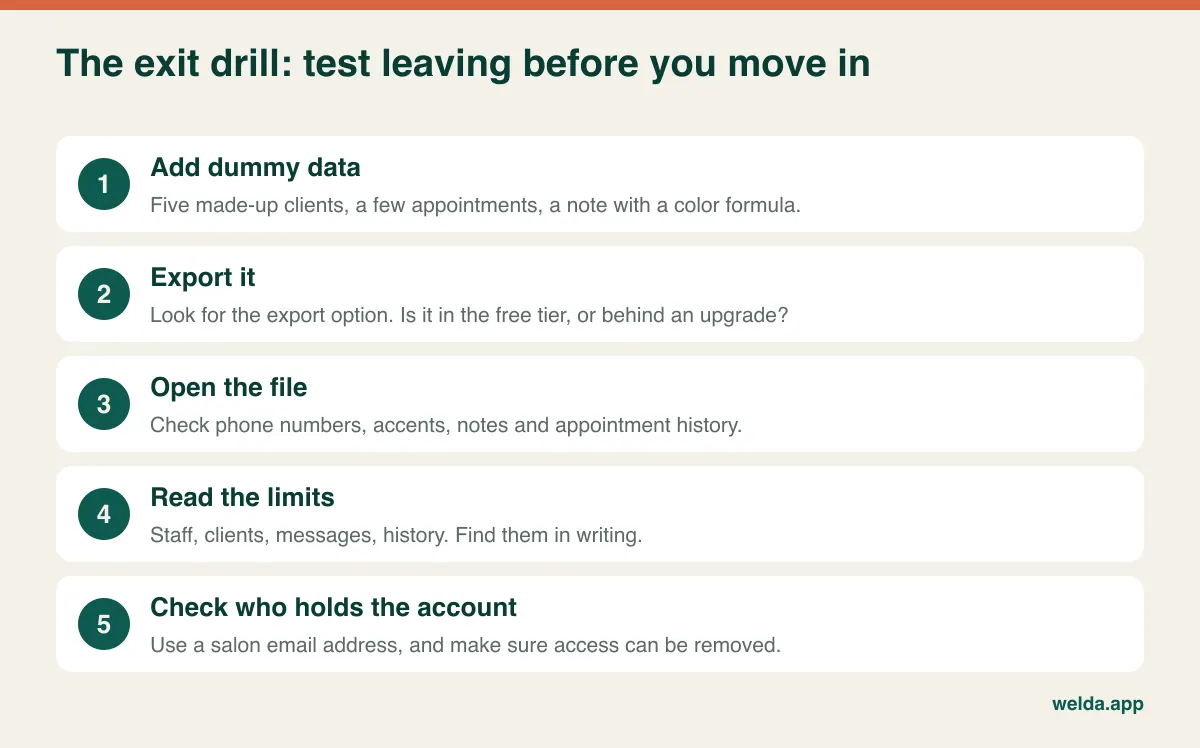
Open the export and read it properly. Did the phone numbers survive, or did a spreadsheet strip the leading zeros and plus signs? Did the notes and appointment history come through, or only names? Is export part of the free tier, or does it sit behind the paid plan? A names-only export means your real asset, years of who had what done and when, stays behind. Put this same question to every vendor you consider, including us. Moving your existing client and appointment data is included when you set up Welda CRM, but ask about the way out too, and ask for the answer in plain terms.
Privacy and paperwork do not get cheaper with the software
This is general information and not legal or tax advice, and the rules depend on where you operate, so check with a local adviser. As a rule of thumb, names, phone numbers and service histories are personal data in most places. In the EU and UK, GDPR and UK GDPR are likely to apply; other countries have their own laws. A free tool does not transfer your responsibility to the vendor. You are still the business that decided to collect the data.
A few questions are worth asking of any free product. Where is the data stored and is it shared with partners or used for advertising? Can you remove a former employee's access the day they leave? Is there a way to record who agreed to what? Appointment reminders and promotional messages are often treated differently, and blasting a discount to your entire phone list can be a problem even when reminders are fine. Welda CRM stores records in encrypted form, records consent and logs access, but those are tools that help you meet your duties. They do not make your salon compliant by themselves.
A booking calendar is also not a till or an invoicing system. Some countries require approved invoicing systems or fiscal registers, and free scheduling tools will rarely address that for you. Ask your accountant what applies, then ask each vendor how invoices and receipts are issued. Welda CRM can issue invoices through e-invoice and e-archive integration with your chosen provider, but whether that fits your country's rules is something to confirm before you buy, not after.
What you are really paying for when you move on
A paid plan is less about extra features than about taking recurring jobs off a person. So when you compare outgrown free hair salon software with a paid system, skip the feature grids at first. List the jobs nobody in your salon should be doing by hand six months from now, then check whether each product actually takes those jobs away. If you cannot name any, you do not need to pay yet.
In fairness, you should know where Welda CRM sits. There is no permanent free version. It is a monthly subscription, and the price depends on your locations, users, message volume and modules, which we work out together in a free consultation. There is no separate setup fee; setup, data migration and team training are included. For a solo stylist with a light book and no reminder pain, it may simply be more than you need today.
If you are past that point, our page on moving on from free hair salon software shows how the per-stylist calendar, clash prevention, online booking requests and automatic WhatsApp reminders work in a salon. There are limits worth knowing. The online booking page is for your own clients and requests are confirmed by you, so if you want a marketplace that sends you strangers, that is not what this is. And since reminders here run on WhatsApp, check how much of your client base actually uses it. In countries where people live on SMS or iMessage, raise this in the conversation before you decide.
The cleanest way to decide is on your own data. During the 7-day free trial all modules are unlocked. When the trial ends your data is not deleted: the account becomes read-only until you pick a plan, and if you carry on you pick up where you left off. A trial is easy to waste by clicking around for ten minutes, so give it a plan.
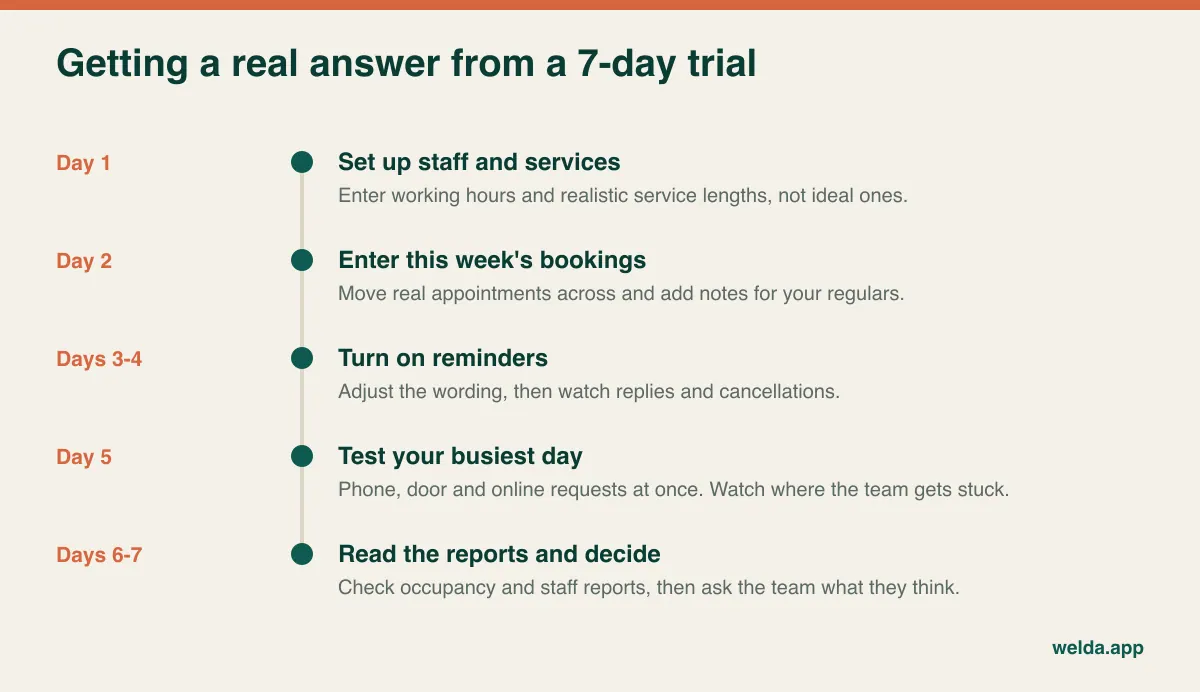
When you do switch, set a hard cutover date and tell the team: from this day, bookings go in the system and nowhere else. Keep the old book or tool for reference for a short while, but do not run two live calendars for long, because you will soon lose track of which is true. Warn regular clients that reminders will start arriving, so the first message is not a surprise. Before you book a free consultation, jot down your number of staff, your weekly bookings, whether you sell packages and where your data is now. We will go through what fits and agree a price, and if your free setup is doing the job, we would rather tell you that than sell you a plan you will cancel.
Frequently asked questions
Is there any truly free hair salon software?
Yes, in the sense that you can use some tools without paying a subscription. But the vendor still has to earn money, usually through limits that lead to upgrades, payment fees or commissions. For a solo stylist that trade can be perfectly fair. Just know which trade you are making.
How many staff can free software handle?
There is no universal number, since the caps differ by product. In practice, the strain tends to begin with the second person using the calendar, because you now need shared access, permissions and a single source of truth. Read the limits in writing rather than assuming.
Can I just use a shared calendar and WhatsApp Business?
For one person with low volume, usually yes. It gets harder when several people share one number, when reminders go out by hand and when client history is scattered across chats. It also tends to leave you with no clean record of clients if someone moves on.
What about booth renters in my salon?
Decide who owns each renter's client data before choosing a tool, and put it in the rental agreement. Some salons give each renter their own account or plan, others share one. Either can work, but only if everyone agrees on what happens when a renter leaves.
Will I lose my history when I move from a free tool to a paid one?
That depends on what the free tool lets you export. If you can get client lists and appointment history in a file, most of it can usually move. With Welda CRM, migrating your existing client and appointment data is part of setup; paper records take more planning, so decide how much really needs to come across.
Does Welda CRM have a free plan?
No permanent one. You can try it for 7 days with all modules unlocked, and after that the price is agreed in a free consultation based on your salon. You can see what each plan covers on the Welda CRM pricing page, and the alternative to free hair salon software page explains how it runs day to day.