The right laser hair removal clinic software is the one that treats your machines and treatment intervals as the things you actually schedule around. If you are comparing systems, test four abilities first: it stops two bookings landing on one machine or room, it shows you who is due for their next session but has no appointment, it tracks course balances per body area, and it puts contraindications in front of the operator before the handpiece is picked up. Everything else on the feature list comes after those four.
Most spa and salon booking tools were built around a simple question: which staff member is free? In a laser clinic that question often has the wrong answer. Your operator may be free while the only suitable machine is two doors down, treating someone else. A client may be keen to book next Tuesday when they were treated only three weeks ago. This guide is for owners who feel that friction and need to make a buying decision, including where Welda CRM fits and where we would rather tell you to check than promise.
The moment a generic booking tool starts to fail
A one-room, one-machine practice can run happily on nearly anything. The owner holds the rules in their head, and the calendar only has to record what they decide. The trouble begins with the second machine or the first receptionist, because at that point the rules have to live somewhere other than one person's memory.
Three signs tell you that you have reached that point. Reception asks an operator "can I book this?" several times a day. Clients on a course discover that the next available slot is outside the window their therapist recommended. And when somebody asks how many paid sessions you still owe, nobody can answer without an afternoon's work. If two of those sound familiar, you are shopping for a different kind of system, not a nicer version of the one you have.
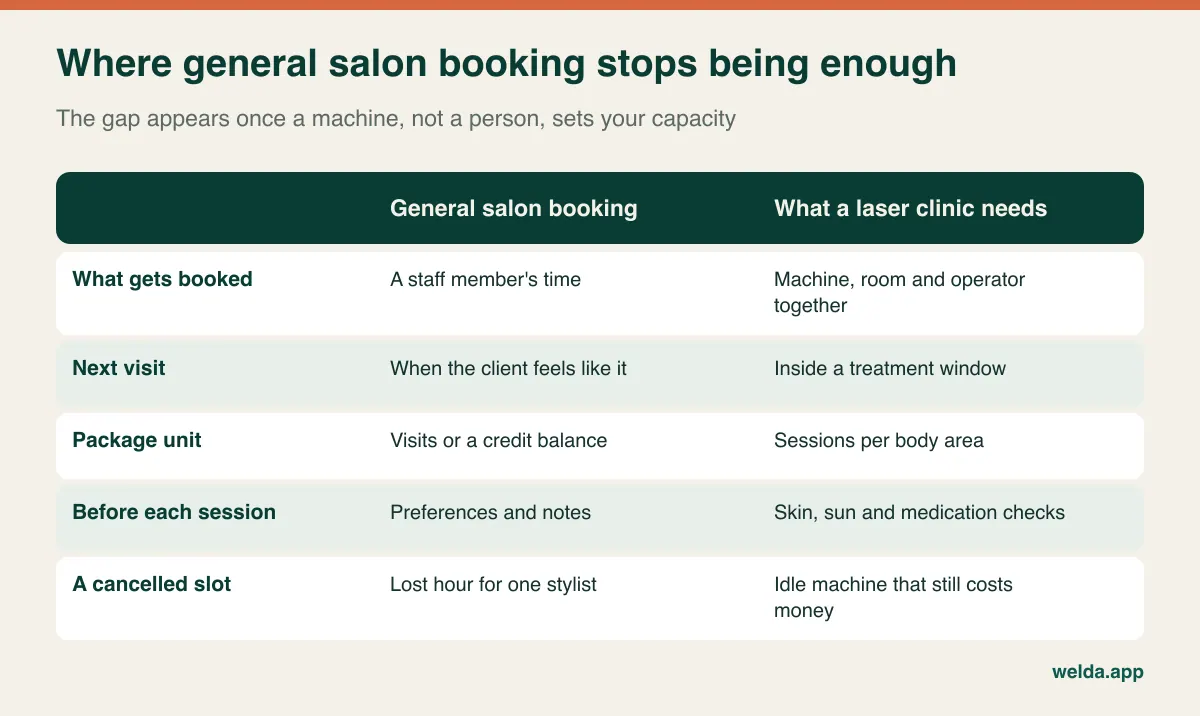
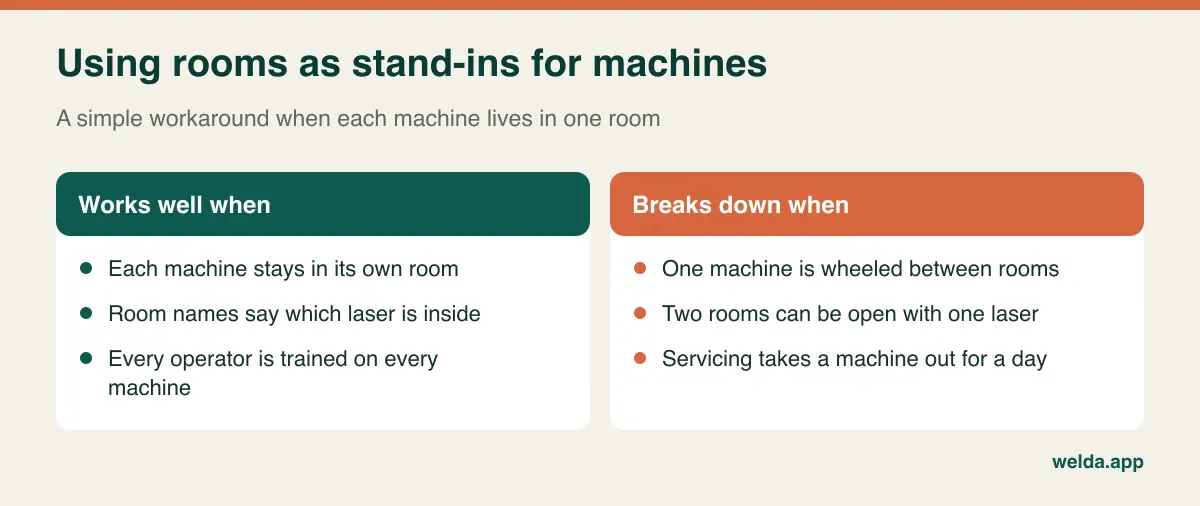
Be precise about your own setup, because laser clinics differ more than vendors assume. If each machine is installed in its own room, a room calendar is effectively a machine calendar. If you own a diode and an Nd:YAG and your clinicians choose between them based on a client's skin type and hair, then a booking cannot simply go to whichever machine is open. And if one laser moves between two rooms on a trolley because the second room also does facials, room availability will mislead you: the room looks free while the machine is elsewhere.
Welda CRM offers staff, room and branch calendar views with conflict detection against double bookings. For clinics with a machine per room, naming rooms after the laser inside is a practical way to work. We should be plain about the limit: our product pages do not describe a machine as a separate bookable resource that is independent of rooms and staff. If your laser travels between rooms, that is a question to put to us directly, then test with your own schedule during the trial.
Work in laser-hours, because sold sessions are future calendar
Hair salons sell today's time today. You sell a promise of six or eight visits spread across months, and every course sold in spring is a claim on the summer calendar. That is why clinics can run a successful promotion and then, a couple of months later, field complaints about never being able to get an appointment. The staff did not shrink. The queue of already-sold sessions simply was not on anyone's dashboard.
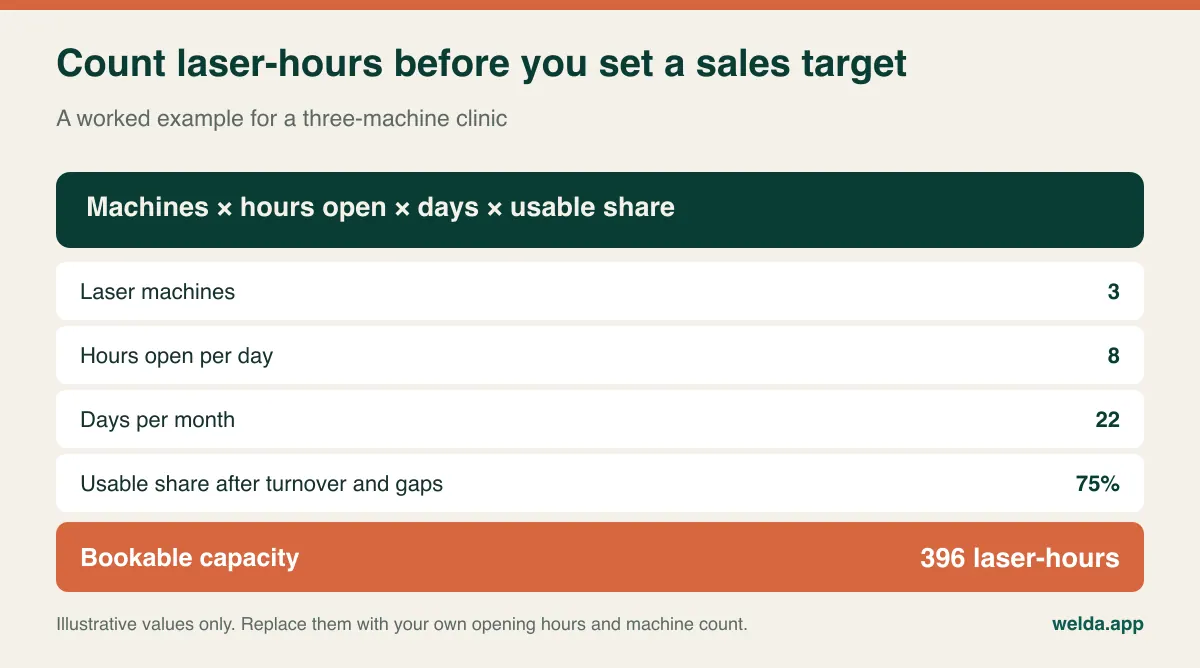
A worked example makes this concrete. Take a clinic with three machines, open eight hours a day, twenty-two days a month. That is 528 gross laser-hours. Allow a quarter for room turnover, set-up and gaps you cannot fill, and you have 396 hours you can actually book.
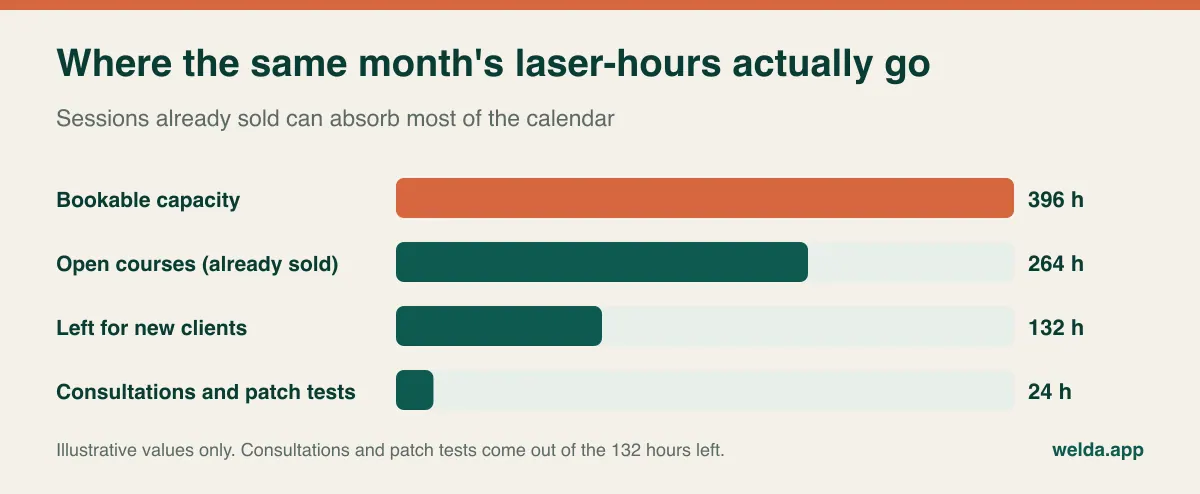
Now suppose open courses take up 264 of those hours this month: for instance, 400 active clients on an average interval of about six and a half weeks, at around an hour per visit when combined areas are included. Only 132 hours remain for new clients, and consultations and patch tests come out of that too. The clinic looks half-empty if you glance at next month's calendar, because many of those clients have not booked yet. The demand is real, just not visible.
So when you evaluate software, ask how quickly you can answer: how many sessions are still owed, on how many open courses, and how many of those clients have nothing booked? In Welda CRM, package sales, remaining sessions and usage history sit on the client profile, and occupancy and revenue reports are available. Our pages do not claim a ready-made forward capacity forecast of the kind above, so you may need to export figures and combine them in a simple spreadsheet. Ask about it in a call rather than assuming either way. The business value is straightforward: you decide whether to run a promotion based on the free laser-hours in the next quarter, not on how quiet this week feels.
Treatment windows: the feature vendors rarely demo
Ask a vendor about retention and you will usually hear about reminders. Reminders are worthwhile, since a no-show on a laser slot wastes operator and machine at once. But a reminder only helps someone who already has an appointment. The client who silently drifts away after session three is on no list at all, and months later may be telling friends that laser "didn't work for them." Finding that person is a separate job.
Laser is generally most effective on hair in its active growth phase, which is why treatments are spaced out. The intervals below are a planning illustration, not a clinical protocol. What is right for a given client is decided by your machine manufacturer's guidance and your practitioner.
| Area | Illustrative planning window | What it does to your calendar |
|---|---|---|
| Face, upper lip | 4–6 weeks | Frequent short visits; easy to slot into gaps |
| Underarm, bikini | 4–8 weeks | Short and popular; often combined with other areas |
| Legs, arms | 6–10 weeks | Long blocks that need reserving well ahead |
| Back, chest | 8–12 weeks | Long gaps, and the highest risk of being forgotten |
One client can easily hold two of these at once. Your system should be able to show the state of each area separately, even if your practitioner chooses to merge visits. Also think about early bookings: a client who wants to come back too soon needs a human conversation, and reception should be able to see the last treatment date for that area without digging for it.
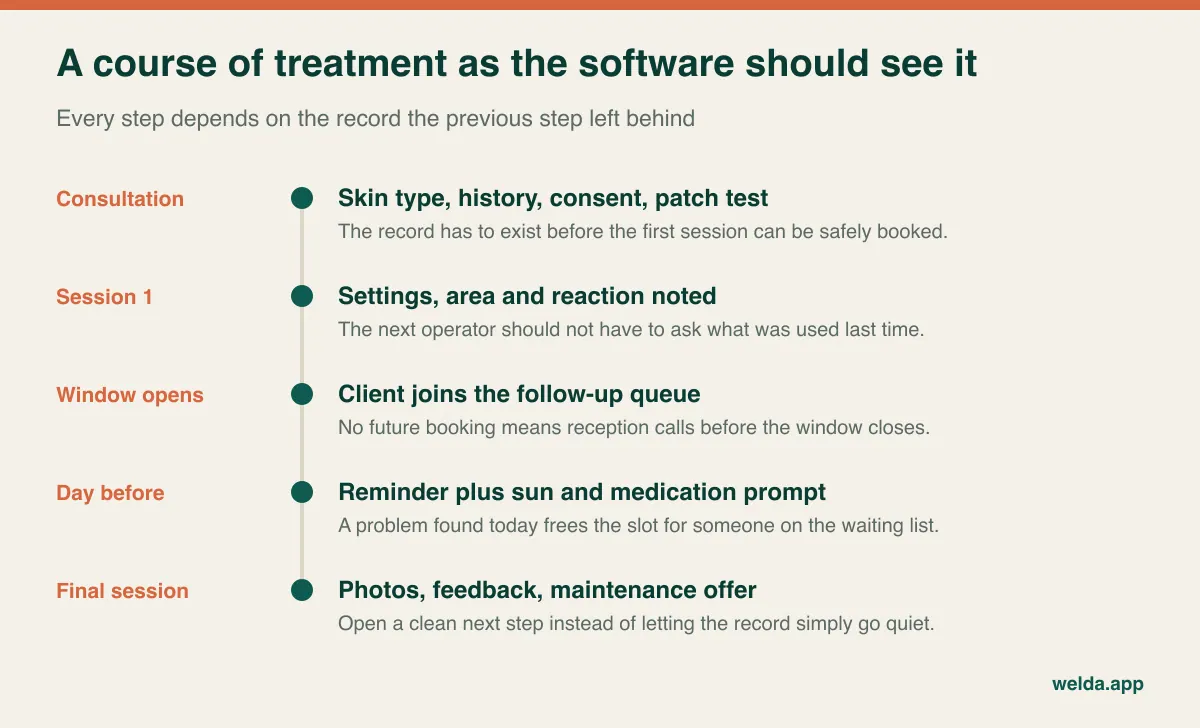
The Welda CRM parts that support this are notes and tasks with reminders, CRM stages, a follow-up queue that shows who to contact, and message flows before and after each appointment. The simplest habit is to book the next session before the client leaves and create a reminder task where that is not possible. A rule along the lines of "list every client whose back-area window opened this week" is not something our product pages describe as built-in, so we will not promise it here. Ask, and try to build your follow-up routine in the trial.
Sessions that shouldn't happen: sun, medication and the safety record
Few other beauty services involve so many reasons to stop at the last minute. Recent tanning, a new photosensitising medication, pregnancy, a changed mole in the treatment area: a good operator will postpone. Two practical questions follow for software.
First, can a postponement be recorded without burning a session? If the balance reduces automatically whenever an appointment is closed, your team needs a clear way to mark "attended, not treated." Try this live, because this is exactly the sort of edge case a sales script skips and clients remember. Second, can you catch problems before the day? A message the day before that asks about sun exposure and new medication turns a same-day gap into a slot you can offer to the waiting list. Welda CRM's pre-appointment message flows can be used for this; have your clinical lead approve the wording.
The operator also needs to see the history at the point of care: skin type, reaction notes from last time, photos where they are consented. Welda CRM provides encrypted health records with allergy and contraindication alerts, along with client history and notes on one profile. Machine settings such as fluence, pulse width and spot size are another matter. We do not list a dedicated, reportable parameter field, and although they can be recorded in notes, you should ask if you need to search or report by setting. We also make no claim to connect to laser hardware or read shot counters. If handpiece life tracking is central to your operation, keep your own log for it.
Data protection and licensing vary by country
This software category sits awkwardly between beauty and healthcare. Skin history, medication and pregnancy details are likely to be treated as health data under regimes such as the EU GDPR and UK GDPR, which brings stricter handling; in the United States, whether HIPAA applies depends on the nature of the provider, and state privacy laws may matter either way. Before and after photos of intimate areas deserve particular care regardless of the law.
Who may operate a laser varies as well. Depending on where you are, it may involve local licensing, operator training requirements or medical oversight, and rules have changed over time in several markets. No software can verify this for you, so check with your regulator or adviser. What software can give you is the operational layer: role-based permissions, an audit log of who accessed what, and versioned consent records, all of which Welda CRM includes. Our guide to patient data security in clinics gives a useful checklist to start from. If your market requires data to stay in a specific country, or you need a data processing agreement, raise that early with any vendor, us included.
Course balances per area, and the arguments they prevent
"How many sessions do I have left?" should have an instant, specific answer: three on legs, one on underarms. Any system storing a single number on a course will struggle as soon as clients buy combinations. It gets harder when real life arrives, so walk through these cases before you commit:
- Combination visits. Legs and underarm in one appointment should deduct one from each, and show the correct total time on the calendar.
- Pauses. A client who is pregnant or on medication needs a course on hold, without being chased by your follow-up routine.
- Transfers. If you allow a client to pass unused sessions to someone else, the new person needs their own consent and record.
- Branch moves. Sold in one location and treated at another: where does revenue go and who earns the commission?
- Payment plans. Reception should see that a client has used more sessions than they have paid for, before they are in the treatment room.
- Expiry. If your terms set an expiry, you need to know who is approaching it while there is still time to help them.
Welda CRM tracks package balances, payments and instalments, and reduces the remaining count when a session is logged. How to define combination courses, as a single package or one per area, is best settled at set-up to match how you actually sell them. For more detail on record keeping, read about tracking sessions and packages. Prepaid courses also raise questions of tax treatment and consumer refund rights that differ by country, so have your accountant look at your terms; the system records what you decide, but does not make the decision for you.
Three clinic shapes, three different shortlists
Buying advice depends on what you run. Here is how we would think about it, including the cases where we are not the safe answer.
| Your clinic | What should drive the choice | How Welda CRM fits |
|---|---|---|
| Owner-operator with one machine | Course balances, reminders, a clean record | A sensible fit; the calendar is simple and reminders save admin |
| Two to four machines in fixed rooms with reception | Room calendar, permissions, follow-up queue, commissions | A good fit; room views can stand in for machines |
| A group with several branches | Cross-branch courses, comparable reports, central control | Multi-branch is supported; test cross-branch use with real cases |
| A medical practice with laser as one service line | Clinical records, regulatory requirements, referrals | Health records exist, but check them against your clinical and legal requirements |
| Machine moved between rooms | Machine as an independent resource | Not confirmed; verify before committing |
| Requires hardware or shot counter integration | Device connectivity | Not a claim we make; look for a specialist option |
If laser sits alongside facials and skin treatments, a single client record for both is often the deciding factor. That is the case our laser hair removal clinic software for beauty centers addresses. Our broader guide on choosing clinic appointment software helps if you are still working out the general criteria.
Run the demo as a bad Tuesday
A standard demo shows a calm Monday full of perfectly behaved sample data. You need to see the Tuesday when your Alexandrite goes down at eleven o'clock, reception has someone on the phone, and a client walks in with a holiday tan. Bring these situations with you and ask the vendor to perform them live, using your treatments and durations.
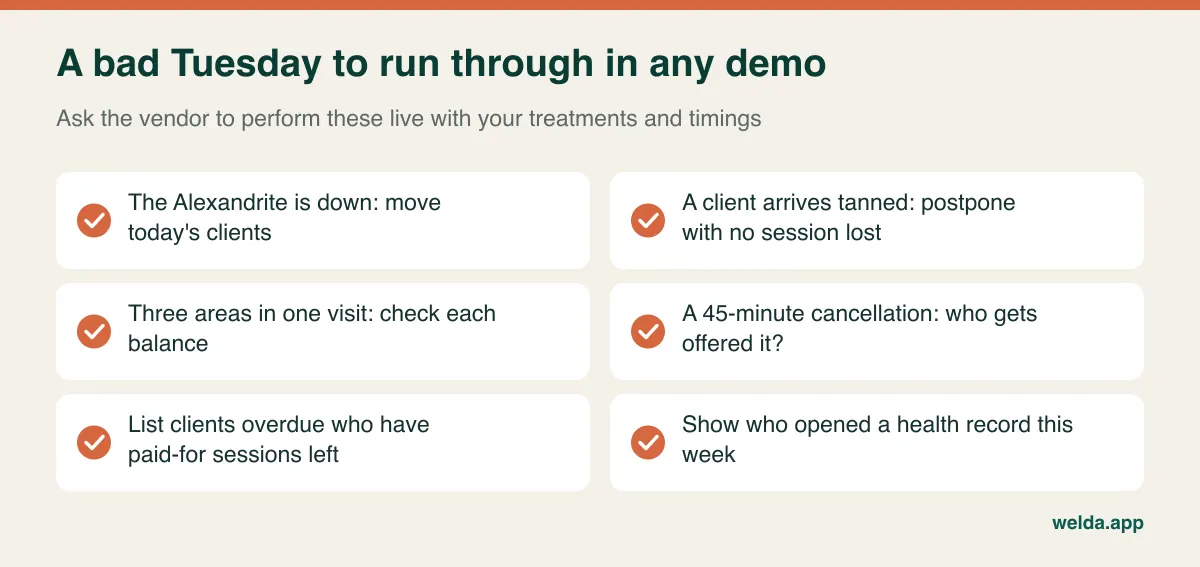
While you watch, keep three questions in mind. Could a receptionist do this while on the phone? Could an operator record the outcome on a tablet between clients? Could a manager later see what happened, even if somebody tried to tidy it up? Welda CRM is web-based and needs no installation, so it can be used through a browser on computers and tablets at the same time. The seven-day free trial has all modules open, which means you can run a real week of your own scenarios rather than judge from a presentation.
Include the people who will actually use the system. An owner who evaluates alone tends to focus on reports, while the daily pain falls on the receptionist's and operators' screens. And avoid scheduling your switch just before your busiest season. Learning new software during peak demand is hard on staff and noticeable to clients. For many clinics in the northern hemisphere, the quieter stretch after the summer peak is a more forgiving moment, though your own booking pattern is the better guide.
Language deserves a mention too if your clients or team are mixed. Welda CRM's interface and templates are available in English, Turkish and German, and reminders can go out in the client's language. Check that this matches your real mix of clients before relying on it.
What actually drives the bill
Do not compare headline monthly amounts. Compare what makes the amount grow in a clinic like yours. Laser has a few cost drivers that salons feel less:
- Message volume. A multi-session business sends a lot of reminders and follow-ups. Ask what is included, what overage costs and who pays any WhatsApp or SMS charges.
- Photo storage. Before and after archives grow quickly. Find out what happens when you hit the limit.
- User definitions. Do part-time operators count as full users? Do inactive accounts still cost?
- Modules. Are stock tracking, commissions and automated flows in the plan you are looking at, or a higher tier?
- Payment processing. Some vendors take a share of card or online payments, which can matter when courses are paid upfront.
- Exit terms. Can you export course balances in a usable format if you leave, and at what cost?
Build your comparison around a real month: your staff, your branches, your approximate message count, your photo volume. Ask each vendor to quote against the same description, in writing. Welda CRM is a monthly subscription with no separate set-up fee, and account set-up, data transfer and team training are included in every plan. Plans differ by branches, users, message volume, storage and modules, with stock, expenses, automated message flows, cash desk and POS, and commissions starting at the Pro level. If you want to track gel and consumables as part of the system, mention that when we talk. The right plan and price are settled in a free call based on your setup.
Moving open courses without a dispute
Appointments renew themselves within a few weeks. Course balances do not. If "three leg sessions remaining" becomes "two" during an import, you have an awkward conversation at the front desk and a client who no longer trusts your records. That is why the balance list deserves more care than the appointment history.
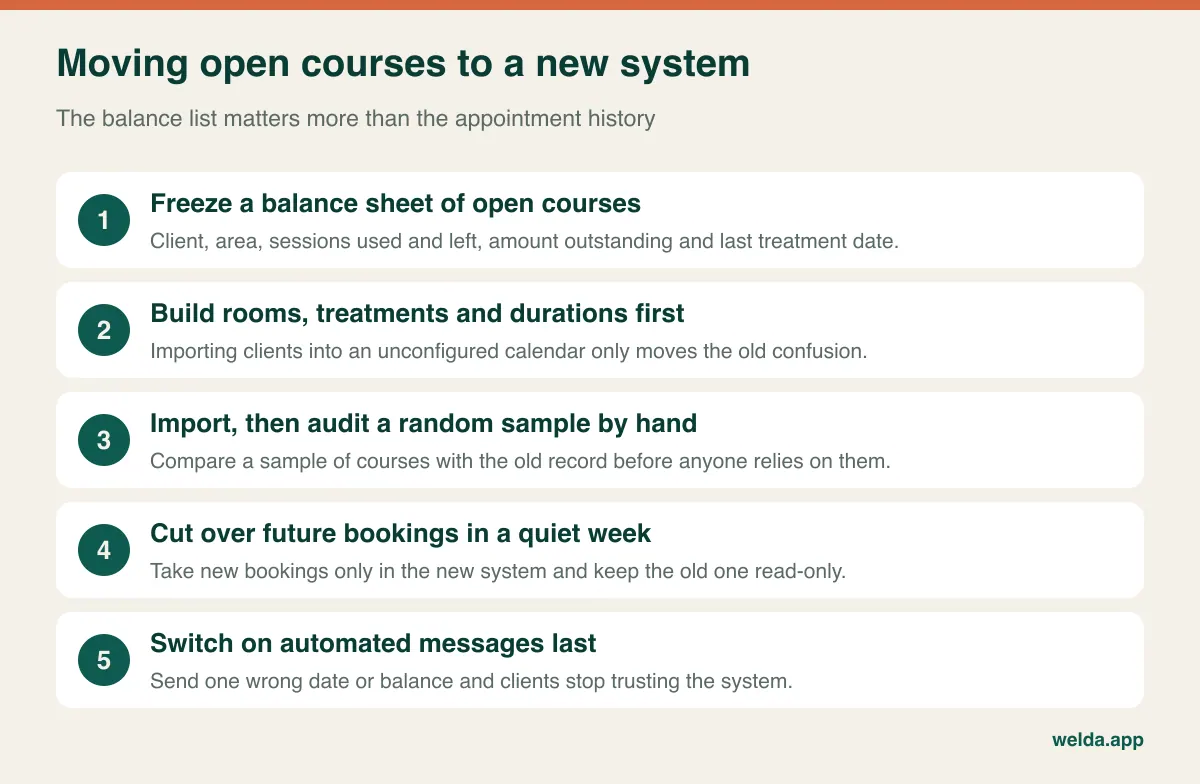
With Welda, setting up your account, branches and staff calendars and transferring existing client and appointment data are part of onboarding, and reception and practitioners get hands-on training on appointments, client tracking, packages and payments. However clean the import, it is smart to confirm the remaining balance with each client at their first visit after the switch. It takes ten seconds and catches anything that went wrong. While things are settling, it is also a good time to review how you reduce no-shows, as your reminder setup is being rebuilt anyway.
Questions laser clinic owners ask
Can we book by machine in Welda CRM?
The calendar offers staff, room and branch views with conflict detection. If each laser has its own room, the room view acts as a machine schedule. We do not describe a machine as an independent resource, so if a laser moves between rooms, raise it with us and test it with your schedule.
Will clients be contacted automatically when their next session is due?
Booked appointments get automatic WhatsApp reminders and you can set up message flows around each appointment. Automatically identifying clients with no booking by area and window is not something we list as built-in. Follow-up tasks and the queue can support a manual routine.
Is WhatsApp suitable for reminders that touch on health?
Keep reminder wording minimal and avoid unnecessary treatment detail. Whether a given channel and wording suit your jurisdiction is a question for your privacy adviser. Also note that promotional messages typically have stricter consent rules than service reminders.
Does the software handle tax invoices for my country?
Welda CRM covers invoices, receipts, payments and instalments, with e-invoice and e-archive integration available through your chosen provider. Local fiscal requirements vary widely, so confirm with us and your accountant what is available in your country before relying on it.
Could a very small clinic get by with something simpler?
Yes, if you are one person with one machine and a few active courses, a simple calendar plus a spreadsheet may well do for now. The case for dedicated software grows when someone else takes bookings or nobody can state the number of sessions you still owe.
How do we find out the price?
Pricing depends on branches, users, message volume and modules. We go through your setup in a free call and settle on the right plan and price together, with no commitment.
Once you have worked out your laser-hours and named your real bottleneck, the next step is small. Have a look at Welda CRM as laser hair removal clinic software, book a free call to walk us through your clinic, and use the seven-day free trial to test your bad Tuesday. If there is something your clinic needs that we cannot carry, we would rather say so in that conversation.