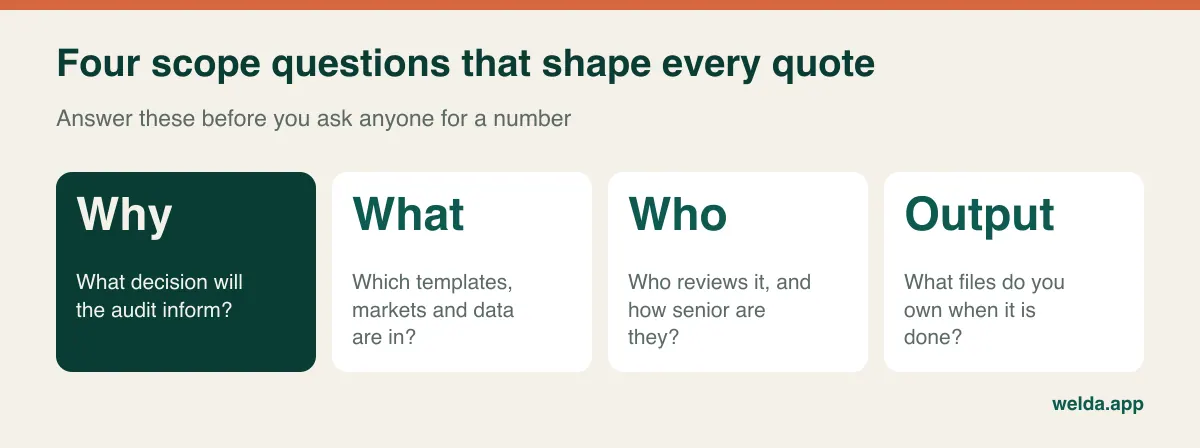
SEO audit cost depends far less on how many pages your site has than on four things: the decision the audit has to support, how complex the site really is, how much human review goes into the data, and which files you own when the work is finished. That is why two quotes for the same website can look wildly different and both be reasonable. They are usually quotes for two different jobs. If you want a one-off audit before committing to a monthly SEO retainer, the useful first move is not to ask for a number. It is to write down the scope, so the numbers you get later actually mean something.
The rest of this guide helps you do that. You will end up with a short brief you can send to any vendor, a list of deliverables worth naming in the contract, and a way to compare proposals without being misled by the bottom line. If you first want the basics of what an audit examines, our explainer on what an SEO audit covers is a good place to start. This article is about buying one.
What you are really buying when you buy an "SEO audit"
The phrase covers at least three distinct products, and vendors rarely tell you which one they are selling.
An automated report is software output: a tool checks a page or a crawl against a set of rules and produces a score with a list of warnings. Our own free SEO report is this kind of thing. It reviews the page you enter plus your domain's robots.txt and sitemap, runs more than 20 checks and scores the result out of 100. It does not crawl your whole site or look at rankings, competitors or backlinks. That is useful for a first look and honest about its limits. The trouble only starts when output like this is resold as a professional audit.
A technical audit involves a specialist crawling the whole site and recording problems with crawling, indexing, speed, redirects and structured data at URL level. It answers the question "can search engines reach and understand this site?" It often will not tell you what to write next or which service page deserves investment first.
A strategic audit adds content, search intent, competitors and commercial context on top of the technical layer. Someone has to learn which services actually make you money, read the results pages for those queries and turn everything into a ranked plan. This is what most businesses mean when they want an audit before signing a retainer, and it is the version where human time dominates the budget.
A quick way to tell which one you are being offered: pick any line in a sample report and ask the vendor to explain it using your site. Someone selling tool output will recite a general rule. Someone who has done the work will open a URL, show the crawl data or Search Console figures, and tell you what it means for your business.
The scope drivers that actually move the quote
An audit is mostly expert time, so understanding the price means understanding where the hours go. These are the lines that change a proposal most, along with what to pin down for each.
| Driver | Why it adds effort | What to ask |
|---|---|---|
| Number of templates | Thousands of URLs on one template usually share one problem. Each new template needs its own review. | How many templates, and how many samples of each? |
| Manual content review | Intent and quality are judged by reading, not by software. | How many pages will a person actually read? |
| JavaScript rendering | Raw and rendered HTML have to be compared to see what bots receive. | Will you run a rendered crawl? |
| Countries and languages | Hreflang, local demand and duplication need checking per market. | Which markets are in scope? |
| Locations | Business Profiles, location pages and local results are separate pieces of work. | How many locations get reviewed? |
| Competitor analysis | Every competitor means more results pages and content to read. | How many competitors, across which query groups? |
| Log file analysis | Shows where bots really go. Valuable on large sites, often unnecessary on small ones. | Do we need this, and why? |
| Backlink review | Separating risky links from valuable ones takes judgement. | A summary or a full review? |
| Walkthroughs | Presenting findings to leadership and developers is real work. | How many sessions are included? |
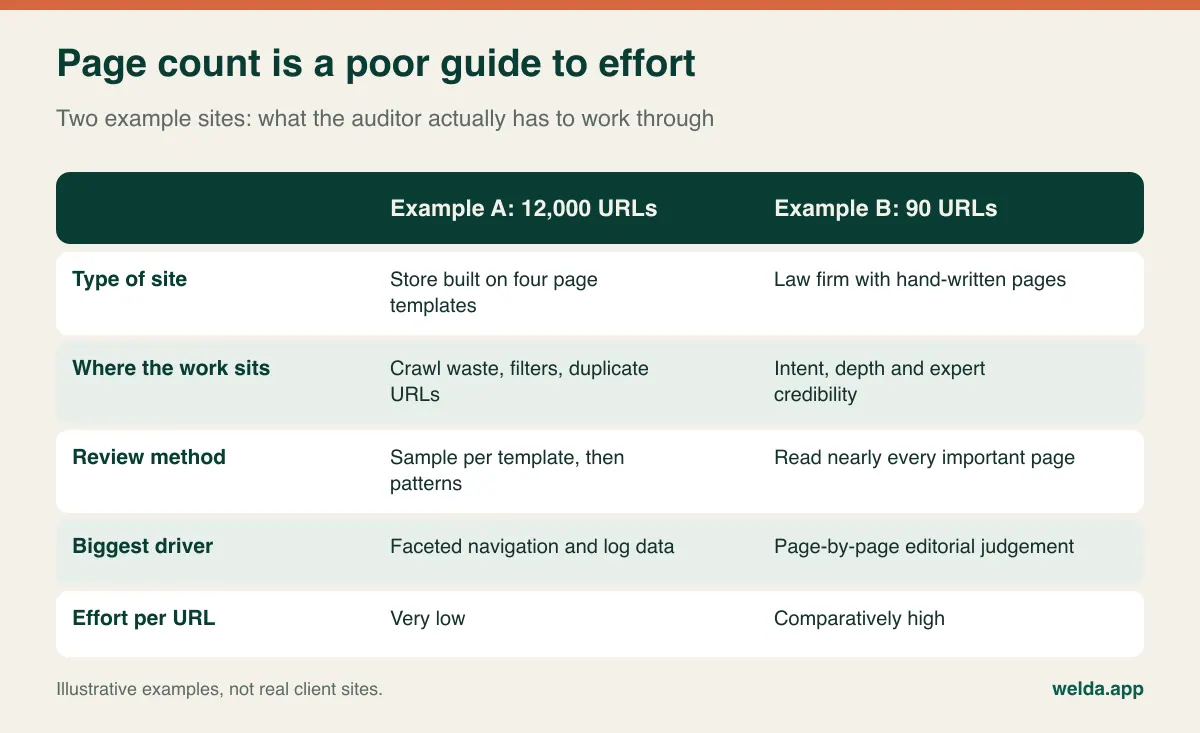
The easiest mistake is treating page count as the main variable, since it is the first thing anyone asks about. Consider two illustrative sites. One is a store with 12,000 URLs built on four templates, where most of the effort goes into faceted navigation, duplicate parameter URLs and how crawl budget is spent. The other is a law firm with 90 hand-written pages, where each page has to be read for intent, depth and credibility. A per-page rate would be unfair to both. If someone quotes after asking only for your page count, assume they have estimated the job without seeing it.
A few situations push cost up in ways that catch buyers off guard. A headless or heavily JavaScript-driven front end requires rendered crawling and closer developer involvement. A recent migration means comparing old and new URLs against historical data. A site with little history in Search Console gives the auditor less evidence, so conclusions are more tentative, whatever the price. And a business in a regulated field such as health, finance or law tends to need closer content review, because credibility signals matter more when readers are making consequential decisions.
The filtering is the product
Any crawler can produce a list of warnings in minutes. That list is the raw material, and on a real site most of it does not deserve your attention. A missing alt attribute on an old press image and a noindex tag on your best-selling category can sit in the same export with similar labels. What you are paying a person for is the journey from that export to a small number of decisions you can fund and schedule.
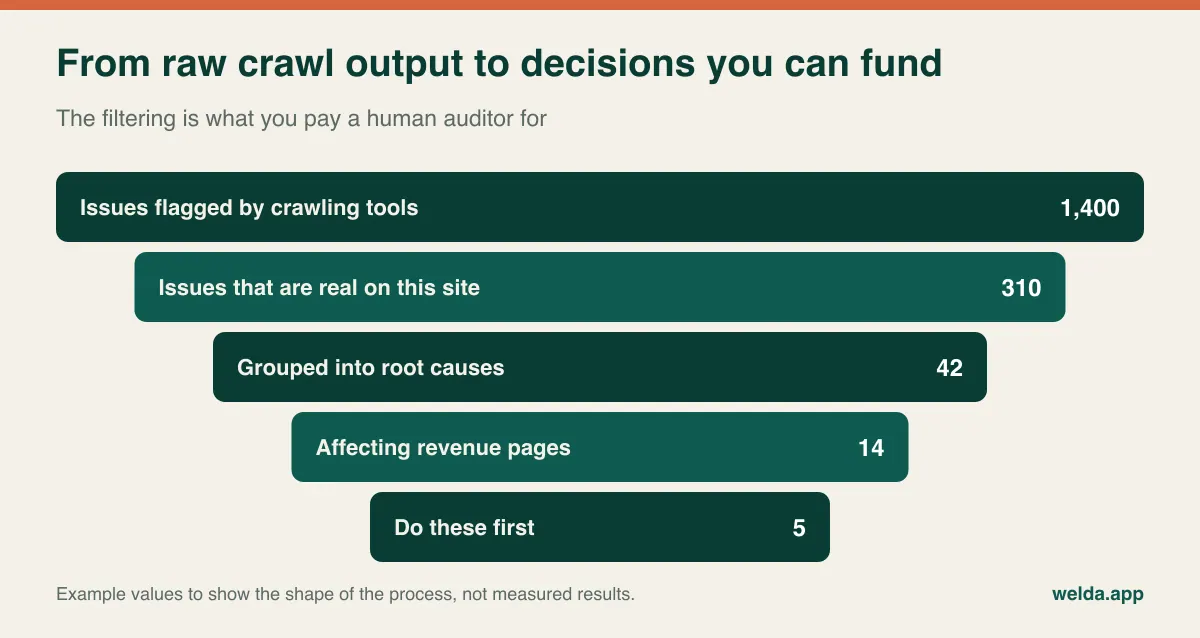
This changes what you should value in a proposal. A long report is not a sign of a good audit, and it is often the opposite. If a report lists 300 items at equal weight, the auditor has passed the hard part back to you. Ask vendors how they group findings by root cause and how they decide what comes first. A strong answer connects priority to something specific: revenue pages affected, demand behind those pages, effort for your particular team. A weak answer talks about "critical, high and low" labels that come straight from a tool.
Sizing matters too. An audit that recommends more work than you could complete in a year is not more thorough, just less useful. Tell the auditor your developer capacity and content budget at the start, even roughly. For a small business, a good audit might end in five things to do this quarter and a short list of what to ignore. If your budget is tight, our guide to SEO priorities on a small budget shows how to think about that order.
Deliverables worth naming in the contract
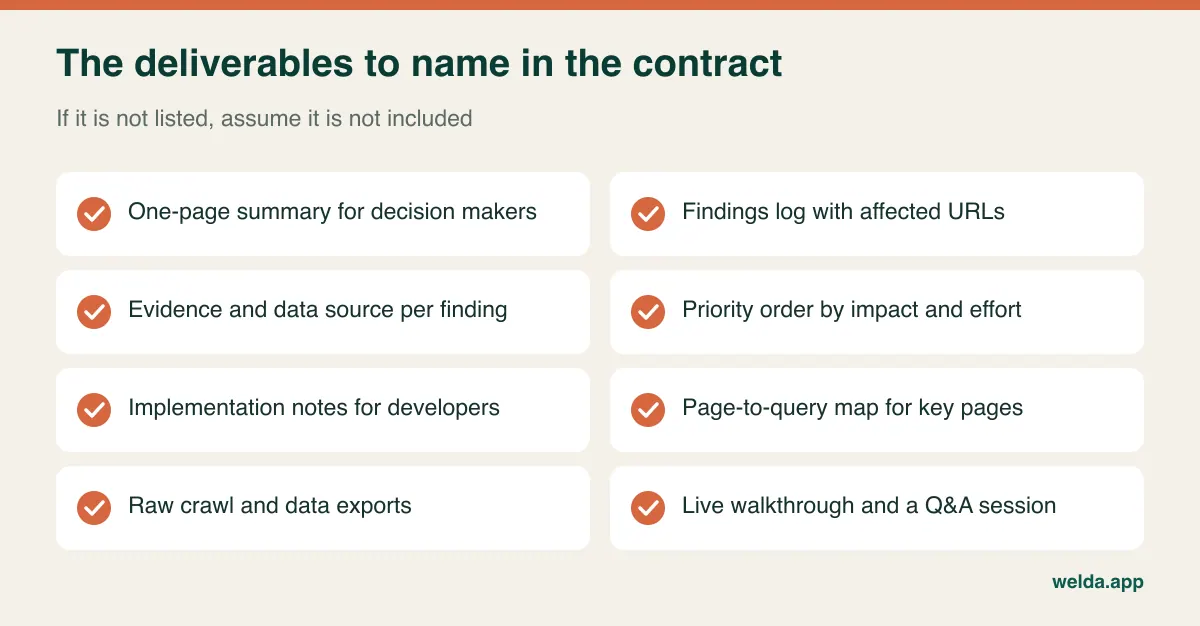
The fastest way to settle a pricing conversation is to define the output. "A report" can mean a five-page PDF or a working file with hundreds of rows. Write these into the proposal so nobody has to guess:
- An executive summary. A page or two for whoever approves the budget: where the site stands, the handful of decisions that matter and what is at stake.
- A findings log. An editable spreadsheet, with one row per finding: affected URLs or template, evidence, recommended fix, priority and suggested owner. Screenshots inside a PDF cannot be imported into your task tracker.
- A justified priority order. Ranked by impact and effort, with the reason stated.
- Developer-ready notes. Clear enough for your developer to estimate the work without another meeting.
- A page-to-query map. Which key pages serve which searches, and where pages compete with each other.
- Raw exports. Crawl files and data pulls, so the next person does not begin from zero.
- A measurement plan. Which metric will show whether a fix worked, and when to look.
Then ask for one anonymised sample finding, because format is hard to fake. Here is what separates useful work from filler:
| Weak finding | Useful finding | |
|---|---|---|
| Issue | Pages have thin content. | Six service pages target the same query and split clicks between them. |
| Evidence | Tool screenshot. | Search Console query data per URL, plus the crawl export. |
| Why it matters | "Content is king." | These pages cover your main commercial service, and none holds a stable position. |
| Fix | Add more content. | Merge into one page, redirect the other five, keep the sections listed. |
| Priority | High. | First in the content queue; requires only one writer and a redirect rule. |
The numbers in that table are illustrative. There is no reason to pay a premium for the left-hand column. The right-hand column keeps your developer from spending a sprint on things that were never the problem.
Auditing before a retainer: handling the conflict of interest
Most businesses buying a one-off audit are really saying: "Show me how you work before I commit every month." That is sensible. It also comes with a built-in tension, because the firm writing the report may sell the work the report recommends. We are one of those firms, so the caution applies to us too. Here is how to think about who should run your audit.
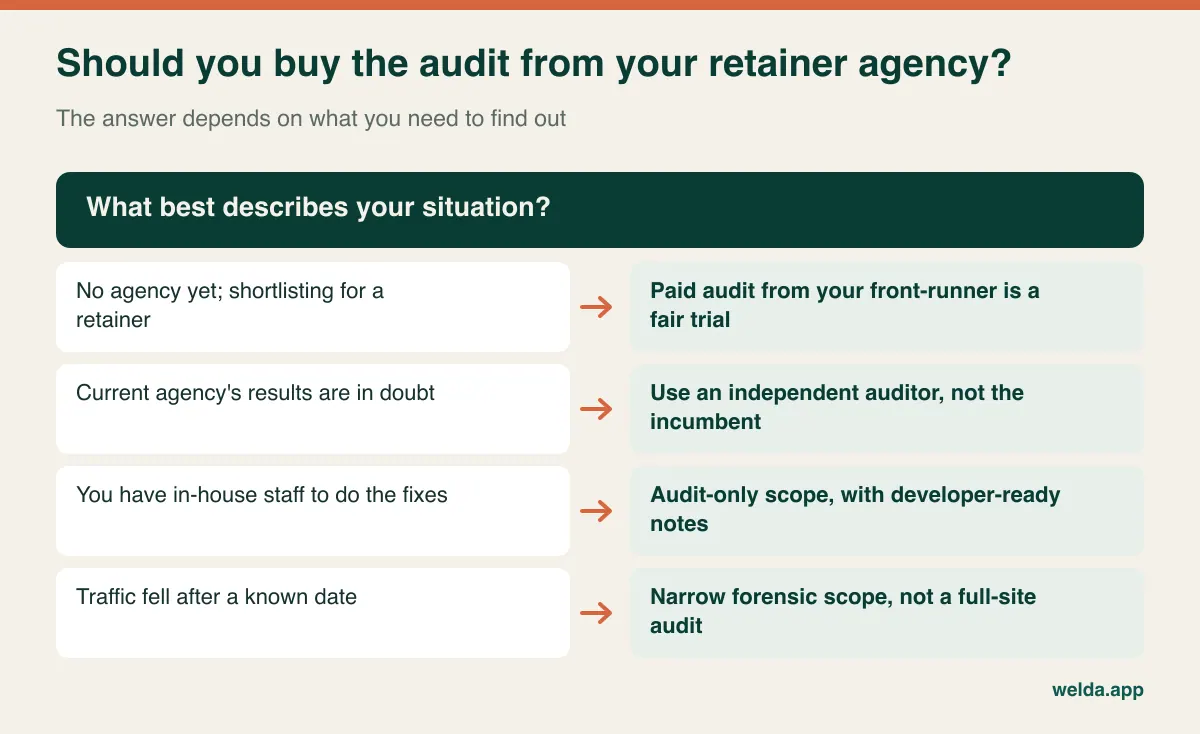
An audit from the agency you are shortlisting is a reasonable paid trial. You see how they think, how they report and whether they are pleasant to disagree with. If your concern is the agency you already use, the logic flips, and you want someone with no stake in defending earlier work. Either way, four terms keep things clean, and it is worth having them in writing:
- You own the report. You can hand it to another agency or your in-house team without restriction.
- No retainer is implied. The audit fee should not depend on buying anything later. Check the small print.
- Credit is stated upfront. Some firms credit the audit against a retainer and others do not. Either is fine, as long as you know beforehand.
- Recommendations rest on evidence. "Produce more blog content" needs to be supported by a visible gap on your site and not simply by the existence of a content package.
If you do go on to a retainer, the audit becomes the brief. You can ask where each hour of the monthly fee goes and match it to specific findings. Our guide to evaluating SEO proposals covers that next stage. Arguably this is the greatest value of doing an audit first: it ties an open-ended budget to specific work.
International sites: where audit scope quietly multiplies
Businesses selling across borders often underestimate this. Adding a market does not simply add pages. It adds a separate competitive landscape, a separate set of search behaviours and a set of technical relationships that can break.
- Structure. Country domains, subfolders and subdomains behave differently, and the audit has to consider whether your choice still suits your plans. Changing it later is a project in its own right.
- Hreflang. A reliable review checks that annotations are reciprocal, point to live indexable URLs and match the versions you actually want each market to see. A site in English for the US, UK and Australia can have very similar pages competing with each other.
- Translated versus localised content. UK buyers may search "solicitor" where US buyers search "attorney". A tool cannot judge whether translated pages fit how people in that country search, so someone with knowledge of the market has to read them.
- Different search landscapes. The players, the marketplaces and the shape of the results vary country by country. A competitor list valid at home may be irrelevant elsewhere.
- Privacy and consent. Consent rules such as those under GDPR in Europe and the UK or state privacy laws in the US can affect how much data analytics tools collect. Part of the gap between Analytics and Search Console may come from consent choices and is not necessarily a tracking fault. This is general orientation, not legal advice, so involve your own counsel on specifics.
When requesting quotes, list exactly which markets are in scope and whether each one receives a full review or a sampled one. A sensible compromise for many companies is a full audit of the primary market with a focused technical and hreflang review for the others. On proposals from abroad, also compare currency, whether tax is included, and how time-zone differences will affect the walkthrough.
Putting three proposals side by side
You can only compare totals once scope is equal, and that takes a few hours, not a formal procurement process.
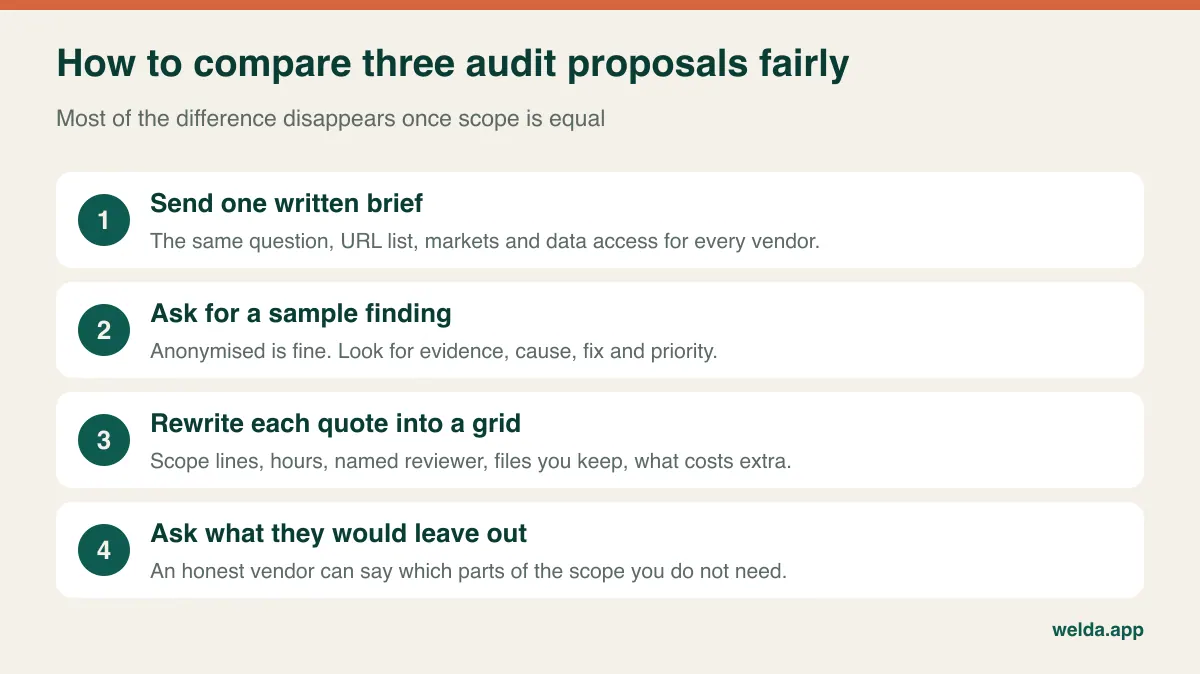
A workable brief fits on half a page: the question you want answered, the domain and markets in scope, your priority services, your platform or CMS and whether Search Console and analytics access is ready. Send it to every vendor unchanged. Return any one-line proposal that just says "comprehensive SEO audit" and ask for scope line by line.
Next, ask who will do the work. Is the senior consultant on the sales call the person reading your data? Which tools are used, and who interprets the output? Ask for an estimated total of hours too. Some firms will not share a rate, which is fair enough, but an hours estimate is a useful reality check against the scope they claim.
The question to keep for last is "what would you remove from this scope?" Someone who has looked at your site might say a log file review is overkill or that backlinks are not your problem. A vendor who says everything is essential may be sizing the invoice and not the site. Once your grid is filled in, you can see which line a cheap quote skipped and which line an expensive quote added. If you would like help filling in that grid for your own site, you can talk to our team about SEO audit cost and scope. The fee is settled in a free consultation once the scope is clear.
What the audit fee does not pay for
An audit is a diagnosis. Treatment is separate and usually takes longer. Businesses that budget only for the invoice tend to get a surprise when the report arrives, so plan for these too:
- Developer time for redirects, template changes and performance work, whether that is your employee, a freelancer or your web agency.
- Content work. Pages to merge, rewrite or create. This is frequently the largest share of the follow-up.
- Verification. Who checks that the fixes went live correctly? Often this is a separate line, so ask early.
- Tooling. Will repeating the checks require paid licences, or can they be tracked with free tools?
- Extra sessions and markets. Additional meetings or a late-added language version may be billed separately.
- Your own team's hours. Granting access, answering questions and reading findings never appears on an invoice, but it is real.
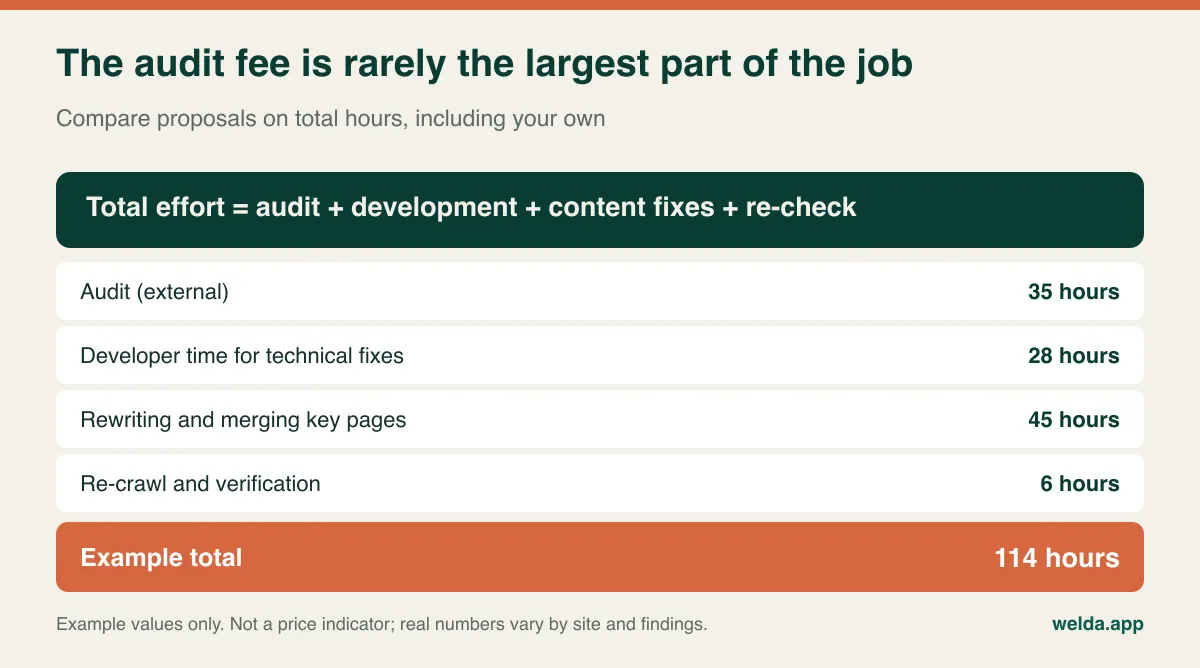
So the better question is not only "what does an audit cost?" but "will this audit produce work we can actually finish?" If your developer has a few hours a month, a hundred-point report is headed for a shelf.
When a paid audit is the wrong purchase
Plenty of businesses do not need one yet. You may be better off spending elsewhere if:
- Your site is small and new. With a handful of pages and a few months of data, there is little to analyse. Get the basics in place, register with Search Console and build your real service pages. A free automated check is often enough for now.
- You are about to rebuild. Do not pay to polish an old template. Ask for a pre-migration inventory and a launch check. Our website migration SEO checklist shows what that involves.
- Nobody can implement the findings. Reports age. Secure capacity first, or plan implementation together with the audit.
- The problem is not search. If traffic is healthy but enquiries are not, your offer, your pricing or your page copy may be the issue. An SEO audit might hint at this, but it will not resolve it. If a sudden decline is the issue, ask for a narrow forensic scope before commissioning anything broad.
A vendor willing to tell you this is giving you useful information about how they will behave later. Treat "every site needs a full audit right now" as a warning sign.
Preparing so you do not pay for waiting
Every day an auditor waits for access is time someone eventually pays for. Before kickoff, gather the following:
- Named, limited-permission user access to Search Console and analytics. Do not share admin passwords, and remove access when the work ends.
- A dated list of significant changes from the last couple of years, such as redesigns, platform changes, domain moves and content removals.
- Your most profitable services or product groups. An auditor cannot guess this from outside.
- Past agency reports and any link building history, even if awkward. Purchased links are better disclosed than discovered.
- A realistic picture of who can do what: developer capacity, writers and any platform vendor who controls the code.
Avoid exposing personal data the audit does not need, such as form submissions or customer lists. If access to such data cannot be avoided, a data processing agreement may be appropriate, depending on where you operate. Ask your adviser if you are unsure.
Testing the report before you sign it off
If part of your payment depends on acceptance, this gives you leverage, and it is worth doing even if it does not. Pick three findings at random and verify them yourself: open the URL and find the evidence. Ask "if we could only do three things, what would they be?" and expect an answer without flipping through pages, tied to how your business makes money. Give the file to your developer and see whether they can estimate the work without calling a meeting. Finally, ask what could not be reviewed. Every audit has limits, such as unavailable tools, short data history or excluded sections, and a report that hides them is incomplete.
The warning signs are familiar: promises of first-page rankings, a verdict based on one score, boilerplate about problems your site does not have, equal priority on every line and unsourced forecasts of traffic growth. Search engines decide rankings. An honest audit points out opportunities and leaves the guarantees out.
Where an audit sits in Welda's SEO work
In our SEO service, a technical audit is the first step. We review your site's technical state, current rankings and competitive landscape using Search Console, Screaming Frog and PageSpeed Insights, and bring the key problems and opportunities together in a prioritised report. Keyword and content strategy, implementation and monthly reporting follow. We use white-hat methods only and do not guarantee number-one rankings.
We do not have a fixed price list: SEO fees depend on your site's size, the competitiveness of your market and the content volume required. If you want the audit alone, say so at the start of the conversation. We will look at your site with you, work out whether a one-off engagement suits your situation and explain what would shape your SEO audit cost. If you would rather start with a quick self-check, the free report is a sensible first step. To arrange a free consultation, get in touch.
Frequently asked questions
Why does SEO audit cost vary so much between vendors?
Because the quotes are usually for different work. An automated report and a strategic audit differ in scope, effort and output. Equalise the scope, the people and the deliverables before comparing totals.
Should I trust a quote given without seeing the site?
Be cautious. A figure given without knowing your site, scope and market is usually the price of a fixed package, and it makes your comparison worse. On our side, the fee is agreed in a free consultation after the scope is clear.
How long does an SEO audit take?
It depends on scope, site complexity and how quickly access is granted. Ask for a time estimate per phase in the proposal, and ask how delays in access affect the schedule.
Can we run an SEO audit ourselves?
The basics, yes. Search Console, free crawler tiers and automated reports will surface a lot, and our SEO audit overview shows what to look at. The harder parts are ranking the findings in a business context and seeing your own work impartially.
Will rankings improve after the audit?
Not on their own. A report changes nothing until fixes are applied, and even then, search engines and competitors influence the result. Nobody can honestly guarantee a ranking.
How often should we get an audit?
Tie it to events more than to a calendar: a migration, a platform change, an unexplained drop in traffic, a change of agency or entry into a new market. If monthly SEO work is underway, basic checks should already be part of it.
Is a one-off audit worthwhile without a retainer?
It can be, provided you have someone to implement the findings. In-house developers and writers can often do a lot with a well-prepared report. Without that capacity, the report loses value quickly, so plan for implementation before you buy.