Local SEO services cost what they cost because of three variables: how many locations you run, how crowded the search results are around each of them, and how much of the ongoing work stays with your own team. That is why a flat price sheet tells you very little. A single-location barber and a seven-site dental group can both buy "local SEO" and be buying completely different jobs. The useful question is not "what's the going rate?" but "what work is actually behind this number, and do I need all of it?"
We don't publish a rate card for this service at Welda, because scope can't be judged until someone has seen your location list and your local competition. The figure gets settled in a free consultation. What follows is written so that you can judge any proposal, ours or anyone else's, and decide whether you need an agency at all.
A free listing, a paid service: where the money really goes
Google charges nothing for a Business Profile. Owners often stop right there and ask why anyone would pay for something Google gives away, and it's a fair question. The answer is that the listing is free, while the labour around it is not. Choosing categories, verifying each location, untangling old listings, keeping a review habit alive, tying the profile to a website page that actually supports it, and proving any of this produced phone calls all take someone's time.
Split that labour into two piles and most proposals become easier to read. One pile is finite: verification, categories, services, hours, first photos, duplicate removal, fixing the address format everywhere it appears. The other pile recurs: responding to reviews, posting holiday hours, checking for edits suggested by the public, adding photos, improving location pages, reporting. A proposal that charges monthly but only describes the first pile deserves a direct question: what will you be doing in month five?
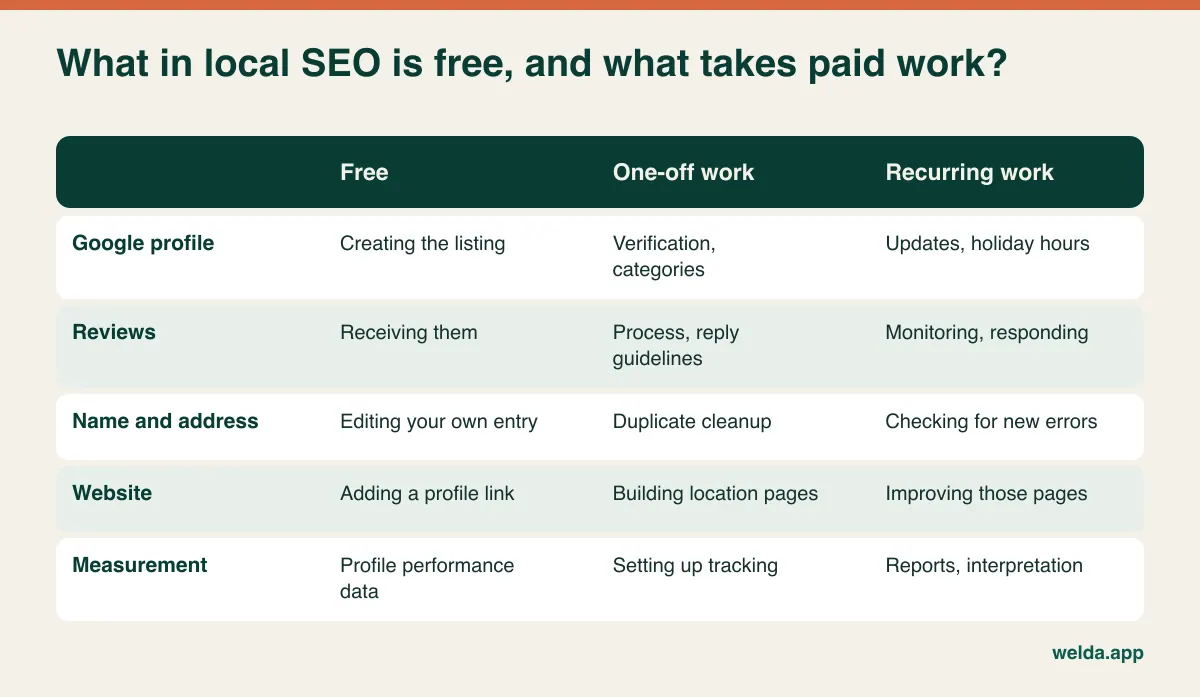
Google's own documentation frames local ranking around relevance, distance and prominence. Distance is the one a contractor can't change. Relevance comes from your profile and your website together, so a business with a thin one-page site often has a larger scope than one with solid service pages. If you want the fundamentals before reading proposals, our guide to local SEO and Google Business Profile covers them.
Why your customer's phone sets part of the bill
Ordinary SEO lets you ask "what position are we in for this keyword?" and get a roughly usable answer. Local search doesn't. Results for "physiotherapist" change with the searcher's location, sometimes within a few streets. You might sit first outside your own front door, fourth half a mile away and nowhere across the river.
This has two consequences for what you pay. The first is that competition is hyperlocal. A nail salon in central Manchester may share walking distance with a dozen others, while the only vet in a Canadian prairie town competes mainly with a clinic an hour away. Identical monthly packages make no sense for those two. The salon may need steady work on reviews, photos and pages; the vet may need a tidy setup and very little after that. If a provider quotes before looking at your area, the quote reflects their standard package rather than your market.
The second consequence is measurement. One screenshot of a ranking, usually taken close to the business, proves almost nothing. A better method is to split the map into a grid and track the same search from each point. Tools that do this tend to be billed by location or keyword, so that line grows with your footprint. Ask whether it's included, and ask to see a sample report before signing.
It also explains why a "guaranteed number one" claim falls apart in local search. Number one from where, on what device, for whom? When we talk through local SEO services cost and scope with a business, we don't guarantee first position, because Google's algorithm and your competitors decide that. What can be promised is the work and honest reporting on it.
Three business shapes, three different jobs
Before comparing numbers, work out which of these you are, because the shape of your business changes what you should be buying.
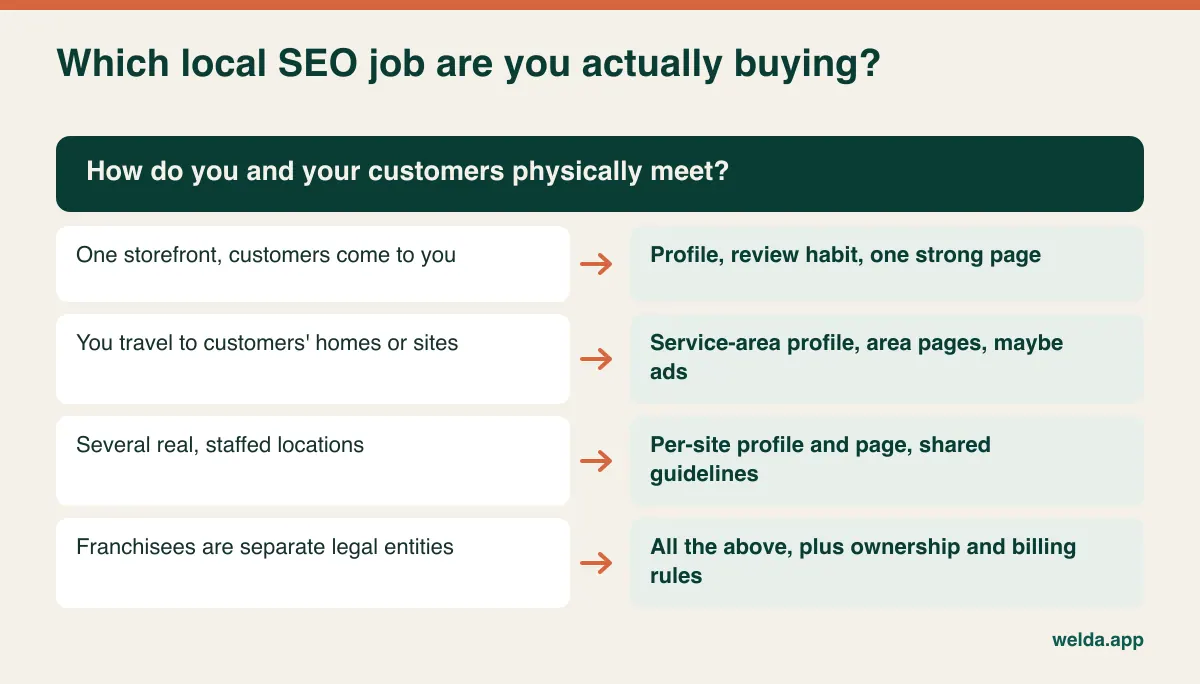
The single storefront is the simplest case: one address, customers come to you. Most value sits in a clean profile, a strong page for what you do, and a steady stream of honest reviews. If the neighbourhood isn't crowded, this may be a setup-and-maintain job rather than a long retainer.
The service-area business is a plumber, locksmith, mobile dog groomer or cleaning company. Customers don't visit you, so Google expects you to hide your address and define the area you serve. Here's the part that gets oversold: listing twenty suburbs as a service area doesn't mean you'll appear in the map pack across all twenty. Your verified location still matters for proximity. A realistic plan puts more of the effort into dedicated service and area pages, reviews that mention real jobs, and sometimes paid ads for the far side of your territory. Be wary of anyone promising you map visibility everywhere you're willing to drive.
The multi-location operator is where costs get genuinely hard to compare, so it gets its own section below.
A warning that applies to the first two shapes: buying an address. Virtual offices, mailboxes and a relative's shop are sometimes pitched as a way to "open" a location in a new suburb. Google's rules generally expect a real presence where staff meet customers, and a location that doesn't hold up can fail verification or later get removed. If a proposal includes extra addresses, ask in writing how each one meets the guidelines.
What adding a location does to the workload
Owners of several sites often assume cost multiplies with every location. In a sensibly built proposal, it doesn't. Part of the work belongs to the brand and only happens once: the category decision, review response guidelines, the location page template, the reporting format. The rest genuinely belongs to each site: verification, address cleanup, the page's real content, local photography, review monitoring.
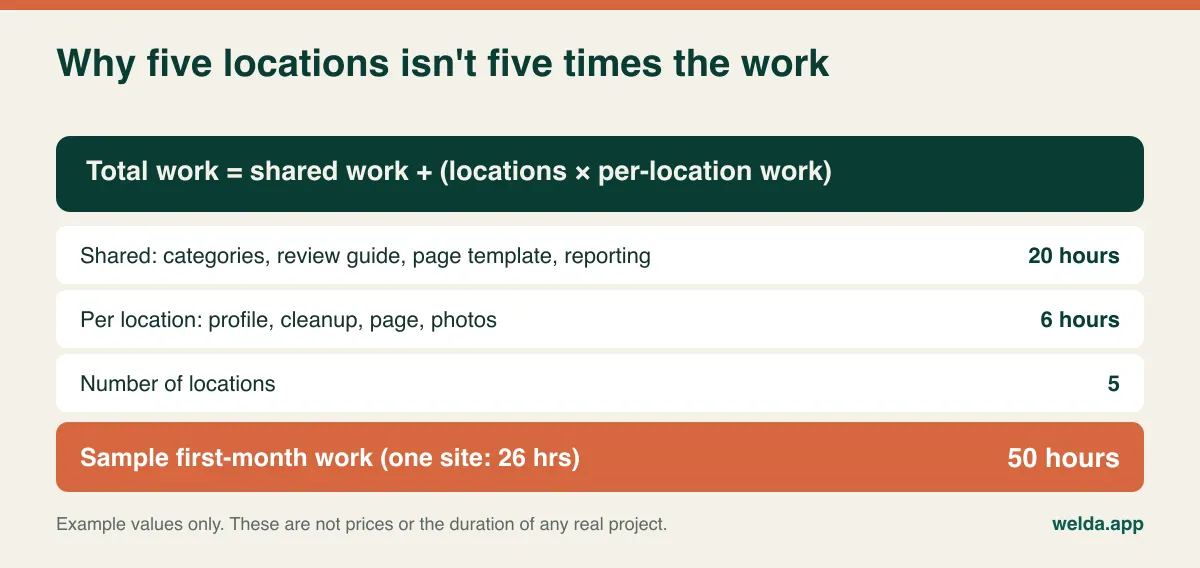
In this example, a single location needs 26 hours and five locations need 50, so the job has almost doubled while the location count has quintupled. Use that logic on any proposal you receive. A flat fee per location invites the question of how often the shared work gets billed. A single price regardless of location count invites a different one: which sites will actually get attention?
Franchises add a layer the sales conversation tends to skip. When each site is a separate legal entity, someone has to decide who signs, who gets invoiced, how VAT or sales tax works in each case, and who controls the profile when a franchisee leaves. A franchisee who changes photos on their own can quietly undo brand consistency, and a corporate team that locks franchisees out will probably stop getting local photos altogether. Those are operational questions, and they eat real hours in the early months, so they belong in the scope. Your accountant and lawyer should handle the legal details.
Your site structure is part of this calculation too. Each profile needs a genuine page to point at, and a page that only swaps the city name won't do much. Our article on website architecture for multi-location businesses goes through what these pages should contain. If your current site can't support them, find out at the start whether development sits inside the SEO fee or outside it.
The unglamorous line item that explains big price gaps
When two quotes for what looks like the same job are far apart, cleanup is often the reason. Nobody puts it on the brochure, yet a business with a messy history can spend its first months here.
Consider what a decade of trading leaves behind: an old address on a directory, a name written three ways, a phone number that belonged to a former manager, and a duplicate profile a previous agency created and nobody can log into. Then add market-specific sources. Which directories matter varies by country and trade: Yelp and industry review sites come up often in the US, Yell and trade-vetting sites in the UK, Yellow Pages-style listings or TrueLocal elsewhere. Apple Business Connect and Bing Places are worth covering in most markets, since people use those maps too.
Tell providers upfront if any of these apply, because they change the quote:
- You've moved, rebranded or closed a location in the last several years
- A former employee, agency or franchisee owns one of the profiles
- Your brand name appears differently from one location to another
- Your phone lines route through a call centre or a tracking number
- Your site was migrated and old location URLs are now dead
On the subject of names, the rule is plain: use the name you actually trade under. "Riverside Dental Best Emergency Dentist Leeds" may look clever, but it breaks Google's guidelines and any competitor can report it. A cheap package that includes this tactic is selling risk, not a discount.
Hire someone, or keep it in-house?
Plenty of small businesses don't need an agency for this, and it's better you hear that before you've paid for one. Basic local SEO isn't secret knowledge. The real issue is whether anyone on your team will still be doing it in six months.
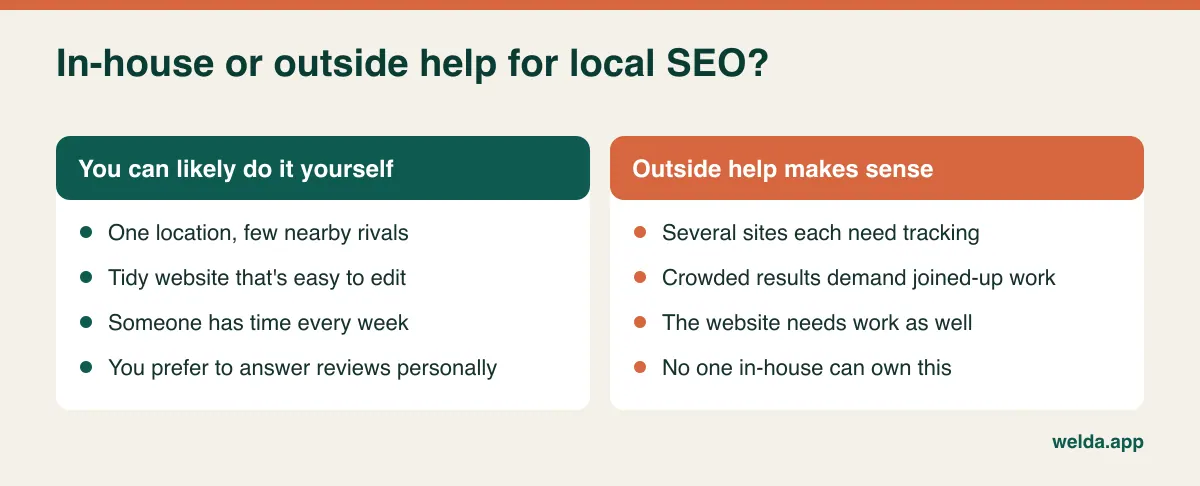
Doing it yourself is reasonable for, say, a single-location optician in a small town. There aren't many rivals, the clientele is already local and the website is in decent shape. Half an hour a week for replying to reviews, adding photos and keeping hours accurate could carry that business for a long time. A paid one-off audit may be all the outside help it ever needs.
A freelancer often suits defined, bounded work such as a one-time setup or a listing cleanup, and the best ones know the territory thoroughly. The limit is capacity. Local SEO overlaps with web development, content and reporting, which is hard for one person to cover at once. Ask where the logins and the work history would live if that person became unavailable.
An agency starts to make sense under certain conditions: you run several sites that each need tracking, your local results are crowded enough that reviews, content and technical work need to move together, your website needs work as well and you don't want to coordinate two vendors, or no one in-house has time to own this. If none of that sounds like you, take the meeting if you're curious, but "not yet" is a perfectly sound answer.
Who holds the keys to your profile?
This risk is particular to local work and can cost more than any fee. A profile holds your reviews, photos and history. Some businesses let a contractor create it from the contractor's own account and discover years later, on parting ways, that they can't get in.
The arrangement you want is simple: your business's own Google account is the primary owner, and the provider is added as a manager. Avoid one employee's personal Gmail; use an account the business controls. Apply the same rule to Search Console, Analytics and any directory logins. Then get the exit in writing. Who owns the location pages, the photography, the review templates and the past reports once the contract ends? Does the licence on those photos survive the relationship?
Privacy deserves a line in the contract as well. Review requests usually mean sharing customer contact details with a contractor, and call tracking can involve recordings. Depending on where you operate, GDPR, UK GDPR, CCPA or local equivalents may apply, along with consent rules for recording calls. Healthcare and legal businesses have an extra concern: even confirming in a public reply that someone is your patient or client can be a problem, and advertising rules for these professions vary by country. Take this as a prompt to ask a qualified adviser, not as legal advice.
Putting two proposals side by side
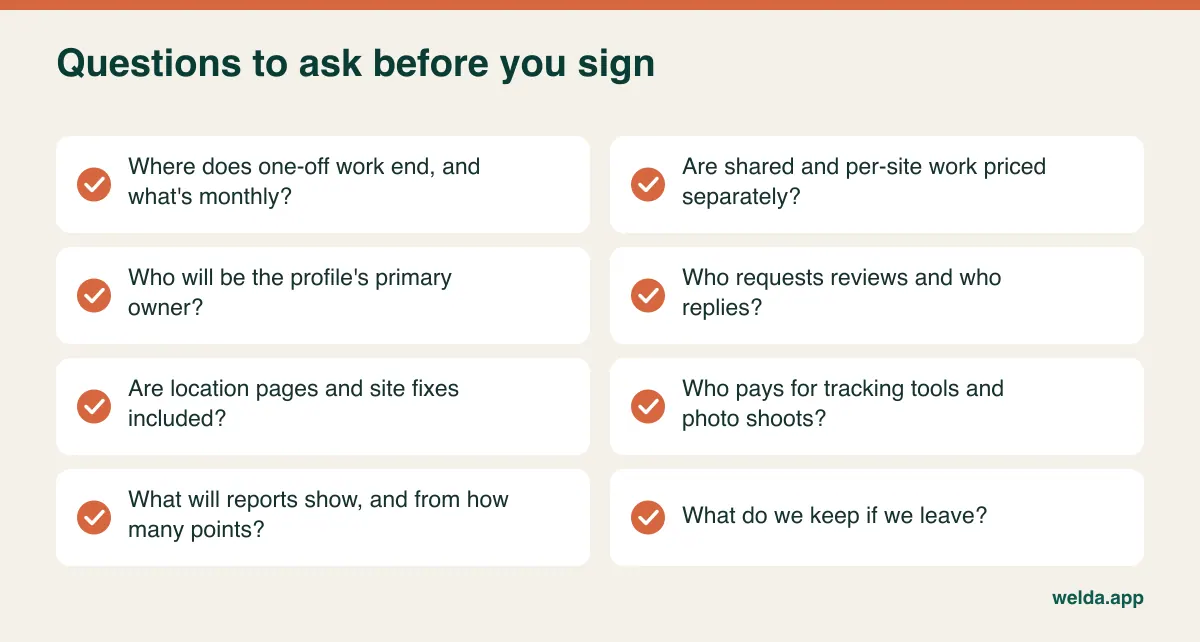
The classic mistake is to compare totals first and read scope later. Do it the other way round. Copy each proposal into the same set of rows, and leave a blank wherever the proposal is silent. Blanks are usually where the extra invoices come from.
| Line to compare | What you want to know | Worth a second look |
|---|---|---|
| Setup vs monthly | Where does one-off work stop? | The same "optimization" line every month |
| Location logic | Are shared and per-site work separate? | A figure quoted without your location list |
| Reviews | Who asks, who replies, who approves? | A promised number of reviews |
| Website work | Are location pages and fixes included? | "Site changes are your responsibility" |
| Tools | Who pays for tracking software? | Licences added after signing |
| Photos and copy | Is a shoot or writing included? | Photography billed separately later |
| Reporting | Calls and directions, or only rankings? | One ranking screenshot per month |
| Contract | Term, exit, tax, what you keep | Long lock-in, vague access terms |
Costs that tend to be missing from the headline number: setup fees, a photo shoot, development for location pages, tool licences, tax shown separately, a surcharge when you open a new site, and the assumption that paid ads are included (they rarely are). Your staff's hours count as well. If branch managers must collect photos and prompt for reviews, that's a real cost even though no invoice ever shows it.
For a broader framework, see our piece on evaluating SEO proposals. One local-specific test is worth adding: ask the provider to open one of your locations during the call and name the first three problems they see. A team that has really looked at your business will find something concrete quickly.
Where a bargain turns expensive
Some cheap packages only look cheap until something goes wrong. Bought reviews, or reviews exchanged for a discount, break Google's rules. Regulators have also been tightening up on fake reviews, with the US FTC and UK consumer law among those taking a firmer line, so this has become more than a platform policy matter. Filtering requests so that only happy customers get the link isn't a healthy approach either. Our guide on Google reviews and reputation management explains how to build the habit properly.
Keyword-stuffed names, fake addresses, mass submissions to low-quality directories and false reports against competitors belong to the same family. A suspended profile can vanish from the map until it's reinstated, and what you lose in that window could dwarf years of savings on the monthly fee. We only use white-hat methods at Welda, and we won't pitch a shortcut because it's fast.
Judging the return without fooling yourself
A local SEO report should tell you whether the phone rang. Business Profile performance data shows calls, direction requests and website clicks. Break them out per location, then connect them to your own records: how many calls became bookings, and how many bookings became paying customers? Your provider can't see that last step without your help. A simple "how did you find us?" field at the front desk or till is your part of the job.
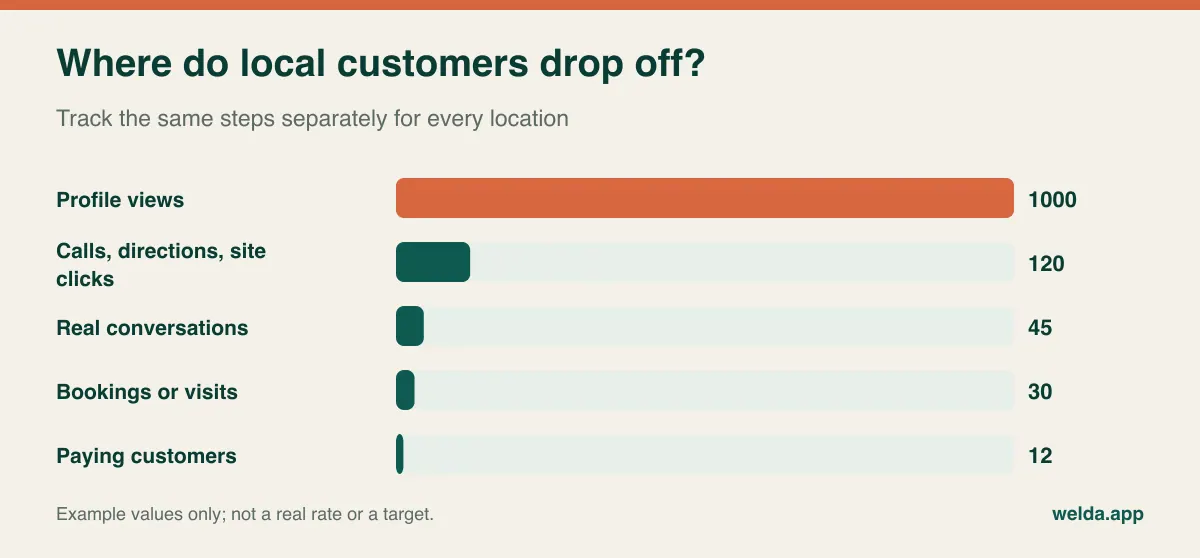
Do the break-even arithmetic before you sign. Take your monthly total, meaning the fee plus tools plus your own team's time, and divide it by the gross profit a new customer brings in. As an example, a monthly total of 100 units and a first-year gross profit per customer of 8 units means about 13 extra customers a month to cover the cost. For an implant dentist, that sum might look very different from a coffee shop's. The result won't tell you whether a given agency is good, only whether this scale of service fits your business.
On timing, our service page puts it this way: technical fixes can show effects within weeks, while content and ranking gains generally become clear over 3 to 9 months, depending on competition and your starting point. A business with duplicate profiles or failed verifications will spend the first stretch simply clearing the ground, and you should expect that to be reflected in the early reports.
What makes a quote fast and accurate
The better your inputs, the less a provider has to guess. Before any call, gather the trading name, full address and phone number of each location; who currently has access to each profile and from which account; which services are most profitable and which you'd like to push; the neighbourhoods where competition feels hardest; who at each site will handle photos and reviews; and any reports or credentials left by a previous provider. Note who manages your website and whether it can be changed easily, because that's where local projects most often get stuck.
At Welda, work begins with an audit of your site and profile. Our local SEO services cost conversation starts from that, covering Google Business Profile, map visibility and local directories, along with technical SEO, on-page work and content where they're needed, and monthly reporting so you can see progress. Instead of a fixed list, we put together a scope and proposal for your business, and if you could comfortably run this yourself, we'll say so. Send us your location list in a free consultation and the scope and figure can be pinned down from there.
Frequently asked questions
Why does local SEO cost vary so much between providers?
Because very different jobs are sold under the same label. One provider may only tidy up your profile, while another includes location pages, content, a review process and reporting. Location count and local competition move the number as well. Put the scope into matching rows before comparing totals.
Should I pay per location or a single fee?
Neither model is automatically right. What matters is whether shared and per-site work can be told apart. With per-location pricing, check that shared work isn't billed repeatedly. With one fee, check that every location is truly in scope.
If Google Business Profile is free, do I need anyone?
Not necessarily. With one location, light competition and a person who will keep at it, you can often manage alone. Several sites, crowded results or a website that needs work are what tend to change that answer.
What happens to my profile if I end the contract?
If your business is the primary owner, nothing: you remove the provider's access and carry on. That's why you shouldn't let anyone set it up under their own account. Confirm in writing that pages, photos and past reports stay with you as well.
Can local SEO replace my paid ads?
Sometimes, not always. Ads buy visibility immediately and stop when you stop paying, while local SEO takes longer and accumulates. Service-area businesses chasing work far from their base often need both. Assume ad spend isn't part of an SEO fee unless the proposal says otherwise.
Should I trust a provider who promises a set number of reviews?
Be careful. Your customers ultimately decide how many reviews you get. A provider can set up the request process, the timing and the replies, but a promised count raises the question of where those reviews will come from. Ask for the method in writing.
What do you need from me to give a number?
A location list, your website address and the areas you want customers from are enough to start. We'll work out the scope together in a free consultation, and the figure follows from that scope.