When you are comparing options for social media management for beauty salons, judge them on two things before anything else: how the agency handles client image consent, and whether its monthly report reaches booked and attended appointments. Everything else, from the visual style to the number of Reels, matters only after those are settled. An agency that makes gorgeous content but stops at reach and likes leaves you unable to tell whether the fee is paying for itself.
This guide is for salon owners who want Instagram to bring bookings and are thinking about handing it over. It covers what to ask for, how to read a proposal, and when you should not hire anyone at all. If you want the general checklist that applies to any business, read our guide to choosing a social media agency. Here we stick to what is different about beauty.
The brief most salons never write: which hours are you trying to sell?
A salon sells a fixed stock of time. A treatment room, a lash bed or a nail desk has a limited number of hours each week, and an unsold Tuesday morning is gone for good. That single fact should shape the whole relationship with an agency, yet many briefs simply ask for "more clients".
More demand on Saturday afternoon, when you are already full, produces turned-away clients and unanswered DMs. More demand on quiet weekday mornings produces income. So before the first agency call, open your diary and look back over the last four weeks. Write down which days and hours sit empty, which services could fill them, and which treatment you would most like a new client to start with. A one-off brow shape and a six-session skin course are different sales conversations and need different content.
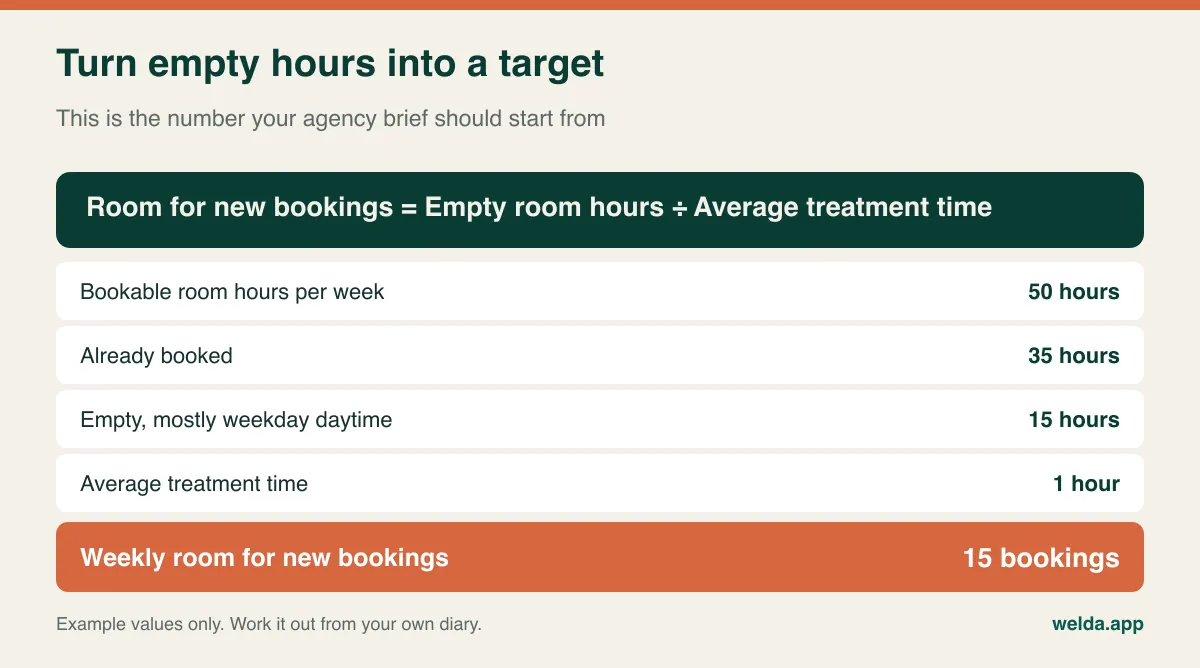
With that in hand, your brief changes from "grow our Instagram" to something like "we want more new facial clients on weekday daytimes, and we want to know each month how many came from social". Watch how an agency responds. A good one will challenge the target, explain what content can do alone and what would take paid ads, and decline to promise a number. If someone promises a full diary in ninety days without having seen your diary, ask what that promise is based on.
Your best content has somebody's face in it
A coffee shop can film its coffee. Your strongest material is usually a real person's skin, brows, nails or body. This is where beauty differs most from other sectors, and where the wrong agency can leave you with a real problem.
Photos and videos of an identifiable person are generally personal data. Rules differ by country: the GDPR and UK GDPR set a demanding standard in Europe and the UK, and elsewhere you may be dealing with privacy, publicity or image rights laws. Images that reveal a skin condition or treatment may also be treated as health-related data in some places. We are not giving legal advice here, and your consent form deserves a review by someone qualified locally. What holds nearly everywhere is the practical point: a casual "do you mind if I film this?" is weak evidence six months later, when the clip turns up in a paid ad and the client's employer sees it.
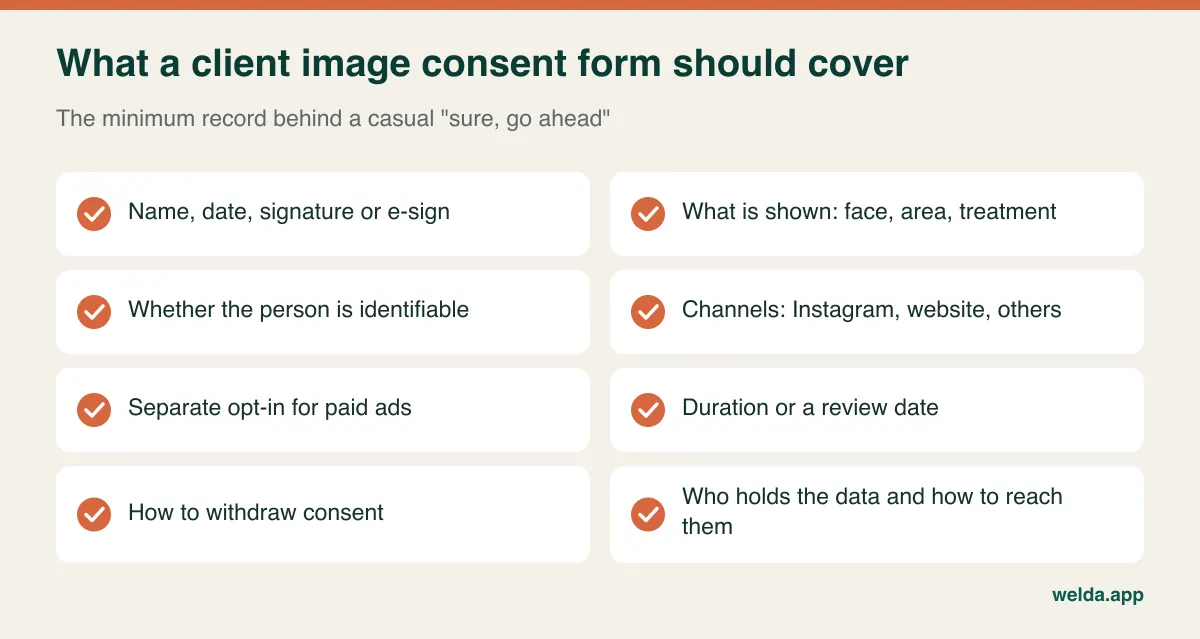
The question to put to an agency is simple: who tracks consent, and who checks it before publishing? A strong answer sounds like this: the salon collects and stores the form, the agency marks the consent status against each asset in the content calendar, and nothing without a recorded consent goes live. A weak answer is "if you send it to us, we assume it's fine". That leaves the entire risk with you.
Where consent usually breaks
- Organic versus paid. Agreeing to appear on your profile is not obviously agreeing to be shown in ads to strangers. Keep them as separate tick boxes.
- People in the background. The client in the mirror at second three of a Reel is in the video too. Ask who checks this during editing.
- Your staff. When a therapist is the face of your account and then moves to a competitor, what happens to those videos? Agree it in writing before you film, not after the resignation.
- Withdrawal. When someone changes their mind, the image has to come down from the feed, the highlights and any active ad set. Decide who does that and how fast.
- Under-18s. Prom and teen brow content needs a parent or guardian involved, and in many places extra care besides. Plenty of salons simply avoid it.
What a proposal should say about wording, before-and-after and music
Beauty is one of the sectors where the copywriter's instincts and the rules collide most often. "Permanent", "guaranteed", "pain-free", "one session" and "best in town" are exactly what stop the scroll, and exactly what advertising regulators tend to question. In the UK, the ASA and CAP Code apply to many social posts as well as paid ads. In the US, the FTC expects claims to be substantiated and paid or gifted endorsements to be disclosed. Other countries have their own versions. Some treatments carry stricter limits again: in the UK, prescription-only injectables cannot be advertised to the public, for instance, which is easy to overlook on an aesthetic account.
Before-and-after images face two separate gates. The first is the law and consent. The second is the platform: Meta's ad policies restrict content that focuses on personal appearance and can reject before-and-after comparisons, so an image that is fine as an organic post may fail as an ad. Health-related business categories can also see limits on the conversion data available to them. An experienced agency raises these points before you plan a campaign around them, not after the first rejection.
Then there is influencer work. A free treatment in exchange for a glowing Reel is usually still a commercial relationship and generally needs to be disclosed. Ask how the agency handles this, and whether it writes the disclosure into the arrangement. Music is the last quiet trap: business accounts often have a narrower library of licensed tracks than personal accounts, and a video built around a chart hit may later be muted or removed.
An easy test in the first meeting: ask for two pieces of beauty copy the agency has written, point at one claim and ask how it would be defended if challenged. You don't need a lawyer's answer. You want someone who takes the question seriously and can offer an alternative, such as replacing "visible results after one session" with "most courses are planned after a skin consultation, and the number of sessions varies from person to person". That sentence is safer, and it also sounds more credible to the client you actually want.
The DM inbox is where bookings go missing
In beauty, the most valuable message on your account is often the shortest: "how much?" or "any availability Friday?". That person is close to buying. They are also easy to lose, since replies can come hours later, answer with a price and nothing else, or leave the thread sitting in a shared inbox nobody owns.
"We manage comments and DMs" is not a specification. Pin down the detail:
- Hours. Beauty clients often message after work. Does the coverage include evenings and Saturdays, or is it office hours only?
- Price questions. Who holds the current price list, and how do changes get to the agency? If you prefer not to quote in DMs, what wording moves the person to a call or a booking link without irritating them?
- The handover. An agency that cannot see your diary cannot confirm a slot. How quickly does a booking question reach reception, and through which channel?
- Health questions. "Is this safe in pregnancy?" or "can you treat this mole?" must never be answered by a social media coordinator. The rule should be written down: pass it to a qualified member of your team.
- Complaints. If a post-treatment burn or reaction comment appears at 10 pm, nobody should delete it or improvise. You should get a call.
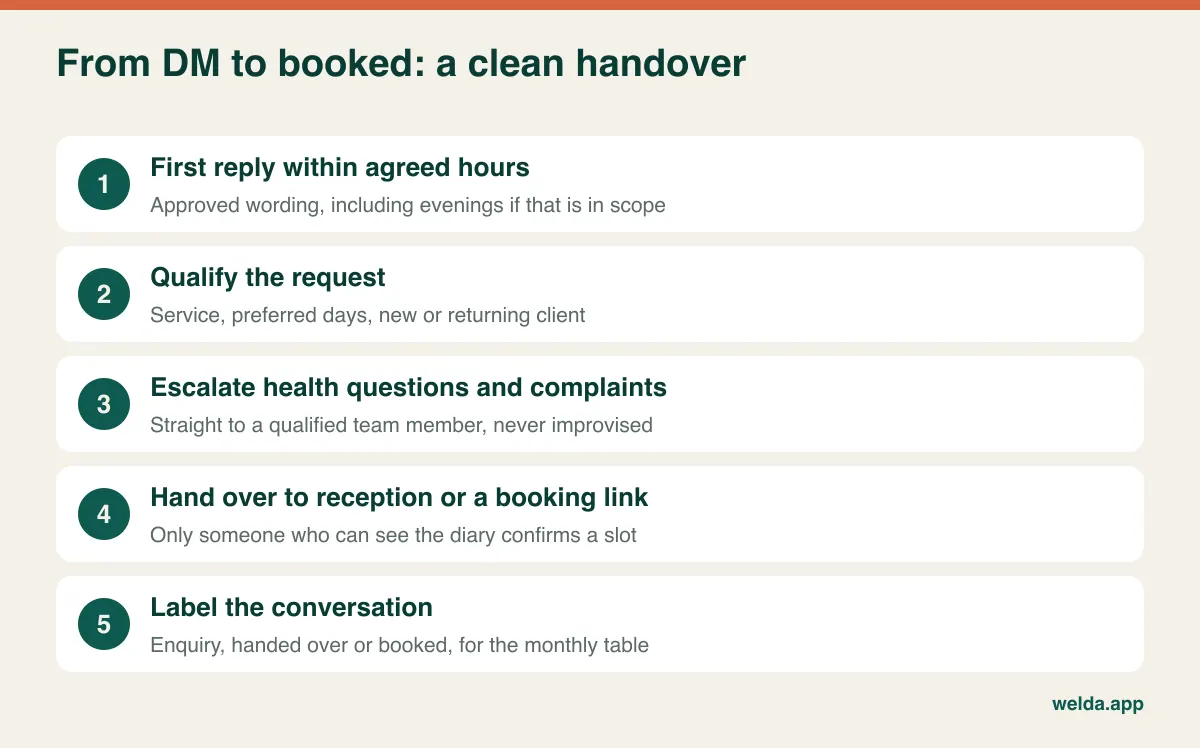
The arrangement that tends to work is a split one. The agency handles first contact with approved replies, and the booking itself happens in your system or with your reception team. The trade-offs of keeping booking in chat are covered in our piece on WhatsApp booking versus appointment software. Bear in mind that a phone number given for a booking is not automatically permission to send promotions. Marketing consent is its own question in most jurisdictions, including under GDPR and related e-privacy rules.
Measuring bookings when Instagram can't see them
Instagram Insights shows reach, engagement, profile visits and link taps. It cannot show the appointment, because that usually happens elsewhere: a phone call, a WhatsApp chat, a booking page, a walk-in after someone saw a Reel. Nobody closes that gap for you by default. It takes a small routine shared between the agency and the salon.
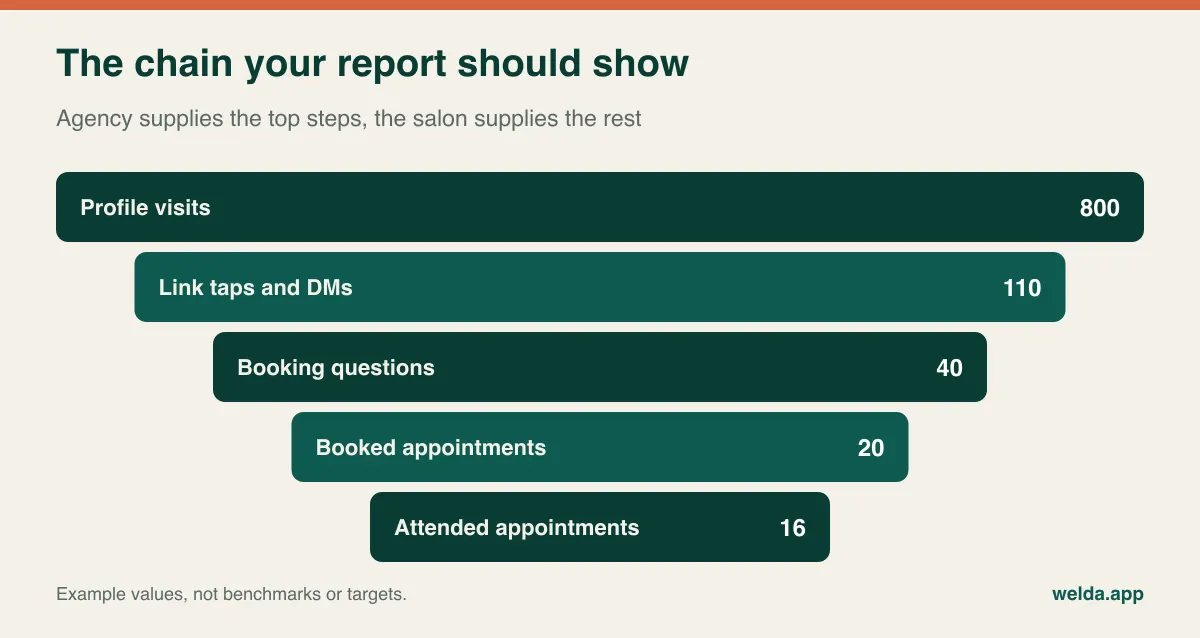
You do not need an elaborate setup. For most independent salons, four habits are enough:
- Service-specific message links. The link under your facial content opens a chat with a prefilled line about facials, and the one under lash content does the same for lashes. You see at a glance which service is attracting interest.
- Tagged bio links. UTM parameters on the link to your site or booking page make Instagram show up as a distinct source in your analytics. Our social media analytics guide explains what each figure can and can't tell you.
- Inbox labels. The person handling DMs marks each conversation with a simple status such as enquiry, details taken or handed to reception. Those counts tell you more than a comment total.
- The front-desk question. Ask each new client how they found you, and record the answer in one place. It is imperfect, and still far better than not asking.
Be realistic about accuracy. Someone sees a Reel, thinks about it for two weeks, Googles your name and rings you. That booking looks like search. No method fully fixes this, and an agency claiming to know the exact number of bookings it produced should be asked how. The aim is a consistent method, read month over month, that shows direction.
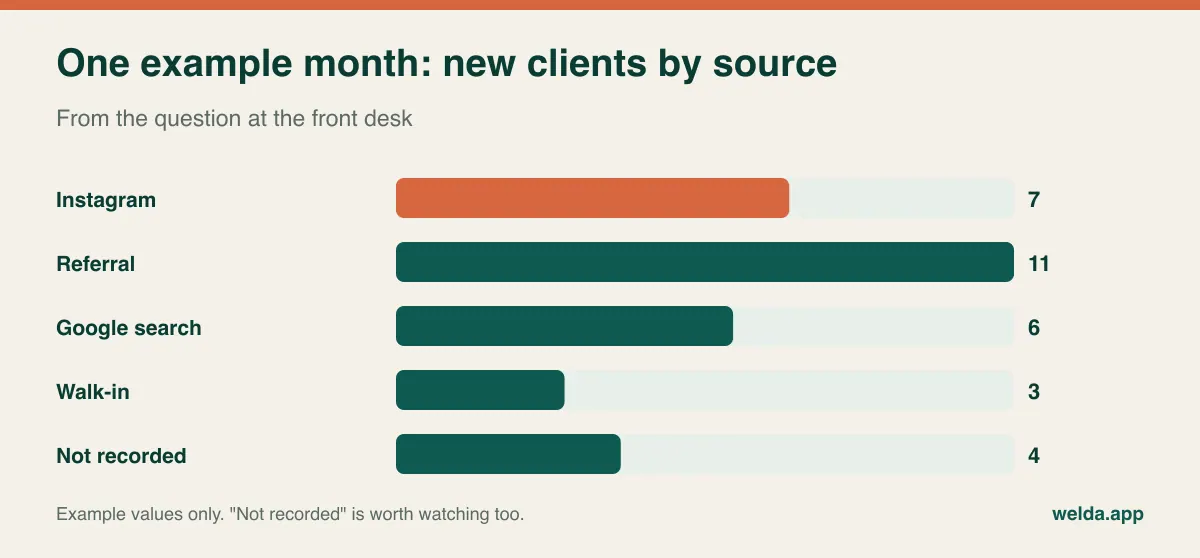
Decide who supplies which number. Reach, engagement and DM counts come from the agency, while bookings, attendance and revenue come from you. Unless both sets meet in one table, the agency will report that engagement is up, you will report that the till disagrees, and you will both be right. Share totals, not client lists. The agency has no need to see your client records for this.
Here is an illustrative month. A series on facials for sensitive skin gets modest views, yet its link opens a steady run of conversations. A comedic salon-life video in the same month goes further than anything else on the account and produces no booking enquiries at all. A likes report says repeat the comedy; a bookings table says repeat the series. Which of those drives next month's plan shows you what the agency is really managing.
Reading a proposal line by line
"Social media management" can mean almost anything. To compare proposals, ignore the headline figure at first and break each one into the components below. These are also what drive the cost, which is why no single "going rate" helps much: a retainer with monthly on-site filming, evening DM coverage and ads is a different product from one delivering templated graphics.
| Component | What to pin down | Where extra cost hides |
|---|---|---|
| Filming and photos | How often, on site, who shoots | "Client supplies assets" quietly puts the work on your therapists |
| Editing and design | Volumes, formats, revision rounds | Extra revisions or videos billed separately |
| Community management | Hours, weekends, handover rule | Comments included while DMs are excluded |
| Paid social | In scope or separate | Ad spend goes to Meta on top of any management fee |
| Measurement | Who builds links, labels and the table | A "report" that is just screenshots of Insights |
| Exit | Account access, files, raw footage | Raw footage stays with the agency, so a new team starts from zero |
One cost never appears on the proposal: your own time. If you have to approve every post individually, attend every shoot and check every reply, your hours are stacked on top of the fee. Ask for a single weekly or batch approval. And ask how shoots work around paying clients, because pulling a therapist out of a treatment to film a clip is expensive. Good planning puts filming in quiet blocks, often the same hours you are trying to fill, and cuts one session into many pieces.
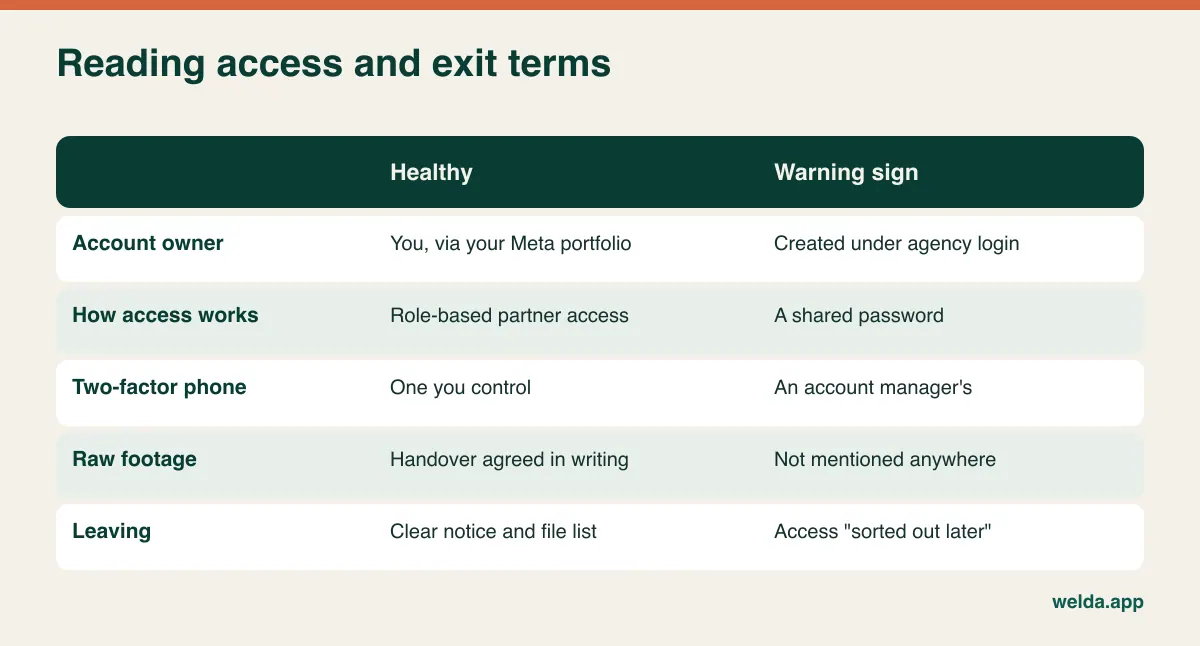
Also check the access model. You should own the Instagram account, the Meta business portfolio and any ad account, with the agency added through role-based partner access rather than a shared password. Two-factor authentication should sit on a phone you control. And check whether the agency works with another salon on your street: it isn't always a conflict, but you should know.
When hiring an agency is the wrong move
Plenty of salons shouldn't outsource this. A solo practitioner with a full diary built on referrals, whose personality is the brand, may lose more in authenticity than they gain in polish. Compare that with a three-room salon whose owner treats clients all day and whose account goes quiet for weeks. There, outsourcing can fix a real gap.
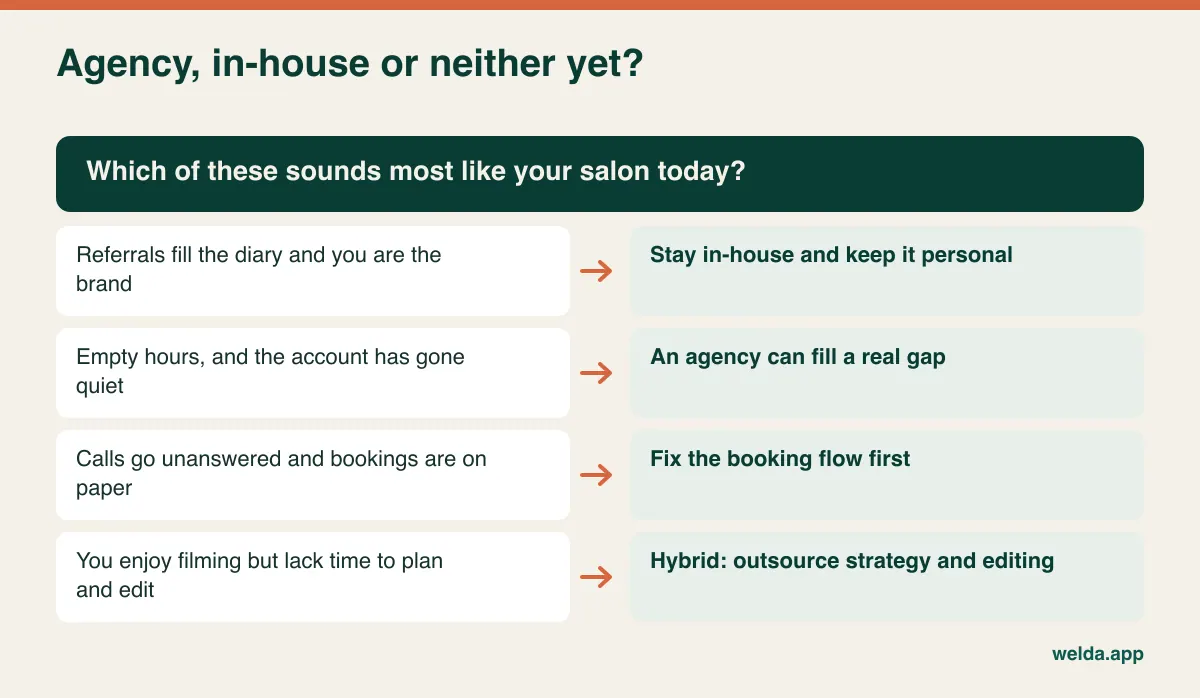
There is also a sequencing problem. If calls go unanswered, bookings live on paper and no-shows go unreminded, extra attention from Instagram just leaks away faster. Fixing that first may give a better return, and our article on how to choose beauty salon software sets out what to look for. Hybrid setups work too: the agency handles strategy and batch production, you stay on camera, and your reception team keeps the inbox.
The questions that separate the agencies
After the presentation, ask these. Concrete answers matter more than polished ones.
- Show me how you track client image consent. Who signs off before anything is published?
- Tell me about a post that flopped and what you changed afterwards.
- Will the monthly report include bookings and attended appointments? How do you get that data from us?
- Who will actually reply to our DMs? Can I speak to them?
- What happens if an ad is rejected or the account is restricted?
- If we part ways, what do we receive and how soon?
- Which live accounts can I look at today? (Then check them yourself: how recent are the posts, and how are comments handled? A live profile tells you more than a slide.)
Your first month with a new agency
A sensible first month produces order, not a surge. In week one, finish the consent form, the current service and price list, your tone of voice and a list of phrases you will not use. In week two, write the DM replies and the handover rule, brief reception, and set up the tagged links. Week three is the first batch shoot, scheduled in a quiet block. In week four the first calendar goes live and the first version of the bookings table gets filled in, even if it looks thin.
Use the same month to clean house. Remove old agency and ex-employee access, and put a reminder in your calendar to check again every few months. Look through the old feed as well: before-and-after posts with no consent on file are worth archiving now, not defending later. If the agency proposes skipping this groundwork so it can start posting right away, ask what it plans to do when the first consent question or complaint arrives.
Where Welda fits, and where it doesn't
Welda offers social media management for beauty salons as part of its general service for businesses: strategy, a monthly content calendar, design, captions, comment and DM management, and a monthly performance report, with one team and one dedicated contact. Your accounts remain yours. Our standard metrics are engagement, reach, follower growth, saves and shares, profile visits, link clicks and best-performing content type. Bookings and attended appointments come from your records, so if you want those lines in the report, we should set up the method together at the start. Put the questions above to us as well.
Three boundaries worth stating. Paid campaigns fall under our separate digital advertising service, and ad spend goes directly to the platforms. On-site photo and short-video shoots are planned under content production. And your consent form's legal wording is for you and your adviser; we help build the pre-publishing check, but we don't provide legal advice.
If scattered bookings are the reason you can't measure anything, Welda CRM brings the calendar, online booking requests, WhatsApp reminders, a lead pipeline and occupancy reports into one place, with a 7-day free trial. Test during the trial how you would record the Instagram source in your own workflow. It isn't a prerequisite, though: a well-kept spreadsheet is enough to start measuring.
The fee depends on the number of platforms, monthly content volume and scope, and we agree it in a free consultation. To see the scope, look at our social media management for beauty salons and other service businesses, then book a free call and bring your quiet hours with you.
FAQ
Can an agency guarantee a number of bookings?
A careful one won't, because results also depend on your prices, location, reply speed and capacity. Ask instead for commitments on deliverables, on the measurement method and on how targets get reviewed.
How long before we can judge results?
Consistency and reply times can improve in the first weeks. Reading the effect on bookings takes at least a few months of steady data, and longer for treatment courses with a long decision time. Don't draw conclusions from one month.
Can we produce good content without client photos?
Yes. Therapist explainers, treatment room footage, process clips without faces, aftercare tips and answers to common questions can all work. For many salons they are a less risky starting point, and easier to sustain.
Should we show prices on Instagram?
There's no single right answer. Clear prices on standard treatments can cut repetitive questions. For courses that depend on a consultation, inviting people to that step is more honest. Check the consumer pricing rules that apply where you trade, and whichever you choose, always state the next step.
Is Instagram enough, or do we need TikTok as well?
Instagram is a common starting point for booking goals, but people who see a Reel will often search your name, read reviews and check your address, so your Google profile and website matter too. Add TikTok only if you can realistically sustain regular video.
Can a team member run the account instead?
They can, provided the job has protected hours and a plan. "When reception has a spare moment" rarely lasts long. A middle route is to buy strategy and batch production externally and keep the inbox in-house.