Restaurant social media management is worth paying for when three things are true: your food or room changes often enough to need fresh footage on a schedule, the people who see your content can realistically come in, and the margin on one extra cover pays back the monthly cost at a number you could actually seat. If one of those fails, you will usually get more from a single well-planned shoot, a staff member with protected hours, or an afternoon fixing your Google listing than from a monthly retainer.
Most owners looking this up are not lazy about social media. They just run a business whose busiest hours are everyone else's scrolling hours. This guide works through the decision the way a restaurant actually experiences it: who shoots the food and when, how far your guests travel, who answers messages at 8pm on a Saturday, and what the numbers have to do for an agency to make sense.
Start by naming the job you are hiring for
"Manage our Instagram" can mean five different jobs, and agencies will quote whichever one they prefer to sell. Before you compare anyone, decide which of these you actually need. Filling quiet weekday lunches is a different job from selling out a tasting menu. Announcing a second location is different again. A neighborhood pizzeria trying to get more delivery orders inside its courier zone needs almost nothing in common with a hotel restaurant trying to reach visitors before they book a table elsewhere.
Write one sentence: "In six months, I want more of ___ on ___." More walk-ins on Tuesday nights. More private dining enquiries for December. More direct orders rather than third-party ones. That sentence becomes the test for every proposal you read. If a proposal could be sent unchanged to the restaurant across the street, it wasn't written for your sentence.
It also shows you when an agency is the wrong answer. If the sentence is "more people finding us when they search nearby," your problem lives mainly on maps and in reviews rather than in a content calendar, and you should read about local SEO and your Google Business Profile before you spend anything on social.
The kitchen sets the shooting calendar
Here is what generic social media advice misses: a restaurant's content has a shelf life measured in seconds. Cheese pull, steam off a bowl of ramen, the crackle of a pork belly, foam on a flat white. Nobody can write that at a desk. It has to be captured in the room, usually in the narrow window before service when the kitchen is prepping and the light is workable. Pulling plates for a camera at that moment costs real kitchen time, and a good shooter knows it.
So the first number to look for in a proposal is not "posts per month." It is hours on site per month. Twelve posts built from one afternoon will look like twelve posts from one afternoon: same table, same light, same three dishes. You will be bored of the account before your guests are, and that usually happens around month three.
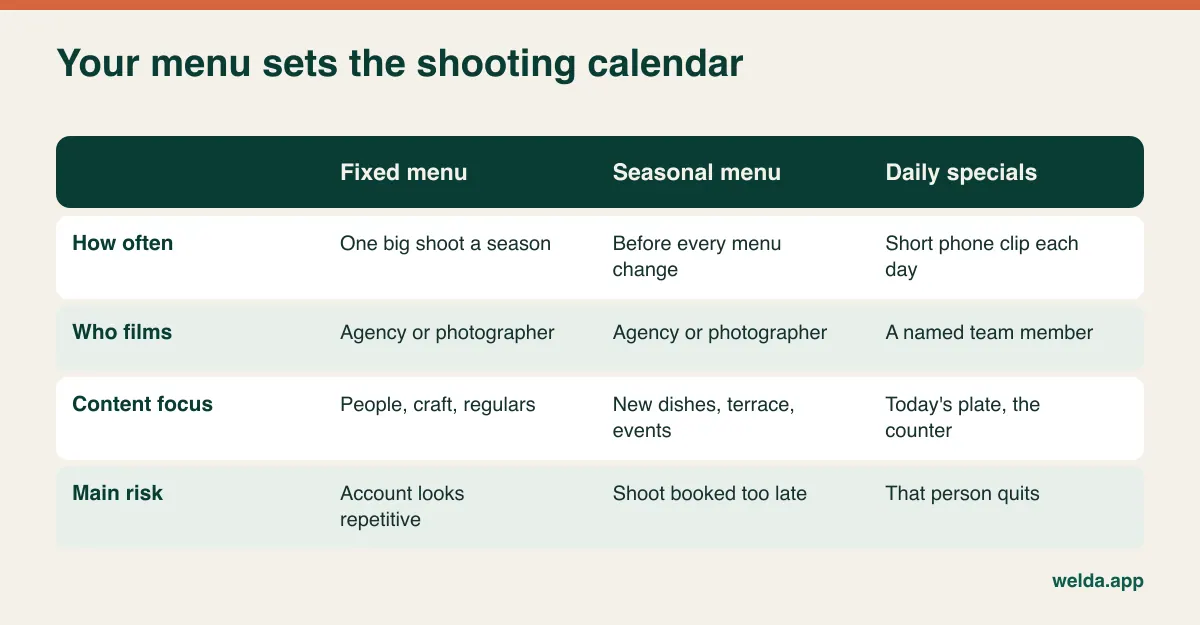
How often someone needs to be on site depends on how fast your offer moves:
- Fixed menu, strong identity. A steakhouse or a long-running family trattoria can do one substantial shoot per season, then top up with short sessions. The dishes don't change, so the story moves to people, technique, regulars and the time of year.
- Seasonal or rotating menu. Every menu change is a shoot trigger. Book it before the change so the content is ready for launch day, including summer terrace openings, holiday set menus and group booking periods, which people plan further ahead than you might expect.
- Daily specials or a changing counter. Nobody can afford a shooter every day. This model works when a named person on your team films a quick clip each morning and the agency handles editing, captions and scheduling. Ask whether the agency will train your staff and give them a simple brief on angle, light and length.
Cafes sit in their own category. Coffee, pastries and the room stay usable for longer, so one session yields more material. The problem is sameness: every cafe within a mile has posted the same latte shot from the same overhead angle. The difference comes from what only you have, whether that's the roaster you work with, the regular who has had the same table for years, or the way your barista dials in the morning's espresso. An agency can't get this from an intake form. You have to tell them, and if they don't ask, take note.
Your real audience fits on a map
For a restaurant, a thousand followers in another country are worth less than fifty people who live or work within walking distance. Follower growth looks good on a report but does nothing for table turnover. A serious plan answers "who sees this?" with places and distances. If the audience in a proposal reads "foodies, 25 to 45," it hasn't reached your business yet.
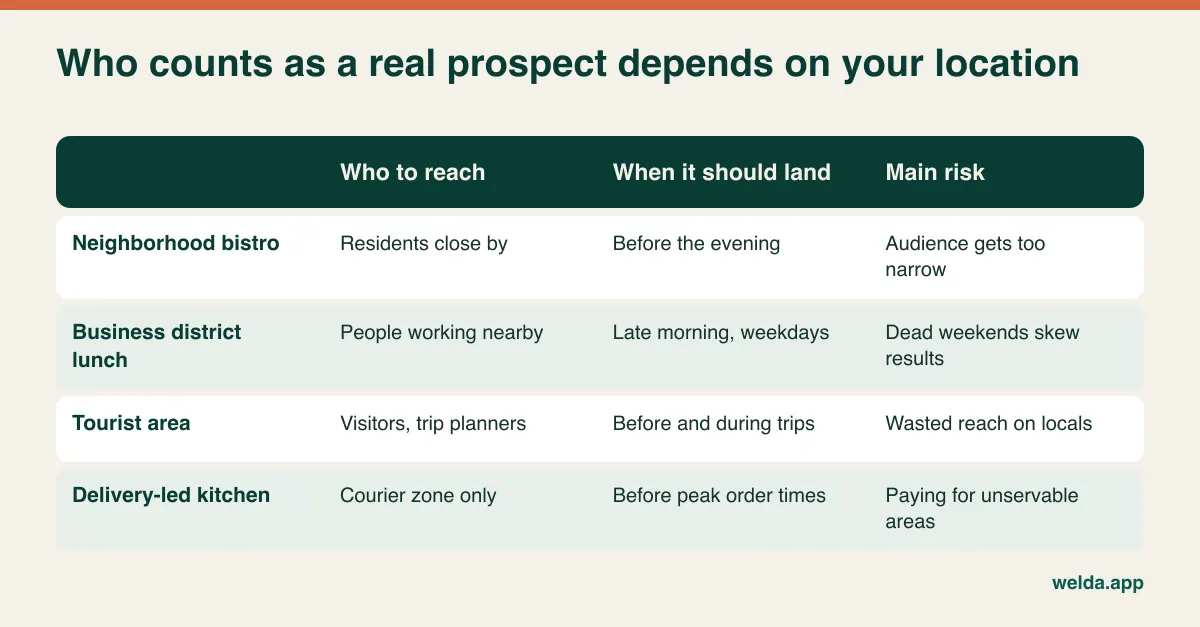
The right radius depends on the kind of place you run. A neighborhood bistro depends on residents nearby and can think small. A lunch spot in a business district cares about people who work there, wherever they sleep, and its content needs to land before midday. A tourist-area restaurant targets people currently visiting or planning a trip, which changes language and subject matter: visitors want to know whether it's the local thing to do, how to book and whether they'll be understood. A delivery-led kitchen has the hardest edge of all, because anyone outside the courier zone is pure waste.
You have limited control over who sees organic posts, but you can still push them in the right direction with location tags, naming the neighborhood naturally in captions, putting the area in your profile, and collaborating with nearby businesses. Precise targeting mostly lives on the paid side, where platforms such as Meta let you set a location and radius. Resist going so narrow that the audience collapses. A small monthly boost on a proven post, aimed at your catchment during a specific slow period, tends to be easier to justify than a broad awareness campaign.
Social also rarely closes the visit alone. Someone sees your reel, then searches your name, checks the rating and looks at your hours. If that search shows the wrong closing time and a string of unanswered complaints, the interest you paid for ends right there. Treat social and your listing as one path, and read up on managing Google reviews and reputation if that second half is weak.
The 8pm Saturday problem
Restaurant inboxes are not ordinary community management. A message saying "Do you have a table for four tonight?" is a sale that expires within the hour. "Can we bring a cake?" and "Do you have a high chair?" are the small questions that decide whether a family comes. And "Is this gluten-free?" is a question with real consequences, one a remote account manager can't safely answer.
Most agencies list "community management" without saying what that means at the times your inbox is busiest, and agency hours typically aren't restaurant hours. So split messages into three lanes and put the split in writing:
- Static answers such as address, hours, parking, dogs, terrace, menu link. An agency can handle these from an approved answer sheet.
- Live answers such as tonight's availability, large groups, private hire. These go straight to a named person or a booking link, with no improvising. A fast "call us on this number and we'll sort it" beats silence.
- Sensitive answers such as allergens, illness claims, complaints about staff, hygiene photos. Nobody outside your business answers these on their own. They escalate to you the same day.
Allergens deserve their own sentence in the contract. A cheerful "yes, it's nut-free!" from someone who has never seen your kitchen is a promise about cross-contact they can't verify. Agree that any such question gets routed to the kitchen or the manager. If there's no weekend coverage in the scope, that may be acceptable, but only if you know it and set up an auto-reply with a phone number. What isn't acceptable is finding out on a Monday that Friday's booking requests sat unread.
What the account would cost you to run yourself
Doing it yourself sounds free because the phone is already in your pocket. It's the hours that cost you. Planning, shooting, editing, caption writing, publishing and replying add up, and they tend to come out of the time after close. Before deciding, track one normal week honestly, and you may find that editing and replying use far more of it than posting ever did.
There is a good in-house version of this. If someone on your team genuinely enjoys it and has an eye, giving them protected paid hours can produce something warmer and more specific than any outside team. You should try this first if that person exists. The word that matters is protected, because "post when it's quiet" means never, since the quiet moments are when side work gets done.
The risk is that it all depends on one person. When your server leaves, the account goes silent, and the login may leave with them. The agency risk runs the other way: reliable output with a voice that slowly drifts into something any restaurant could have posted. Many restaurants land in the middle, with staff capturing daily moments and an outside team handling planning, editing and reporting.
Turning the fee into covers
Any honest conversation about cost starts by separating three streams of money, because proposals often blur them. Management covers planning, copy, design, publishing, comment and message handling, and reporting. Production covers time on site, photo and video shooting, editing and possibly lighting or equipment. Media spend is money that goes straight to the ad platform and is separate from what an agency earns. Ask directly whether it's included, and whose card and ad account it runs through.
What moves the fee most is scope: the number of platforms, the volume of short video, how often someone comes on site, the hours in which messages are covered, the number of locations and the number of languages. If a line isn't written into a proposal, assume two similar totals describe different work. To compare fairly, send every agency the same brief and ask for the same answers: hours on site, revision rounds, who keeps raw footage, whether ad management is separate, and the notice period. Our own fee depends on these same variables, so we work it out in a free consultation rather than publishing a figure that may not fit your situation.
Hidden costs usually sit at the edges: extra shoot days billed separately, licensed music or stock with limited terms, ad accounts created under the agency's name, long minimum terms with exit fees, and design templates you can't reuse after leaving. Add one that never appears on an invoice: the plates, ingredients and kitchen time used for shoots.
Once you have a total, convert it into covers. Use contribution rather than revenue: what's left of an average check after food and other variable costs.
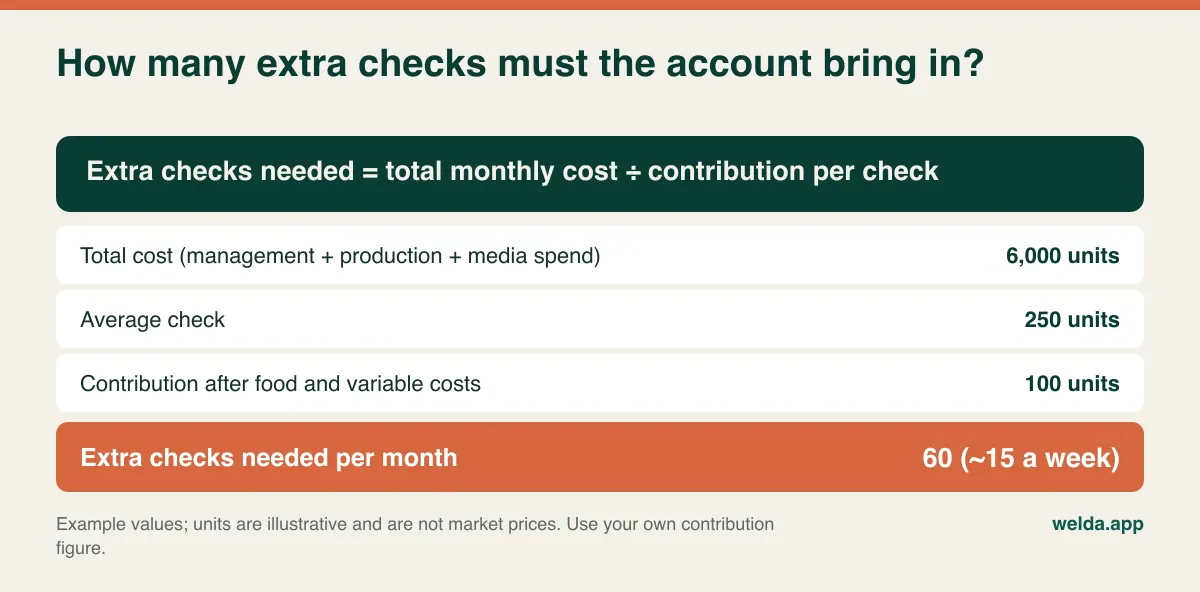
We used neutral "units" in the example because the real numbers vary too much across cities and concepts. What matters is reading the answer against your capacity. If you need fifteen extra checks a week and you're already full on Friday and Saturday, those guests must come on Tuesday or Wednesday. That changes the content brief entirely, from "come visit us" to a concrete reason to come on a quiet night. A place that's already full all week may want social to do something else, such as filling private events, supporting a delivery line or selling a higher-margin set menu.
Things a restaurant account has to get right legally
Rules differ widely by country, so treat this as a list of questions to raise with a local adviser rather than legal guidance.
- Guests and staff on camera. Privacy rules such as GDPR and UK GDPR, and their equivalents elsewhere, can apply when recognizable people appear in marketing. Shoot before opening or with people who have agreed, be especially careful with children, and decide in advance what happens when a former employee asks for a video to be removed.
- Alcohol. Rules on promoting alcohol vary between countries and sometimes between regions, and ad platforms add their own restrictions and age settings. If drinks are central to your concept, ask the agency how it handles this in your market.
- Influencers and free meals. Many regulators, including the FTC in the US and the ASA in the UK, expect paid or gifted partnerships to be clearly disclosed. A free meal in exchange for a post can count.
- Music. Business accounts often can't use the same tracks as personal accounts. Unlicensed audio can get a video muted or removed, so ask how the agency sources sound.
- Claims. "Best burger in the city," "healthiest," "allergen-free" and "organic" can all need evidence, and in some cases formal certification.
When you should not hire anyone yet
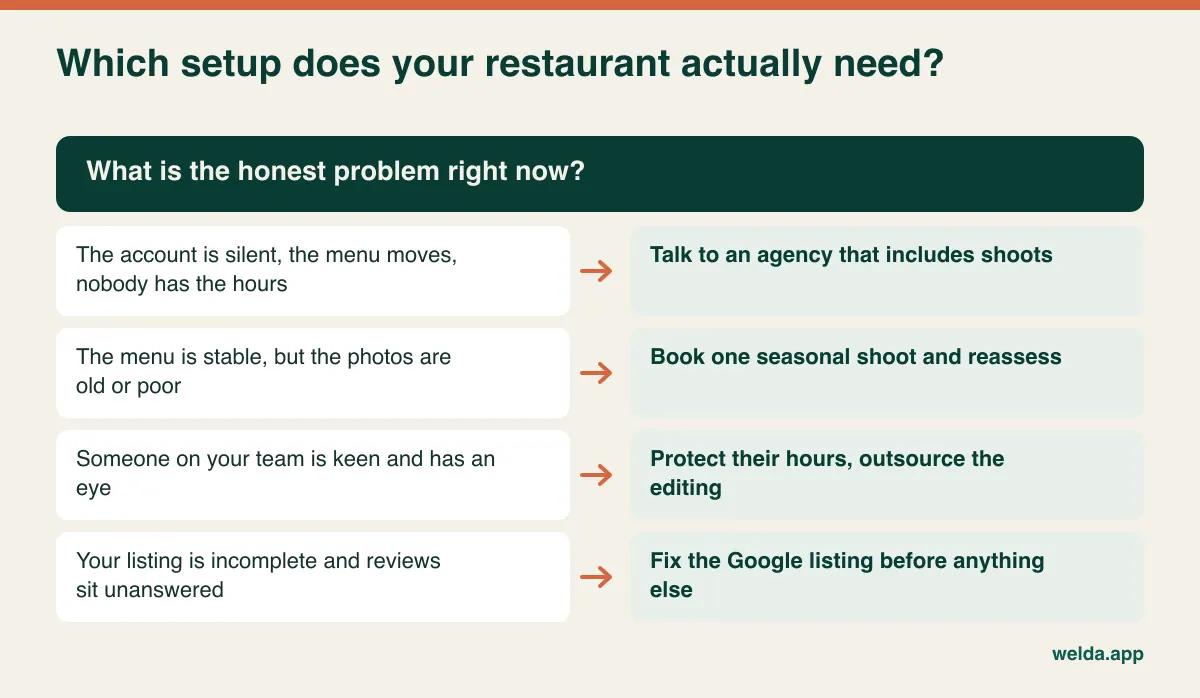
If your listing is incomplete, your hours are out of date and your menu isn't online, start there. Those fixes are low-cost and often pay off first. Our restaurant and cafe website guide lists what guests expect to find.
If you have a known food or service problem, social media will only advertise it faster. A concept that's still changing weekly is also a poor fit for a long contract, because the brand you describe today may be gone in a month. A short project shoot and a review afterwards is a better test. And a small room that's booked weeks out through word of mouth may need little beyond good photos and accurate information.
An agency tends to earn its fee when several locations need to look consistent, when you have a launch or new branch with a deadline, when there's a clear slow period you want to fill, or when the owner has honestly admitted that the account won't get done otherwise.
Eight questions that reveal whether they understand restaurants
General agency selection is covered in our guide to choosing a social media agency. These are the questions that apply specifically to your trade. Listen for specifics rather than polish.
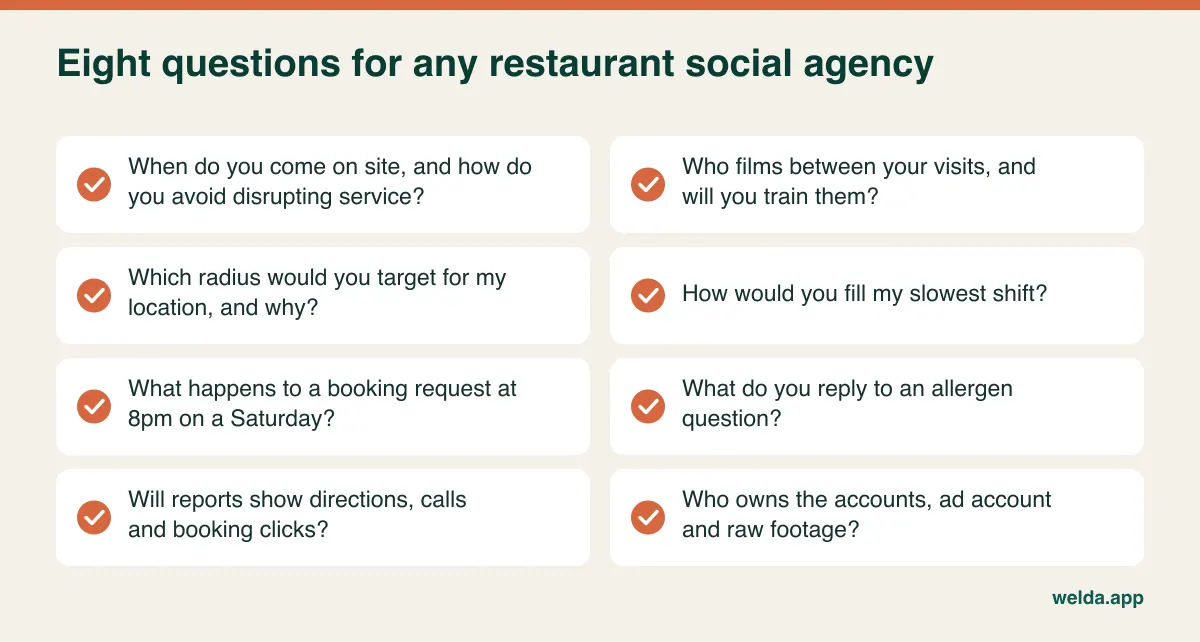
Ownership deserves extra attention here, since restaurant accounts are frequently tied to an old employee's phone or a relative's email address. Before handover, make sure your Instagram and Facebook sit inside a Meta business portfolio you control and that two-factor authentication runs through your device. Grant the agency access through the portfolio instead of handing over a password. The same applies to the ad account: if it's created under the agency, your history may not come with you when you leave.
Measuring a restaurant account without fooling yourself
Likes are easy to report and don't pay rent. The numbers closest to a real visit are direction requests, calls, booking link clicks, profile visits and saves. Before starting, write down a baseline for three months: covers per weekday, your slowest shifts, and the actions on your Google listing. Without it, you can't answer "did this work?" at the end of the quarter.
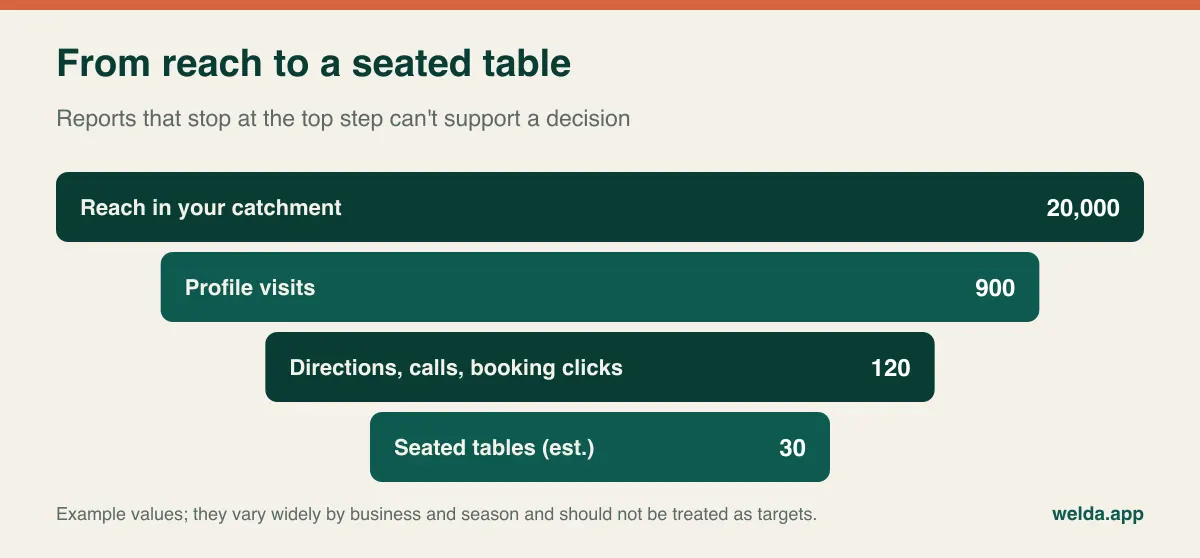
Attribution in restaurants will never be clean, so use rough signals and be honest about it. Train your hosts to ask how guests heard about you, offer a small social-only perk that gets rung up separately on your POS, and look at whether specific slow shifts moved after a specific campaign. No agency can responsibly guarantee a number of guests, so if one does, ask exactly how it will be measured.
A sensible first quarter runs like this: secure account access and baseline numbers in the first two weeks, complete the first shoot and message rules by the end of month one, build a publishing rhythm in month two, and decide in month three, using the numbers above, whether to continue, reshape the scope or stop.
Is Welda a fit?
Welda's restaurant social media management covers strategy and positioning, a monthly content calendar, post, reel and story production, captions, comment and DM handling, and a monthly performance report. Cafes and restaurants are among the sectors we work with, and ownership of and access to your accounts stay with you, including if we stop working together.
A few boundaries are worth stating. On-site food photography and video sit under our content production service, and how that combines with monthly management depends on your menu and location, so please check whether regular visits make sense where you are. Ad campaigns and local search are separate services. We also don't take reservations or manage your tables, so live booking requests would be routed to the person you nominate.
If you tell us how your menu changes, where your guests come from and which shifts stay quiet, we can talk through what restaurant social media management would involve in a free consultation, and we'll say so if a single shoot or a fixed-up listing would serve you better for now.
Frequently asked questions
How often should a restaurant post?
There's no magic number. A pace you can hold for three months beats an intense schedule you'll drop after two weeks. Settle the shooting rhythm first, because that determines how many good posts you can really produce.
Which platforms matter most for restaurants?
Instagram is the usual starting point because food and rooms are visual. TikTok can work when you have a steady supply of short video and a younger audience. Facebook still matters for some age groups and local communities. Your Google Business Profile isn't a social network, but skipping it is usually the most expensive mistake. Don't open a channel you can't maintain.
Does a small cafe need an agency?
Often not at the start. One good shoot, a clean listing and a staff member with an eye can take you a long way. An agency becomes more attractive when that routine keeps falling apart, or when you reach a milestone such as a second location.
Can social media increase delivery orders?
It can help with awareness and promotion inside your zone, but it can't promise orders. Ratings, delivery time and menu price on the ordering platform also play a large part. Make sure paid reach never extends beyond where your couriers go.
How much does it cost?
There's no fixed list price; the fee depends on the number of platforms, content volume, shoot frequency and message coverage. A free consultation is the quickest way to get a number that reflects your actual scope, and we're happy to look at competing proposals using the three-stream split above.
What happens to our photos and videos if we change agency?
That depends on your contract. Published content staying on your account isn't the same as receiving the source files or the right to reuse them. Get raw footage, design files and usage rights in writing before work begins.
How long until we know if it's working?
Consistency shows up within weeks, but give a restaurant account at least a full quarter before judging business impact, and account for seasonality. Comparing November with July tells you very little in most locations.