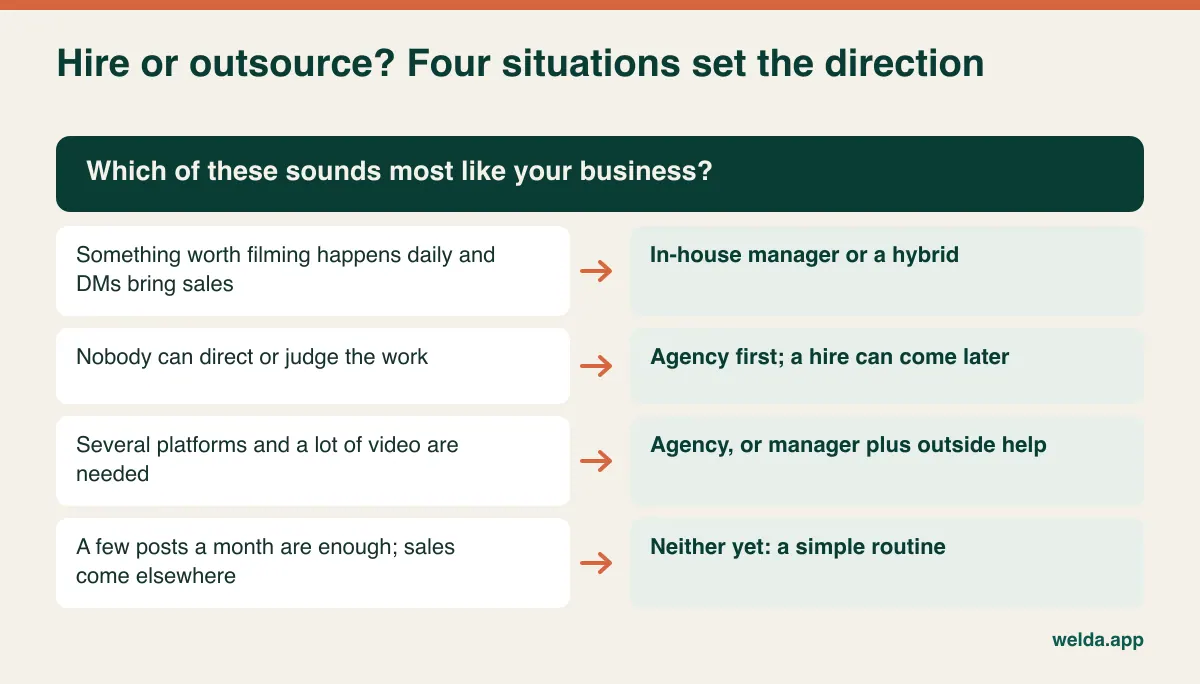
Hire a social media manager if something worth filming happens in your business every day, customers buy or book through DMs, and someone on your team can actually direct that person. If any of those three is missing, and especially if nobody can judge the work or you need steady video on several platforms, an agency is the safer place to start. And if a few posts a month are enough because customers come from referrals or search, you may not need either yet.
Most people frame social media manager vs agency as a price comparison: the salary on a job ad against the number on a proposal. The trouble is that those two numbers don't buy the same thing. With an employee you buy someone's working hours, and what comes out of those hours is your problem to direct. With an agency you buy a defined scope, and getting them close enough to your business to make it interesting is your problem to solve. This guide compares the two on three axes: the true cost of a full year, what one month of real production capacity looks like, and whether your account survives when somebody leaves.
The job ad says one person. The work is six professions.
Read a typical small-business job posting and you'll find a request for someone who plans content, designs graphics, shoots and edits video, writes copy, handles comments, runs ads and builds reports. That isn't a job description; it's a department. Strategy, design, video, copywriting, customer conversation and data analysis are separate skills, and it's rare to find someone equally strong at all of them, particularly at the salary a small company has in mind.
What happens in practice is that the person drifts toward their strength. A designer makes the feed beautiful while video output falls. A natural on camera produces attention-grabbing clips while the monthly report shrinks to two lines. A writer builds a strong voice and leaves the visuals on a template. None of that is poor performance. It's the predictable result of writing one job ad for six kinds of work.
So before you hire, ask what your account most needs over the next twelve months. For a restaurant, the answer is probably short video. For an industrial supplier, it's clear, technically credible writing on LinkedIn. For a med spa or a salon, it's before-and-after content and quick replies. Hire without an answer to that question and you'll end up selecting whoever interviews best.
Agencies solve this on paper by splitting the work between people, but depth varies a lot. Ask who designs, who edits, who writes and how many other accounts each of those people carries, and you'll see the real team behind the proposal. We cover the rest of the vetting process in our guide to choosing a social media agency.
How much content does one month really produce?
Capacity debates stay vague until you put hours on them. The numbers here are examples, not data from any real company; the point is the method. Picture a manager with 160 paid hours a month producing 10 short videos and 12 graphics for one platform. Say a video takes 4 hours from idea through shoot and edit, a graphic 1.5 hours, and all the captions together 10 hours.
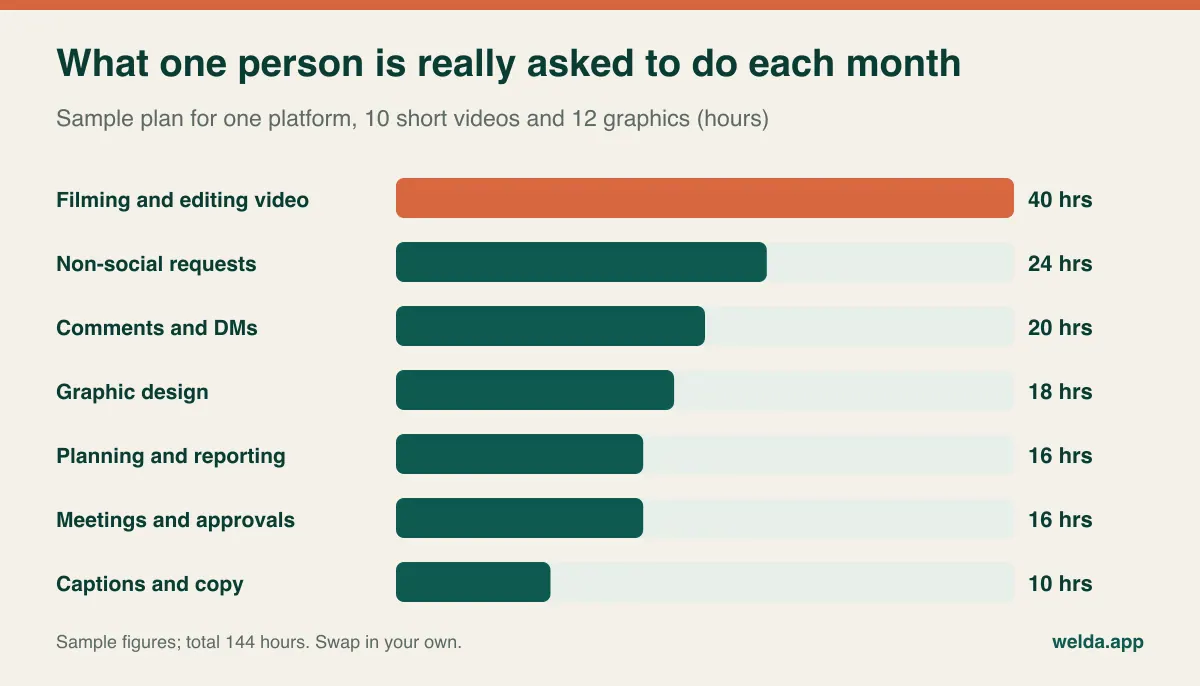
That's 68 hours of production. Add comments and DMs, planning and reporting, and meetings and approvals, and the month fills up fast. There's one more line that's close to inevitable in a small company: the flyer for the event, the website banner, the slide for a sales deck, the trade show handout. It all starts with "you're good at design, could you just..." In our example it eats 24 hours, leaving a buffer of only 16 hours out of 160.
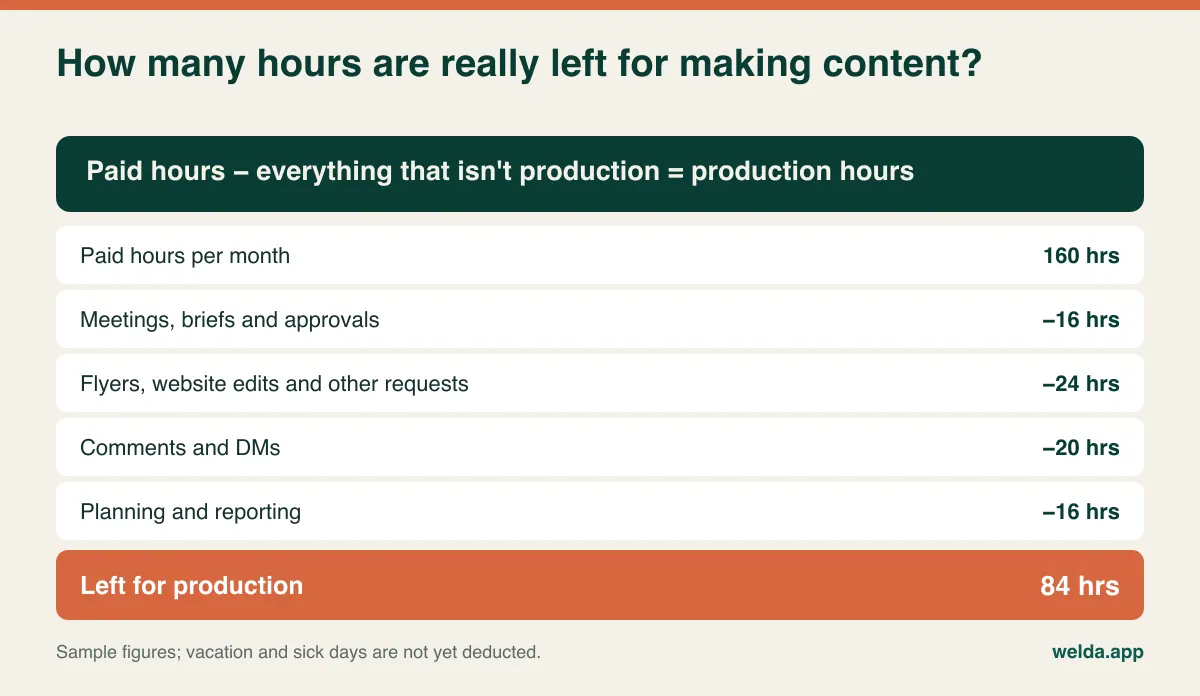
This tells you two things. First, for one platform at a moderate volume, one person really can do it, so ignore anyone who says a single hire can never work. Second, the margin is thin. Add a second platform, or ask for five more videos, and you've spent 20 more hours and passed the limit. Vacation, sick days and public holidays aren't in this sum either, and if content isn't supposed to stop during those weeks, someone has to bank it in advance out of the same narrow buffer.
To run your own version, write down four lines: how many pieces per month, a realistic time per format, how long comments and messages take per day, and what else this person will be asked to do. Be honest about line four, because that's where owners are most optimistic. If you need help turning volume into a schedule, our guide on how to create a social media content calendar picks up where this math stops.
A paycheck and a retainer don't measure the same thing
Salary against retainer is an easy comparison and a misleading one. An employee's salary is only part of what they cost: employer payroll taxes, health or pension contributions where they apply, paid leave and bonuses all sit on top, and in many countries so do notice periods or severance. Have your accountant work this out on your actual payroll rather than using a rule of thumb from the internet, since the answer differs a lot by country. Then there's equipment: phone or camera, lights, a microphone, a laptop that can handle video, and a stack of annual software licenses. Some of these are one-off and some renew.
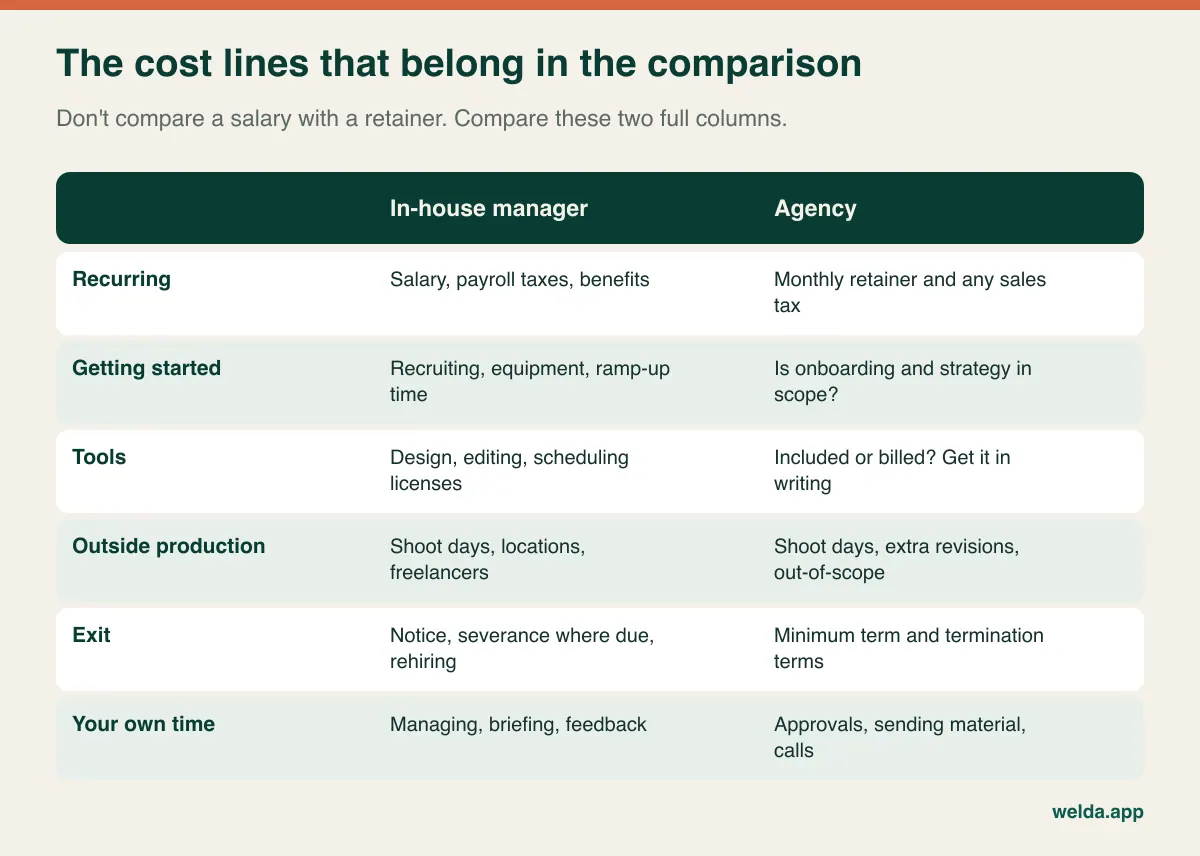
With an agency, the trap is somewhere else: what does the monthly fee cover? "Social media management" can mean shoots, editing and DM handling in one proposal, and templated posts plus scheduling in another. Ask line by line about revision limits, additional platforms, shoot days, stock image and music licensing, ad management and extra work during campaign peaks. Ad spend is usually separate in both models, so don't go looking for it inside a proposal.
The cleanest way to compare is to find a common unit. For each option, write the total money over twelve months, then divide by the number of pieces you expect to be published in those twelve months. That figure doesn't settle the decision, since quality and community work don't show up in a division. It will, however, show you when the "cheap" option is the most expensive per published piece. Then add a second line for the owner's time. Managing, briefing and giving feedback to an employee takes hours, and so does sending material to an agency and approving posts. Your hours aren't free just because no invoice shows up for them.
What happens to the account when your manager takes two weeks off?
Continuity doesn't appear on a cost sheet, but it's the loss you feel fastest on social media. In a one-person setup, everything lives in that person's head: brand voice, how to answer which customer, what worked and why, where the templates are, what the passwords are. Two weeks of vacation slows things down. A resignation is the real test.
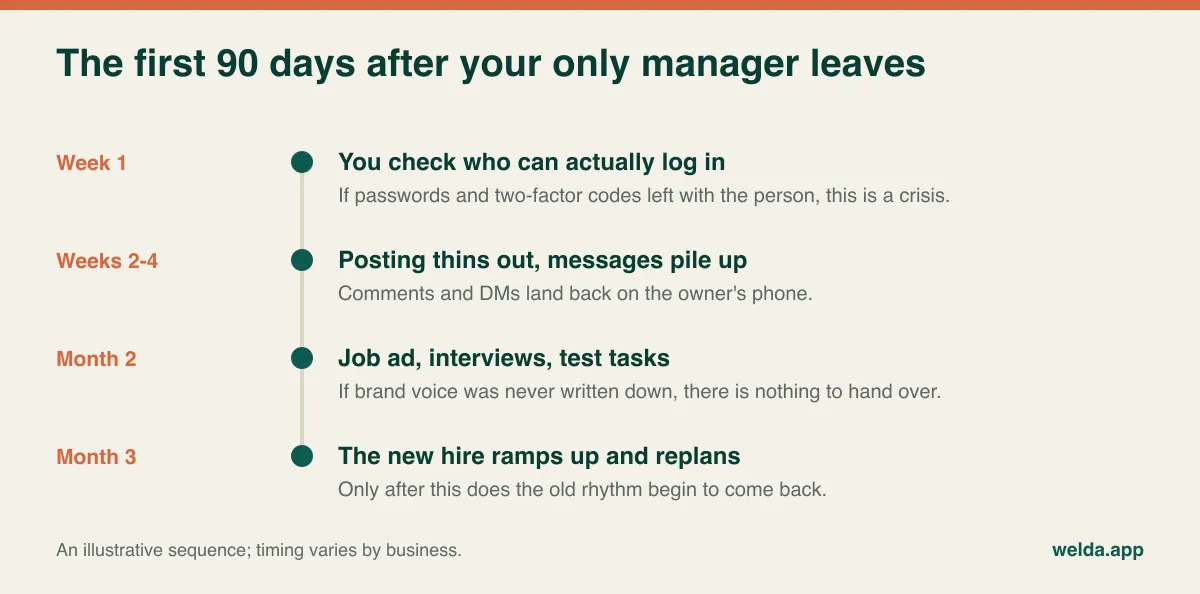
You can reduce this risk cheaply: a short brand voice and reply-rules document, one shared content folder, a monthly note on what worked, a bank of ready posts for planned absences. Write these into the role when you hire. A manager who says "I'll just handle it" isn't acting in bad faith; nobody ever asked them to do it differently.
Agency continuity isn't guaranteed either; the risk just sits elsewhere. The account lead who understood your business can leave, your account can be passed to someone junior, and attention can drift when a bigger client signs. So ask at proposal stage: who runs our account, when would we be told if that changes, and how is a handover done? At an agency, one person's vacation doesn't stop the account, but if your whole relationship runs through one person, that advantage shrinks. The end of the contract is its own test, which we'll get to below.
The one thing an agency can't do: be on the shop floor
The strongest argument for an in-house manager isn't cost. It's access. The first tray coming out of the bakery oven, the odd problem found under a car on the lift, the moment a stylist reveals a dramatic color change, the new machine rolling into the workshop: many of these can't be scheduled and can't be restaged tomorrow. Someone who works there notices, pulls out a phone and has it in fifteen seconds.
An agency only sees these moments in two ways: a planned shoot day or footage you send. Shoot days produce tidy batches of content but miss the spontaneous. Footage only arrives if someone in the business makes a habit of capturing it. This is a typical point where an agency relationship stalls: the agency says material never comes, the business says the content all looks the same, and both are right.
How much this matters depends on the business. In cafes, restaurants, salons, gyms and car detailers, closeness is very valuable, though a staff member with a phone can close much of that gap. In a clinic or dental practice, things change: patient images need consent, healthcare advertising is restricted in many countries, and being on site is worth less than planning that respects those rules. In a B2B manufacturer or engineering firm, the raw material is usually what your experts know. Neither an outside agency nor a new junior hire knows that on their own, so a monthly hour interviewing your engineers is required in either model.
The test from this section is simple: will the thing that lifts our account out of the ordinary be what happens here every day, or a well-built plan? If it's the first, you need an employee or a designated insider. If it's the second, a remote team is enough.
Whose job is the inbox: marketing or sales?
The least discussed part of social media management is the message inbox. In many businesses DMs are a sales channel: "Is this in stock?", "Can I book tomorrow?", "Do you handle bulk orders?" Those answers depend on inventory, calendar and pricing knowledge, not on design talent. An agency simply can't know today's stock or tomorrow's open appointment.
If you work with an agency, draw the line early. Give them written answers to common questions, and put in writing which messages go to which person, through which channel and within how many hours. With an in-house manager the risk is the opposite: the inbox eats the whole day and production stops. In a busy business, sharing DM duty with whoever is already at the front desk often makes more sense than hiring another person.
Messages also contain personal data: names, phone numbers, addresses, sometimes health questions. If you have customers in the EU or UK, GDPR is likely to apply, and giving an outside agency access can call for a data processing agreement. Other regions have their own privacy rules, and clinics need particular care. Check the details with a lawyer who knows your market, because this article isn't legal advice. The practical steps hold everywhere: know exactly who has access, give each person their own login, and remove leavers the same day. The same goes for deciding who speaks when a bad review blows up. Write your social media crisis management plan when you pick your model, because there won't be time once the crisis starts.
The hard part of a first hire: knowing what good looks like
If you don't know social media yourself, it's hard to evaluate someone who does. A polished personal profile, a big follower count, or "I managed that brand's account" are all difficult to verify. Handing the account to a young employee because "you understand this stuff" is a version of the same problem: using these apps and producing business results with them are different skills.
Move interviews away from the portfolio and toward the work. Give candidates a topic from your own business and ask for a small, paid test: a one-week mini plan and two content drafts. Then ask: what changed on that account, and how do you know you caused it? Show me something that got lots of likes and did nothing for the business. Looking at our account, what would you stop doing for the first three months? If every answer comes back to follower counts, be careful. The metrics in our social media analytics guide are useful in this conversation.
Don't skip the management question either. Who sets this person's goals, who reviews the work, and who notices a bad month? Without that person, the manager either invents their own work or becomes an in-house designer serving everyone's requests. Write down concrete outcomes for the first ninety days and agree on them before the start date. An agency reduces this management load but doesn't remove it. You still need someone who reads the month-end report and asks whether it helped the business.
Hiring a contractor rather than an employee raises another issue: in many jurisdictions, treating a full-time, closely directed contractor as self-employed can create misclassification risk. If your freelancer starts to look like staff, ask your accountant or lawyer.
In between: hybrid models, and the option of "not yet"
This isn't a two-way choice. Three middle models are worth weighing, each with its own weak spot.
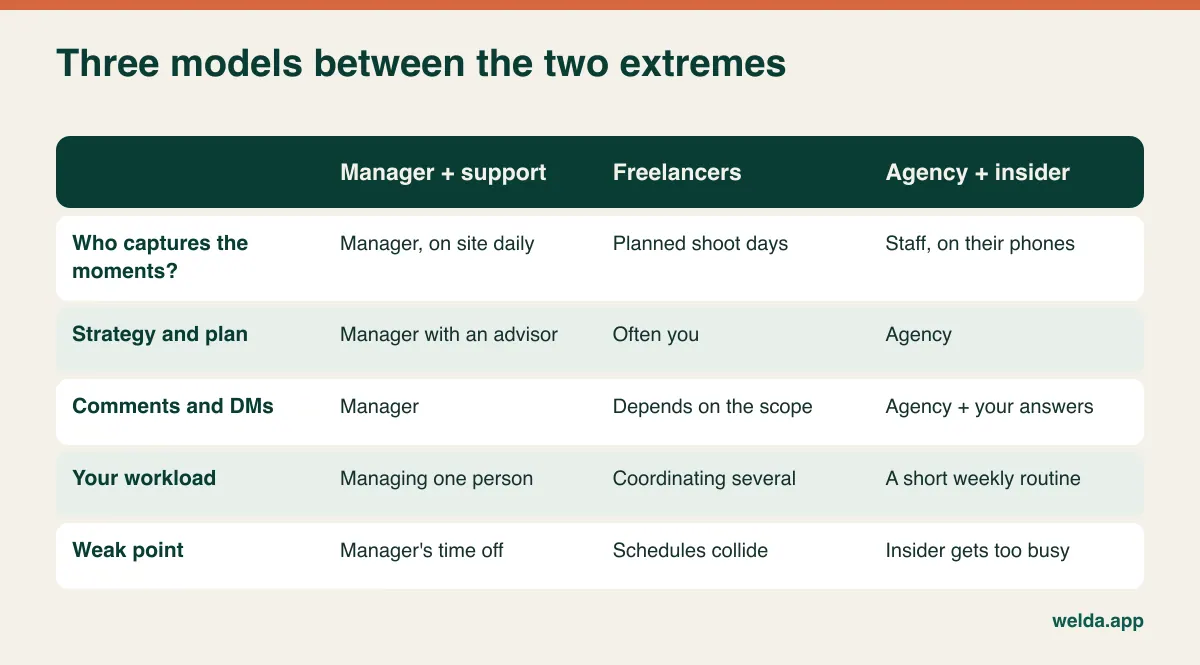
- Manager plus outside support: Daily content and messages stay in-house, while strategy, video editing or design templates are bought in. It suits busy, visually rich businesses with higher volume.
- Freelancers: Flexible for specific jobs like editing and design. You usually do the coordination and planning yourself, so it needs a dependable owner on your side.
- Agency plus insider: Planning, design, copy and reporting sit with the agency, while one staff member shoots phone footage a few times a week and sends a short weekly update. You don't need a new hire, but you do need to say clearly that it's part of that person's job.
The fourth honest option is neither, for now. If customers reach you through referrals or Google, if social media is really a shop window, and if a few well-chosen posts a month are enough, a full-time salary or a monthly retainer may not pay back yet. Start with a simple routine and templates, and grow the budget once you can see the account bringing in customers.
Plan the breakup on day one
This applies to employees and agencies alike, and it's where the most expensive mistakes get made. If the account was opened with someone's personal email, if two-factor codes go to their phone, or if the ad account sits inside an agency's portfolio, you'll have a fight on your hands when the relationship ends. Fix it on day one, even in the friendliest partnership.
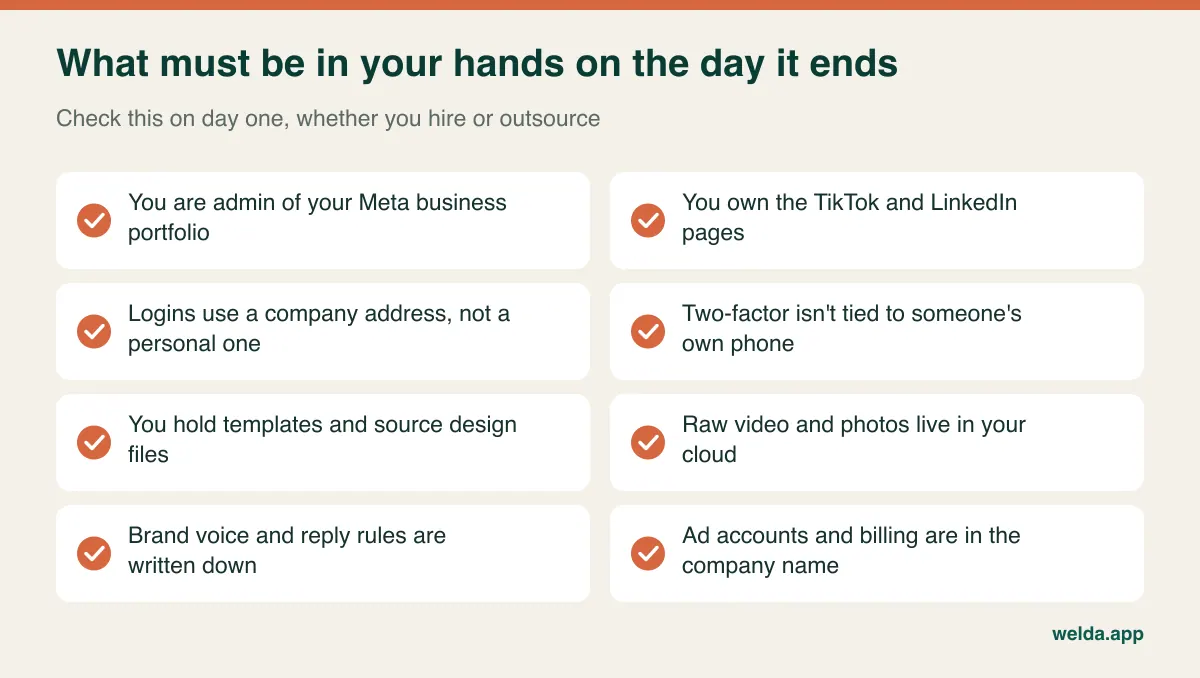
Content rights belong on the same list. As a general rule, work an employee creates as part of the job tends to belong to the employer, but with freelancers and agencies, who owns the source files and usage rights should be spelled out in the contract, because defaults vary widely by country. Music, stock imagery and videos showing customers need their own permissions. And if you work with creators, paid content generally has to be disclosed under rules such as those from the FTC in the US or the ASA in the UK, so decide who checks that.
Switching from one to the other without going silent
Most businesses let the account go quiet while they change course. Silence isn't a disaster, but it's avoidable. Moving from employee to agency, plan at least two weeks of overlap before the employee's last day: take over access, list the best and worst content, and collect the questions that keep turning up in messages. Moving from agency to employee, start recruiting well before the contract ends, ask for templates, source files and the last six months of reports, and build the first month's calendar together.
Either way, don't treat the first six weeks as a growth period. The goal is to keep the rhythm and settle the new setup: access, documents and a content bank in weeks one and two, posting rhythm and DM flow in weeks three and four, and a first review in weeks five and six. When you measure, look at business-linked numbers such as profile visits, link clicks, inbound messages and closed sales, not follower growth alone. By the end of that period, whatever isn't working will have become visible.
Where Welda fits in this decision
We're an agency, so we aren't a neutral observer here. It's only fair to say where we help and where we might not. For businesses leaning toward the agency side of the social media manager vs agency decision, Welda provides strategy, a monthly content calendar, design and content production, copywriting, comment and DM management, and a monthly performance report from one team. We manage Instagram, Facebook, TikTok, LinkedIn and YouTube, you get one dedicated contact, and ownership of and access to your accounts always stay with you. From you we ask for basics such as your logo, brand visuals and any product photos.
What we can't do is the thing described above: be in your shop every day. If the value of your business lies in spontaneous moments and nobody on site will capture them, a remote team may not give you the best result, and a hybrid with an insider or an in-house manager may fit better. Don't assume on-site shoots are included by default; let's clarify that on a call. There's no fixed price list. The fee depends on the number of platforms, monthly content volume and scope, and it gets settled in a free consultation. We can run the hours math above together on that call, and if the answer is that hiring suits you better right now, we'll say so.
Frequently asked questions
For a small business, is a social media manager or an agency the better choice?
For a single-location business with nobody to run marketing, an agency or agency-plus-insider setup is usually lower risk to begin with, because it removes the burden of picking and managing one person. But where there's plenty happening on site and DMs bring in a lot of sales, someone in-house can get more done. Check your answer with the hours math above.
Is a part-time social media manager a good compromise?
It can be, if volume is low and the job description stays narrow. A part-timer may not be able to keep up with comments and DMs during the day, though, and meetings and approvals take a bigger proportion of their hours. Rerun the math at half the hours; you'll often need to drop to a single platform.
If I hire an agency, is there nothing left for my team to do?
There's still work. Sending material, approving content, answering stock and booking questions, and reading results all stay with you. A short weekly routine can handle it, but it isn't zero. Expecting it all to disappear sets the relationship up for disappointment.
Does this comparison include paid ads?
Treat ads separately. Organic content and advertising call for different skills, and ad spend sits apart from service fees. Ask a candidate or agency how they've set up and measured campaigns, and make sure any proposal states in writing whether ad management is in scope.
When will I see first results?
In either model, clear gains in consistency and engagement typically show within the first few months, and lasting growth depends on steady posting. Allow for ramp-up with a new hire and for discovery and first planning with an agency. At the end of month one, measure rhythm rather than growth.
What happens to my accounts if I leave an agency?
That depends on your contract and how the accounts were set up. If you used the list above on day one, everything is already yours. At Welda, ownership and access stay with you from the start; if you work with someone else, ask for this in writing at proposal stage.
What should I do to make the decision?
Write down your monthly content needs, your DM traffic and how many management hours you can spare. Then you can talk through your social media manager vs agency decision in a free consultation with us; those notes let the conversation run directly on your numbers.