Corporate website design cost comes down to how many people spend how many days on your project, and that is set by five things: the number of distinct page templates, the amount of custom design, the integrations, the content work, and how many people must approve each stage. That is why no honest supplier can quote you a single figure from a list, and why two sound proposals for what sounds like the same site can differ widely. The practical answer is to estimate your project in effort, send every supplier the same scope, and compare what each one includes over three years rather than on the first invoice.
This guide is written for the executive or owner who will sign the purchase order. Market price ranges vary too much by country, supplier and scope to settle this decision, so the focus here is on a method you can use this week: how to size the work, what makes a corporate site more expensive than it looks, what never appears on the first invoice, and how to read proposals side by side.
Why "corporate" costs more than the page count suggests
A ten-page site for a sole trader and a ten-page site for a company with a board, a legal adviser and a marketing team are different purchases. The pages may look alike. The work around the pages does not.
What you are paying for in a corporate project is largely coordination and risk. Several departments want a say. Someone in legal needs to read the privacy notice. Someone in IT wants to know where data is stored and who holds admin access. The brand team has rules about logo use. A procurement department may send a supplier questionnaire before anyone discusses design. None of this shows up in a sitemap, yet all of it takes hours from a person your supplier is paying.
Consider two invented companies, each asking for "about ten pages". The first is a family-run consultancy: the managing partner approves everything, one language, an enquiry form that sends an email. The second is an engineering group with three shareholders, offices in two countries, a careers section feeding an applicant system, and a compliance officer who wants a record of who changed what. Same page count, very different budgets, and the second company is not being overcharged. When a proposal seems high, ask which of those hours you could remove by changing how you work, not only what you build.
Size the job in days before anyone quotes
You do not need to be technical to estimate roughly. Break the project into phases and ask what each needs. An estimate in days gives you something a price list cannot: a way to see whether a proposal is realistic and where it differs from another.
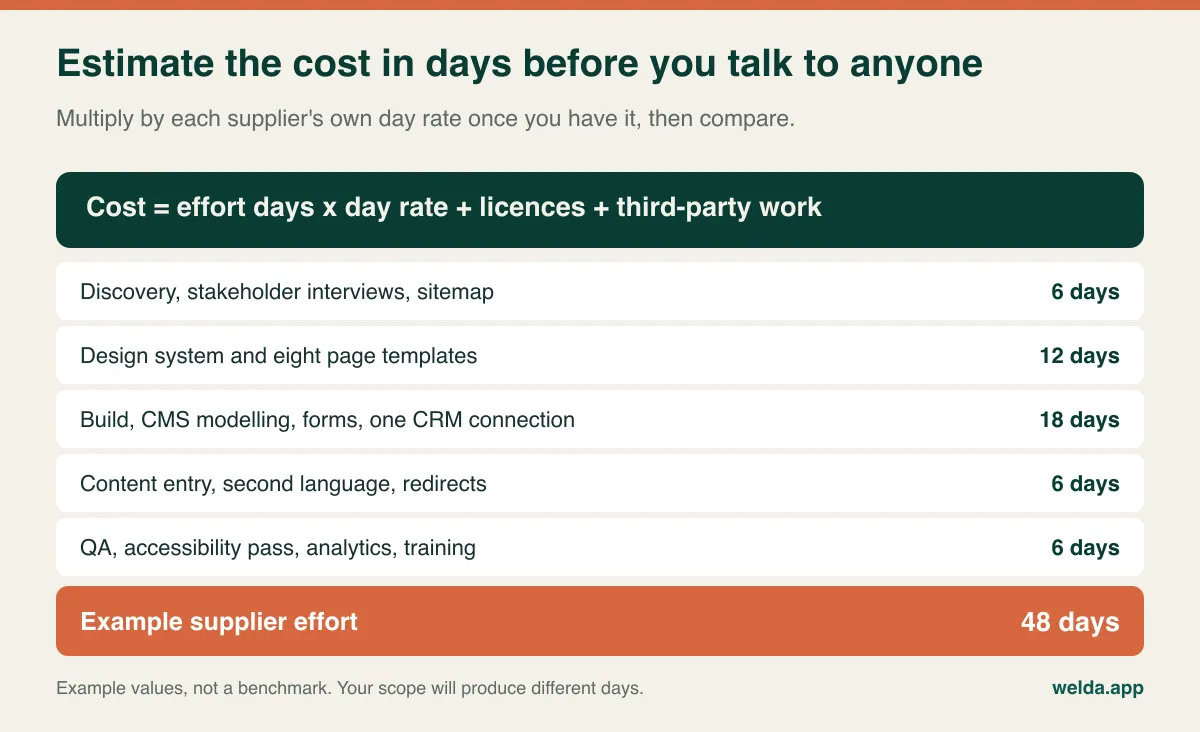
The figures above are invented for a fictional project, so do not reuse them. Use the structure. Once you have your own version, ask each supplier for the same breakdown. If one bidder allows far fewer days for design than the others, it may be planning to adapt a purchased theme, which can be a perfectly good choice as long as you know that is what you are buying. If another allows no time for discovery, it is assuming your brief is complete. It rarely is.
The line that surprises buyers most is often content entry and migration. Moving a few dozen old pages, tidying them and setting redirects sounds clerical, but it takes time and someone has to do it. Decide early whether that person is on your side or theirs.
Multiply each supplier's days by its own rate and you have a number you can reason about. Asking to see a rate may feel awkward, but a supplier who works on a fixed price can still tell you the assumptions behind it. A clear one-page brief makes that conversation far easier, because every supplier is then pricing the same assumptions.
The decisions that move your budget most
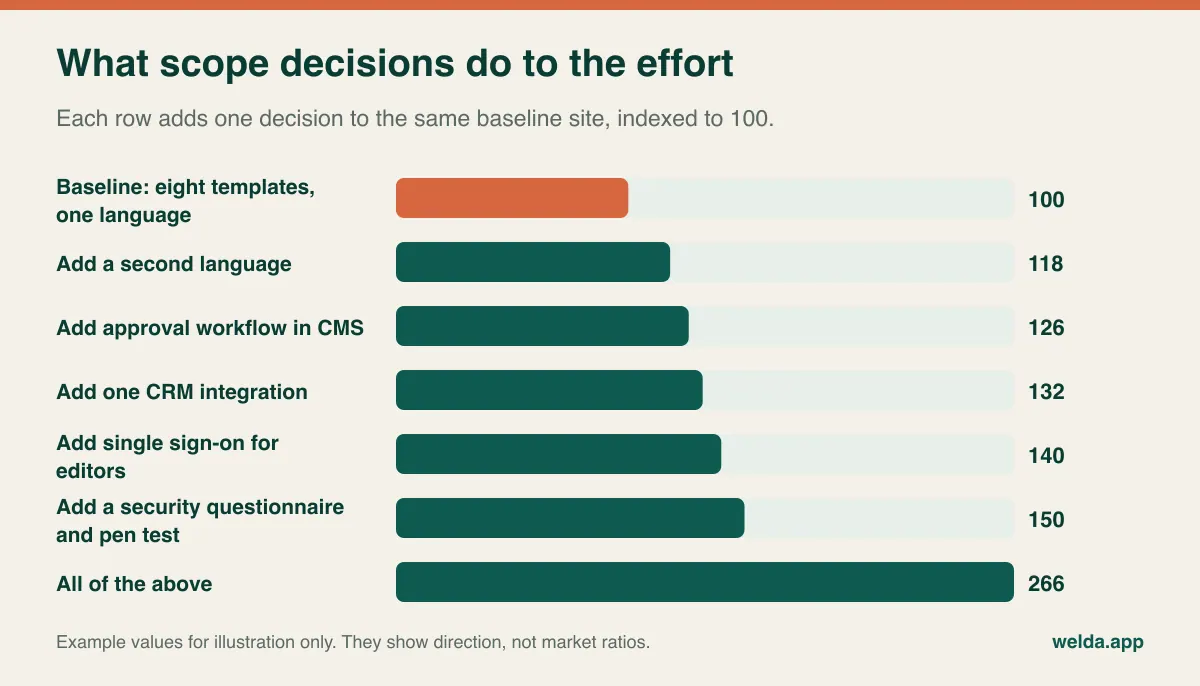
Most of the cost is decided before design starts. Each of the choices below looks small in a meeting and shows up later as days of work. The chart adds them one at a time to the same fictional baseline, which is why it is useful for direction rather than for arithmetic on your own project.
| Decision | Why it adds cost | A cheaper way to get most of the value |
|---|---|---|
| Unique page templates | Each layout needs design, build and testing on several devices | Merge similar pages into one flexible template |
| Extra languages | Translation, technical setup for search, and every later update twice | Launch one language, but have the structure ready for more |
| CRM, ERP or applicant system connections | Depends on the other system's documentation and on people outside the project | Start with form to email, connect in phase two |
| Editorial workflows and roles | Needs extra CMS configuration, training and testing | Limit to two roles until you see who actually edits |
| Security and procurement reviews | Questionnaires, tests and fixes take senior people's time | Share your requirements on day one, not before launch |
| Bespoke illustration, video and animation | Production cost, plus potential impact on page speed | Invest in a few pages that carry real weight |
Scope is your largest lever, and it is one that many buyers underuse. A phased plan usually beats a compromised full launch. Open with the pages your primary readers need, and leave the investor area, the third language or the knowledge base for a second phase. You spend later, on evidence, and you avoid paying for pages nobody asked for. A good supplier will suggest this before you ask. Be slightly wary of one who agrees to everything on the list without a question.
Three pricing models, and who pays when scope moves
Scope changes on nearly every corporate project, usually because the company learns something during the work. So the pricing model matters as much as the amount, since it determines who carries that change.
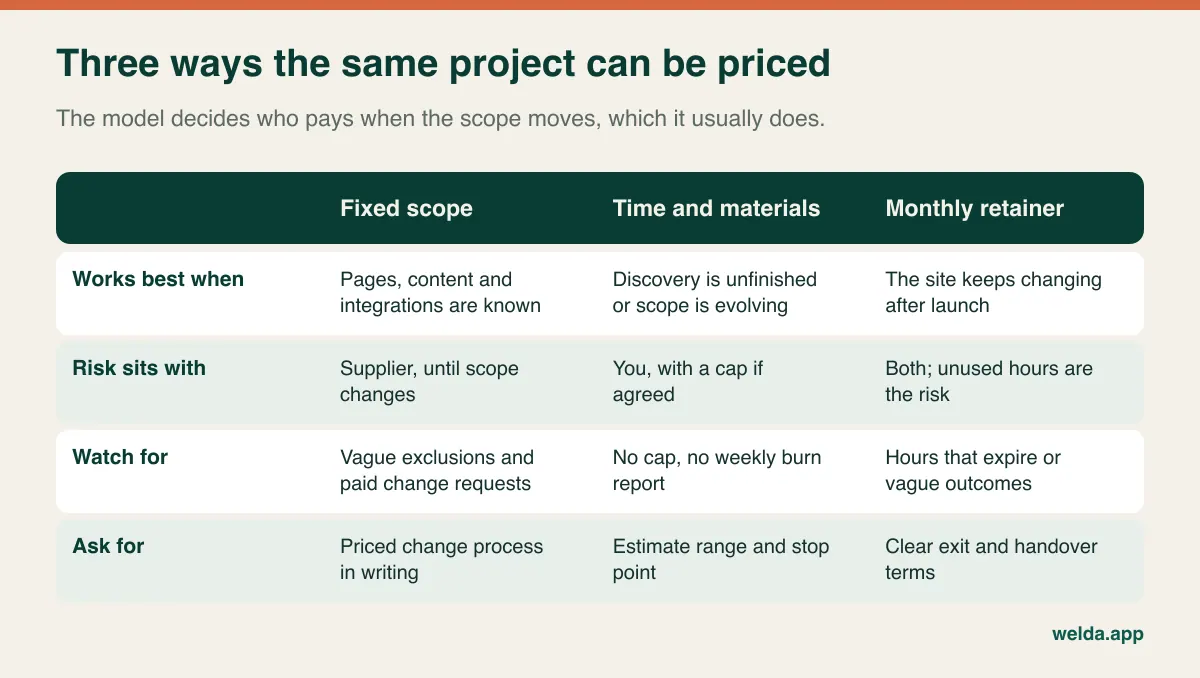
Fixed scope suits a project where pages, content and integrations are genuinely known. The temptation is to demand a fixed price before discovery has happened, which forces the supplier to either pad the quote or exclude a lot. A two-stage purchase can be fairer: a small paid discovery that produces a real specification, then a fixed quote for the build. You also own a document you could take elsewhere.
Time and materials is honest when the scope is still moving, but only with a cap, a weekly report of hours used, and a clear point where work stops for a conversation. A retainer makes sense when the website is a living marketing tool with constant changes; it makes little sense as a way to keep paying for a site that nobody touches.
Whichever you choose, the change process deserves its own paragraph in the contract. Who can request a change on your side? How is it estimated? Does it need written approval before work begins? Most disputes grow from this gap and not from the original quote.
Costs that never appear on the first invoice
A build quote answers one question: what does this supplier charge to deliver this scope? A budget has to answer a wider one: what will this website cost the company over the years it will run?
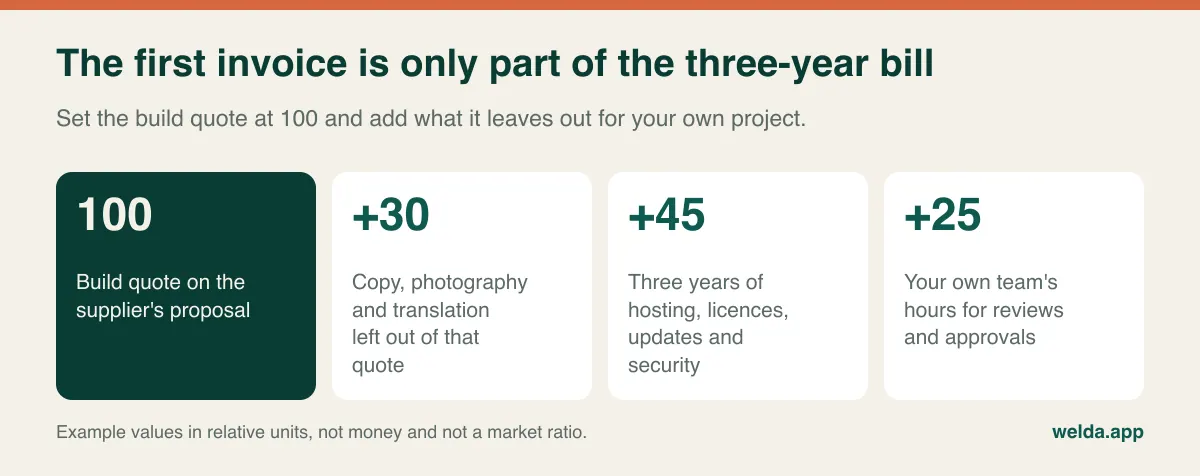
Run through this list and put a name and an estimate next to each item for your own project:
- Content: copywriting, photography of real premises and people, translation, and legal review of the result. This is often the largest item left out of a proposal.
- Licences: premium themes and plugins, fonts, stock images, form tools, cookie consent platforms, CMS seats. Check whether they are annual, and whose account they sit in.
- Running costs: hosting, domain names, monitoring, backups, security updates. Some sites have low hosting costs and higher update needs; others are the reverse.
- Integrations over time: a connected system that changes its API needs someone to adjust the connection. Ask who does that and on what terms.
- Your own team's hours: reviews, approvals, training, feedback. This is real money even though no invoice arrives.
- Exit costs: what you would pay to move on if the relationship ends. If the site lives on a proprietary platform or your supplier holds the accounts, this can be significant.
Exit cost is the item buyers most often forget, and the one most worth checking in writing. Our guides on total cost of ownership and website ownership and source code go deeper on both points. At Welda, as a concrete reference for what to ask, the design and the source code are delivered to you with documentation, you can host wherever you choose, and care plans are optional. Whoever you buy from, ask to have the equivalent in writing.
Reading proposals side by side
Proposals are written to be persuasive, and each one is structured differently on purpose. Before you compare, force them into one format. Send a grid with your brief and ask bidders to complete it, in addition to whatever they want to send.
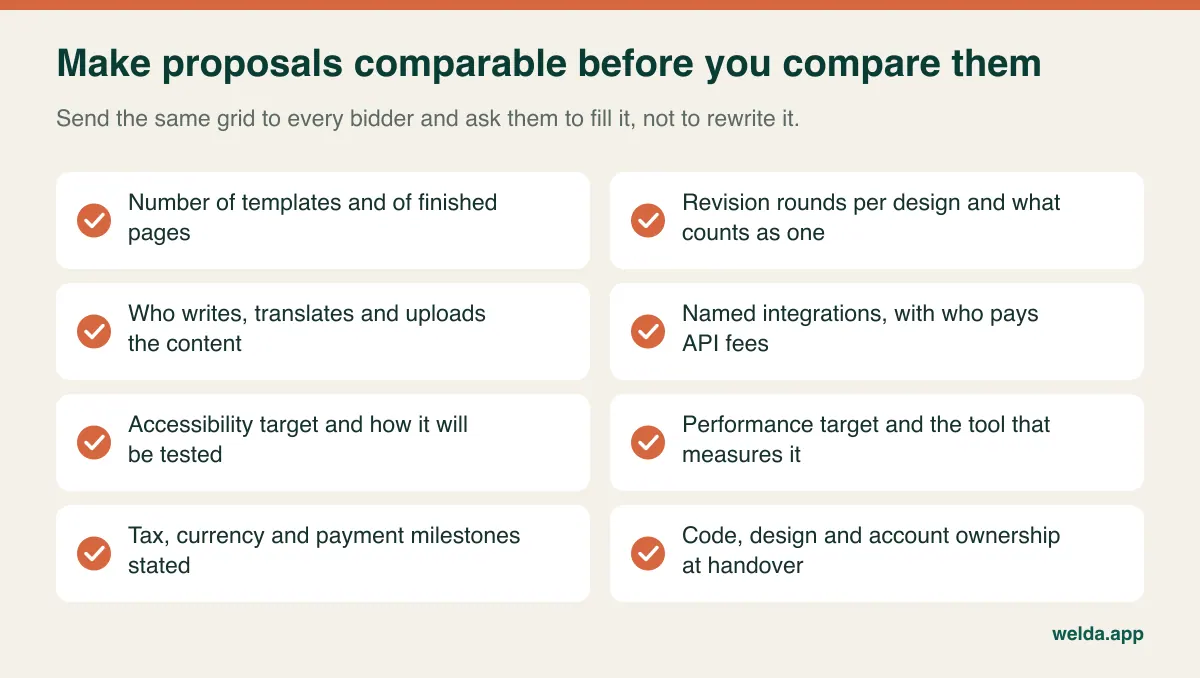
Then read for what is missing. A proposal that names no number of revision rounds has not solved the question; it has postponed it. "SEO-ready" without a list of what that includes tells you very little. Ask for structured data, heading structure, redirects, sitemap and a performance target measured by a named tool such as Lighthouse or PageSpeed Insights. Nobody can honestly promise a specific ranking, so treat any such promise as a warning sign.
Keep the process proportionate. A formal tender with a scoring committee costs you a lot of internal time and can discourage good small studios from bidding. For most mid-sized companies, a simple funnel is enough:
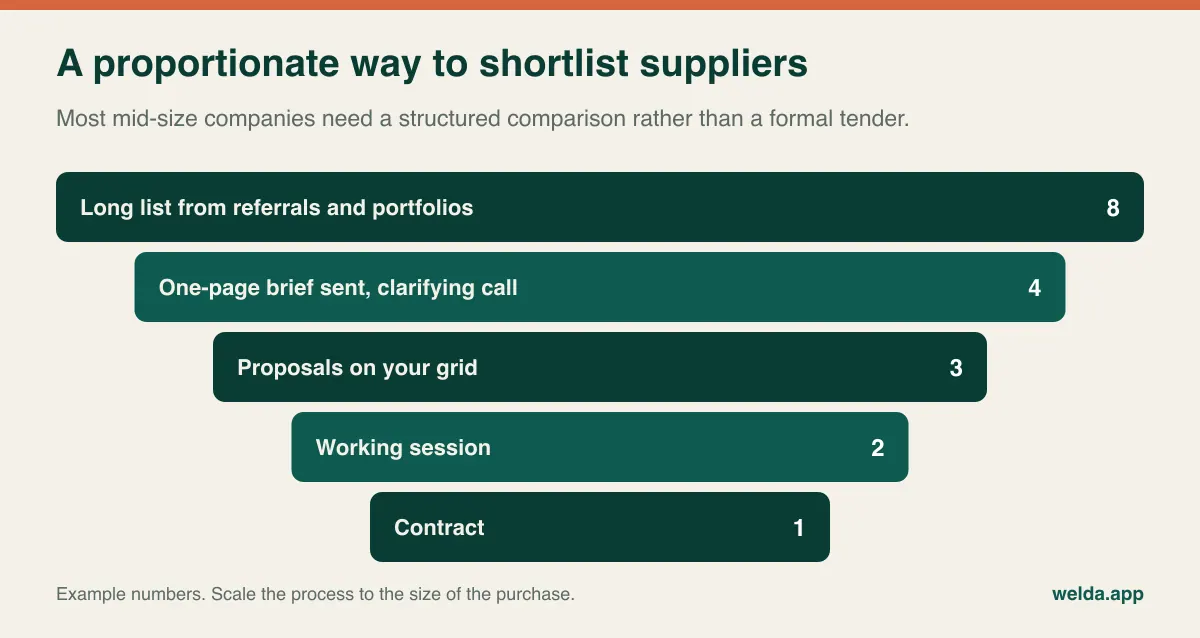
In the working session, give the shortlisted teams one real problem from your project, such as how to handle careers content across two countries, and watch how they think. You are about to spend months with these people. Ask who will actually do the work, not only who is presenting. For a question-by-question walkthrough, see our guide on evaluating website proposals.
Buying across borders: tax, law and time zones
Corporate buyers increasingly hire outside their own country, which can widen the choice but also adds items that are specific to this kind of purchase. Check these before comparing totals. This is a general overview and not legal or tax advice, so take your specific situation to your advisers.
- Tax and currency: does the quote include VAT or a similar tax? Might reverse-charge or withholding rules apply? Which currency is it in, and who carries the exchange-rate risk over a multi-month project?
- Governing law and disputes: which country's law applies, and where would a dispute be heard? An excellent contract you cannot practically enforce is worth less than it looks.
- Data protection: depending on where your visitors are, frameworks such as the EU GDPR, UK GDPR or US state privacy laws like the CCPA may affect forms, analytics and cookies. If a supplier in another country can access personal data, a data processing agreement and transfer safeguards may be needed. Ask your data protection lead early.
- Accessibility: WCAG is the usual technical reference. The European Accessibility Act, the ADA in the US and public-sector rules may or may not apply to you. Decide on a target level and put it in the scope, because retrofitting it costs more.
- Working hours and language: how much overlap do your teams have? Who attends on-site workshops, if you need any, and are travel costs included?
In the spirit of laying this out plainly: Welda is an Istanbul-based team. If your procurement rules require a domestic supplier, regular on-site presence or a particular certification, we are not the right fit and it is better to learn that on the first call. For more on the compliance side, our guide to a privacy-compliant website covers the practical items.
Matching the supplier to the risk you actually have
The natural question is "agency, freelancer or site builder?", but the sharper one is "what would hurt most if this went wrong?" Answer that and the choice narrows quickly.
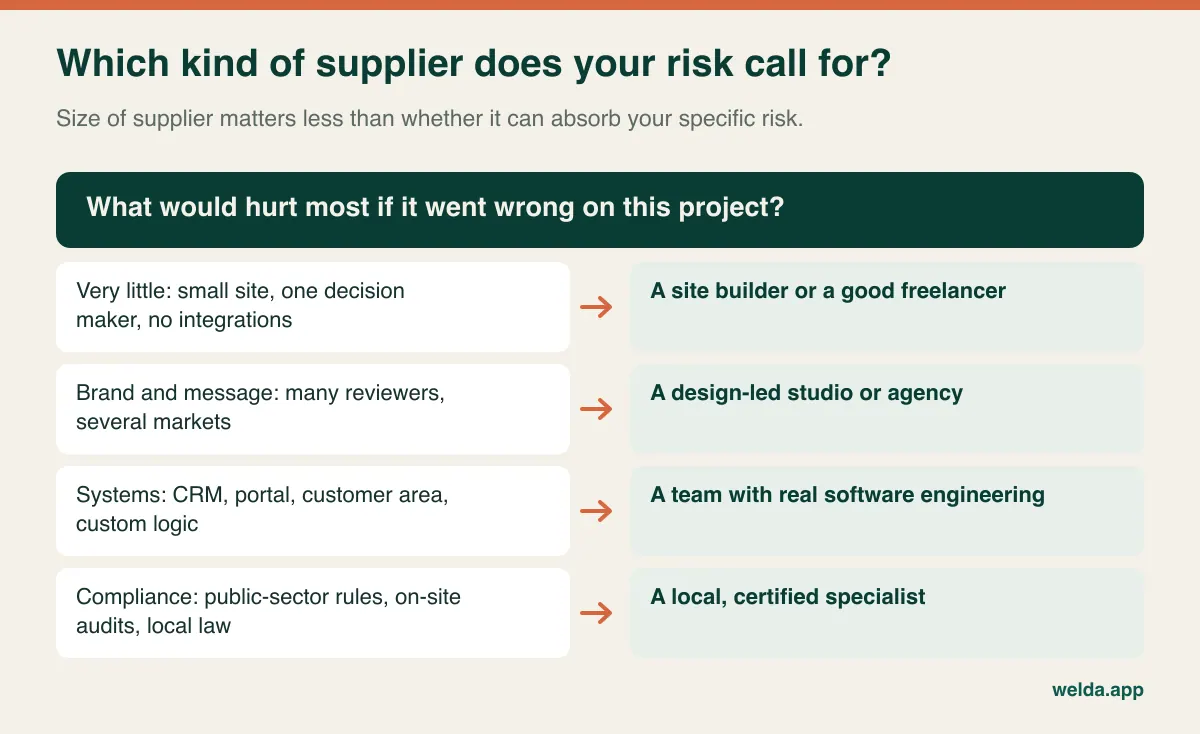
A site builder can be a sensible answer for a small company with one decision maker. You will trade flexibility for speed, and you should check how easily you can leave. A good freelancer can do excellent work on a well-defined project, as long as code and accounts are in your name and you have considered what happens during holidays or illness. A design-led studio earns its fee when brand and message carry the project. A team with software engineering behind it matters when the site connects to other systems or grows into a customer area, because at that point you are buying a small software product.
That last category is where Welda sits. The team that builds our own production software, Welda Stock and Welda CRM, also designs corporate sites from scratch in Figma and builds them in Next.js/React or WordPress. Speed and technical SEO go in from the start and are measured with Lighthouse, Search Console and GA4 are set up at launch, and a CMS lets your team edit pages without us. If what you need is the quickest, lowest-effort brochure site, that is more than you need, and we would tell you so. If you would like your own project sized, you can get your corporate website design cost scoped in a free call, with no price list involved, and receive a written quote showing what is in and what is out.
Corporate website cost questions
How much does a corporate website design cost?
It depends on effort, which depends on templates, custom design, integrations, content and approvals. Any single figure given without seeing your scope is a guess. Prepare a one-page brief, ask several suppliers for the same breakdown, and compare the three-year total. Welda's pricing is agreed after a free discovery call, against a written scope.
Why do proposals for the same brief differ so much?
Usually because they are not for the same work. One may adapt a purchased theme while another designs from scratch; one may include content entry and migration while another excludes them. Other factors include team seniority, location and how much risk the supplier builds in. Ask each to state its assumptions.
How long does a corporate website project take?
A standard corporate site typically takes a few weeks, and larger or multilingual projects take longer. Internal approvals and content readiness usually have more influence on the date than the build itself, so tell suppliers honestly how many people need to sign off.
Is a custom design always worth the extra cost?
No. If your site is small, your brand is modest in its ambitions and speed to market matters most, a well-chosen theme can be right. Custom design earns its cost when the site must differentiate you, when the structure is unusual, or when performance and long-term flexibility matter. The important thing is to know which one you are buying.
Should a fixed price include ongoing maintenance?
Keep them separate so you can compare them and cancel one without the other. Find out what maintenance covers: security updates, backups, monitoring, content changes. Also ask what happens to the site if you stop paying, because the answer reveals a lot about who really controls it.
How can we reduce the cost without damaging the result?
Reduce the number of templates, launch in phases, prepare your content before design begins, and appoint one person to consolidate feedback. These reduce effort without touching quality. Cutting testing, discovery or redirect work tends to save money only until launch day.
What should we prepare before requesting quotes?
The site's main job, your priority readers, a list of pages and languages, the systems to connect, who writes the content, who approves, and your target date with the real reason for it. One page is enough. If some of it is unclear, a discovery call can help you work it out.
Before you sign
A good test of any proposal is whether you could explain it to your finance director in two minutes: what is included, what is not, what it costs to run, how scope changes are handled, and what you own if you leave. If you cannot, ask more questions before signing. And if you would like a second view, or a first scoped number to set beside the others, tell us about your project: we discuss corporate website design cost for your specific scope in a free conversation and put it in writing, so you can compare it with any other proposal you have.