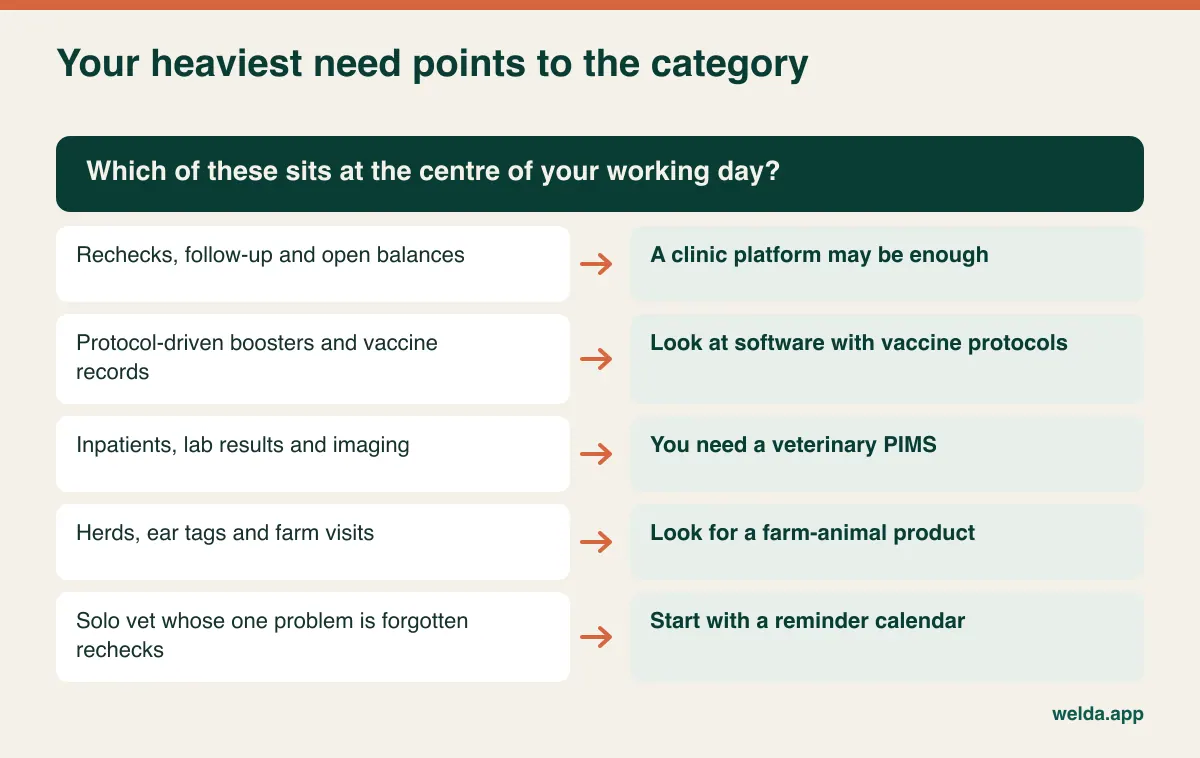
The right veterinary practice management software is the lightest system that handles your records, reminders and billing without workarounds. If your days are mostly consultations, vaccinations and rechecks, a well-organised clinic platform with per-patient histories, automatic reminders and balance tracking will often be enough. If inpatient care, in-house lab results, imaging and a dispensary drive your day, you need a dedicated veterinary system, usually called a PIMS. If you are a solo vet with a small list and one real problem, forgotten rechecks, a calendar with reminders can carry you for a while. Which one you need depends less on feature counts than on where information currently gets lost in your practice.
This guide is for practice owners close to a buying decision. It does not rank vendors, because a system that suits a two-vet companion animal clinic can be a poor fit for a 24-hour hospital and the reverse is just as true. What you will find instead are the questions that separate these categories, a demo script built around awkward real situations, and a plain account of where Welda CRM fits and where it does not.
Three different products are sold under one search term
Search for veterinary software and you will see very different products described in nearly the same words. Sorting them into three groups before you book a demo saves weeks.
Scheduling tools with reminders do one job. They hold the diary, send appointment messages and store a short note. They are quick to adopt and rarely get in the way, but there is no real clinical history and usually nothing for money.
Clinic platforms were built for appointment-based health and service businesses and adapted by sector. You get a patient record with a chronological history, a calendar per clinician, automated messaging, invoicing and balances, reports and staff permissions. They are strong on front-of-house flow and communication, and thinner on anything species-specific or tied to medical devices.
Dedicated veterinary PIMS are built around the animal from the first screen: client and patient as linked objects, species and breed fields, vaccine protocols, inpatient boards, dispensing, lab and imaging connections. They do more and they ask more of you, in setup time, staff training and often in ongoing cost and contract length.
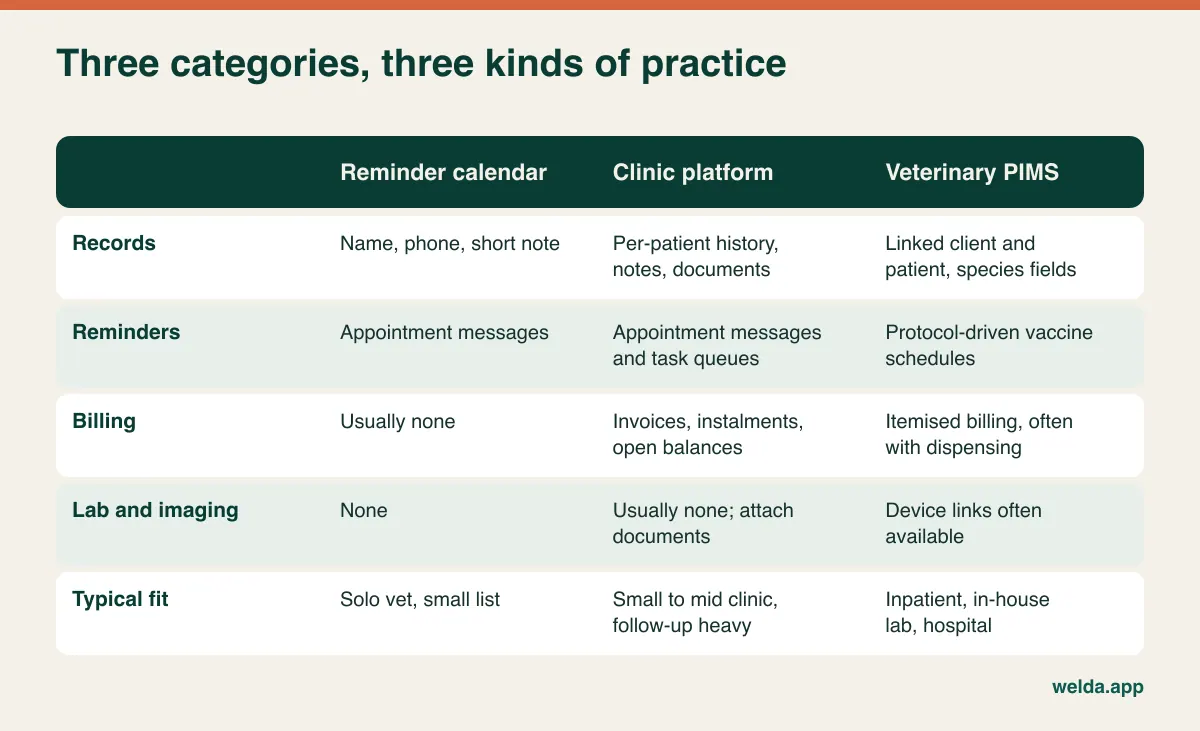
None of these groups is automatically better. A busy dispensary-led hospital running on a clinic platform will fight it every day. A two-room practice that buys a full PIMS may use a fraction of it while its team quietly returns to paper. The rest of this article is about working out which of those mistakes you are closer to making.
Your patient cannot talk and your client is not your patient
In human healthcare software, the person booked in, the person who pays and the person who gets the text message are normally the same. In veterinary practice they split apart. Bella is the patient, Sarah answers the phone, her partner pays by card, and a neighbour brings Bella in for the recheck. How a system models that split shapes almost everything else.
Three structures are common. In the client-first model, the owner holds the record and pets sit underneath. Multi-pet households are tidy, but check whether searching by the animal's name works at reception. In the patient-first model, each animal has its own record and owner contact details sit inside it. Histories stay clean and reminders reach the right number, but a four-cat household means four records. In the linked model, clients and patients are separate objects joined together. That is the most flexible and also the most common in dedicated veterinary products.
Welda CRM uses the patient-first approach. Each animal gets its own patient record with the owner's phone as contact details. Treatment notes and documents build up chronologically, and details such as species, breed and age go into the notes. We do not describe species and breed as separate reportable fields, so if you want to filter your list by breed or pull every rabbit on your books, raise that in the conversation rather than assuming it.
Now run your own list through a few situations that a paper file or a good receptionist's memory handles silently:
- The rehomed animal. When a dog moves to a new family, the history should stay with the dog while the old owner's details and consent leave the record.
- Two households, one pet. Separated owners may share a dog and disagree about who gets the reminder and who pays. Can you hold two contacts and a clear billing party?
- Rescues and fosters. Charities often bring in animals with changing foster carers and a central account that pays. Decide where that account's balance will live.
- The agent at the door. A neighbour or pet taxi driver brings the animal in. Know where the name, the authorisation and the phone number get recorded, because consent disputes start here.
- The deceased pet. A vaccination reminder sent after euthanasia is one of the most painful messages a practice can send. Test that marking a patient deceased stops future messages in practice, not just in theory.
That last one matters more than most feature comparisons. Software designed for human clinics rarely treats it as a workflow, so it is unlikely to come up in a sales presentation unless you bring it up yourself.
Protocol reminders and appointment reminders are different purchases
"Vaccine reminders" appears in most brochures and can mean two quite different mechanisms.
A protocol-driven system generates the next due date when you record a vaccine or parasite treatment, using rules by species, age and product. You get overdue lists and often a printed vaccine record. If preventive care is the backbone of your income, that automation is very valuable. Setting it up takes clinical decisions, because vaccination intervals vary between countries, products and vets, and no default template will suit everyone.
An appointment-driven system sends a message for whatever is in the calendar. It is simple to understand and works the same for a booster, a suture removal or a dental check. It also depends on discipline: if nobody books the next visit at the end of the consult, nothing fires.
Welda CRM is in the second group. There is no separate vaccination schedule module. Vaccines and treatments are recorded in the animal's record as notes and documents, the history shows chronologically, and creating an appointment for the next one triggers an automatic WhatsApp reminder. For practices centred on rechecks and follow-up that works well. If you want the software to calculate boosters on its own, this is not the right tool and you should look at a PIMS instead.
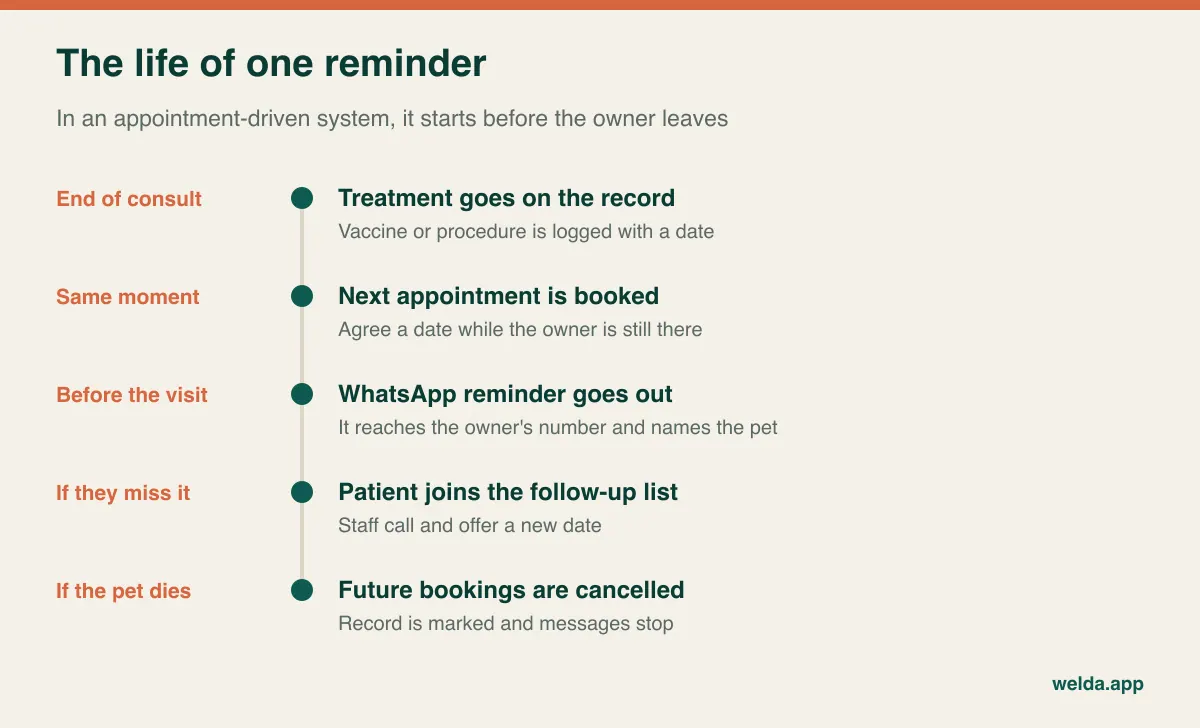
The hard case for appointment-driven reminders is the annual booster. Giving someone a time slot eleven months ahead can feel odd. A workable rule is to place a provisional appointment near the due date and confirm the exact time when the owner replies. Write that into your end-of-consult routine so that it survives staff turnover. For a fuller view of lists and message wording, our guide on the patient recall system goes through it step by step.
Channel is a separate question and depends heavily on your market. In much of Europe, the Middle East and Latin America, WhatsApp is often what owners read first. In North America and parts of the UK, SMS and email may still be the expectation. Our product material describes automatic reminders over WhatsApp, with templates in English, German and Turkish. If your clients expect text messages or email reminders, ask about that directly before committing. Our guide to WhatsApp appointment automation covers how those flows work.
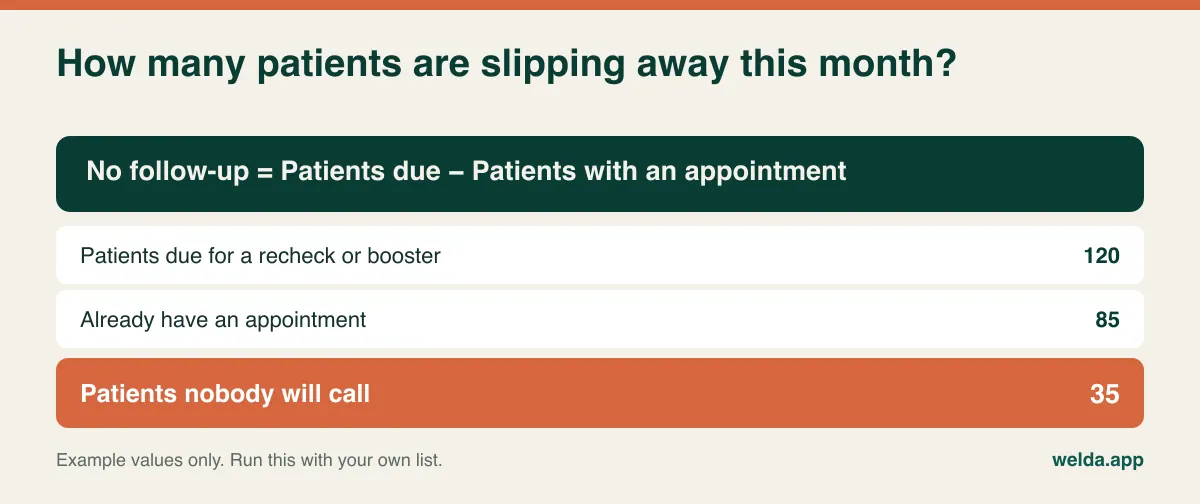
You can test whether reminders are working in your practice today with a simple count. Take the patients due for a recheck or booster this month, then subtract those who have an appointment. The remainder is the group nobody is going to call.
The invoice at the end of a bad day
A veterinary bill is rarely one line. There is the consultation, a vaccine, two medicines, a dressing and maybe a bag of food. With surgery and hospitalisation, the bill spreads over several days, with a deposit up front and the rest later. And the money conversation often happens with someone who has just had difficult news. Evaluate billing using your worst day, not the tidy example in the demo.
Ask these questions:
- When you open a record for a recheck, is an outstanding balance immediately visible, or does reception have to go looking?
- If an owner has two pets, can you see the total they owe as well as which animal each item belongs to?
- Can you take part-payment and instalments and still see at month-end who owes what?
- Can you produce an estimate before a procedure and compare it with the final invoice?
- If you deal with pet insurance claims, what can the software export or print to support them?
In Welda CRM, payment and remaining balance appear on the patient record, and open balances can be followed through reports. Invoices or receipts, instalment tracking, and cash, bank and card movements are handled in one place, and there is a quotes feature. Because each animal has its own record, a balance sits on that record, so if a combined owner total is essential to you, try it with your own example. We do not describe an insurance claims workflow, so treat that as absent unless shown otherwise.
Electronic invoicing is a country-by-country question. Welda's invoicing connects to e-invoicing through an integrator of your choice, and which integrators are relevant depends on where you operate. Ask specifically about your country and your tax setup, and check the requirements with your accountant.
What your regulator, insurer and data protection law may expect
Rules differ by country, and in some places by state or province. The list below is prompting, not legal advice. Check what applies with your veterinary body and your advisers, but do raise these areas with every vendor.
Medicines records. Many jurisdictions expect records of purchase, administration and dispensing of veterinary medicines, and stricter handling of controlled drugs. If this lives in your practice software, ask how batch numbers and expiry dates are recorded and whether the administering clinician is logged. Welda CRM has stock and consumables tracking, but we do not claim controlled-drug registers, batch-level vaccine tracing or cold chain logging. If those need to live in one system, a PIMS is the safer choice.
Certificates and identification. Rabies certificates, pet travel documents and microchip registration are often separate processes. Find out what the software generates and what stays outside it. Being able to attach a scanned document to a record is useful, but it is not the same thing as generating a certificate.
Retention and audit. Clinical records may need to be kept for a set period, and edits may need to be traceable. Ask whether notes can be changed silently, or whether the history shows who changed what.
Data protection. An animal is not a data subject, which leads some practices to treat their database casually. But the owner's name, phone, address and payment details are personal data under laws such as GDPR, and a clinical history tied to them can reveal a good deal about the person. Look for role-based access, an audit trail, a way to record consent and a route for getting your data back when you leave. Welda CRM stores records encrypted and provides role-based permissions, consent management and an audit log. Those tools support your obligations; your privacy notices and internal processes remain your responsibility. Our article on patient data security in clinics goes further into this.
Four practice shapes and what each usually needs
These are illustrative profiles, not customer stories. Find the closest one and adjust.
| Practice shape | The real pressure | Usually enough | Warning sign you have outgrown it |
|---|---|---|---|
| Solo vet, one nurse | Rechecks forgotten, balances remembered by memory | Reminder calendar or clinic platform | You keep a second list on paper |
| Two to four vets, surgery days | Diary conflicts, case handover, follow-up | Clinic platform with per-vet calendars and permissions | Inpatient notes live on a whiteboard |
| Hospital or 24-hour care | Inpatient charts, medication times, lab and imaging | Dedicated veterinary PIMS | Results are re-typed from devices |
| Mobile or house-call vet | Travel time, weak signal, few staff | Lightweight system with reliable phone or tablet use | You rewrite notes at night |
Two further cases deserve a blunt answer. Farm and equine work runs on herds, holdings, ear tags and passports, and a patient-per-record model does not suit it. We would not recommend Welda CRM there. Secondly, connectivity matters for mobile vets: Welda CRM is web-based, so access pauses when the connection drops, while records stay safe on the server. We do not claim an offline mode. If you often work without signal, test any vendor in the worst barn or block of flats you visit.
A demo script that does not let the vendor drive
Sales demos tend to feature one calm dog, one owner and one clean payment. Your Tuesday does not look like that. Take this script with you and ask to see it on screen, not described.
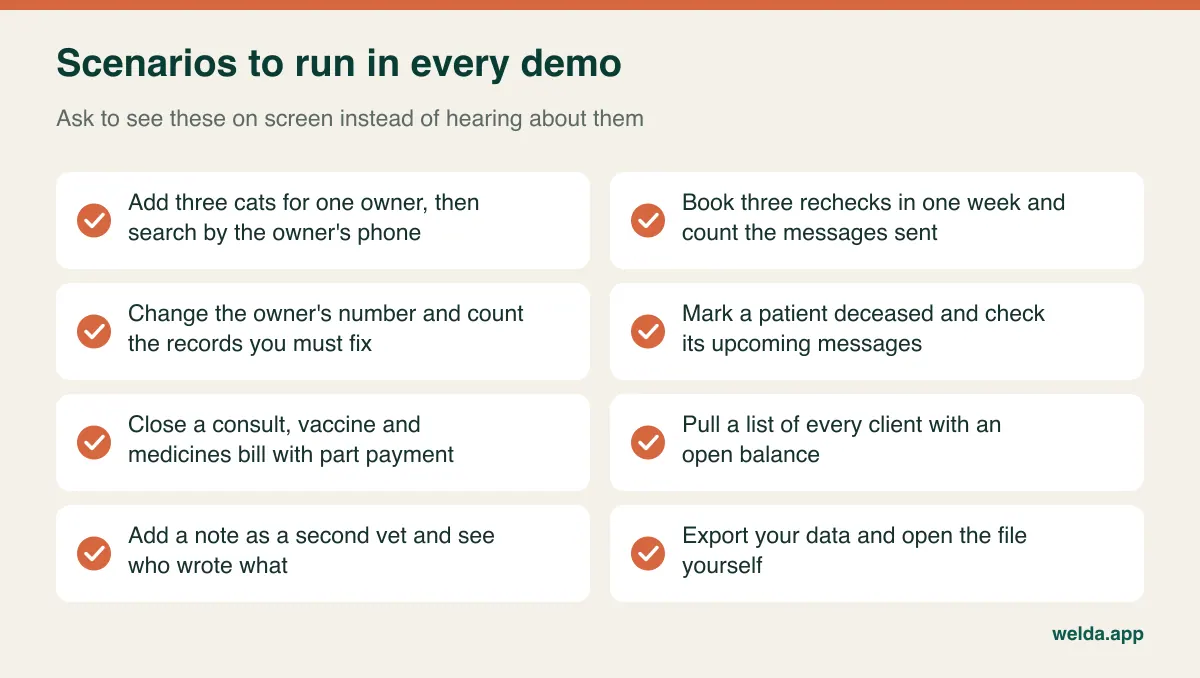
While the script runs, watch for friction nobody puts on a spec sheet. With an owner on the phone, how many clicks does it take to register a new patient? With someone waiting at the desk, how many seconds does it take to find a history? A vet in gloves cannot type during a consult, so who enters notes, when, and on which device? Those details predict whether the system is still in use after three months.
Bring your head nurse or receptionist, not just the partners. They will live in the system all day and they tend to spot problems faster. Then use the trial properly: enter ten real patients, book a real week and send reminders to your own phone. Welda CRM's 7-day free trial is long enough for that sort of test if you plan it in advance.
Comparing quotes when no two are built alike
Headline prices cannot be compared until you know what sits inside them. Ask every vendor to fill in the same lines, then read across.
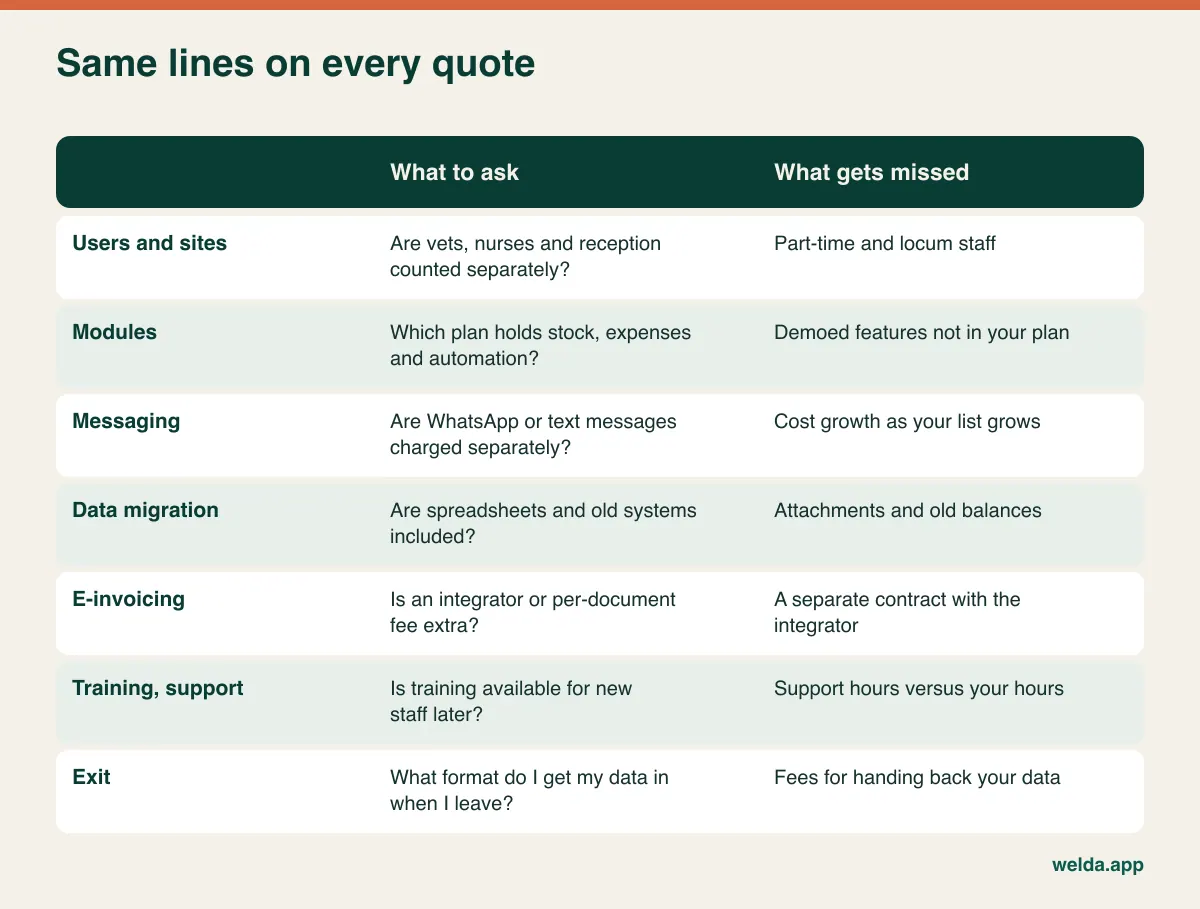
Pay particular attention to messaging and exit terms. Reminder volume grows with your list, so ask how message costs behave as it grows. And ask in what format you get your data back if you leave, whether that costs extra, and whether clinical notes and attachments are included or only names and phone numbers.
Add your own side of the sum as well. Spend one normal week counting the time spent on phone reminders, the checks that slipped and the balances nobody chased. That count makes each proposal easier to read, because you can see what the software would need to change. Welda CRM runs as a monthly subscription, and the fee depends on your locations, users and modules. It is set out in a free conversation, with setup and data migration included.
Migrating without dragging ten years of paper along
The classic mistake is trying to import everything. That takes months and leaves you with a patient list full of animals that have died or moved away. Reverse the order. Bring active patients and future appointments first, then pull older records across only when they are needed.
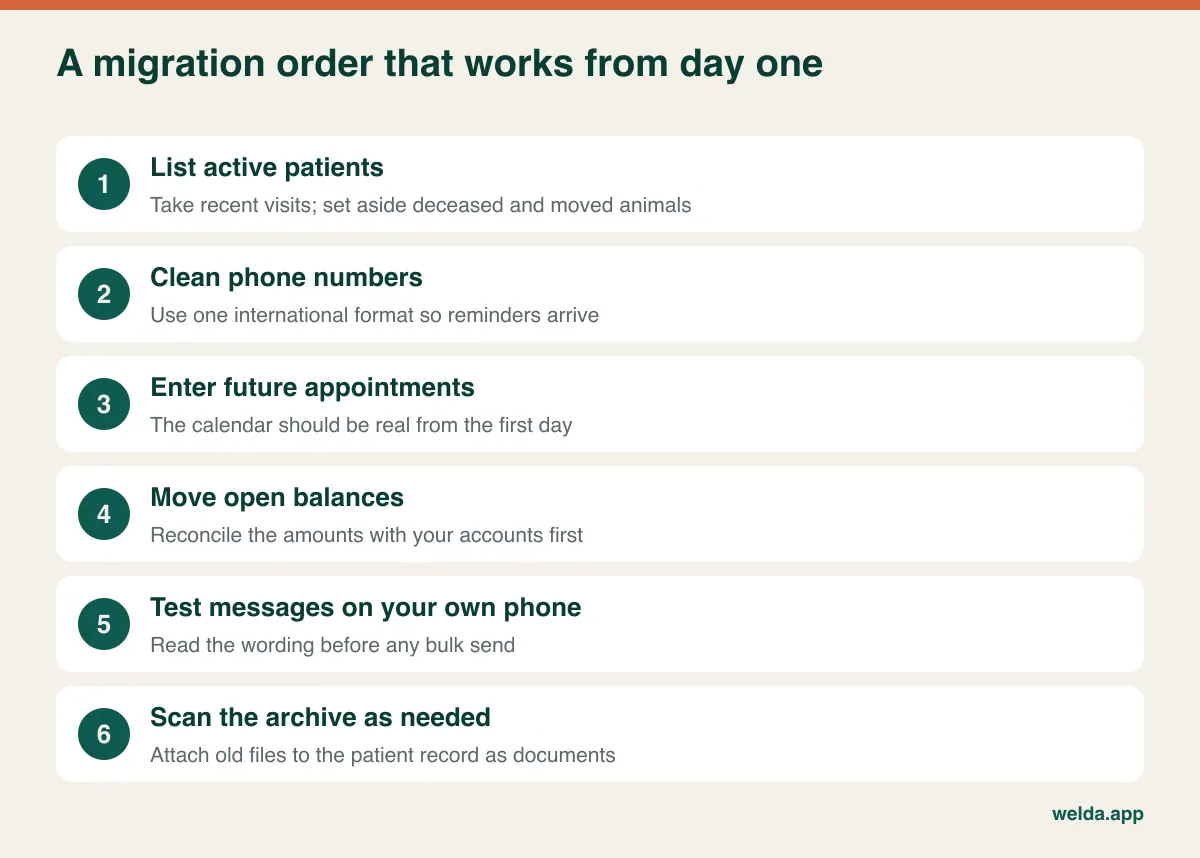
Clean phone numbers into a single international format, otherwise reminders fail silently or reach the wrong person. Merge owners whose names were entered in several spellings. Exclude deceased animals or flag them clearly, and check the list again before your first bulk message goes out; this is the migration error owners remember. Reconcile balances with your accounts before moving them.
With Welda, existing patient and appointment data is transferred during setup, and paper records can be scanned and attached to the relevant patient as documents. Moving from another PIMS is harder than moving from a spreadsheet, so ask any new vendor to show you a sample import of your own data before you sign. Keep the old system read-only for a defined period, then close it. Running two systems indefinitely trains people to trust neither.
Where Welda CRM fits, and where it does not
Welda CRM is not a veterinary hospital system. It is an appointment and client management platform for clinics and service businesses, adapted by sector so that modules and screen terms match your work. As veterinary practice management software for smaller clinics, it fits practices that want each animal on its own record, automatic WhatsApp reminders for rechecks and repeat visits, per-vet calendars without double-booking, and payments and open balances visible on the record. It works in the browser on computers and tablets with no installation, and the interface and message templates are available in English, German and Turkish, which helps in multilingual areas.
It is the wrong choice if you need automatic vaccine protocols and printed vaccine records, device integration with your lab or imaging, inpatient boards, controlled-drug registers, or herd management. For a wider look at running a clinic beyond the software decision, including stock and emergencies, see our veterinary clinic management guide.
If you are between two categories, describe a typical day to us in a free conversation. We will tell you honestly whether it fits, including when it does not. You can review how our veterinary practice management software handles records and reminders on the product page, then try it free for 7 days.
Frequently asked questions
What is the difference between a PIMS and a clinic platform?
A PIMS is built specifically for veterinary work, with species-aware records, vaccine protocols, inpatient and dispensing workflows and often device links. A clinic platform focuses on scheduling, records, communication and billing across health and service businesses, and is adapted by sector.
Does a small practice need a full veterinary system?
Not necessarily. If inpatient care, device integrations and protocol-driven vaccine schedules are not central to your work, a lighter system may do the job. What matters more is that you can export your data and move on if your practice grows.
Can Welda CRM manage vaccination schedules?
There is no separate vaccination schedule module. Vaccines are recorded in the animal's record as notes and documents, and the history is chronological. When you book the next appointment, an automatic WhatsApp reminder goes out.
How do I record several pets for one owner in Welda CRM?
Each animal gets its own patient record with the owner's phone as the contact number. Histories stay separate and reminders go to the owner's number.
How do I stop reminders going out after a pet has died?
Set up a routine: as soon as the loss is reported, cancel the animal's future appointments and mark the record. In appointment-driven systems no reminder fires without an open appointment, but test this in whichever software you choose, using a dummy record.
Should I migrate all my old records?
Usually not at first. Move active patients and future appointments, then scan or import older files as needed. Before destroying any old records, check your local retention requirements.
How much does veterinary practice management software cost?
It depends on users, sites, modules, message volume and migration, so compare quotes line by line rather than by the headline figure. For Welda CRM, the fee is agreed in a free conversation based on your locations, users and modules.