If you are wondering how to choose an ecommerce agency, judge it on three things you can verify yourself: a live store similar to yours where the agency can state exactly what it did, a contract that leaves your domain, ad accounts, customer data and code in your hands, and a written measurement plan that ties results to your order records rather than to the agency's dashboard. A beautiful pitch can't substitute for any of the three, and a plain-looking proposal that has all three deserves a second look.
This guide is for brand owners with money on the line: people launching a first serious store, or running one that has stalled and needing outside help to move it. It won't tell you to look for "passion" or "a good culture fit". It gives you the questions, the clauses and the numbers that separate one proposal from another, and it points out the deals worth walking away from.
First question: who will actually touch your store?
The agency market runs on subcontracting, and there's nothing inherently wrong with that. Plenty of good agencies use trusted specialists. The problem is not knowing. The person who wins the pitch is often a founder or strategist, while your theme may be built by a contractor you never meet, your ads run by a junior account manager and your tracking handled by a white-label partner in another time zone. When something breaks at the start of a sale, the distance between you and the person able to fix it is what matters.
So ask early, and in writing: who designs, who develops, who runs paid media, who owns the relationship? Which of those are employees, freelancers or another agency? What's the working overlap with your hours? If your account manager leaves, what's the handover process? A straight answer such as "we outsource development to a studio we've used for years, and here's how we review its work" is far more reassuring than a vague "we have a global team".
Before you spend time on calls, a short email can do most of the filtering. These five checks take minutes to request and rarely need a meeting.
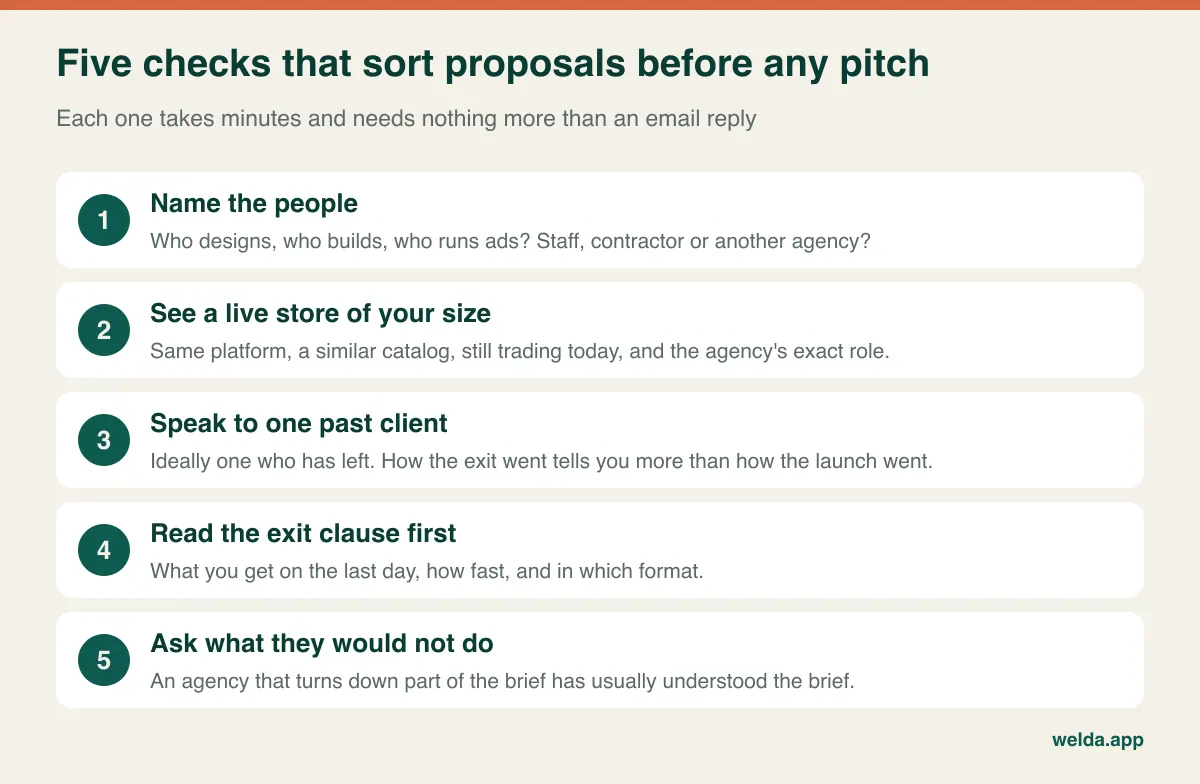
The last check deserves a word. Good agencies say no. If you ask for a redesign, Amazon management, a rebrand and TikTok content, and the reply is an enthusiastic yes to all of it, you may have found a generalist who needs the work. An agency that says "we'd fix your tracking and product data first, and we don't do video in-house" has usually read your brief. And if the job is narrow and one-off, a good freelancer may suit you better than any agency.
Launching and scaling are different purchases
A founder launching a store and a brand scaling one may both search for an ecommerce agency, but they're buying very different things. A launch is mostly a project with an end date: platform choice, catalog structure, checkout, payments, shipping and analytics, followed by a handover. Scaling is an ongoing operating relationship: experiments, ads, SEO, email and merchandising, reviewed month after month. Mixing them up is how people end up on a long retainer for a build, or with a fixed-price project for growth work that never really finishes.
Take a skincare brand with a tested product and a healthy Instagram following but no real store. It needs a tightly scoped build and a clean handover, not a twelve-month growth plan. Now take a homeware store that has traded for three years and can see traffic rising while orders stay flat. Hiring a design agency for a redesign may feel productive, yet the actual problem could be slow mobile pages, poor product data or a broken checkout event that makes the numbers unreliable.
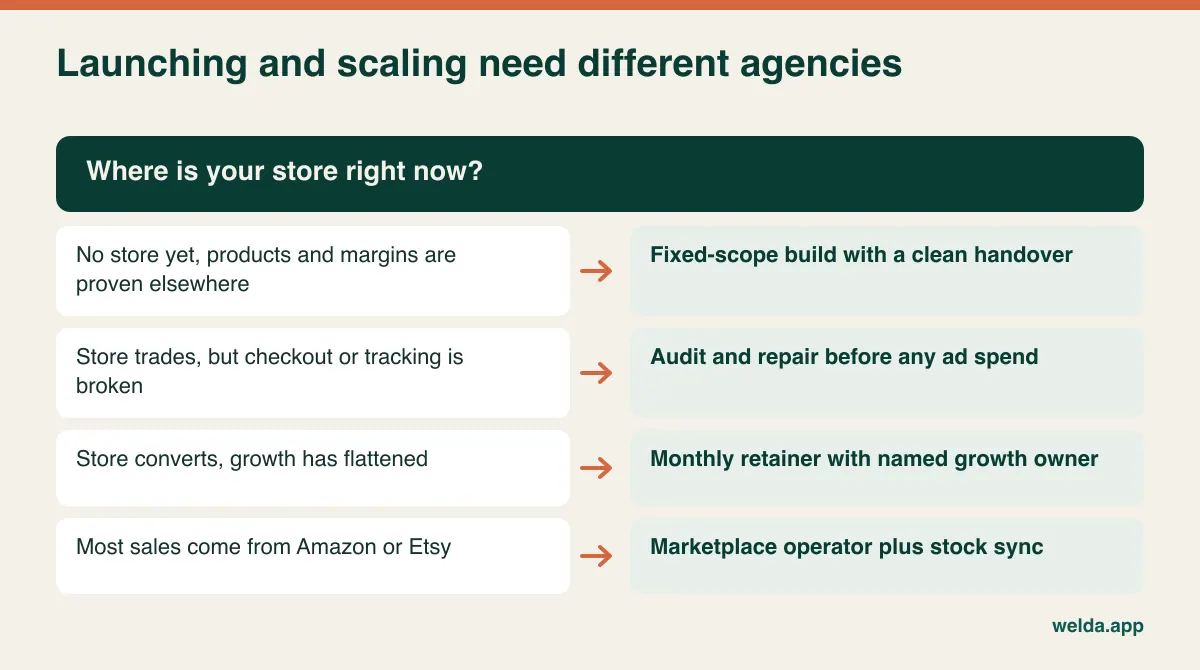
There's also a stage many people skip: the audit. If your store already sells, a paid, tightly scoped audit is a cheap way to test how an agency thinks before you commit to anything long term. You get usable findings whatever happens next, and you discover whether they can explain problems without burying you in screenshots. Be wary if the audit's only recommendation is the agency's largest package. A cost breakdown like the one in our ecommerce website cost guide will help you see which recommendations carry real ongoing expense.
What counts as evidence, and what doesn't
Partner badges tell you that an agency has a relationship with a platform, and depending on the program, that it has met certain criteria. They're worth noting, but they don't tell you whether the agency has solved your problem. Logos are weaker still; a logo might mean one landing page, years ago. Award wins usually reward how a site looks, which is only loosely tied to how it sells.
Stronger evidence is specific and checkable. Ask for three live stores with a similar catalog size, platform and order complexity. Then shop them on your phone over mobile data. Use the search box, apply a filter, pick a variant, add to cart and proceed to the last step before payment. Can you see shipping costs before you get there? Is guest checkout available? Are the return terms easy to find? Do pages jump around as they load? You'll learn more in that half hour than from any capabilities deck.
Then call a client, and try to find one who has left. Clients who are still happy tell you about the good days, but former clients tell you how the agency behaves when the relationship ends. Ask how quickly access was handed over, whether files arrived intact, and whether there were any surprises on the last invoice. Questions like those complement the broader list in our guide on what to ask a web agency.
Finally, treat case-study numbers carefully. A claim that revenue doubled means little without the baseline, the period, the change in ad spend and the effect of seasonality and returns. Ask: "How did you separate your contribution from everything else that happened that year?" A thoughtful agency will discuss limitations honestly. One that takes offence has answered the question in a different way.
The platform choice is also a lock-in choice
Most agencies have a favorite platform, usually the one their team knows best. That's fine, as long as you can tell a recommendation from a habit. Shopify is known for being fast to launch and low on maintenance. WooCommerce is flexible and WordPress-friendly, with full control over hosting and code, which also means someone must own updates and security. Your choice should reflect your product count, variants, markets, marketplaces and how much customization you really need, and an honest agency will be able to explain why its suggestion could be wrong for you.
Look at the recurring stack as well as the build. Ecommerce stores collect subscriptions quietly: a page builder, a reviews app, a subscription tool, a search app, a loyalty program, a shipping connector, an email platform. Each one can be sensible by itself, while together they add cost and slow down pages. Ask for a list of every paid tool the proposal assumes, who holds each account and who will pay for it. Also ask what happens to the store if a given app is uninstalled. Some leave code behind, and some take features your customers rely on with them.
Proprietary frameworks need the sharpest questions. If an agency builds on its own CMS, theme system or "accelerator", you may get a faster launch at the price of a much harder departure. Get an explicit answer on who owns the code, whether another developer can work on it, and how products, customers, orders and URLs can be exported. Add to that list the shipping and payment connections you'd have to rebuild if you ever moved.
The contract, read from the exit backwards
Most owners read a contract from the top: scope, then price, then legal terms they skim. Try reading it from the end instead. Picture the relationship breaking down in month seven, with the holiday season coming. What do you get, how fast, and who has to cooperate? Exit terms tell you a lot about how the agency expects the rest of the relationship to go.
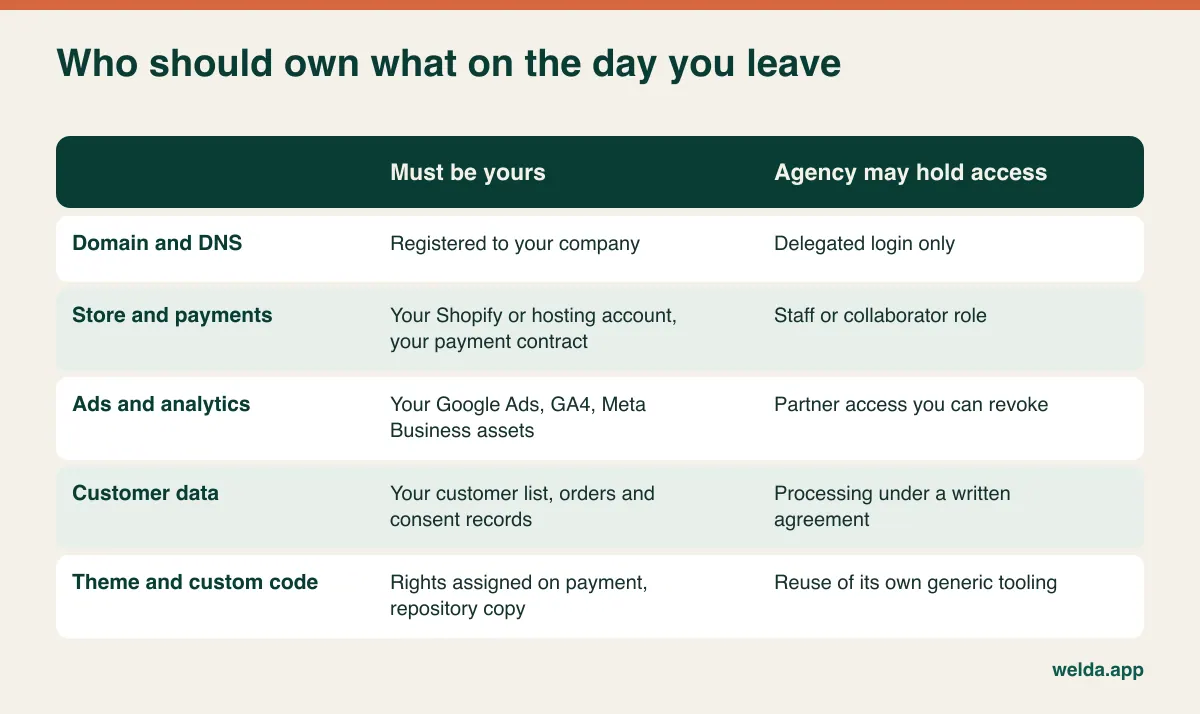
With ownership sorted, the rest of the contract needs to make "done" measurable. A build agreement should list the number of products and variants migrated, templates included, integrations connected, browsers and devices tested, training provided, and who accepts the work. Payment should follow milestones, with a meaningful share held until acceptance. A retainer should state what's delivered each month, how unused hours are treated, how changes are requested and how much notice either side has to give.
Three more clauses earn their keep. The first is an intellectual property assignment: under many legal systems, a creator may keep rights in code and design unless they're assigned in writing, so state that the rights pass to you on payment, excluding the agency's generic tools. The second is a data processing agreement if the agency can see customer data. The third is incident response: when checkout goes down on a Saturday, who is contacted, how, and how soon must they respond? This article is general guidance, not legal advice, and it's worth having a lawyer read anything with a long commitment.
Deals to walk away from (or rewrite)
Some proposals are weak because they leave something out. Others are built in a way that shifts the risk onto you. These are the structures to spot before you sign.
- Guaranteed revenue or rankings. Sales depend on price, product, stock, season and competitors, none of which an agency controls. Promises like these usually come with exclusions you'll only read about later. Commit the agency to work and transparency, not to outcomes it can't deliver.
- Ad accounts in the agency's name. Conversion history and audiences build up in those accounts, and you can lose them when you leave. You also can't confirm what was really spent. Keep the accounts in your company's name and give the agency revocable access.
- Percentage-of-ad-spend fees with no ceiling or review. They reward spending more, whether or not extra spend is profitable. The model isn't wrong in itself, but build in a review point and a way of judging spend on contribution, not revenue.
- Auto-renewing long terms with no performance exit. A minimum term for growth work is reasonable, since results take time. A contract that silently renews and gives you no way out when agreed work isn't being delivered is a different thing.
- One-line scopes. "Full-service ecommerce build" sounds comforting, but it commits nobody to anything. It's also impossible to compare with a detailed quote, and it tends to resolve itself through change requests.
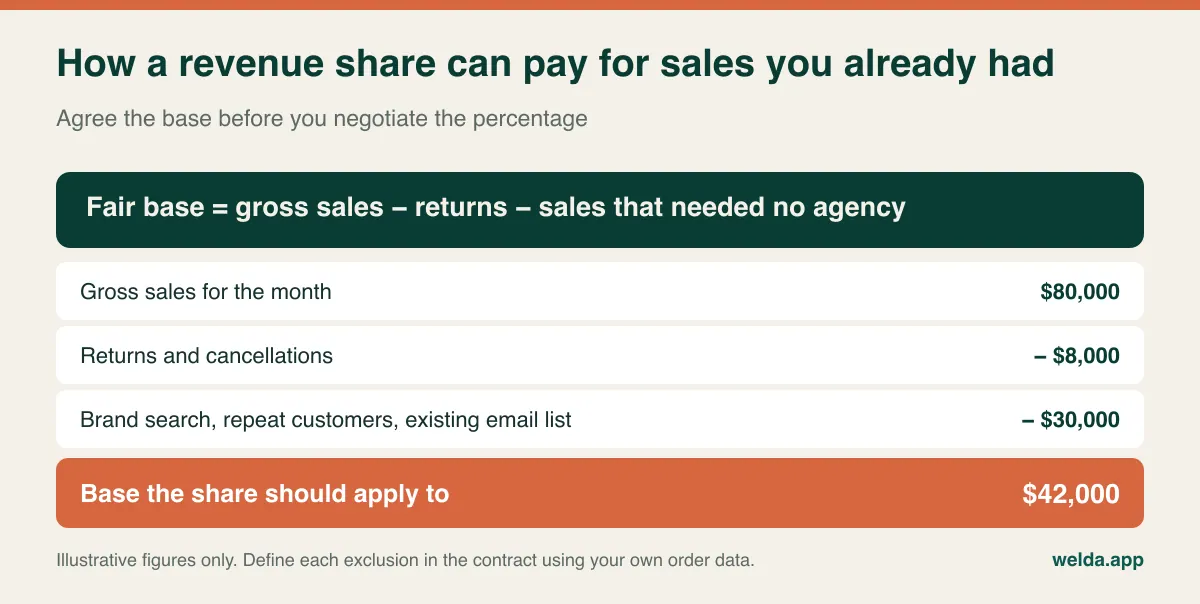
- Revenue share on an undefined base. See the example below.
Revenue share deserves its own attention because it sounds so fair. If an agency only gets paid when you get paid, the incentives look aligned. But the base decides everything. If it's gross sales, you may pay on orders that were later refunded, on customers searching for your brand name, and on people you could have reached with your own email list for next to nothing.
Measurement: agree on the ledger before you agree on the goals
Every monthly report is an argument, and it matters which numbers the argument uses. Ad platforms tend to claim credit generously, and two platforms can each count the same order. GA4 sits in the middle but misses visitors who decline tracking and can be thrown off by faulty setup. Your store's order ledger knows what was actually sold, and your returns data knows what you got to keep. Those sources will never match exactly. A good agency can explain the gap, while a poor one chooses whichever number looks best that month.
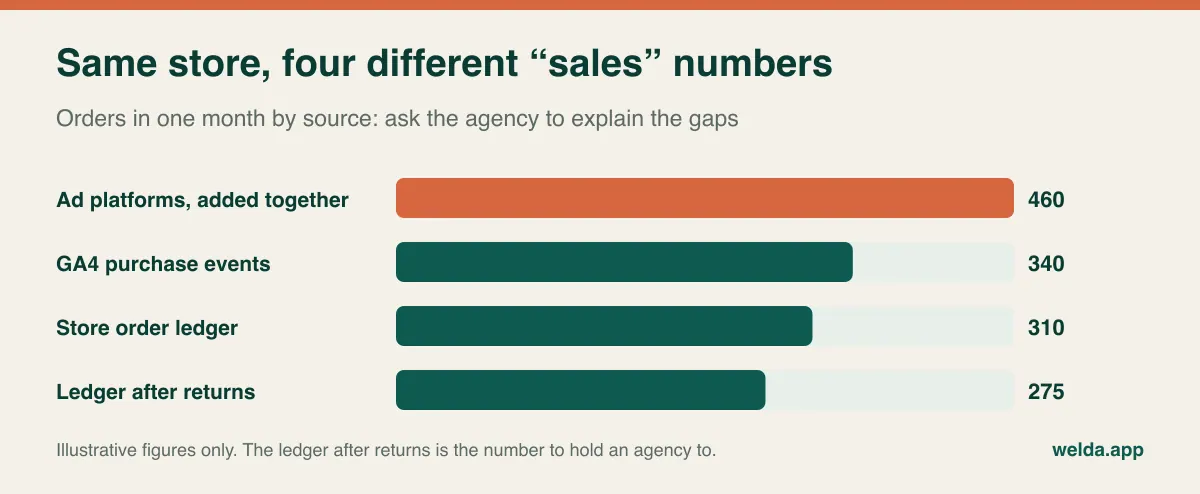
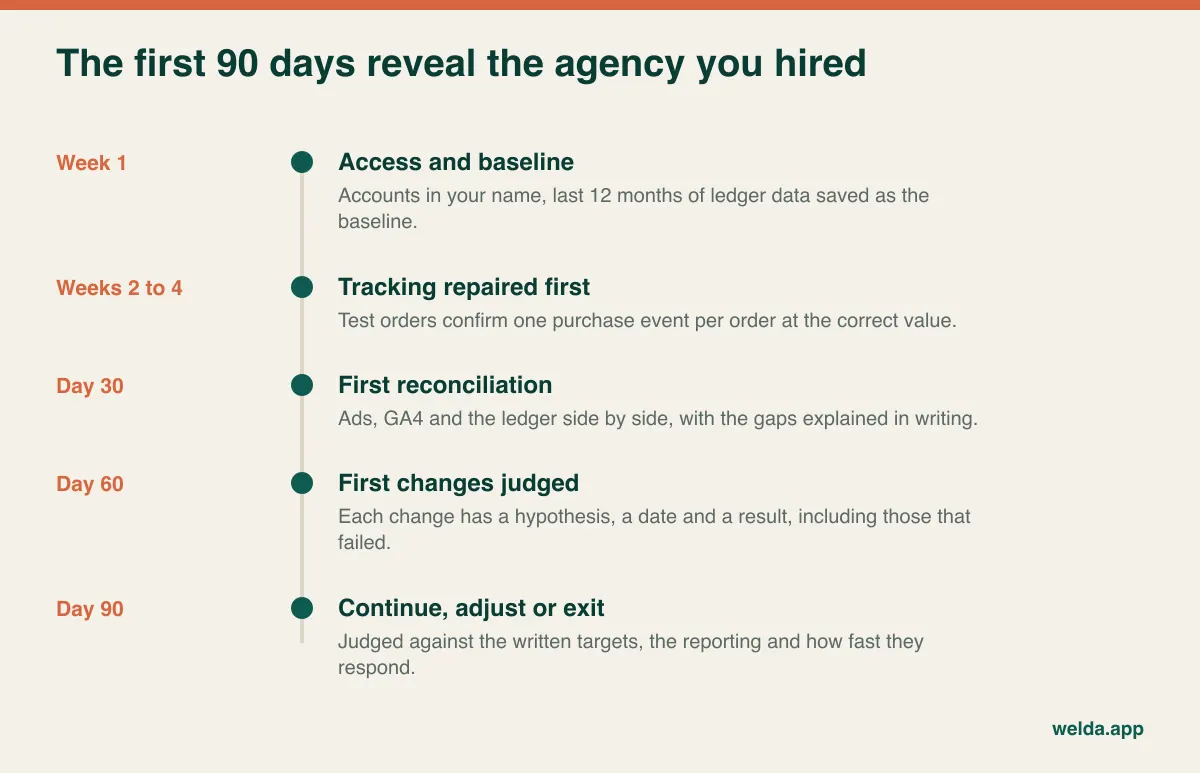
Write down the measurement plan before work begins. It should name the metrics: conversion rate, average order value, checkout completion, cart abandonment, recovered carts, revenue and repeat purchase rate. Add return rate and, if you can share it, contribution margin, because a store can grow revenue while losing money. For every metric, record the source, the starting value, who reports it, and how often. Save twelve months of ledger data as your baseline before the agency makes any change, so nobody can later dispute the starting point.
Then test the setup yourself. Place a real order with a real card, refund it, and check together that exactly one purchase event fired, with the right value and currency, and that the refund appears as you'd expect. If you're running cart-recovery emails, abandon a cart under your own address and see what comes through. Our guide to setting up conversion tracking walks through the details. It isn't glamorous work, but if the tracking is wrong, each later decision rests on a guess.
Ask too for a report format you can actually use. Three questions are enough: what changed, why do we think it changed, and what happens next? Experiments that failed should be listed alongside the ones that worked. Twelve pages of green arrows with no failed tests suggest one of two things: either nothing is really being tested or the bad news is being left out.
If you sell across borders or on marketplaces
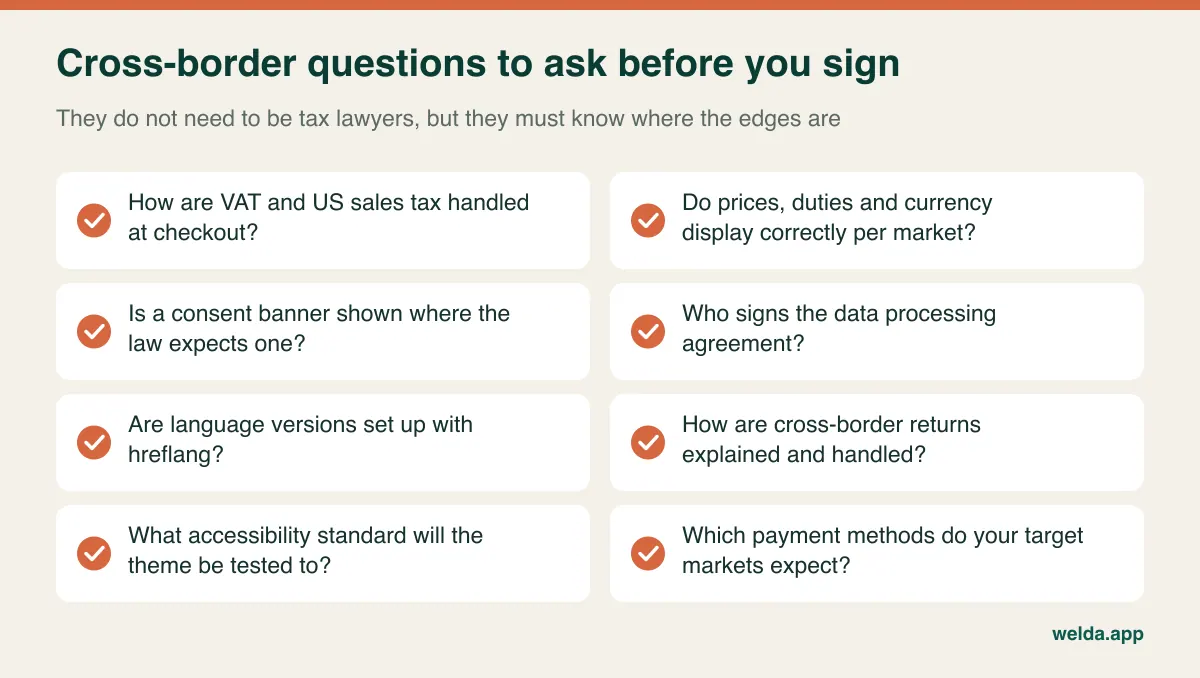
An international store multiplies the questions a local one can ignore. Tax is the first: EU VAT rules, UK VAT and US state sales tax work differently, and your checkout has to display and collect correctly for each market you serve. Privacy comes next: GDPR in Europe, state laws such as California's CCPA in the US, and consent requirements that shape what your tracking can see. Card data should stay with a PCI-compliant payment provider, not on your own systems. Accessibility is a growing issue too, with the European Accessibility Act applying to many online shops and accessibility claims appearing in the US. These obligations vary by company and market, so take specific questions to your accountant or lawyer.
An agency doesn't have to be your tax adviser, but it does need to know where the edges are and tell you when to bring one in. An agency that says "that's fine, everyone does it this way" hasn't helped you.
Marketplaces add a separate operational layer. If you sell on Amazon or Etsy alongside your own store, ask how stock is kept in sync, what happens if the connection fails, who answers customer messages, and whose seller account it is. It has to be yours. Also ask for profit reporting by channel. A marketplace can bring in plenty of revenue and leave little after fees, so a good agency should be willing to tell you when a product doesn't belong there. Our piece on marketplace fees and profitability shows how to work through it.
Scoring proposals so the cheapest doesn't win by default
Proposals arrive in different formats, which makes the total the easiest thing to compare and the least useful. A low quote that leaves out migration, app subscriptions or product data entry isn't cheaper; it just hasn't charged you yet. Send every agency the same one-page brief and the same list of cost lines, and ask them to mark each line as included, excluded with an estimate, or paid by you directly.
The list should include the platform subscription, theme license, paid apps, hosting, payment fees, marketplace connector, email tool, product photography, copy, translation, ad budget, training and ongoing maintenance. Now you can score what's left. The weights below are only an example, so change them to suit your priorities.
| Criterion | Example weight | What earns a high score |
|---|---|---|
| Verified similar work | 25 | Live store checked, client spoken to, role confirmed |
| Ownership and exit terms | 25 | Accounts in your name, handover steps with deadlines |
| Measurement plan | 20 | Metrics, sources, baseline, report format |
| Scope clarity | 15 | Quantities, integrations, training and change process |
| Team and communication | 15 | Named people, working hours, stated response times |
Budget gets no row in this table because it works better as a separate check once you've compared like with like. Agency fees depend mainly on scope, so a real figure can only follow a real scope. At Welda we don't publish fixed prices for this reason; the fee is set in a free consultation once the platform, product count, integrations and management level are clear.
What the first 90 days should look like
You find out who you hired after the contract is signed, which is why the first three months should have checkpoints. Small problems are cheap at this stage. A vague report in month two is easy to raise; twelve months of vague reports isn't. If you're moving an existing store, add redirects and historical order data to the plan, and avoid launching right before your busiest period. Category and product pages that rank today can lose that position in a careless move.
Be realistic about your own part as well. Product data, images, approvals and answers to questions are going to come from you. Ask the agency up front how many hours a week it expects from your side, and who needs to sign off on what. Many late launches are caused by this gap, and an agency that raises it before you sign is already doing part of its job.
Where Welda fits, and where it doesn't
We're an agency, so read this part knowing our interest, and apply the same list to us. If you're working out how to choose an ecommerce agency, our service page shows what we'd put forward: stores on Shopify or WooCommerce, catalog and content work, payment and shipping integrations, Amazon and Etsy connections kept in sync with your store, GA4 Enhanced Ecommerce and Meta Pixel tracking, cart-recovery email and conversion work. Delivery includes admin training and technical documentation. For inventory and point of sale we can connect your existing system, or recommend our own product, Welda Stock, if you want the store, marketplaces and physical sales drawing from one stock pool.
We're probably not the right fit if you need a platform other than those two, a large custom-built commerce application or a deep ERP project. Raise it on the first call and we'll say so. A small one-off fix might not need an agency at all. If you've reached a shortlist and want to compare notes on how to choose an ecommerce agency for your store, book a free consultation. Bring your ownership and measurement questions, and we'll work through scope and price there.
Frequently asked questions
What should I prepare before contacting an ecommerce agency?
A one-page brief with your product and variant count, sales channels, markets, approximate order volume, current systems and a clear statement of the problem you want solved. Add twelve months of order data if you have it. Sending the same brief to everyone is what makes the proposals comparable.
Should I choose a specialist or a full-service agency?
That depends on how many problems you actually have. If one area is clearly holding you back, such as tracking or paid media, a specialist often goes deeper. If you need several connected things done together, one accountable team can reduce the coordination burden. Either way, ask who does the work.
Does the agency need to be in my country?
Not necessarily, but experience of your market matters: payment methods, tax display, language, shipping expectations and consumer rules all vary. Working hours matter as well. If your peak trading falls outside the agency's working day, find out how urgent problems are handled.
How long should an agency contract run?
There's no single right length. Builds should end at acceptance and handover, while growth work needs enough time to test things properly. A reasonable approach is a defined minimum term, a written review at 90 days and clear notice periods. Avoid automatic renewals that are easy to miss.
How can I tell if my current agency is underperforming?
Compare the agreed targets with your order ledger after returns, not with its dashboard. Then look at the process: do reports explain why things changed, are tests documented, and do messages get answered? If you can't verify the numbers or don't own the accounts, fix that first.
Can I switch agencies without losing my data?
Usually, provided the accounts are in your name. Check ownership of the domain, store, payment contract, ad accounts and analytics before you announce anything, then read the handover clause. Keep exports of products, customers and orders, and revoke access only once the new team has confirmed everything works.