Cross-border ecommerce website development is not a matter of adding a language switcher to your existing store. It means building a sales line that lets a buyer in another country understand the product, pay in a familiar way and receive the parcel without a surprise bill. Four decisions set the scope and most of the budget: which languages, which currencies, which payment methods and which shipping arrangement. For a producer selling abroad for the first time, the sensible starting point is usually one market, one language and one currency, on top of a product catalogue already structured for more.
This guide is for manufacturers and makers who are close to commissioning a build. It works through what each decision adds to the project, what can safely wait, and how to read proposals that look identical but describe very different work. If you still want the wider picture of customs, markets and channels first, start with our cross-border e-commerce guide. Here, the focus is the website itself and the sequence of investment.
Four decisions that define the build
Quotes for an international store often differ widely, and part of that gap comes from assumptions rather than labour. One agency hears “multi-language” and pictures the same pages in two languages. Another hears it and scopes market-specific price lists, tax logic and carrier rates. Both proposals carry the same headline. They do not describe the same job.
Before you talk to anyone, write down where you sit on each decision. Language is not only a count: who writes the copy, who checks it, and does each market get its own URL? Currency splits into what the screen shows and what lands in your bank account. Payments begin with which providers will accept your company at all. Shipping runs from the rate table through customs paperwork to the route a return takes back.
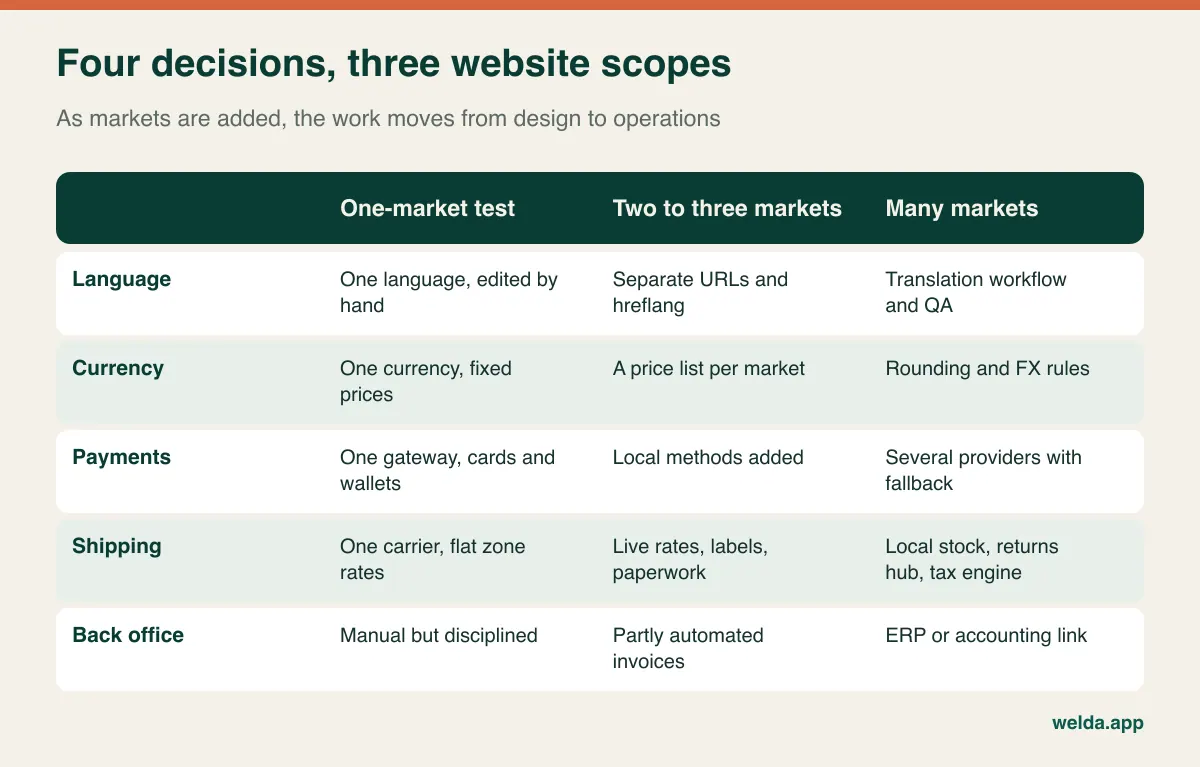
Most producers do well to prepare for the middle column and launch with the left one. The right column rarely pays for itself until repeat sales exist in several countries. Build it before you know where your buyers are, and you are funding machinery with nothing to run through it.
Follow one order across a border
The fastest way to scope an international store is to walk a single order through it on paper. Take a hypothetical example: a small ceramics maker in Portugal sells a boxed tableware set to a customer in the United Kingdom.
The customer finds a product page written for a British reader, with dimensions and care notes they can act on. The price appears in pounds. At checkout, the address form accepts a UK postcode and does not demand a state. The shipping line and any tax or duty treatment are clear before payment. The card is authenticated, the money settles in the seller's currency after a conversion, and an invoice is issued. A label is printed with the commodity code, origin, weight and declared value. The buyer gets tracking in English. Two weeks later a plate arrives chipped, and the customer wants a refund.
Every sentence in that story is a line of scope. If your proposal does not say who handles it, you are the one handling it. Mapping this for your own product also shows up the issues that a feature list conceals. A breakable item changes your packaging and refund policy. A bulky one may make shipping the deciding factor. A cosmetic or a children's product may raise compliance questions before a single page is designed.
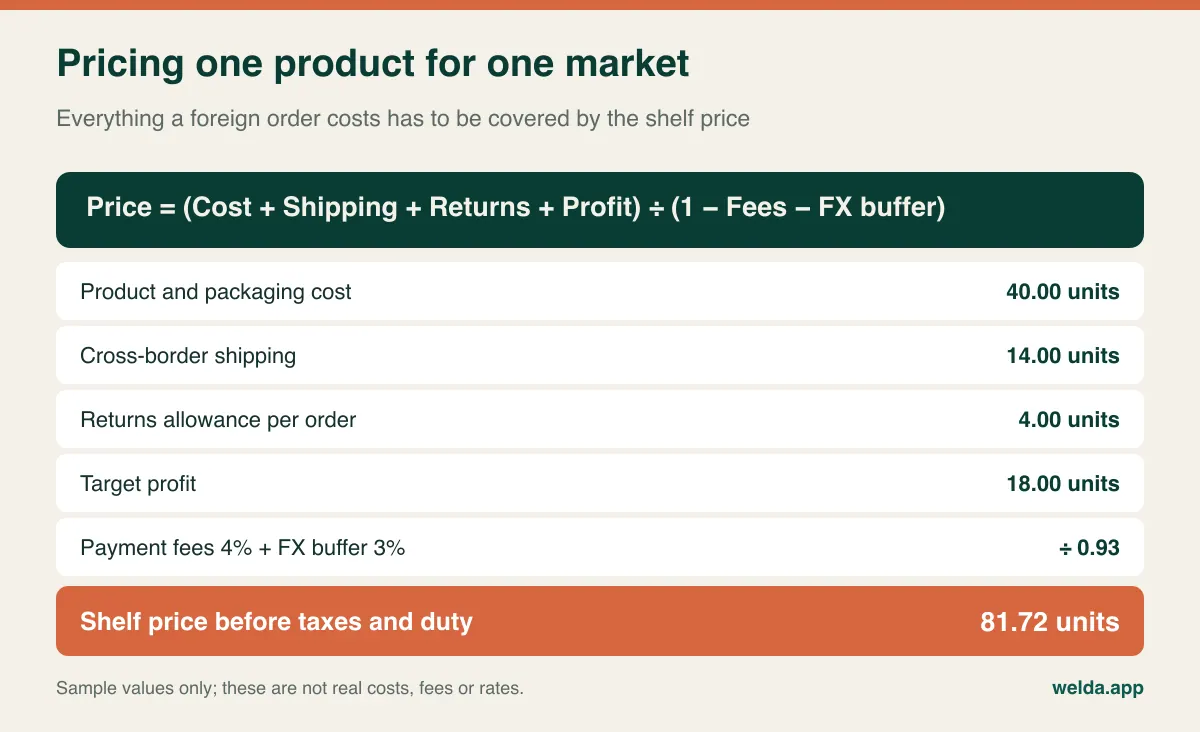
Then price the story. The formula below forces out the costs that a domestic price converted at today's exchange rate tends to ignore.
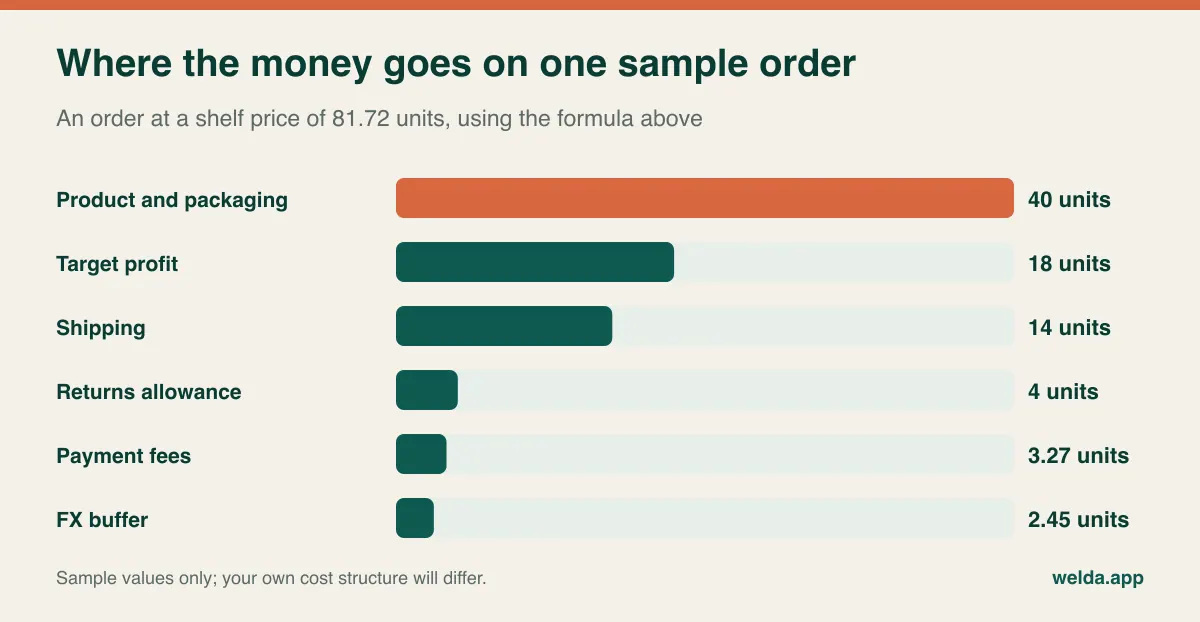
Seen as a share of the sale, the gaps become easier to discuss with your team. Product cost dominates, but shipping, returns, fees and currency together often decide whether the market is worth entering.
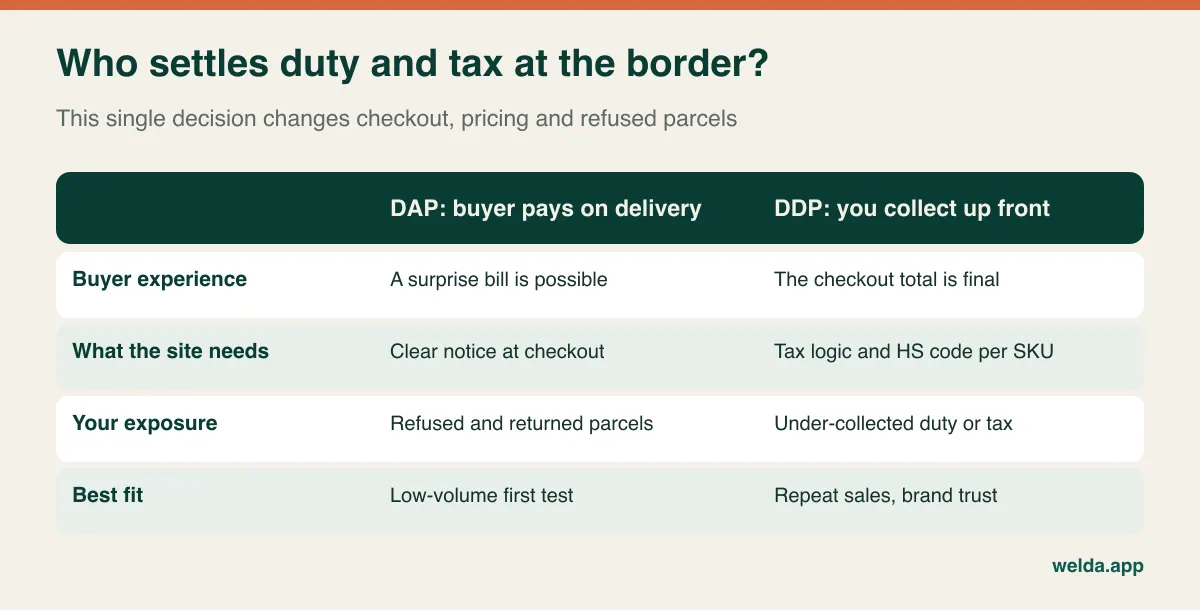
Who pays duty and tax at the border?
This is the decision most often left out of website briefs, and it reshapes the checkout. Under DAP (delivered at place), the buyer settles any duty and import tax on delivery. The store is simpler, but a customer asked for an unexpected payment by a courier may refuse the parcel, leaving you with return freight. Under DDP (delivered duty paid), the amount at checkout is final, because you collect those charges and pay them through your carrier or a service. That gives a cleaner experience, at the price of accurate data per SKU and the risk of under-collecting.
Rules for low-value parcels are also moving targets. The EU has its Import One-Stop Shop (IOSS) arrangement for lower-value consignments and is reshaping how those imports are treated. The UK requires VAT handling on low-value consignments in many cases, and US rules on low-value parcels changed substantially in 2025. Canada, Australia and others have their own regimes. Treat any line saying “no tax under this amount” in an older article as a question for your carrier or customs adviser, not an answer. The site should allow these settings to change without a rebuild, which is worth raising directly with whoever builds it.
Returns need the same forethought. Consumers in the EU and UK generally have a statutory right to withdraw from a distance purchase, so a returns policy that works only in your home market may not hold up. For low-value goods, a refund or replacement without collecting the item can cost less than freight. For high-value goods, a local returns address may be justified. Our guide to ecommerce shipping and returns covers how to turn these choices into a working policy.
Language: localising is more than translating
A translated store can be grammatically perfect and still fail to sell. Buyers in the US search for a “comforter”, in the UK for a “duvet”. Sizes may need inches and pounds as well as centimetres and kilograms. Address forms vary by country; many have no state field, while some expect a postcode first. Dates, decimal marks and even the order of names can read as wrong. None of this is covered if you simply hand your pages to a translator.
Keyword research has to happen for each language, because the terms people use rarely map neatly from your home language. Machine translation can help draft high-volume catalogue text, but product titles, category pages and checkout microcopy deserve human review by someone who actually knows that market.
There is also an honest test for how many languages to launch with: can you answer a customer message in that language within a reasonable time? Publishing in German and then answering a complaint three days later through a translation tool sets a promise your operation cannot keep. One foreign language done properly typically beats four done poorly. For a fuller way to weigh it, see when you really need a multilingual website.
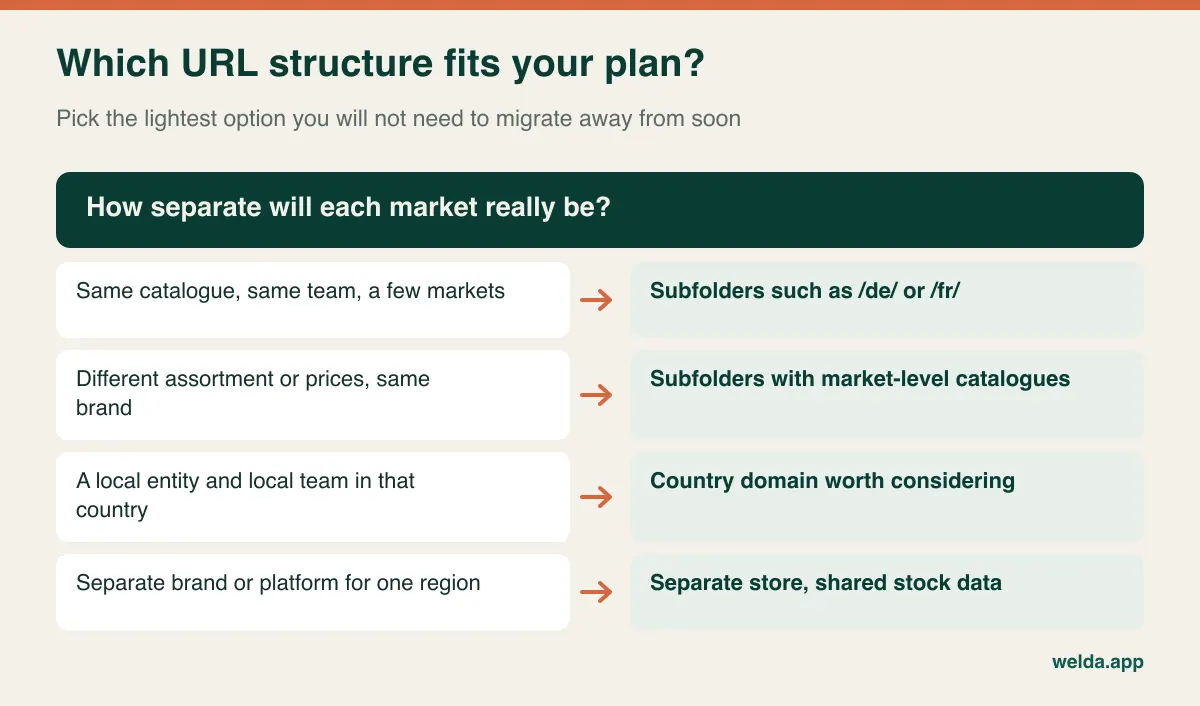
Two technical choices are hard to reverse, so settle them early. The first is URL structure, shown above. The second is hreflang, the annotation that tells search engines which page is meant for which language and region; its setup is fiddly, and our hreflang guide walks through it. Avoid forcing visitors to a version purely by IP address, too. Suggesting a market and letting them choose is friendlier to people travelling abroad, and safer for search engines crawling your pages.
Currency: showing a price and collecting it are separate jobs
There are roughly three levels here. At the first, prices are only converted for display, and the card is charged in your home currency; the buyer's bank applies its own rate, so the statement does not match the page. At the second, the buyer truly pays in their currency and the provider converts it for you, usually with a margin built into the rate. At the third, you hold and settle in that currency, which requires the right accounts and provider support. Ask which level a proposal actually delivers, because “multi-currency” can describe any of them.
Then decide how prices are set. Automatic conversion is effortless, but produces awkward figures that shift day to day. A fixed price list per market takes more upkeep and gives you clean, deliberate numbers and predictable campaigns. With a small catalogue, a fixed list is often the tidier start. Whichever you use, decide how often it gets reviewed, especially if your costs and revenue sit in different currencies. A tiny-looking FX spread on every order is still a real cost, and it should appear in your model next to the payment fee.
Payments: a provider has to accept you first
Before comparing checkouts, check eligibility. Global payment providers do not support every country of incorporation or every product category in the same way, and restrictions change. Confirm in writing which currencies you can accept and settle, which card-issuing countries are allowed, how quickly funds arrive, and what reserve or rolling hold might apply. A proposal built around a provider that later declines your company costs months.
Next comes local habit. Cards and major wallets give a solid base in many markets, but iDEAL in the Netherlands, Bancontact in Belgium, BLIK in Poland, buy-now-pay-later options in several countries, and invoice purchase in Germany can matter to a given buyer. Adding a method is often small technically and larger contractually: fees, risk and refund flow all differ. Start with what your first market expects, and measure before adding more.
You also have a structural option. A standard payment gateway leaves you as the seller of record, responsible for taxes and compliance. A merchant-of-record service takes on the sale itself, along with much of the tax handling, in exchange for a higher cut and less control. It tends to suit digital goods and some small physical catalogues; it suits producers with custom logistics less often. Ask about it rather than assuming either way. And plan for disputes: when a foreign buyer contests a charge, you will need delivery proof and correspondence, so linking orders to tracking data quietly protects revenue. Strong customer authentication rules in Europe also mean that 3-D Secure has to be tested properly with real cards from the target market.
Your catalogue is where producers lose months
This is the least glamorous part of an international build and frequently the slowest. Domestic stores usually hold a name, a price, a photo and a stock number. Selling abroad requires a much richer record for each item, and retrofitting it later means going through the catalogue line by line.
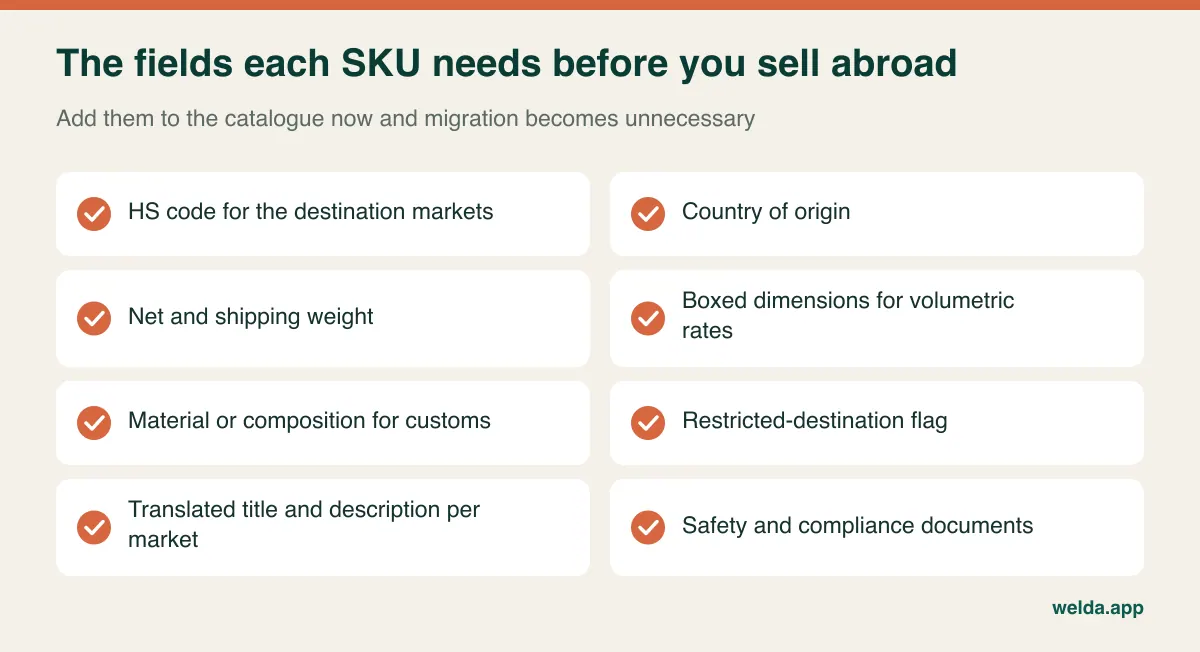
Manufacturers carry some further complications. Lead times differ between stocked and made-to-order items, and a storefront that presents everything as ready to ship creates promises the factory cannot keep. Consumer and trade buyers may arrive at the same site: a retail checkout for one and an enquiry form with quantity and terms for the other can be enough at the start, whereas account-based wholesale pricing is a different project and should be scoped as such.
There is the stock question too. Once one item appears on your own store, on Amazon or Etsy and in a physical shop or factory outlet, keeping separate counts invites overselling. Cancelling an international order is more expensive than cancelling a domestic one, in reputation if not in freight. Sharing a single stock pool across every channel, or at least syncing regularly, is what prevents it.
Choosing a platform without overbuying
Platform debates can eat weeks, so frame them around your own constraints. Shopify tends to be quick to launch and low-maintenance, with cross-border tooling available through its own features and app ecosystem. WooCommerce offers flexibility and full control over hosting and code, while language, currency and tax capabilities are typically assembled from plugins that someone has to maintain. A custom build is justified mainly when your pricing, logistics or product configuration genuinely cannot fit either.
Compare them against the following questions instead of a feature grid: Which payment providers can you actually use in your country? How are languages and market prices managed day to day? What is the annual total of platform fees, apps, plugins and transaction charges at your expected volume? How would you move away if you needed to? Ask each vendor to verify current capabilities, because they do change.
Compliance by destination: the short list to take to an adviser
This is a general orientation, not legal or tax advice. Rules vary and change, and a qualified adviser in the relevant market should confirm what applies. The aim here is to flag items that influence website scope.
- Privacy and consent. GDPR in the EU and its UK counterpart, and state privacy laws such as California's in the US, affect analytics, cookie banners, marketing email and the data you pass to providers.
- Consumer rights. Withdrawal rights, mandatory pre-contract information, and clear total pricing all shape the product page and checkout.
- Product safety. The EU's General Product Safety Regulation expects certain product and manufacturer details in listings and, for sellers outside the EU, may require a responsible person in the Union. Toys, electrical goods, cosmetics and food can carry extra rules elsewhere as well.
- Tax registration. VAT or sales tax can be triggered in the buyer's country, and US economic nexus thresholds work state by state.
- Packaging and producer duties. Several European countries require registration for packaging or electronics, for example Germany's packaging register.
- Accessibility. The European Accessibility Act covers many consumer ecommerce services, with exemptions for some very small businesses; it is worth checking and is cheaper to design in at the start.
A site cannot make you compliant on its own, but it can make compliance impossible if the fields, pages and consent flows are missing. Ask for them to be included in the plan.
What to fund, and in what order
The principle is simple: pay for each layer when a real signal justifies it. Anything that is expensive to change later belongs in the first phase, namely clean product data, a structure ready to take more languages, and proper measurement. Anything that can be added later can wait: an extra language, another payment method, full shipping automation, market-specific campaign pages.
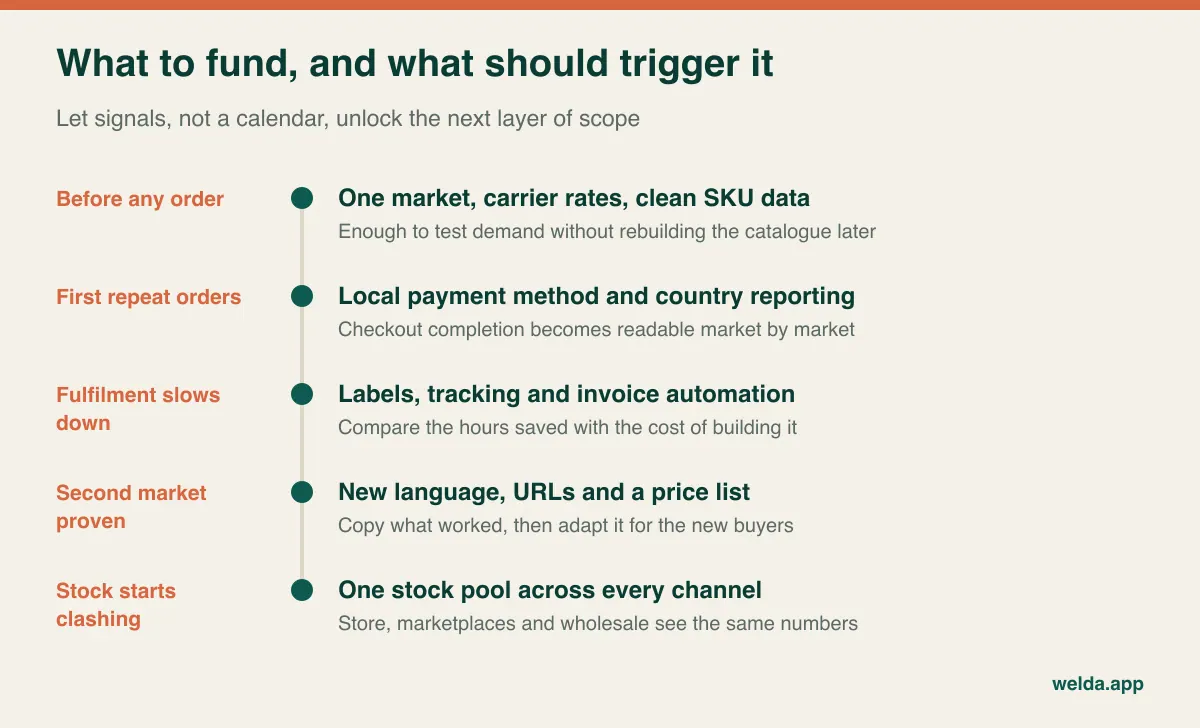
Choosing the first market works the same way. Existing evidence beats ambition: orders or wholesale enquiries already received, country-level sales on a marketplace, organic search traffic from a specific country. When none of those exist, a marketplace trial or a small ad test may be a better first step than a store of your own.
Keep some budget back for traffic. In a new country, nobody knows your brand and a finished website will not attract visitors by itself. Spending everything on the build and nothing on launch is one of the most avoidable ways to conclude, incorrectly, that a market does not work.
After launch, read results by country rather than in total. Checkout completion in each market tells you far more than overall revenue. A drop between adding to cart and completing payment usually points toward shipping cost, delivery time, tax surprises or a missing payment method, not design. Without country-level GA4 ecommerce reporting you cannot tell which decision is failing.
Reading proposals side by side
Put each proposal into the same grid, and mark every line “included”, “excluded” or “extra”. A line nobody mentions is usually the costly one, because it comes up after work has begun.
| Scope line | What to pin down |
|---|---|
| Languages | How many, who translates, who reviews, how future languages are added |
| Currencies and prices | Display or real settlement; fixed lists or automatic conversion |
| Payments | Named providers, named methods, eligibility verified |
| Shipping | Rates, labels, tracking, customs data, duties at checkout |
| Catalogue | Who enters HS codes, weights, origin; how bulk edits work |
| Legal pages | Who writes them, who only places them |
| Running costs | Platform, apps, plugins, transaction fees, who owns each account |
| After launch | Who updates the site when tax or carrier rules change |
Hidden costs tend to come from three places. Subscriptions for language, currency, tax and shipping apps can stack up without appearing in a build quote. Transaction costs include payment fees, FX spread, platform fees and refund charges. Maintenance covers updates, plus the unavoidable rule changes in each market. Ask for a total first-year and an ongoing annual view, not a single build figure.
Useful questions for the first call: Which provider would you use for a company like ours, and how do we verify it? How much work is the next language, and how is it counted? Where do customs fields live in the admin? Who tests hreflang, and how will you show us the result? Who owns the store, the domain and the payment accounts?
Where Welda fits, and where it doesn't
Our cross-border ecommerce website development work starts with discovery: your products, channels, target markets and budget, followed by a shared decision on platform and scope. We build mobile-first stores on Shopify or WooCommerce, structure the catalogue and content, connect payment and shipping integrations, and set up Amazon and Etsy so that products, prices, stock and orders stay in sync with your store. Measurement runs through GA4 Enhanced Ecommerce and the Meta Pixel, with email automation for abandoned carts. If you want one stock pool across store, marketplaces and physical sales, our own product Welda Stock can handle that, though we can also integrate with your existing inventory system.
Some limits are worth stating. Multi-language and multi-currency setups are not sold as a fixed package on our service page; they are scoped in discovery according to your markets, platform and payment provider. Customs brokerage, tax advice and legal counsel are not among the services we list, so HS classification, tax registrations and the legal accuracy of your terms should stay with qualified specialists. Our part is making sure those decisions are reflected correctly in the store. Whether a payment provider accepts your company is ultimately that provider's call, which is why we suggest checking it early.
We don't publish fixed prices, because the fee depends on platform, catalogue size, integrations and management level. If you have a target country, a product list and a sense of your shipping costs, a free consultation about cross-border ecommerce website development can turn them into a defined scope and quote. If you are not there yet, the same call can establish whether your next step should be a store or a marketplace test.
Frequently asked questions
Can I extend my existing store, or do I need a new one?
Often you can extend it. Clean product data and a flexible platform make adding languages and markets reasonable. A store tightly tied to domestic payment and courier arrangements may be cleaner to rebuild or run separately. A short audit of the current setup usually settles it.
How many languages should I launch with?
One foreign language is usually enough to begin, as long as your first market is clear. English reaches some markets on its own, but if Germany or France is the real target, its own language is likely the stronger choice. The limiting factor is whether you can support customers in that language.
Do I need a separate domain for each country?
Not usually at the start. Subfolders on one domain are simpler to run and keep your site's authority together. Country domains begin to make sense when a local entity, team, assortment or legal reason sets that market apart.
What determines the cost of a cross-border store?
The main factors are catalogue size, number of languages and markets, payment and shipping integrations, content and translation, platform and app subscriptions, and post-launch support. Exact pricing for your project is settled after a free consultation, because those inputs vary so much.
Do I need to register for VAT in every country I ship to?
Not necessarily, but the answer depends on destination, thresholds, whether you sell to consumers or businesses, and any schemes you use. Rules differ between the EU, UK, US states and elsewhere, and they change. Take your market list to a tax adviser before finalising prices and checkout.
Should I sell on Amazon or Etsy first, or build my own site?
A marketplace is a strong way to validate demand with less upfront work. Your own site becomes attractive when you want customer data, brand control, wholesale enquiries or lower dependence on marketplace fees. Many producers end up doing both from the same stock pool.
How do I know whether a new market is working?
Look at country-level checkout completion, repeat purchases, return rates and contribution margin after shipping and fees. Total revenue alone can hide a market that sells well and earns nothing. Give the test enough orders to read before you decide, and change one variable at a time when possible.