Good beauty ecommerce website design starts with your catalog and your returns rules, not with a moodboard. Before you brief anyone, decide how shades, sizes and bundles will be modelled, what information every product page must carry, and what happens when an opened jar comes back. Those three answers determine the scope, the platform and which provider is actually right for you. Without them, proposals look alike, can't be compared, and the difficult parts of selling cosmetics turn up later as change requests.
This guide is for founders selling their own beauty brand online, whether you formulate in-house or work with a contract manufacturer or private-label lab. It won't tell you what a site should cost, because that depends on decisions you haven't made yet. It will help you make those decisions, read a proposal line by line and test a provider on your real product instead of their portfolio.
The problem a beauty site solves that a T-shirt shop doesn't
When someone buys a T-shirt online, the worst case is the wrong size. When someone buys a serum, they can't smell it, feel the texture, test the shade against their wrist or ask whether it will react with the retinol they already use. In a department store, a trained consultant handles all of that in ten minutes. On your site, the product page has to do that job alone, at midnight, on a phone.
A new brand carries an extra burden. The shopper isn't just buying a product; they're deciding whether to put something from an unfamiliar company on their face. They want to know what's in it, who makes it, whether it's compliant and who answers if something goes wrong. A generic store theme gives you one description box and leaves all of that to you. In practice, much of the difference between a beauty site that works and one that merely looks good comes down to how much of that consultant's knowledge has been turned into structure.
So the useful question for a kickoff isn't "can you make it feel premium?" Most designers can. The useful question is: where does each answer the consultant would give live on this site, and who keeps it up to date?
Model your catalog before anyone opens Figma
Variants are where beauty sites quietly get expensive. A lipstick range in twelve shades isn't just twelve stock lines. It's twelve swatches, application photos on different skin tones, a rule for what happens when a shade sells out and often a request to suggest the nearest alternative. How you split products from variants affects stock accuracy, where reviews accumulate and which pages can rank.
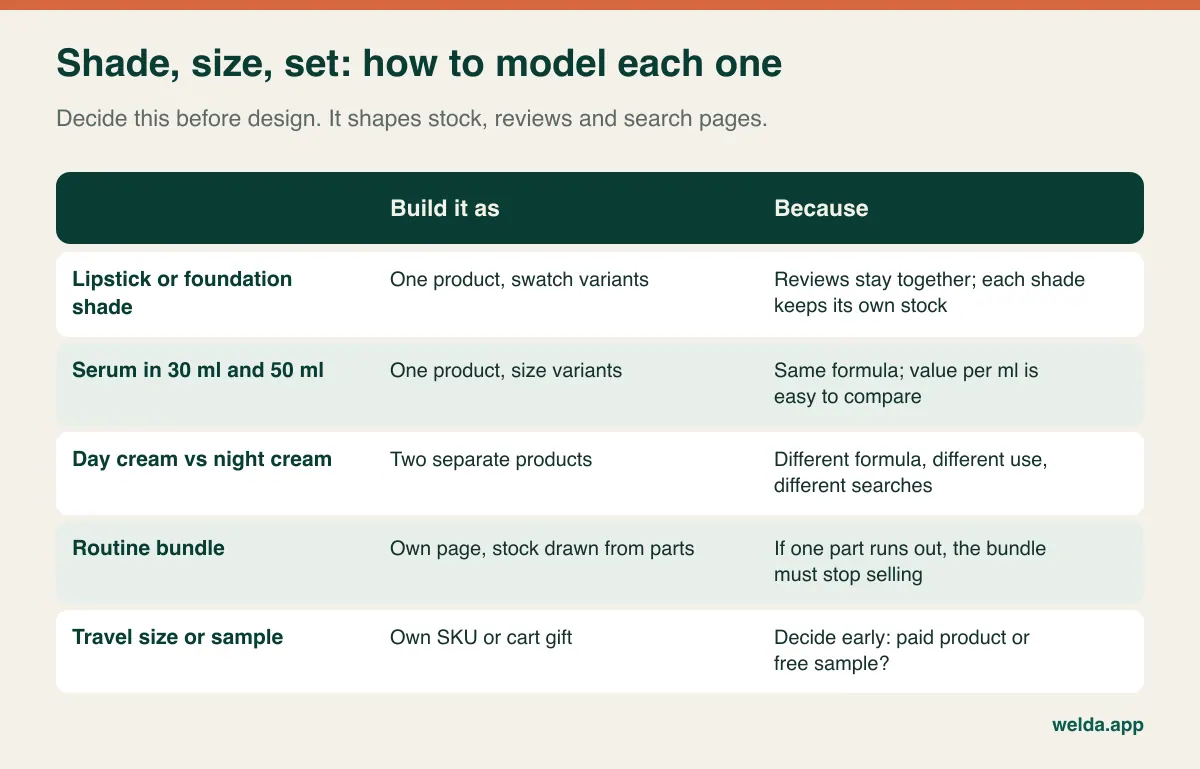
Bundles hide the nastiest trap. Say you sell a three-step "Winter Routine" and the toner sells out. If the bundle is its own stock item, the store keeps taking orders, and next morning you're emailing customers to apologize. The right behaviour is for bundle availability to derive from its components. Depending on the platform this may be built in, need an app or need custom work, so describe this exact scenario to a provider and ask how they would solve it.
Shade imagery deserves its own budget line. Screens render colour differently, and one shade reads differently on light and deep skin. Application shots on a range of skin tones are the most direct way to reduce wrong-shade disappointment. Run the arithmetic early: as an example, twelve shades with three application shots each is thirty-six images, all of which need to be compressed well enough that the page still loads quickly on mobile. If your traffic comes from Instagram or TikTok, that's the context nearly all your first visitors will see it in.
For the stock logic behind this, our guide to product variant management covers SKU structure in more depth. If you also run a physical counter, choosing cosmetics store inventory software looks at the same problem from the retail side.
What goes on the page: turning skin questions into fields
The key difference between a beauty product page and a general one is consistency. A shopper comparing three serums wants to find the active ingredient in the same spot each time. If the information is buried in free text, comparison gets harder and filtering becomes close to impossible: a "suits sensitive skin" filter only works if that fact was entered as data.
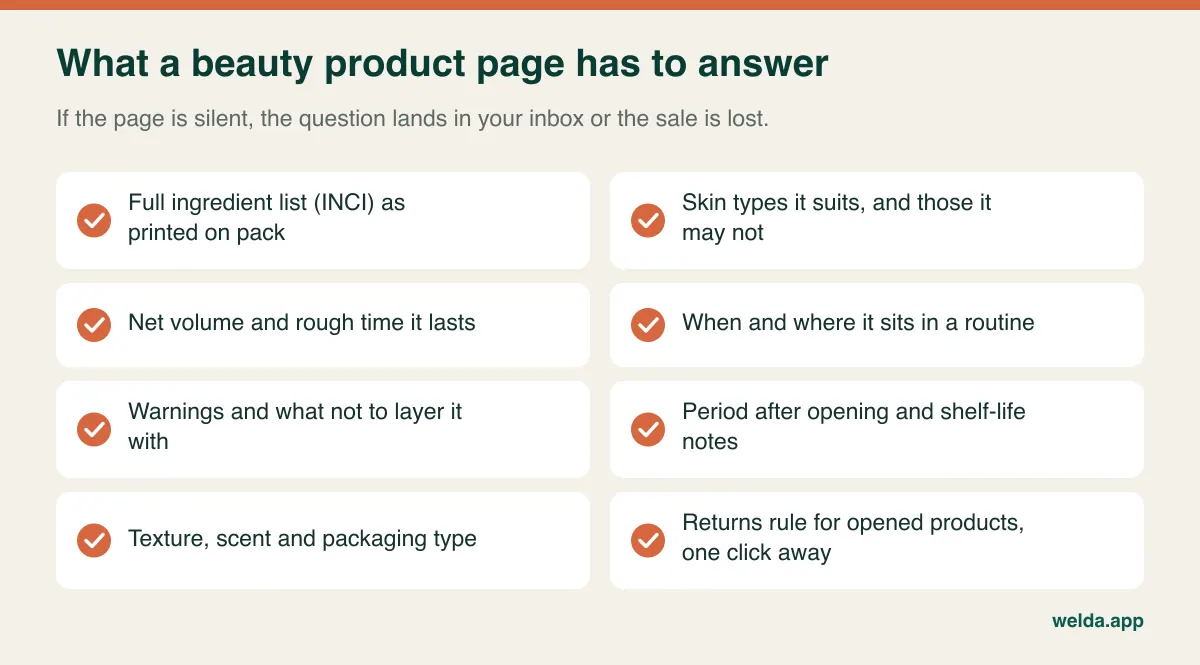
In scope terms, this is custom fields work. Ask each provider: will these be separate fields in the admin, displayed the same way on every product, or will someone type them into the description? The second is cheaper on day one. Fifty products later, the pages no longer match and every change means hunting through them one at a time.
Here's a typical situation. Your lab tweaks a formula, so the label and the INCI list change. With structured data you edit once. With text scattered around, the old list survives on a category page, an Etsy listing and last season's campaign page. In cosmetics, a mismatch between label and website isn't just untidy; it means giving people wrong information about what goes on their skin.
Claims need the same care. Words like "heals", "treats acne" or "cures" can push a product out of the cosmetics category in many jurisdictions and create problems with advertising regulators. Before-and-after photos raise similar questions. A good web partner should flag risky wording when they see it, but the decision and responsibility stay with you and your regulatory adviser. For the writing itself, see our guide to writing product descriptions.
Category structure follows the same logic. A general store sorts by product type: cream, serum, toner. Beauty shoppers often arrive with a concern (dryness, sensitivity, dark spots) or an ingredient they've read about (niacinamide, retinol, vitamin C). A twelve-product brand doesn't need a mega menu; shop by type, shop by concern and a "build your routine" page are plenty. The scope question is whether those are simple filtered lists or content pages built to rank. The second is a real content job and won't appear in a proposal unless you ask. Realistically, a new brand won't outrank major retailers for "best moisturizer", but narrower questions around one ingredient or one routine step can be within reach.
An opened jar comes back. Now what?
In apparel, a return is a logistics issue: it comes back, gets checked and goes back on the shelf. An opened cosmetic generally can't be resold. So your returns policy isn't a page of legal text in the footer; it's a decision that shapes the product page, the packaging, the admin workflow and your support scripts.
Consumer rights vary a lot. In the EU, the distance-selling withdrawal right has an exception for sealed goods that aren't suitable for return for health or hygiene reasons once unsealed. Other markets work differently, and many brands choose a more generous policy than the law requires as a trust signal. If you lean on a hygiene exception, you generally need two things: real tamper evidence on the pack (a seal, a shrink band, an inner liner) and clear wording the customer sees before buying. Have a qualified adviser check your wording for each country you sell to.
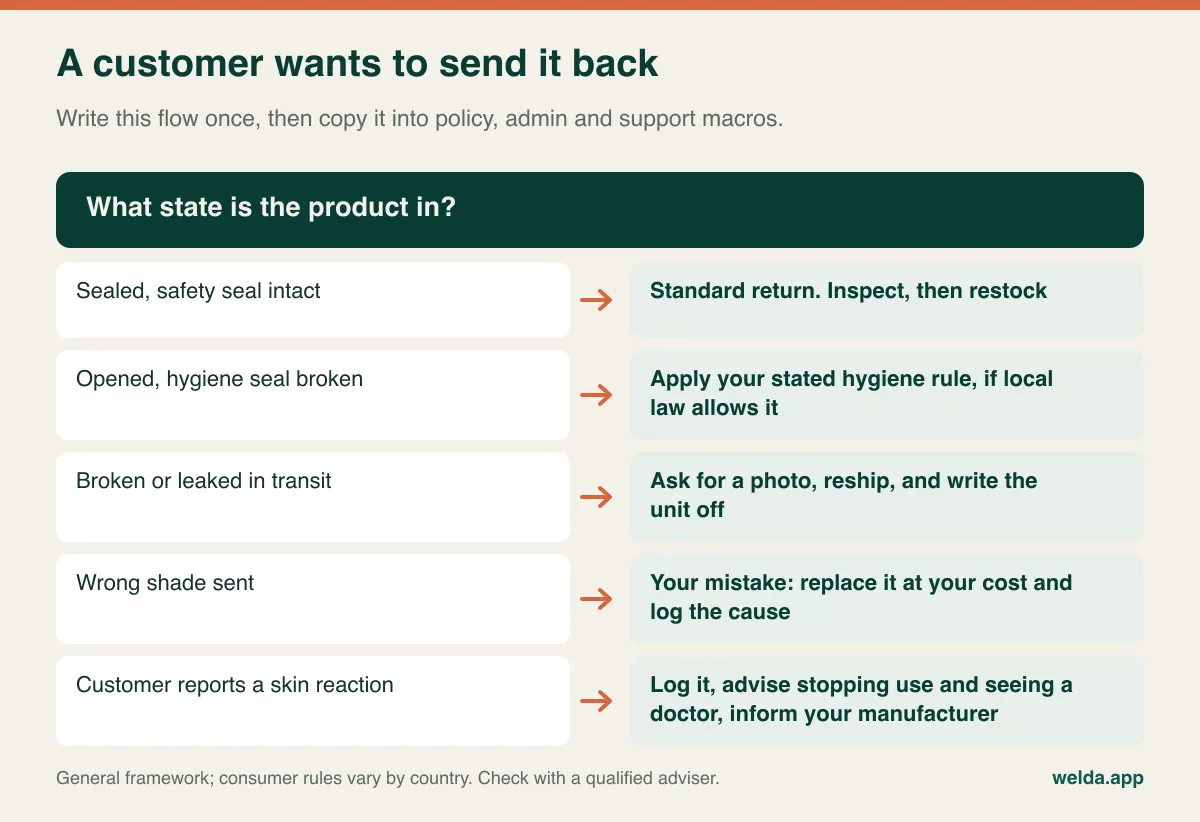
The last row rarely gets planned. When a customer writes "my skin reacted", your support team shouldn't be improvising. You need a script: log it, suggest stopping use and seeing a doctor if needed, and pass the product and batch details to your manufacturer. That's invisible on the storefront but it needs a home in your order notes.
What this means for the build: a visible returns summary on each product page, a clear route for customers to request a return, a short list of return reasons and an admin distinction between "resellable" and "write-off". Reasons are worth collecting. A rising count of "wrong shade" points to imagery; a rising count of "arrived broken" points to packing. Our guide to ecommerce shipping and returns covers the general setup.
Glass, perfume and shelf life: the operations reality
Glass dropper bottles need real protective packaging, which means a bigger box and a higher shipping band than the product's weight suggests. Before you finalize your shipping rates, send yourself test orders using the cheapest packing you'd realistically use. One loose lid can ruin everything else in the box.
Perfume, nail polish, remover, aerosols and high-alcohol products can count as dangerous goods for transport. Carriers may require special terms, restrict air shipping or refuse some destinations altogether. If that's in your range, ask your carrier in writing before you commit to a launch market. The site may also need to restrict certain shipping methods or countries at product level, which is a real scope item.
Then there's shelf life. Small brands produce in batches, so you may have two dates sitting side by side in your stock room. Oldest dates should ship first. That's mainly a warehouse discipline, but it affects marketing too: if you plan a promotion to clear stock nearing its date, be honest about that in the offer. We should be straightforward here about our own tool: Welda Stock can bring your store, marketplaces and physical sales into one stock pool, but batch-level tracking and expiry alerts aren't described on our product pages. If you need that, ask directly, and if the answer doesn't meet your need, run that tracking separately or use a tool built for it.
Selling across borders changes the build more than the design
English-language beauty founders often aim beyond one country from day one, and that's where the scope grows fastest. A beauty product isn't just "shipped abroad"; in many markets someone must be legally responsible for it there. That has consequences for your site well before your first international order.
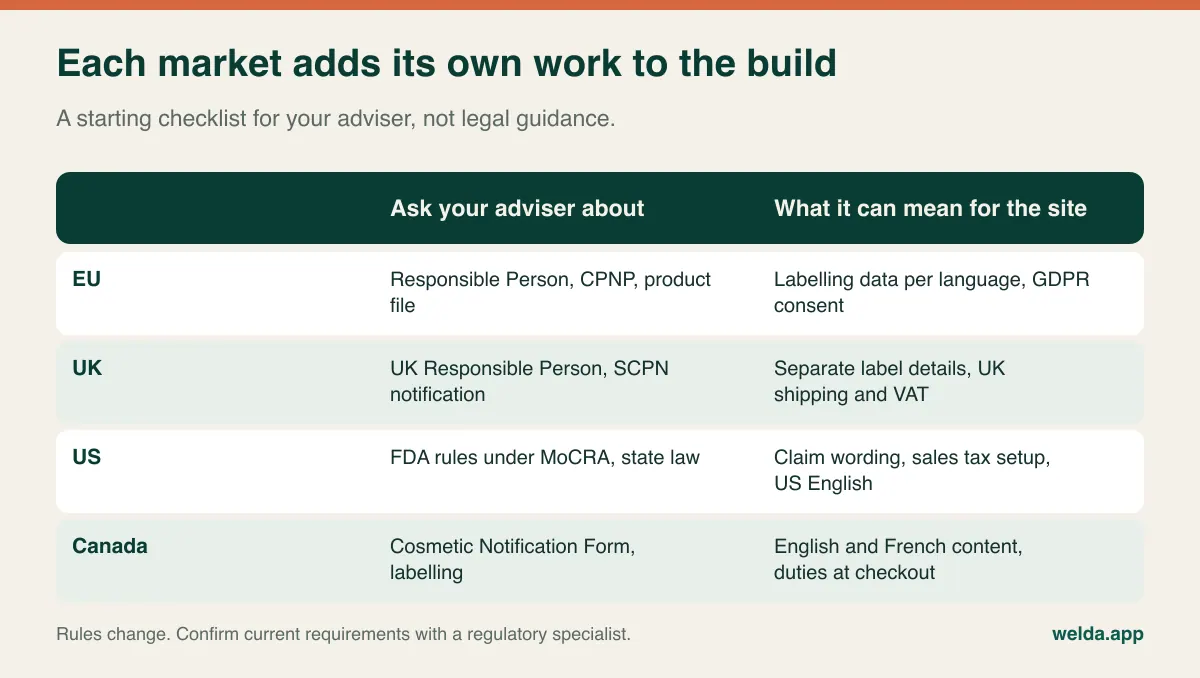
A few principles hold across markets. Start with one or two countries you can actually serve well, including customer support in their language and working hours. Keep labelling data per market in the product record, not in someone's memory, since a shipment into the EU may need different label details than one to the US. Plan privacy for the strictest market you'll sell in: if you're selling into the EU or UK, your analytics, Meta Pixel and marketing emails need consent handling that works, and a skin quiz that asks about pregnancy, allergies or skin conditions may be collecting health data, which often comes with stricter rules. Sales tax and VAT logic should also be scoped explicitly, because "the platform handles tax" is rarely the whole story.
Returns across borders get expensive quickly. For low-value items, many brands refund damaged goods without asking for the parcel back. That policy has margin consequences, so test it with the calculation below. For the wider picture, our cross-border ecommerce guide covers duties, payment methods and localization.
Shopify or WooCommerce: decide by who will run it
We build on both, so here's the practical distinction. Shopify suits teams who want to launch fast and spend little time on maintenance. WooCommerce suits teams who want flexibility, already work with WordPress or want full control over hosting and code, and who have someone responsible for updates. Neither is inherently "the beauty platform". Test each against your own catalog using these questions:
| What to check | Why it matters in beauty | What to ask to see |
|---|---|---|
| Custom product fields | INCI, skin type and usage should sit in the same place on every page | How an editor enters and updates them |
| Images per variant | Choosing a shade should change the photo | A working example with a real shade range |
| Bundle stock logic | A sold-out part must stop the bundle | Built in, an app, or custom? Ongoing fee? |
| Subscriptions | Consumables can suit repeat orders | What's needed if you add this later |
| Multi-currency and tax | Selling abroad affects checkout and pricing | The setup for your first two markets |
| Data export | You may need to migrate later | Export of products, orders and customers |
Think about the person doing the work in month six. If adding a new shade requires opening a ticket with your agency, even the most capable setup will slow you down. An admin your own team uses comfortably beats a more powerful one they avoid.
Marketplaces belong to this conversation too. Amazon and Etsy offer existing demand but limit your brand story and your access to customer data, and those matter when you're asking people to trust a new skincare brand. Our comparison of marketplaces and your own store walks through the trade-offs.
Lean launch or full build?
The most common scope mistake in beauty is building for the brand you hope to be in three years. Three example setups show how far needs can diverge. None of these describes a real company; they're illustrations to help you place yourself.
The single-range skincare brand. Six products, no shades, two sizes. Money and attention belong in structured content, strong photography and a fast mobile checkout. A shade finder and elaborate filters would be wasted here.
The colour cosmetics launch. Eight products but seventy variants. The work concentrates on shade selection, out-of-stock behaviour, back-in-stock requests and imagery. The photo budget may matter more than the site itself.
The multi-channel brand. A counter or pop-up, an Etsy or Amazon presence and its own store. The main risk is selling the same unit twice, so stock, order and price synchronization come first, and design second.
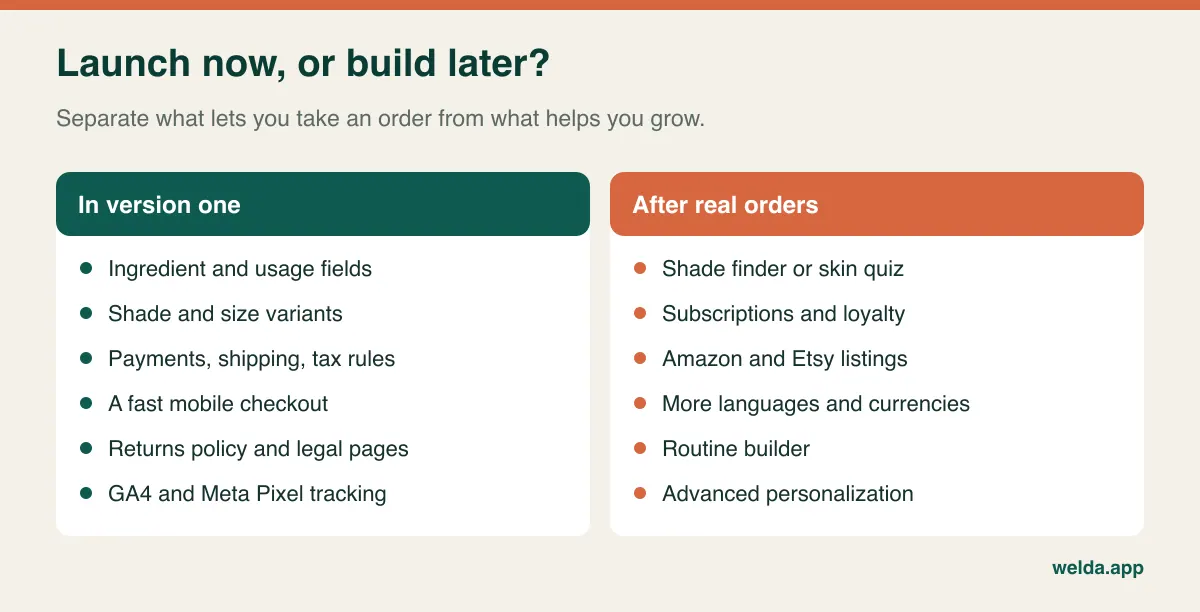
Shade finders and skin quizzes are the features founders ask for most. They can work well when built on good data, but in month one you have no idea how many people will use them, while the cost and the privacy burden arrive up front. Subscriptions follow the same logic. They can make sense for items people run out of, such as a daily serum, but it's worth seeing whether customers actually reorder before you build around it.
Reading a proposal starts with your unit economics
A website budget judged in isolation is misleading. The real question is what's left from each order and how quickly the site pays for itself. In beauty, protective packing, breakage and unsellable returns change this sum compared with a general store.
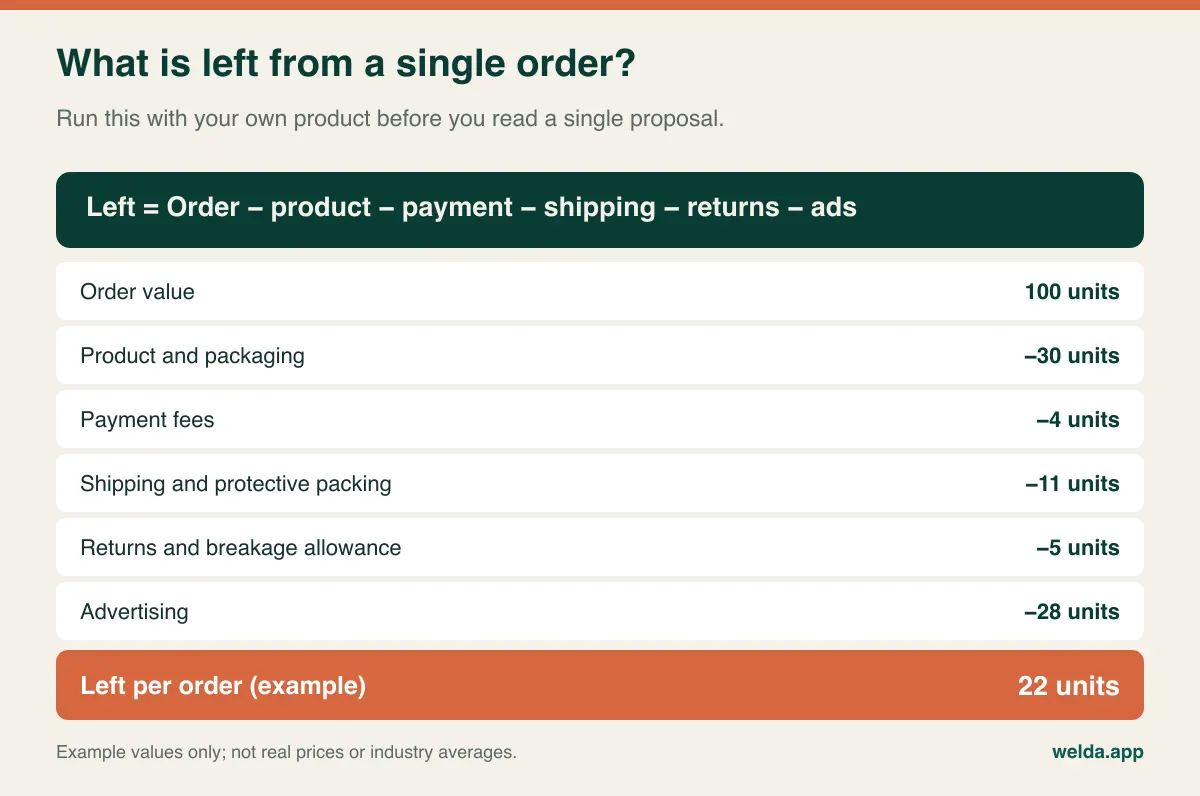
If what's left looks thin, a bigger website isn't the fix. Bundles that raise order value, a free shipping threshold or lower dependence on paid ads will do more. Our guide to ecommerce website cost goes through general line items in detail. For beauty specifically, ask every provider to itemize these so proposals can be compared:
- Platform subscription or hosting, theme and paid apps
- Custom development for product fields and the variant experience
- Product data entry: how many products and variants, and who supplies images?
- Photography, application shots and copywriting
- Payment, shipping, tax and marketplace connections
- Email automation, cart recovery and analytics setup
- Support, updates and training after launch
The hidden costs mostly sit outside the quote: per-transaction fees, the monthly bill for each app, agency hours each time you add a shade, renewal charges after year one and modules you discover you need later. Ask what the site costs to run in year two, not only what it costs to build.
Skip the pitch deck: send them your hardest product
A portfolio shows what a provider did for somebody else. It doesn't show how they'd think about your catalog. A more telling approach is to give every shortlisted provider the same real product and compare what comes back.
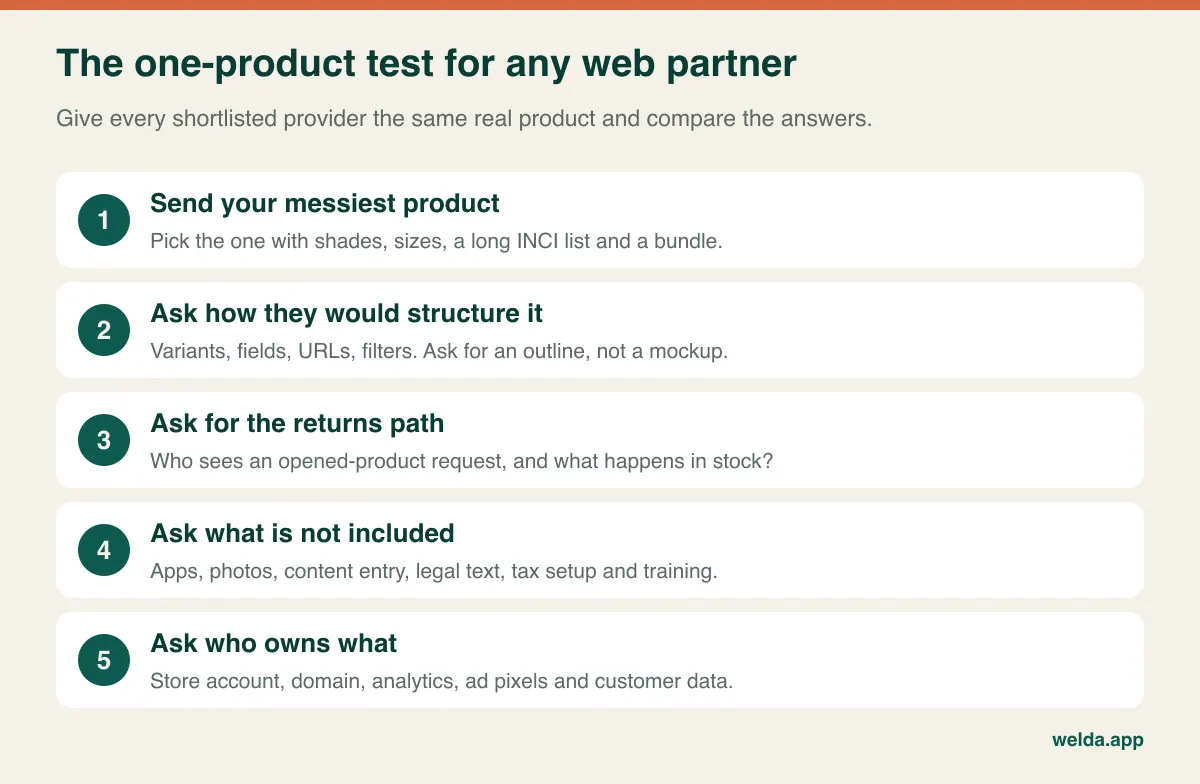
Don't be put off if a provider hasn't worked with beauty before. Someone who asks good questions about your bundles and seals can do excellent work. What should worry you is "we'll sort that out later" in answer to returns or stock questions, along with a proposal where "product upload included" doesn't say how many variants. Get scope in writing, item by item, before you sign, and make sure the domain, store account, analytics and customer data are in your name.
How Welda approaches this, and where we stop
If you're looking for beauty ecommerce website design, we build mobile-first stores on Shopify or WooCommerce. The service covers catalog structure with categories and variants, product copy, payment and shipping integrations, Amazon and Etsy connections, GA4 and Meta Pixel measurement, cart-recovery email automation, admin training and documentation. Our content and design team can help with photography, copy and imagery, and after launch we can continue working on conversion, or you can run day-to-day operations yourselves. If you'd like stock across store, marketplaces and physical sales in one pool, we can set up our own product, Welda Stock.
It's equally useful to know where we stop. Regulatory filings, Responsible Person services, product safety files, formulation and legal advice aren't what we do; you'll want a specialist for those. Shade finders, skin quizzes, subscriptions and tax setup across several markets aren't listed as standard items on our service page. If you need one, raise it early and we'll be upfront about whether and how it fits your platform and scope.
The most productive first call happens when you bring your product list, your shades and a draft returns rule. Book a free consultation about beauty ecommerce website design, and we'll talk through scope and pricing based on your actual products; that's where the numbers get settled.
Frequently asked questions
Should a new beauty brand start on its own site or on a marketplace?
There's no single right answer. Marketplaces offer existing traffic but restrict your storytelling and customer data, both of which matter when you're asking for trust. Work out the margin per order on each channel. Many brands find it practical to build a small own store as their base and add marketplaces later, but follow your numbers if they say otherwise.
How many products do I need before building a store?
Fewer than you'd think, as long as they make sense together. A single strong product can justify a focused store. Keep the number of pages and features in proportion to the catalog, then extend once you know what sells.
Do I have to publish the full ingredient list online?
Rules vary by market and product, so confirm the specifics with a regulatory adviser. Apart from any legal requirement, publishing the same INCI list that's on the pack is a practical choice, since ingredient-aware shoppers look for it and support gets fewer questions.
Can customers return opened cosmetics?
It depends on the country, the seal and your own policy. In the EU, an exception can apply to sealed hygiene products once unsealed, while faulty or damaged goods are treated differently. Many brands offer goodwill terms beyond the legal minimum. Have your policy checked for each market.
Can I shoot product photos on my phone?
For a very small range with good lighting, as a start, perhaps. For shades, colour accuracy matters so much that it's worth spending there first, because a shade that looks wrong on screen comes back as a complaint or a return.
How long does a beauty store take to build?
That depends on product count, variant structure, integrations and how ready your content is. In practice, late product data and images cause more delay than the technical work. Cleaning your product spreadsheet early is the single best way to shorten the timeline.
Can I change platforms later?
Yes, but it's a real migration, and how big depends on your setup. That's why accounts, domain and data should be in your name from day one, and why you should check that products, orders and customers can be exported before you commit.