The right bakery POS software for a shop that sells both by the piece and by weight has to do three things without fuss: ring up an unbarcoded croissant during the morning rush, read a scale label and take the exact weight out of stock, and let you split whatever is left at closing into sold, wasted and carried over. If a system cannot show those three with your own products, its feature list will not save it. If what you really need is automatic recipe costing or a custom-cake order book, you may be shopping in the wrong category altogether, and this guide will help you see that early.
This is written for owners of independent bakeries, patisseries and small bakery chains who already know their trade and want to choose a system once. It stays practical: what to test, what to ask, and where a general retail tool like ours is enough and where it is not.
Start with your counter, not with the vendor's feature list
Before you open a comparison site, write down how your last Saturday actually ran. Bakery software pitches tend to look alike because they lean on the same words: inventory, reporting, integrations. Those words hide very different assumptions, and most general POS products are designed around a shop that buys finished goods and sells them with a barcode on each one.
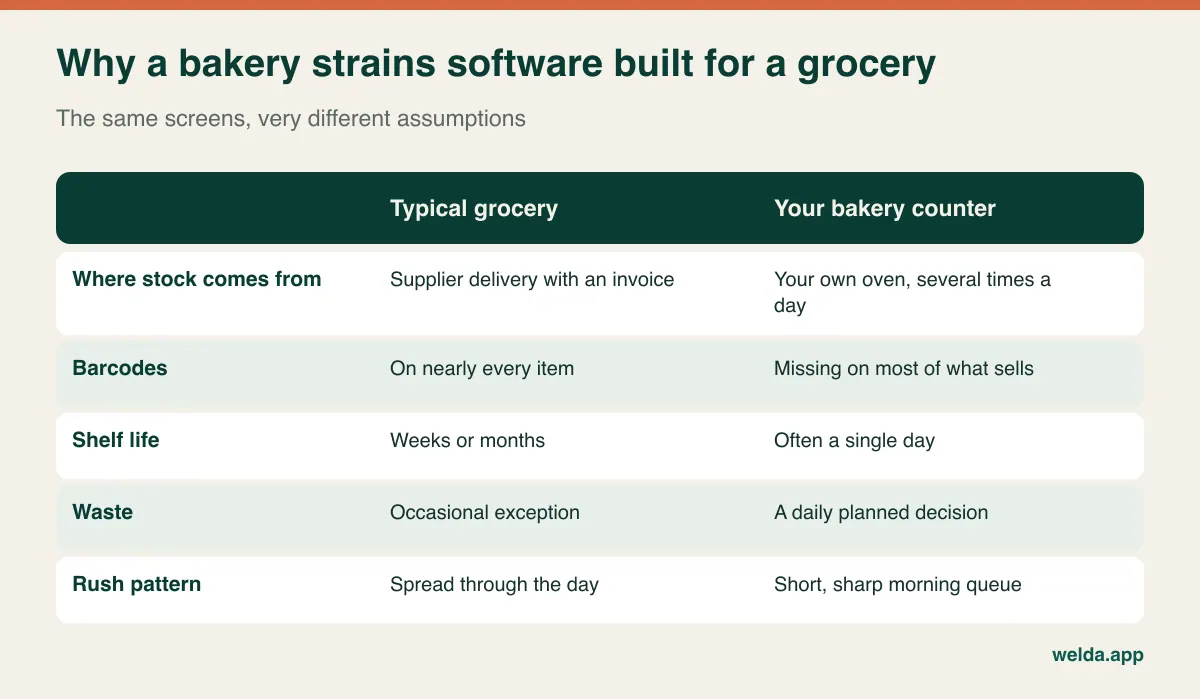
Answer these five questions on paper before talking to anyone. They will sort every option you look at later.
- What share of your income crosses the counter today, and what share is pre-ordered?
- How many items do you bake daily, and how many of them are sold by weight?
- Do you have seating, and do customers pay at the table or at the till?
- Do you supply cafés, offices or shops on account?
- Is everything produced under one roof, or does one kitchen feed several shops?
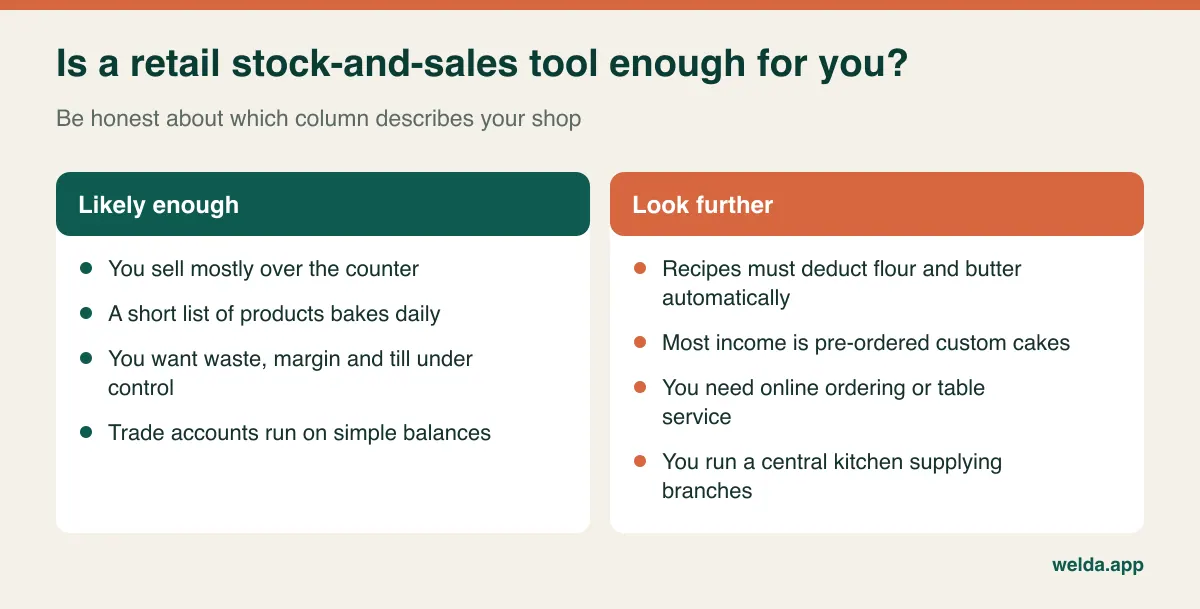
A bakery that is mostly counter sales, with thirty daily items and a couple of trade accounts, wants something very different from a celebration-cake studio taking deposits three weeks ahead. Neither is wrong, but one product rarely serves both well.
Piece, weight or slice: the checkout problem unique to bakeries
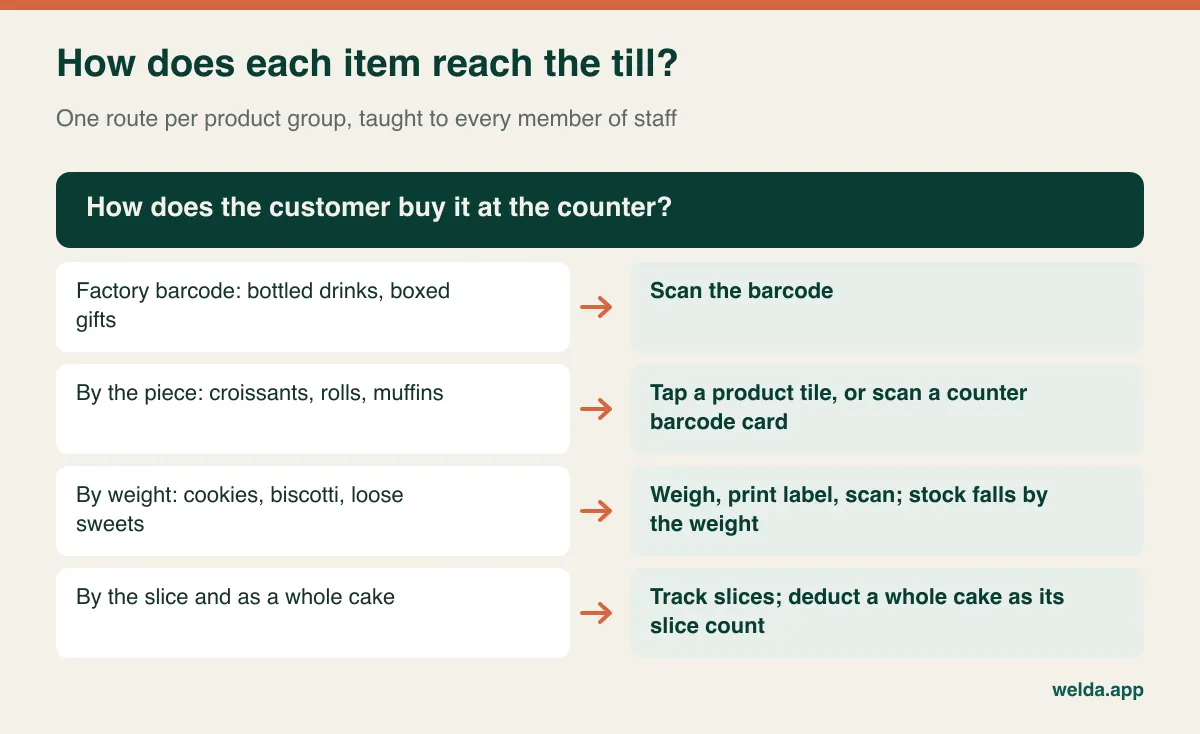
A grocery cashier scans. A bakery assistant reaches into a display with tongs, and the thing in the bag has no code on it. This is the first place generic software shows its seams, so go through your range by how it is sold.
By the piece. Rolls, croissants, muffins and doughnuts are the rush-hour items. You have two sensible routes: on-screen product tiles, or a laminated card of barcodes taped beside the till and scanned like any other product. The card is cheap and surprisingly fast for your top ten or fifteen sellers, but it stops working once staff have to hunt for the right line. Tiles need to stay in the same place every day so that fingers learn them. A search box is a fallback, not a rush-hour method.
By weight. Cookies, biscotti, loose sweets and some breads go on the scale. Here the software should read the weight or price barcode the scale prints. We cover barcode formats and the label test in detail in our guide to POS software with scale integration. The bakery twist is the box: if you weigh cookies inside a gift box, make sure the tare is set, or you will overcharge the customer and take too much out of stock at the same moment.
By the slice and whole. Decide on your stock unit before you enter a single cake. The simple rule is to track the smallest thing you sell: if a cake gives twelve slices, stock is counted in slices and a whole cake takes twelve out. Some systems use unit conversion for this, others a second linked product. Ask to see it rather than asking whether it is possible, because almost anything is possible with enough manual work.
Mixed boxes deserve their own rule, because they quietly wreck stock figures. A customer asks for half a kilo of assorted cookies, an assistant fills the box and presses a single “assorted” key. The sale is right, the stock is not. You can keep all loose cookies in one pooled stock line (easy, but you lose the view of which kind earns its keep), weigh each kind separately (accurate, but slow at busy times), or sell a pre-defined box with a known mix (tidy, but useless for pick-your-own). Most small shops do best by tracking their two or three biggest sellers separately and pooling the rest.
The ten-minute rush that decides whether staff will use it
Picture 7:50 on a weekday. There are six people in line, half of them late, and the order is a filter coffee and two pastries, paid by card. In this window, any friction gets “solved” by staff in the most human way: they take the money and skip the entry, meaning to fix it later. Then your waste report, your margins and your reorder decisions all sit on numbers nobody can trust.
So measure this, and measure it with your newest employee rather than the vendor's demonstrator. Time three sales: a single item, a mixed order of five items, and an order with one weighed product. Compare the results to how long the same sales take on your current till. We will not give you a magic number, because what matters is whether the new setup is noticeably slower than what your team does now. If it is, adoption will slide within weeks.
While you are watching the clock, look for the following:
- Whether the best sellers stay in fixed positions on the screen.
- How many taps it takes to remove a mistaken item, and who is allowed to do it.
- What happens to the sale when the receipt printer runs out of paper.
- How the screen behaves on a slow connection. Web-based software depends on your line, and that includes Welda Stock, so if your connection is unreliable, plan a backup connection before you start.
- Whether your card terminal is linked to the till or runs alongside it, and whether that bothers you. Our product documentation does not describe a payment terminal integration, so with Welda Stock assume a standalone terminal unless we confirm otherwise for your setup.
Yesterday's bread is a financial decision: tracking waste properly
In a grocery, waste is an exception. In a bakery, it is a daily planned outcome, because the only way to have a full display at 4 p.m. is to risk leftovers at 6 p.m. The point of tracking it is not to reach zero, which usually means empty shelves and lost customers. The point is to know what the leftover is costing you and to make that trade-off on purpose.
That only works if “waste” stops being one big number. What ends up in the bin, what is sold as day-old at a discount, what burned, what got dropped, what staff ate and what was given to a regular as a treat are all different events pointing to different decisions. Bin waste points to the production quantity. Burned trays point to the oven or to training. Giveaways point to a house rule. Keep them apart, using the same words every time.
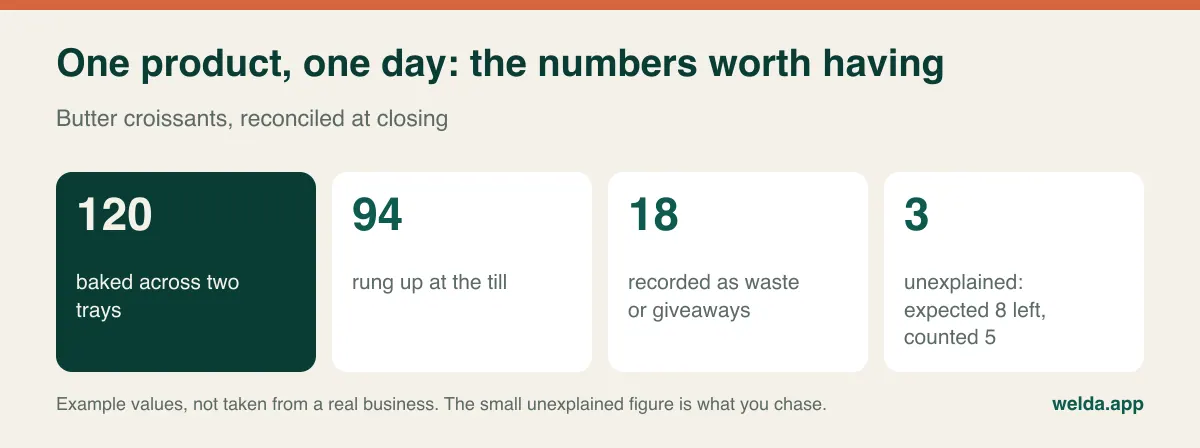
Do this nightly for only your five best sellers at first. The count takes a few minutes if someone does it before the display is cleared, and it falls apart if it waits until the next morning. A small gap is normal. You are looking for the gap that keeps recurring on the same product, the same shift or the same weekday. Our walk-through for end-of-day cash reconciliation pairs well with this routine because a till gap and a stock gap often have the same cause.
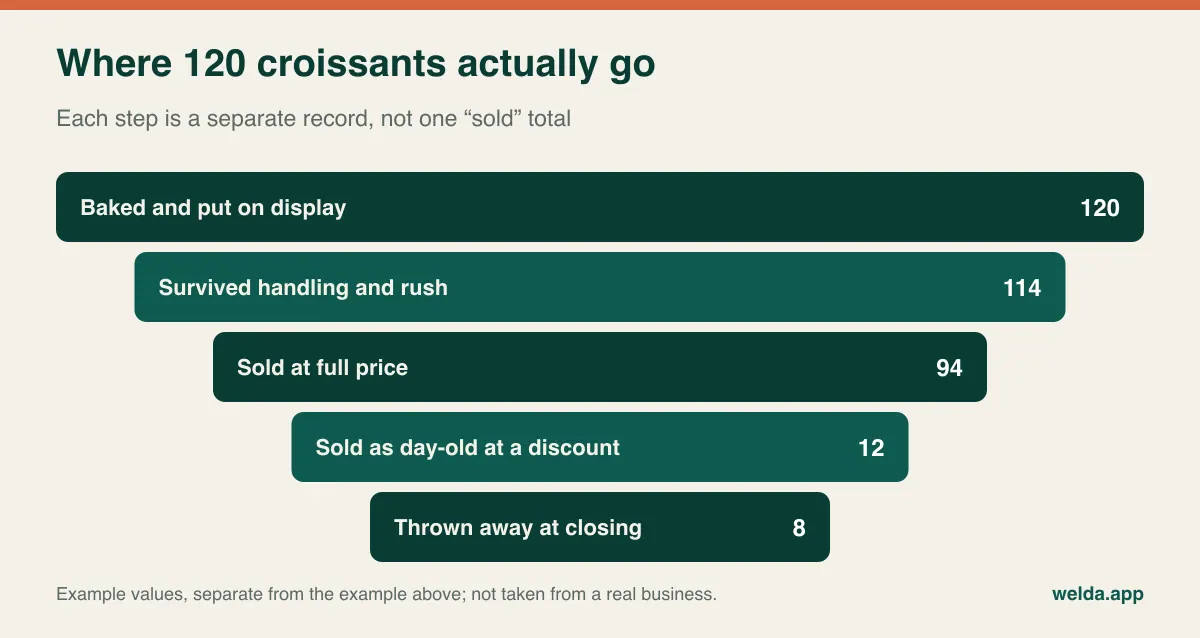
Once you have a few weeks of this, ask a sharper question: is the waste on Monday the same as on Friday? A flat bake plan across the week is rarely right. Sales reports by product and day are what turn “I feel like we overbake on Mondays” into a change you can test. Adjust one product by a small amount, watch it for a couple of weeks, then move on to the next. In Welda Stock you have daily, weekly and monthly sales reports, stock counts and shrinkage tracking, plus a stock movement record for each entry. A ready-made report split by waste reason is not described in our product pages, so if that matters to you, look at it with us in the demo.
Recipes and ingredients: do you actually need them on day one?
Automatic recipe deduction sounds like the obvious answer: bake a tray, and flour and butter leave stock on their own. It is genuinely valuable in a bakery with standardised, weighed recipes and someone who keeps them up to date. It is much less valuable in a shop where the head baker adjusts by feel, because the system then reports a tidy ingredient balance that does not match the storeroom.
Ask yourself what decision you would make with that data. If it is “what should I reorder”, a weekly ingredient count and low-stock alerts on the items that are hard to replace will get you most of the way. If it is “what does this croissant cost me this month, after butter went up”, a periodic hand calculation for your top sellers works: a batch costing 300 units of currency in ingredients that yields 60 pieces gives a cost of 5 per piece. Those figures are only an example. Do it whenever a major supplier changes prices.
A warning on margin reports: they are only as good as the cost you entered. If you bake it yourself, nothing fills in a purchase price for you. Getting ten products right beats getting a hundred roughly right.
To be plain about our own product, recipe-based deduction and production planning are not described in the Welda Stock documentation, so we do not claim them. What it does offer on this side is supplier invoices and payables, per-product margin, and low-stock alerts. If recipes are a hard requirement, tell us at the start, and we will say honestly if we are not the fit.
Custom cakes, trade accounts and the money that arrives later
Income that does not cross the counter on the day is where bakery systems differ the most.
Custom orders. A wedding cake carries a pick-up date, a deposit, an inscription, a design photo and an allergy note. Most retail systems were never built for this. If you take a handful a week, a shared calendar and a clear deposit rule are fine, and many well-run shops work that way. If custom work is the main business, prioritise order management first and treat stock as secondary. Welda Stock's product pages do not describe a deposit-based order book, so we would not sell it to you for that job. Getting orders through your site is a separate topic, which our bakery website guide covers.
Trade accounts. The café that takes forty rolls every morning and pays at month's end needs a balance per customer, a history and a clean way to record payment. Welda Stock handles customer accounts, balances and payment history; the broader method is explained in our article on digital customer credit tracking. Agree on returns from day one. If the café sends back unsold rolls, the credit should reduce their balance and the rolls should be booked as waste, not returned to sellable stock.
Online and delivery. If a good part of your sales arrives through delivery apps or your own web shop, ask each vendor exactly how those orders reach stock. Do not accept “we integrate” as an answer; ask to see one order flow through. Welda Stock's documentation does not describe delivery platform or online ordering connections.
Food rules, tax and data: what to check locally
Rules vary a lot between countries and even between regions. What follows is general orientation rather than legal or tax advice, so confirm the details with your accountant or local authority.
- Sales tax and VAT on food. Bakeries often get caught by distinctions that depend on the item or on how it is consumed, such as hot versus cold or eat-in versus takeaway. Check that the software lets you set the right rate per product, and ask your accountant how mixed baskets should be handled.
- Fiscal rules. Some countries require certified fiscal devices or registered tills. A customer receipt from stock software is not automatically a fiscal document, and our receipt should not be read as one. We make no blanket fiscal compliance claim for Welda Stock, so raise your country's requirement in the first conversation.
- Allergens. Many jurisdictions have rules on allergen information for food sold loose or packed on the premises, and the rules can change. Know who is responsible for keeping the information current, whether or not your software stores it.
- Scales. Scales used to sell by weight are usually subject to trade-approval or verification requirements. Ask your local weights-and-measures office.
- Customer data. Names, phone numbers and addresses in an order book are personal data under laws such as the GDPR. Limit who sees them, keep them only as long as needed, and ask each vendor where the data is stored.
Reading a quote without being surprised six months later
The licence line is rarely where the surprise hides. Put each quote in the same table and answer these questions in writing.
| Cost driver | Why it matters in a bakery | Question to ask |
|---|---|---|
| Pricing model | Decides your total cost over several years | One-time or recurring? Are updates and support included? |
| Users and tills | Separate logins for early and late shifts make gaps traceable | What happens when we add a person or a till? |
| Locations | A second shop splits stock and reporting | What does adding one involve? How are deliveries between sites recorded? |
| Hardware | Scale, scanner, receipt printer, tablet or PC | Will my existing scale work? Who confirms that? |
| Data import and training | Counter staff change often in this trade | Is import included? How do new hires get trained? |
| Add-ons | Recipes, orders and online sales are often sold separately | Which of those is missing from this quote? |
Also ask what happens to your data when you leave: can you export products, sales and customer balances in a usable format? For Welda Stock, the quote depends on users, branches and warehouses, product count and data import, plus your hardware and checkout flow. There is a one-time setup fee, and setup, Excel data import and team training are included. The amount itself is settled in a free consultation, because a two-shop bakery and a single counter need different setups.
Where Welda Stock fits, and where it does not
We do not sell a bakery edition. Welda Stock is built for retail businesses such as delis, grocers, cafés and kiosks, and a counter bakery's needs sit close to a deli and a café combined: pieces and weighed goods on one screen, a daily cash report, customer accounts, and stock per branch.
It is a reasonable candidate for bakery POS software if counter sales drive your business and your priority is seeing waste, till and margin clearly; if you want cashier, warehouse and manager permissions kept apart; or if you want to see several branches from a single account. The interface is available in English, Turkish and German, and because it is web-based there is nothing to install beyond a browser.
It is the wrong choice if you need automatic recipe deduction, production planning for a central kitchen, deposit-based custom cake orders or online ordering. It also does not do table service: Welda Stock focuses on counter sales and stock, and for table and tab management we are working on a separate product, Welda Restoran. A café-bakery that serves at tables should know that this need is not met today.
Six sales to ring up before you sign anything
A sample shop full of perfect data flatters every product. Bring your own price list, one real scale label, and this short script.
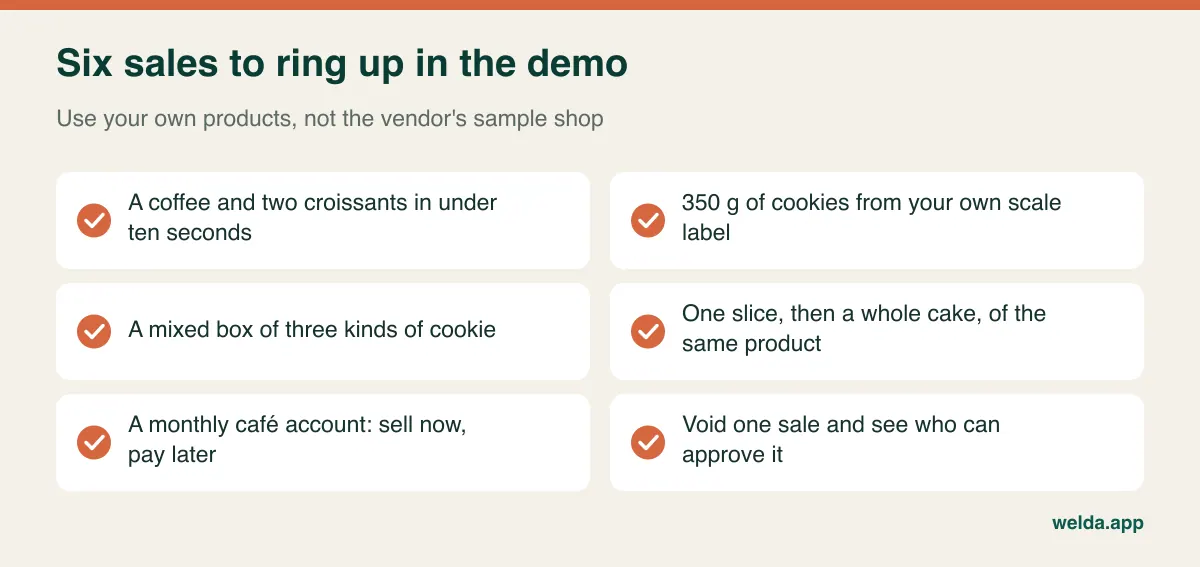
Then close the day in the system. Record waste on three items, pull the sales report and try to answer a real question with it, such as which of your pastries sold best before 10 a.m. If the report cannot answer that, find out whether it is a report limitation or a setup issue. Finally, log in as a cashier and try to void a sale: you are checking that the permissions work, not that your staff are dishonest.
Going live without wrecking a Saturday
Pick a quiet weekday well away from holidays. Move in layers rather than all at once: the display first, then the scale, and ingredients and accounts last. The early weeks are about habit rather than accuracy.
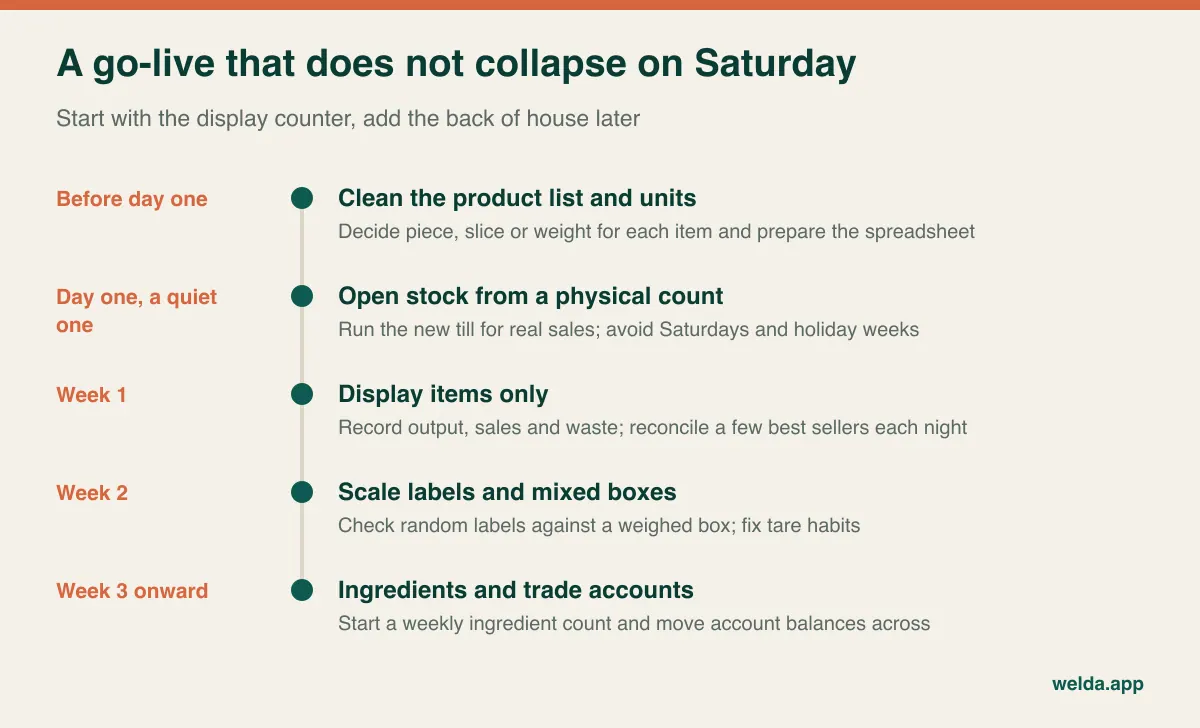
Three mistakes are worth a warning. The first is importing hundreds of products without deciding the units, so that nothing reconciles later. The second is training the owner and manager but not the person on the 6 a.m. shift. The third is giving up on waste entries in week one because the numbers do not match. They will not match at first, and that gap is the information you came for.
Frequently asked questions
What is the difference between bakery POS software and ordinary retail POS?
Often the name more than the technology. What matters is handling unbarcoded items, weighed goods, daily waste and short shelf life. A retail system that does those well can serve a counter bakery. Recipes and custom orders are where specialist systems earn their place.
How do I sell items with no barcode quickly?
With fixed on-screen tiles or a printed barcode card next to the till. Welda Stock's quick sale screen shows products as tiles and lets you add them by name, SKU or barcode.
Will it work with my existing scale?
If your scale prints barcode labels, the most reliable test is to scan a few of your own labels in a demo and check the weight and price. Welda Stock automatically decodes weight and price barcodes from retail scales, and we check compatibility with you before setup.
Does Welda Stock deduct ingredients through recipes?
That is not described in our product documentation, so we do not claim it. You can track ingredients through purchases and regular counts. If automatic deduction is essential, say so in the first conversation.
Can I use it in a bakery café with tables?
For counter sales and stock, yes. Table and tab management is outside Welda Stock's scope today.
Is it a certified fiscal till?
We make no such claim. Requirements vary by country, so check yours with your accountant and raise it with us before setup.
What happens if the internet goes down?
Welda Stock is web-based, so operations run over your connection. A stable line matters, and for unreliable connections we plan the most suitable working setup with you during onboarding.
How much does it cost?
That depends on your users, branches, products and setup. There is a one-time setup fee, and the amount for your shop is settled in a free consultation.
If you would like to walk through your counter, your scale and your closing routine with us, book a free consultation about bakery POS software with Welda Stock. If something does not fit your shop, you will hear it from us in that same conversation.