If you sell sealed bags of pet food alongside loose food weighed at the counter, the right pet store POS software is the one that can tell you, for any single food, how much you own in total, sealed and open, and what an open kilo or pound actually costs you. Look for four things: a clean way to track one food in two forms, reliable reading of the labels your scale prints, a loss record with reasons, and customer accounts with history for your regulars and trade buyers. Then prove all four during a demo using your own products, because a tidy demo catalog will not show you any of them.
This guide is for owners of independent pet stores and pet supply shops who scoop food from bins, or who are thinking about starting to. It covers what makes this kind of retail awkward for general software, how to choose between scooping and repacking, a demo script you can run in half an hour, and a plain account of where Welda Stock fits and where it does not. Calculations are samples and use "units" rather than a currency, so replace them with figures from your own invoices.
One shelf, three stock realities
A typical pet store is really three small shops sharing a till. The first sells packaged goods with fixed barcodes: cans, treats, sealed bags. The second sells by weight: dog kibble, cat food, birdseed, small-animal mix, freeze-dried treats from a jar. The third looks more like a clothing store, with harnesses, sweaters and collars in several sizes and colors, and perhaps a fourth corner of live fish or feeder insects where stock can die.
General inventory software handles the first shop well and often stumbles on the others. It is usually built around the assumption that one sale reduces one item by one. Weight breaks that assumption, and it breaks it in a place you cannot easily see, because the shortfall builds up inside an open bin instead of on a shelf you can count at a glance.
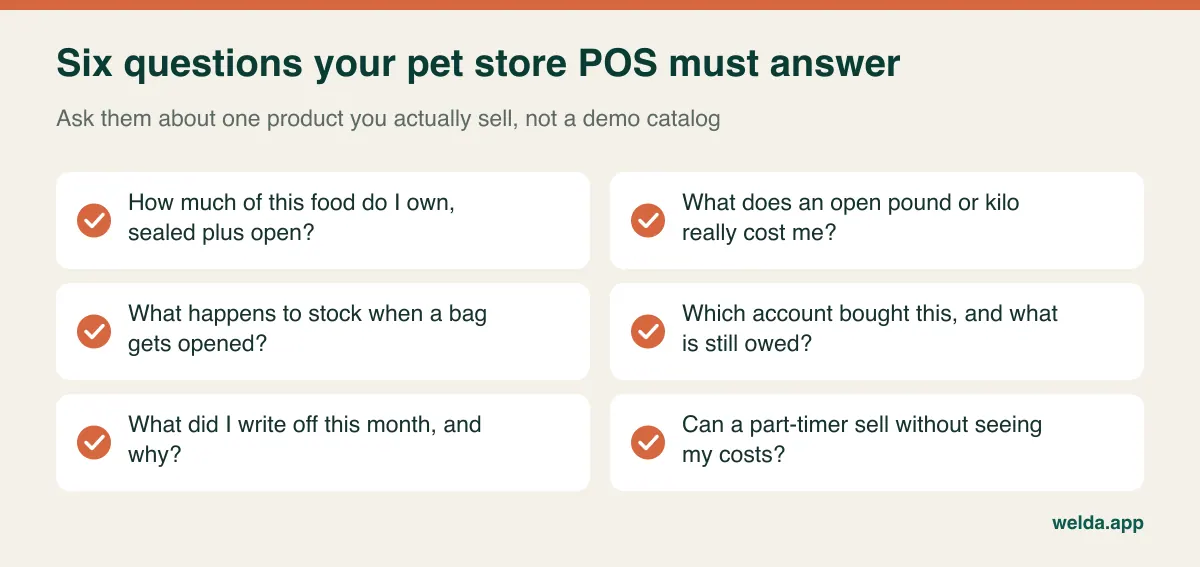
Those questions look simple, but only software that has been set up thoughtfully can answer them. The rest of this article works through each one, starting with the moment that causes most of the confusion.
The bag you cut open on Tuesday
On Monday, a 12 kg bag of salmon kibble is one unit in your system. On Tuesday someone opens it and pours it into a bin, and it becomes 12 kilos of something else. On Wednesday a customer asks for a sealed bag of the same food. If nobody recorded Tuesday's change, your system now shows a sealed bag that does not exist and an open product with no stock at all. Selling from it may push the balance negative, or staff may start working around the system by keying generic items, and at that point your reports stop meaning anything.
There are three common ways to model this. None is universally right, so decide per food.
| Model | How it works | Best when | Watch out for |
|---|---|---|---|
| Single product in weight | Everything is held in kg or lb. A sealed bag sale deducts the whole bag weight. | You rarely sell that food sealed | You cannot see at a glance how many unopened bags remain, and sealed pricing needs its own handling |
| Two separate products | "Sealed" counts in units, "loose" in weight. Opening a bag takes one off and adds its weight to the other. | You sell both forms regularly | It depends entirely on staff recording the opening every single time |
| Automatic conversion | The software links the two products and moves stock across in one action. | You open many different bags a week | Not every product offers this, so ask to see it live and test how a mistake is reversed |
In Welda Stock, products can be defined in weight, scale-label sales deduct the weighed quantity from that product's balance, and stock movements are listed in one place. A one-step bag-to-weight conversion between two linked products is not described in our product material, so we do not promise it here. If you opened only a couple of bags a week, the two-product route with a recorded adjustment may be perfectly workable. If you open dozens, say so at the start of the conversation, and let us work through it with your own numbers before you decide anything.
Scoop at the counter, or repack in advance?
Before you pick software, decide how loose food reaches the customer, because that choice dictates your stock records more than any feature list does. Some stores scoop whatever amount the customer requests and print a label on the spot. Others use quiet hours to bag food into fixed sizes such as 500 g and 1 kg, sticking on a house barcode. Plenty do both, depending on brand.
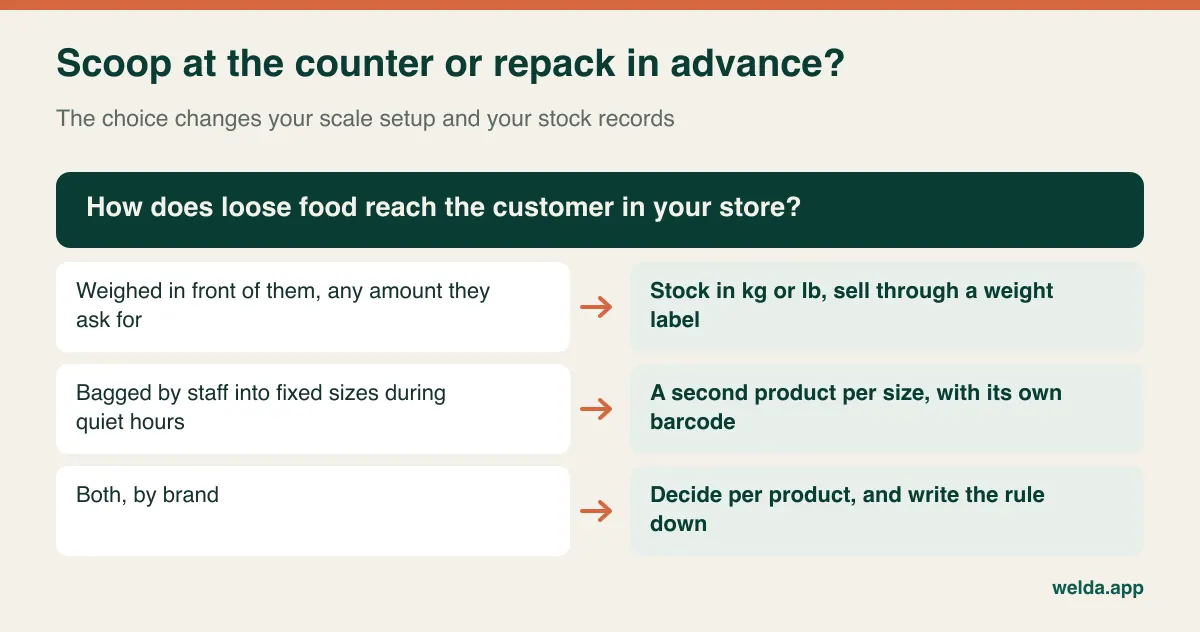
Scooping keeps stock simple, with one product and one weight, and it suits customers who want an exact amount or a small trial portion. The cost is counter time and small losses at each pour. Repacking moves labor to quiet hours and speeds up the till, since a pre-bagged kilo scans like any packaged item. The catch is that every repacked size is a separate product, and a batch of bags has to come off the loose balance when it goes onto the shelf. If that step gets missed, you will count the same food twice. Our guide to POS software for bulk food stores looks at this problem from the perspective of nut and dried fruit retailers, and much of its reasoning carries over.
Your scale matters here too. Three setups are common. A label-printing scale produces a barcode that the till reads. A simple display scale shows a weight that someone types in. And a checkout scale connected to the till sends weight directly over a cable. Welda Stock uses the label route: the weight or price barcode from a retail scale is scanned and decoded automatically, so a scooped item and a boxed toy can sit on one receipt. A live cable connection is not described in our material. How to test label compatibility is covered in detail in our article on POS software with scale integration; in short, bring labels from your own scale and check them against values you wrote down in advance.
Three pet-specific details deserve attention at the scale. Tare first: if staff weigh into a scoop or tub and the tare is wrong, you are either overcharging or giving food away on every sale. Then product codes: loose ranges multiply quickly once you have puppy, adult, senior and sterilized formulas in several proteins, and each needs a code that exactly matches the POS. Finally, naming: when "salmon adult" could mean two different brands, the wrong code gets pressed and nobody notices until the count. A short naming convention that includes brand, species and life stage is cheap protection.
What a loose kilo really costs, and when loose loses money
Many owners price loose food by dividing the bag cost by the printed weight and adding a margin. That assumes you sell every last gram at full price. In practice, kibble spills, staff add a little extra to round up, the last of the bag goes stale and gets thrown out, and small free samples leave the bin.
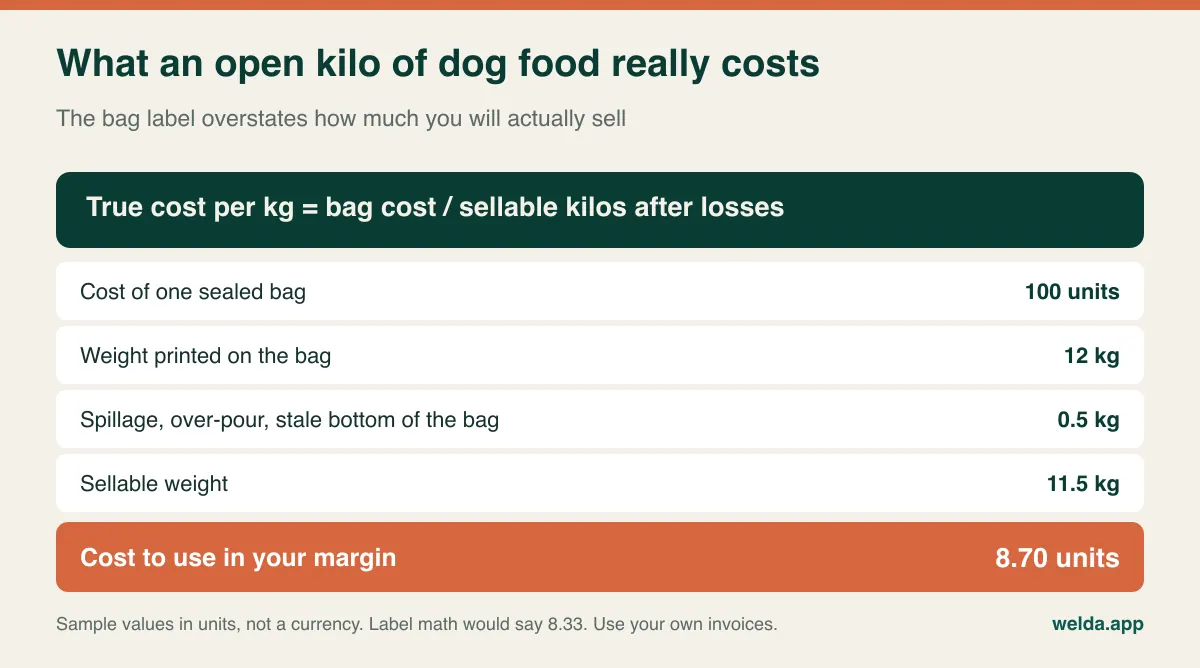
Now extend the sample. You buy that bag for 100 units and can sell it sealed for 125, which earns 25 units a bag. Loose, at 11 units a kilo, selling all 11.5 sellable kilos brings in 126.5 units, which earns 26.5. So far loose seems barely better for considerably more work. Raise the loose price to 12 units a kilo and the full bag earns 38. But if the last 3 kilos go stale and only 8.5 sell, revenue is 102 units and you make just 2. At 12 units a kilo, your break-even with the sealed sale is about 10.4 kilos out of that bag.
The lesson is that a loose program can be highly profitable on fast movers and quietly lose money on slow ones. Knowing which is which takes three reports: margin per product, margin after a supplier raises prices, and sales rate per product. Welda Stock offers margin per product, daily, weekly and monthly sales reports, and supplier invoices tracked in the same place. None of this helps if losses go unrecorded, though. Any report's numbers are only as good as the write-offs entered behind them. If you want a broader framework for reducing them, see our guide on preventing retail shrinkage.
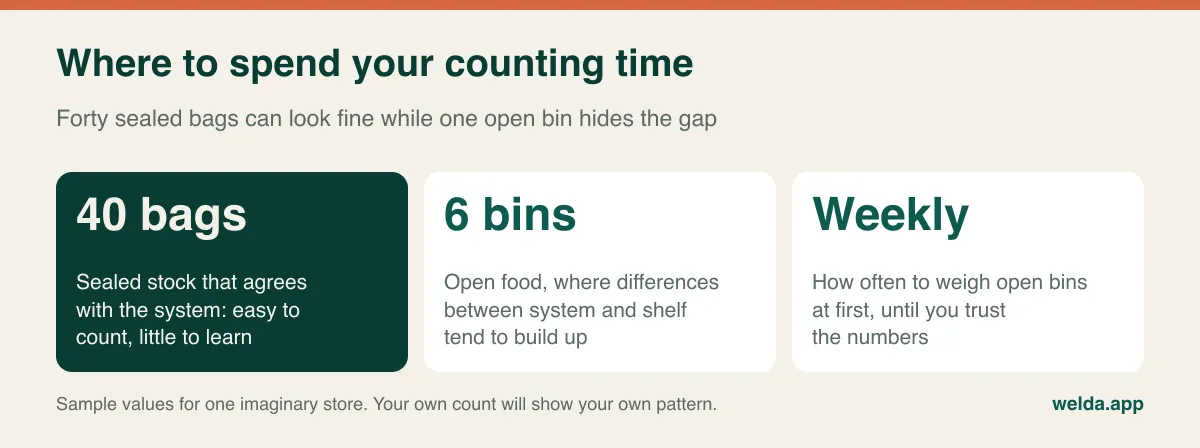
A workable routine: write the opening date on each bin lid, measure the bin's empty weight once and mark it on the side, and weigh your five fastest loose foods on the same day each week. In the first month your goal is not zero variance. It is learning where the variance comes from, because each cause has a different fix. Stale food thrown out suggests you are buying too large a bag or storing it badly. Over-pouring is a habit you can fix with one conversation. Samples are a marketing cost worth keeping, provided they are counted. Welda Stock includes stock counts and shrinkage tracking. Automatic alerts by expiry date or batch number are not described in our product material, so if your suppliers or local rules make that traceability essential, raise it early.
Harnesses, heavy litter and things that swim
Sizes and colors are the second awkward area. One harness model in five sizes and four colors is twenty stock lines, and a customer standing in front of you wants to know if the medium red is in the back. Welda Stock handles this the straightforward way: each size and color gets its own SKU and barcode, defined as a separate product, and a bulk import from Excel saves typing them one by one. If you carry hundreds of combinations, expect a long product list and agree on a naming scheme first. For imported goods with no manufacturer barcode, decide up front whether you will print your own labels or search by name and SKU.
Heavy goods bring a different problem. Litter and large bags of food often live in a stockroom or a separate unit, and you may want to know what is on the floor and what is out back. Welda Stock manages multiple warehouses and branches with separate balances from one panel. Local delivery is another common service in pet retail, but delivery routes and driver tracking are not part of what we describe for this product, so plan to manage those elsewhere if they matter.
Live stock is the third. Fish, crickets, mealworms and small animals die, and when they do, your balance is wrong until someone records it. A tank holding 18 fish while the screen says 25 leads to wrong orders every week, and perhaps a disappointed customer. Use a loss record with a reason so you can distinguish transport losses from ongoing tank problems. If you need individual animal records, health paperwork or breeder documentation, a general inventory system will not provide that, and Welda Stock does not claim to.
Regulars who run out on a schedule, and the trade accounts behind them
Pet food customers differ from most retail customers in one useful way: you can predict when they will run out. A household buying the same 3 kg bag will be back on a roughly regular cycle, and pets don't switch food casually. If you are out of stock when they arrive, they may go elsewhere and stay there. So purchase history is a stock planning tool as much as a customer service feature.
Your best accounts may not be households at all. Groomers, dog walkers, daycare facilities, breeders and rescues can all buy regularly, and many expect to settle on account rather than at the till.
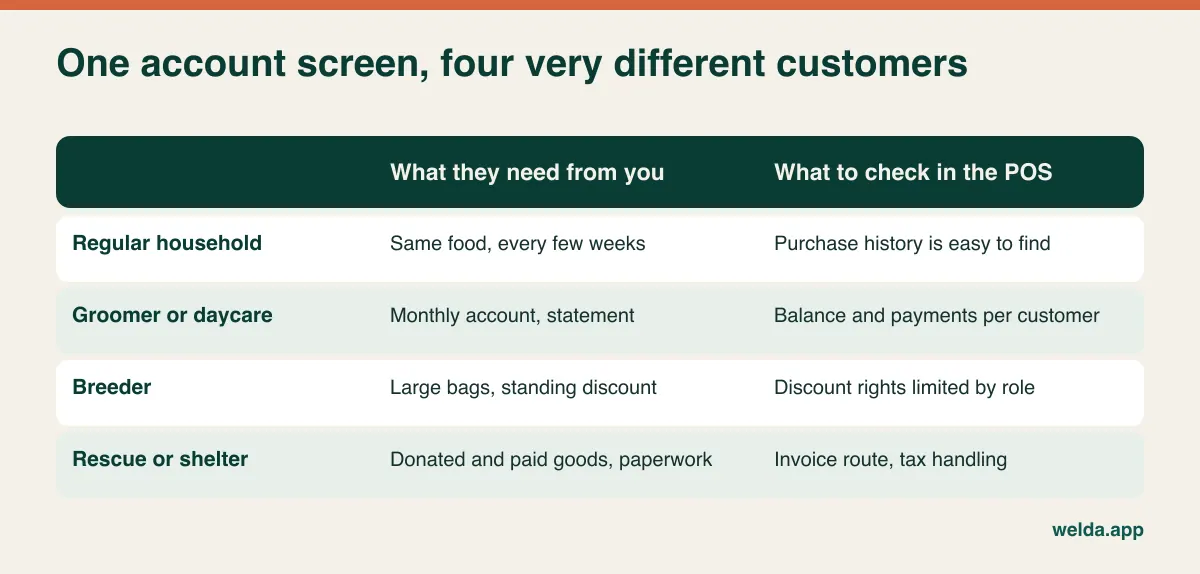
Welda Stock provides customer accounts with balances and payment history, and a sale can be charged to an account. Our article on digital customer credit tracking covers the practical side of moving customer credit out of a notebook. What we do not describe is an automatic "your dog's food is about to run out" reminder, a loyalty points scheme, or a subscription service. Stores that depend on those need a dedicated tool or a different system. A manual substitute for reminders is simple: once a month, review your regulars' histories and use the result to shape your next order.
Discounts are where trade accounts can hurt. A breeder's standing discount is fine as a decision, but a part-timer offering the same discount to a friend wipes out a loose-food margin that was already thin. Welda Stock has separate permission levels for cashier, warehouse and manager. During the demo, log in as a cashier to see what is actually visible and allowed.
Compliance depends on where your store is
This article has an international readership, and rules for pet retail vary widely by country, state and city. What follows is a set of questions to raise, not legal or tax advice. Check them with your accountant, your local authority or a qualified adviser.
- Fiscal and till rules: Some countries require certified fiscal devices or registered tills. Check this first, because it can rule out a system whatever its stock features. Welda Stock produces a customer receipt, and we make no blanket fiscal compliance claim, so ask about your country directly.
- Sales tax or VAT: Pet food, accessories, grooming products and medicated items may be taxed differently, and the rules on pet food are not the same as those for human food in every place. Confirm your rates and check that each product group can carry the right one.
- Selling feed loose: Animal feed is regulated in many markets, and the conditions for selling it from an open bag, including what information must accompany it, differ. Ask your feed or agriculture authority before you build a business on loose sales.
- Weights and measures: Scales used for trade commonly have to be approved and verified. Accurate software does not make an unverified scale legal.
- Live animals: Licensing, species restrictions and record-keeping are often specific and may be changing where you are. Inventory software does not replace any license.
- Veterinary products: Flea and worm treatments may be restricted depending on the active ingredient and jurisdiction, so confirm what you can stock.
- Customer data: Names, phone numbers, addresses and purchase histories are personal data under laws such as GDPR. Restrict access and collect only what you use.
Run this demo instead of watching one
A vendor demo typically shows clean products, perfect barcodes and no opened bags. Ask for half an hour with your own data. Bring a sealed bag barcode, two labels from your scale and a sample of your product list.
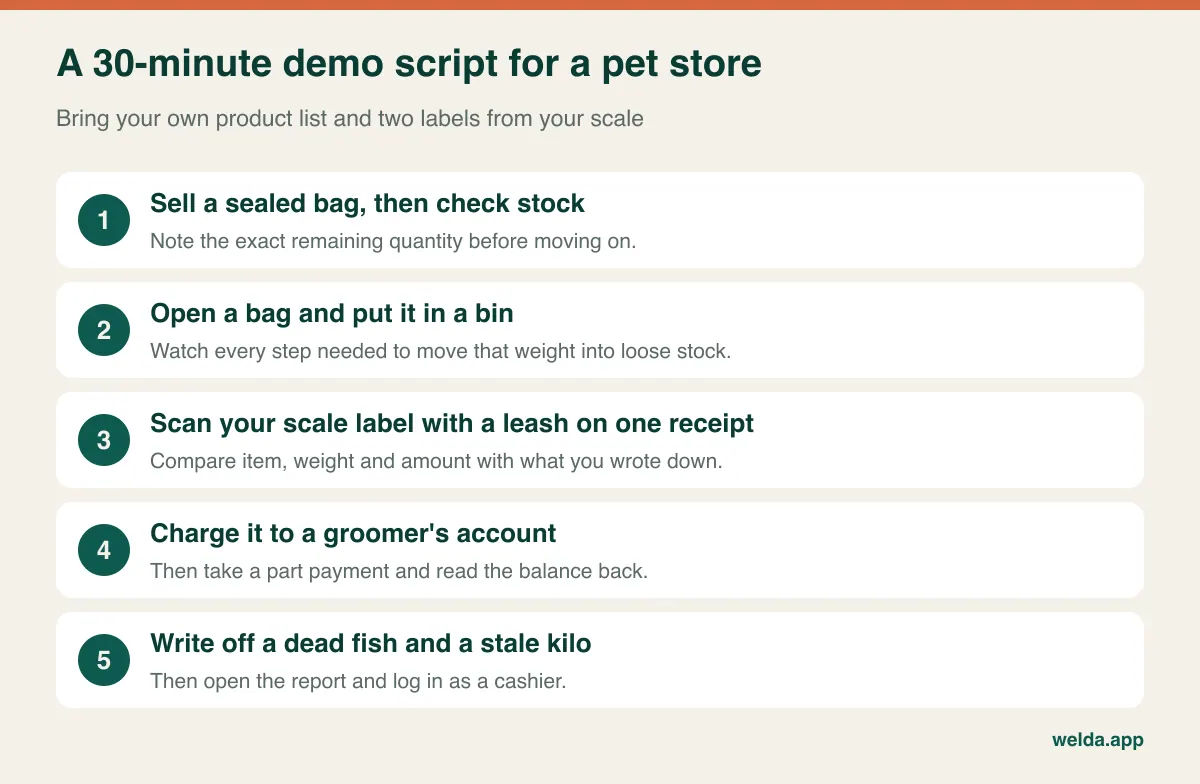
Also ask these questions, and request to see the answer on screen:
- How do I reverse a bag opening recorded against the wrong product?
- Can sealed and loose versions of one food carry separate prices? What updates when a supplier raises the cost?
- What happens at the till if the internet drops on a busy Saturday? This matters for Welda Stock too: it is web-based, its operations run over your connection, and an unstable connection needs planning at setup.
- Does online store or marketplace stock synchronize automatically? We do not describe such a connection for Welda Stock, so if you sell heavily online, that may settle the question.
- Can I export my data in a usable format whenever I want to?
- How many people can use the system at once, and what does each role see?
Who should look elsewhere
A pet store with loose food, packaged goods and a few trade accounts is a reasonable candidate for Welda Stock, and so is one with a second branch or a separate stockroom. But some stores should start somewhere else, and it is better to know now.
| Your store | What it mainly needs | Our honest view |
|---|---|---|
| Independent store, loose food, label scale | Weighted sales, loss records, accounts | Good candidate; test the bag-opening flow |
| Two branches or a separate stockroom | Per-location stock, roles, central reports | Good candidate; multi-branch is supported |
| Mostly online sales | Website and marketplace stock sync | Look first at tools built for this |
| Heavy on subscriptions and loyalty | Autoship, points, automated reminders | Not described for this product |
| Store with vet clinic or grooming salon | Patient records or appointments | Stock software alone will not cover it |
| Country with mandatory fiscal hardware | Certified till connection | Ask us directly and verify before deciding |
| A few lines, no loose sales, one person | A tidy list and a simple till | Probably too much for now |
Reading quotes without getting lost
Comparing total figures across quotes is like comparing bags by price without reading the weight. What decides the cost of pet store software is usually the number of users, the number of locations and warehouses, the number of products and how much data you bring across, and the hardware setup at your till. Write these lines side by side for each vendor:
- Fee structure: one-time, recurring, or both, and the total over several years
- Payment add-ons: card terminals, processing terms and any lock-in period
- Data import: products, barcodes and account balances in scope or billed separately
- Hardware: whether your scale and scanner carry over or need replacing
- Fiscal add-ons: any service your country requires
- Growth: what changes with a new employee or branch
- Training: whether new staff are covered later on
- Exit: whether you can take your data with you
Welda Stock has a one-time setup fee with no hidden or recurring costs. The quote is built on the factors above and includes setup, data import from Excel and team training. The amount is settled in a free consultation once we understand your store. Put the same questions to anyone else you are considering, so that you end up comparing like with like.
Switching without closing the doors
Installing software is rarely the difficult part. Welda Stock is web-based with nothing to install, products come in via Excel, and setup is usually finished within a day. The hard part is an accurate opening balance. Start with the product list: merge duplicates, give every line a unit, and map scale codes. Our guide on moving from Excel to inventory software goes through this cleanup in detail.
Then count after closing, all in one go, so that sales do not move stock while you are working. Count sealed bags. Weigh open bins, subtracting the empty bin weight you have written on the side. Keep torn or damaged bags apart rather than mixing them into sellable stock. Confirm account balances with customers before importing them, because an old error looks official once it is on a new system.
Run your first busy day with the old records still at hand, and compare end-of-day totals. Over the first week, re-weigh only your five fastest loose foods. Finally, teach one rule from day one and keep it short: whoever opens the bag records the bag. That single habit will decide whether a two-product setup stays reliable or quietly falls apart.
Frequently asked questions
Do I need software made specifically for pet stores?
Not necessarily. What counts is function: weight-based selling, write-offs with reasons, customer accounts and per-variant stock. If those work with your own products, general retail software can serve you well. If you need animal records, autoship or clinic features, look for a specialized system.
Is Welda Stock built for pet stores?
Pet stores are not listed separately among the sectors on our product page. The needs are close to those of the bulk and nut shops we do describe, with weighed goods next to barcoded goods. Whether Welda Stock works as your pet store POS software is best settled with your own products in a demo.
How should I track one food sold both sealed and loose?
If sealed sales are rare, one weight-based product can be enough. If you sell both forms regularly, two products are clearer, but every bag opening has to be recorded.
My scale does not print labels. Can I still use POS software?
You will not get the benefit of label scanning. Test how weight entry works in the demo and bear in mind that keying errors become your main risk. If loose sales are a large share of your business, consider a label-printing scale.
Does the system track expiry dates?
Automatic alerts by date or batch are not described in Welda Stock's product material. You can record expired stock as shrinkage. If you must have date tracking, ask about it directly.
What drives the cost?
Users, locations and warehouses, product count, data import and hardware setup. We confirm the amount for your store after a free consultation.
Book a free consultation and bring a sealed bag barcode, two scale labels and a short sample of your product list. We will look at whether Welda Stock is the right fit for your counter, and tell you plainly if it is not.